
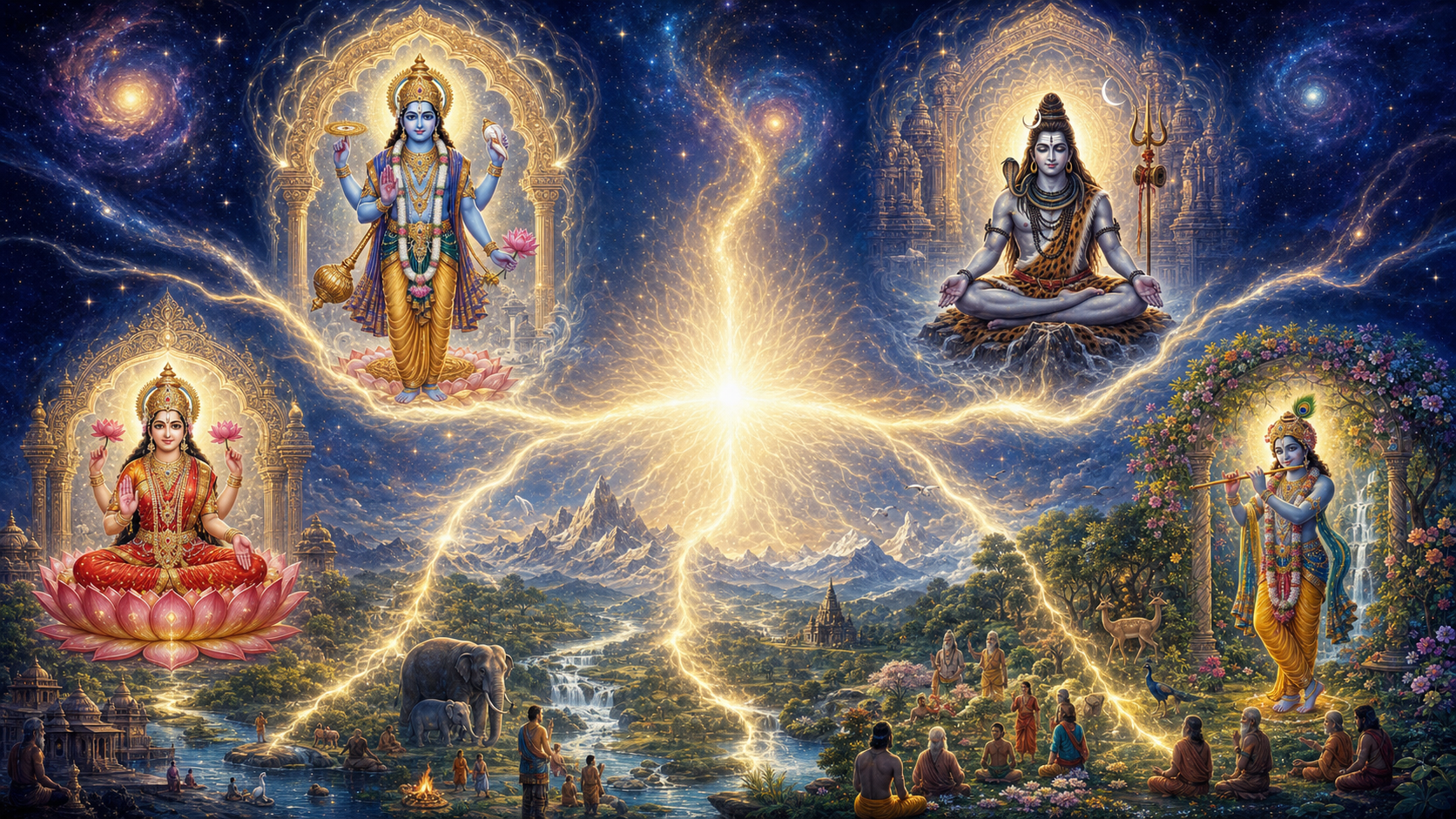
You may stand before Viṣṇu, Śiva, Devī, or Kṛṣṇa and wonder what, exactly, you are meeting. Are these separate divine beings, symbolic faces of one God, or forms through which an impersonal Absolute becomes approachable? The answer changes how you understand a mūrti, choose a practice, and speak about Hindu Dharma without reducing its depth to the slogan that all gods are the same.
A useful answer begins by separating questions that are often mixed together. Hindu traditions distinguish ultimate reality, the personal Lord, particular divine forms, the manifest cosmos, and the conscious self. Different darśanas connect those levels differently. Once you know which level a teaching addresses, apparent contradictions become intelligible rather than embarrassing.
A five-part map prevents the most common confusion
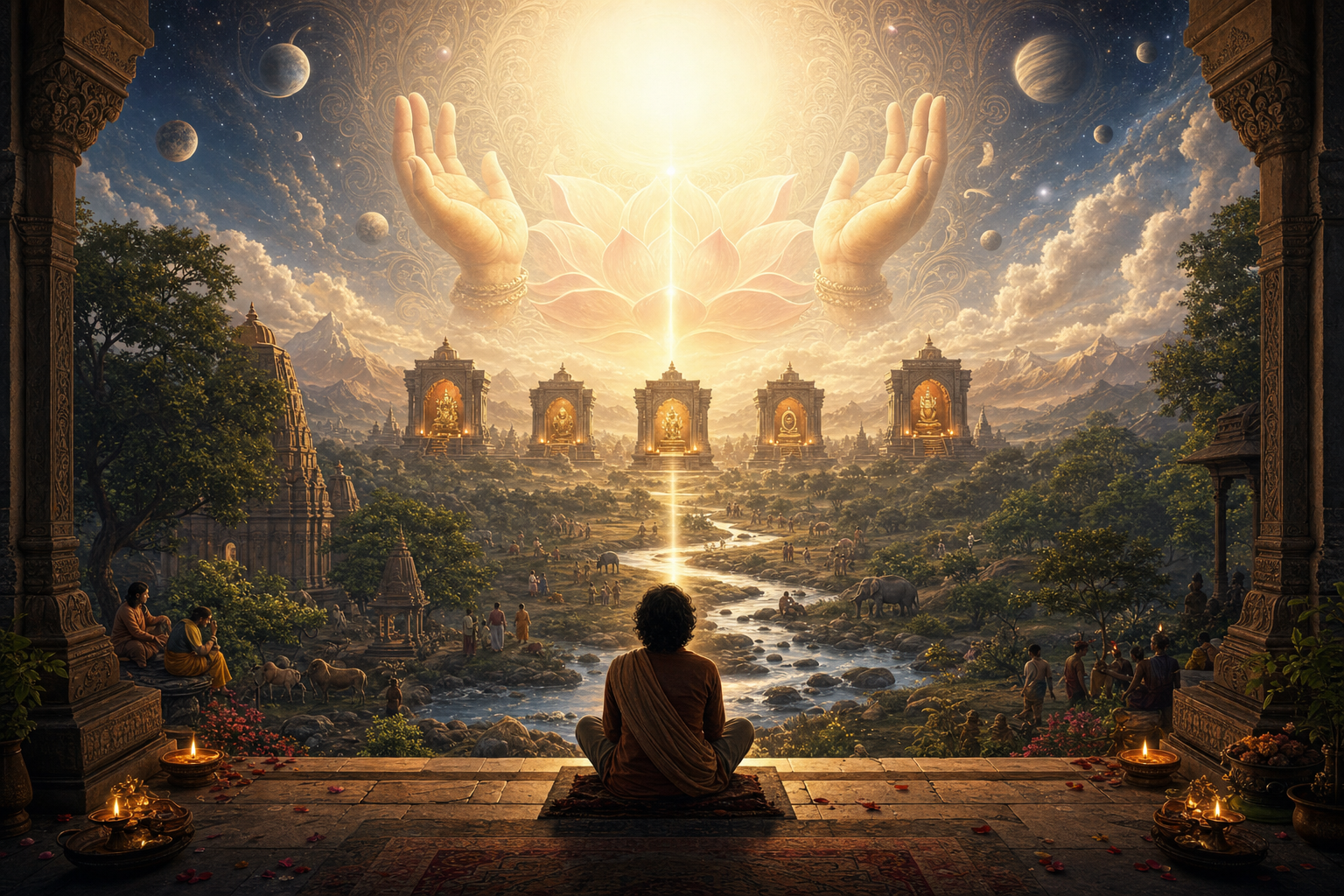
Before asking whether one deity is supreme or whether every deity is Brahman, identify the kind of claim being made. The following distinctions are practical rather than rigid; individual sampradāyas may draw their boundaries differently.
- Brahman: the unrestricted ground of reality, classically approached as Being, Consciousness, and Bliss — Sat, Cit, and Ānanda. Brahman is not one object within the universe or a powerful being alongside lesser beings.
- Īśvara or Parameśvara: the Supreme understood as knowing, ruling, creating, sustaining, and receiving devotion. This is the Divine in relation to the world and the worshipper.
- Devatā and divine form: a particular disclosure of divine reality, known through name, form, attributes, mantra, narrative, and ritual. Viṣṇu, Śiva, Devī, and their forms are not interchangeable labels. Each makes a distinctive aspect of reality available to devotion and contemplation.
- Jagat: the experienced cosmos of bodies, minds, elements, relations, and change. Hindu schools disagree over whether its relation to Brahman is best described as appearance, real mode, dependent expression, or the unfolding of divine power.
- Jīva and Ātman: the individual as an embodied subject and the deeper principle of awareness discovered through inquiry. Some schools affirm the identity of Ātman and Brahman; others preserve a real distinction while grounding the soul completely in the Supreme.
This map gives you a diagnostic tool. When you hear that Śiva is Brahman, ask whether the speaker is making an ultimate claim about Śiva as the Absolute. When you hear that Śiva is the dissolver, the statement concerns a cosmic function. When a devotee addresses Śiva as Lord, the language is relational. None of those sentences must cancel the others.
The distinction between nirguṇa and saguṇa works in the same way. Nirguṇa does not mean a dead blank or a deficient deity. It points to reality unrestricted by the qualities through which finite minds classify things. Saguṇa names the Divine as accessible through qualities, action, beauty, compassion, power, and form. Treating one as real and the other as a disposable concession misses how bhakti and jñāna can support each other.
Use three questions whenever a metaphysical statement seems absolute: Is it describing reality in itself, reality in relation to the cosmos, or reality as encountered in worship? Is it speaking from one darśana or claiming to represent all Hindu thought? Does it preserve the distinctive meaning of the deity being named? Those questions resolve more confusion than counting gods ever will.
Manifestation is not manufacturing from the outside

An artisan needs material other than himself: a potter shapes clay, and a carpenter works on wood. That model becomes unstable when applied to an infinite source. If something exists entirely outside the Absolute, in what sense is the Absolute absolute? Hindu metaphysics therefore often treats the cosmos as appearance, expression, emanation, or play within divine reality, not as an independently existing product assembled at a distance.
The Bhagavad Gītā holds immanence and transcendence together with unusual precision. In 9.4, Kṛṣṇa says that the universe is pervaded by his unmanifest form. In 9.5, he immediately denies that beings contain or confine him in the ultimate sense. The practical conclusion is neither that God is absent from matter nor that the sum of material objects exhausts God. The world is dependent on and permeated by the Divine, while the Divine remains more than the world.
This is why calling the Hindu view simple pantheism is usually inadequate. A stone, tree, river, animal, or person can disclose sacred presence without becoming, as an isolated object, the full measure of Brahman. The better question is not whether an object is God in a crude one-to-one equation. Ask how the object exists through the deeper reality that sustains it, and how reverence should change your conduct toward it.
The major schools do not give one uniform account of that dependence. Their differences matter:
| Metaphysical approach | How manifestation is understood | What you should notice in practice |
|---|---|---|
| Advaita Vedānta | The cosmos is vivarta, an appearance that does not require Brahman itself to undergo real transformation. The rope mistaken for a snake and space appearing divided by pots illustrate dependent appearance. | Distinguish changing perceptions, thoughts, and identities from the awareness in which they appear. Do not turn dependent reality into an excuse to dismiss ethical consequences. |
| Viśiṣṭādvaita | Souls and the cosmos are real modes of Brahman, joined to the Supreme in an organic, qualified non-duality. | Difference is real enough for devotion, surrender, service, and grace. Unity does not erase the worshipper or the world. |
| Śaiva and Śākta traditions | Consciousness manifests through Śakti, its inherent freedom and power. In Kashmir Śaivism, this self-articulation is mapped through levels of awareness, limiting veils, and the 36 tattvas. | Perception, knowledge, agency, and embodiment can be examined as contracted divine powers. Recognition concerns their source, not the glorification of ordinary ego. |
| Sāṅkhya-Yoga | Purusha, pure witnessing consciousness, and Prakṛti, primordial nature, are distinct. The evolutes of nature unfold without requiring a creator-deity. | Practice cultivates discrimination between the witness and the movements of mind and nature. This model should not be forced into a non-dual creation theory it does not teach. |
These are not decorative variations around one secretly uniform doctrine. Advaita asks whether plurality has independent reality. Viśiṣṭādvaita defends the reality of plurality within divine unity. Śaiva and Śākta systems explain manifestation through the freedom of Consciousness and Śakti. Sāṅkhya maintains a fundamental distinction between witness and nature. If you quote one position, name its school instead of presenting it as what Hinduism simply says.
Hindu cosmology also changes the question of when manifestation happened. The rhythm of sṛṣṭi, sthiti, and saṁhāra — emanation, maintenance, and reabsorption — replaces a single beginning with recurring cosmic cycles. Śaiva theology adds tirodhāna and anugraha, veiling and grace. When you encounter the word creation in a Hindu context, check whether it refers to a first event, a recurring cosmic phase, or the ceaseless dependence of experience on its ground.
The sacred image makes a metaphysical argument
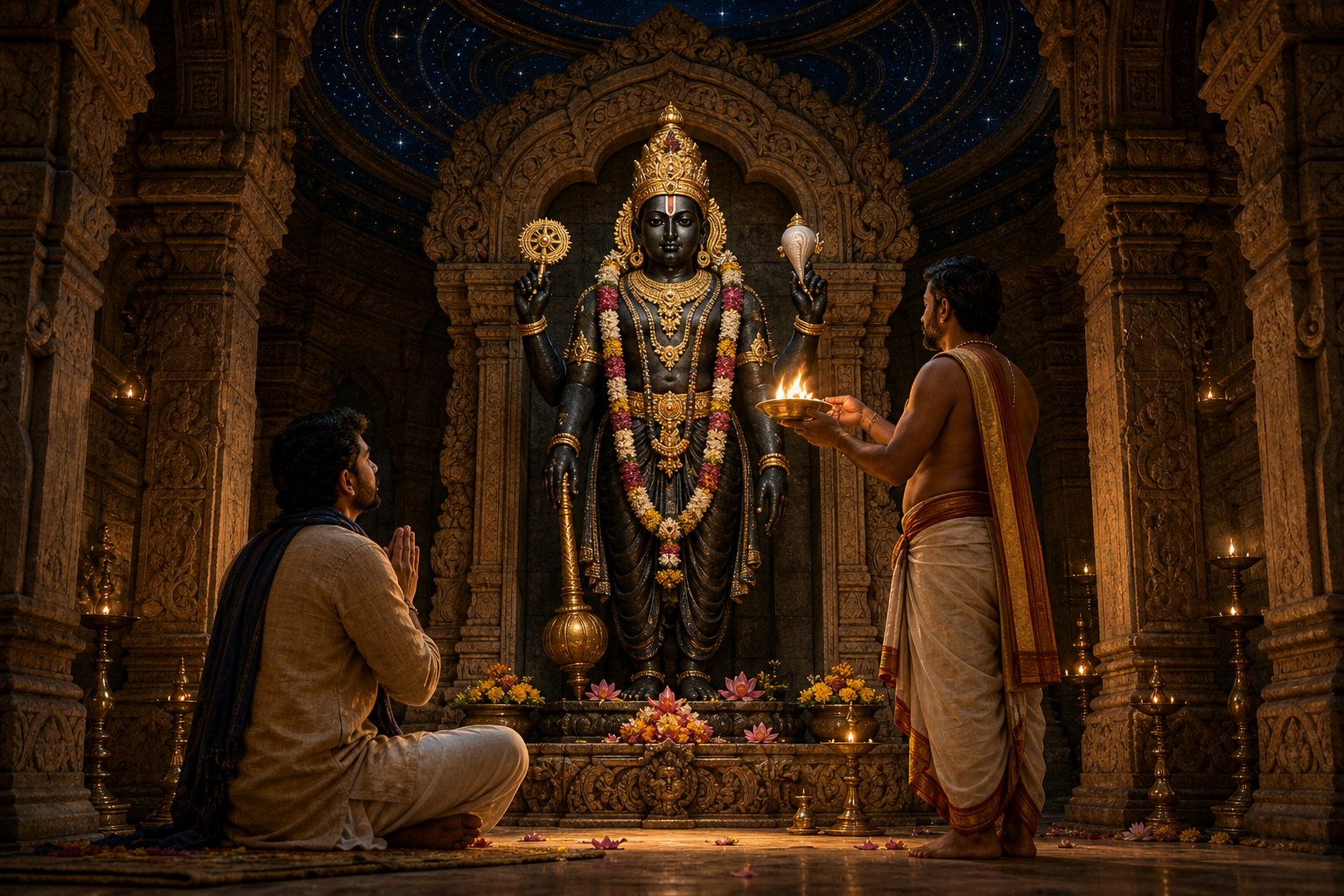
A mūrti is not understood well by asking only whether it resembles a physical person. Sacred art uses color, posture, objects, material, and ritual treatment as a visual grammar. The form tells you how a divine reality functions and how you are meant to approach it.
Viṣṇu and Kṛṣṇa are frequently depicted as śyāma or nīla-megha-śyāma, dark like a rain-bearing monsoon cloud. The hue is not a sign of evil, ignorance, or moral darkness. A monsoon cloud carries concealed abundance; its depth promises nourishment and renewal. The dark body therefore evokes immeasurable being, pervasive presence, and life held in reserve.
The rest of the icon prevents a one-color reading. Viṣṇu’s golden-yellow garment signifies luminosity and sattvic order. The white conch carries primordial sound, the discus communicates incisive intelligence and sovereignty, and the mace conveys weight and order. In a dim garbhagṛha, lamp light, jewelry, silk, and the dark form work together: transcendence appears intimate without becoming visually containable.
Śiva’s whiteness communicates something different. It is often the whiteness of vibhūti, the ash left after fire has consumed distinguishable form. The three lines of tripuṇḍra place that teaching on the body: the guṇas, possessiveness, and the claim of doership are offered into transforming knowledge. Śiva as the inhabitant of the cremation ground confronts you with the end of every constructed identity, while Śiva as Nīlakaṇṭha contains the dark poison at his throat rather than allowing it to govern the whole being.
Placing dark Viṣṇu beside ash-white Śiva does not create a contest between good and evil, sattva and tamas, or one sect and another. Viṣṇu’s darkness conveys sustaining depth; Śiva’s ash conveys the clarity left when forms dissolve. One image points toward the fertile mystery within manifestation, the other toward freedom from attachment to its passing forms.
You can read any sacred image in four passes:
- Name what you actually see. Notice complexion, ash, clothing, weapons, flowers, hand gestures, vehicle, and surrounding figures before interpreting them.
- Identify the cosmic function. Ask whether the feature concerns emanation, preservation, protection, dissolution, concealment, knowledge, or grace.
- Look for mastery rather than a crude guṇa label. A dark color need not mean tamas, and white need not mean ordinary goodness. The complete icon may show the deity governing or transcending all three guṇas.
- Translate the image into a demand on the devotee. Viṣṇu’s sustaining depth asks for trust and alignment with order. Śiva’s ash asks what identity, attachment, or claim of ownership you are willing to release.
The composite form Harihara makes the method visible. Viṣṇu and Śiva remain recognizable on their respective halves; unity does not require either half to lose its attributes. The image teaches coordination without erasure. That is a better model for Dharmic unity than declaring every name, ritual, and theology interchangeable.
Turn metaphysics into attention, devotion, and conduct
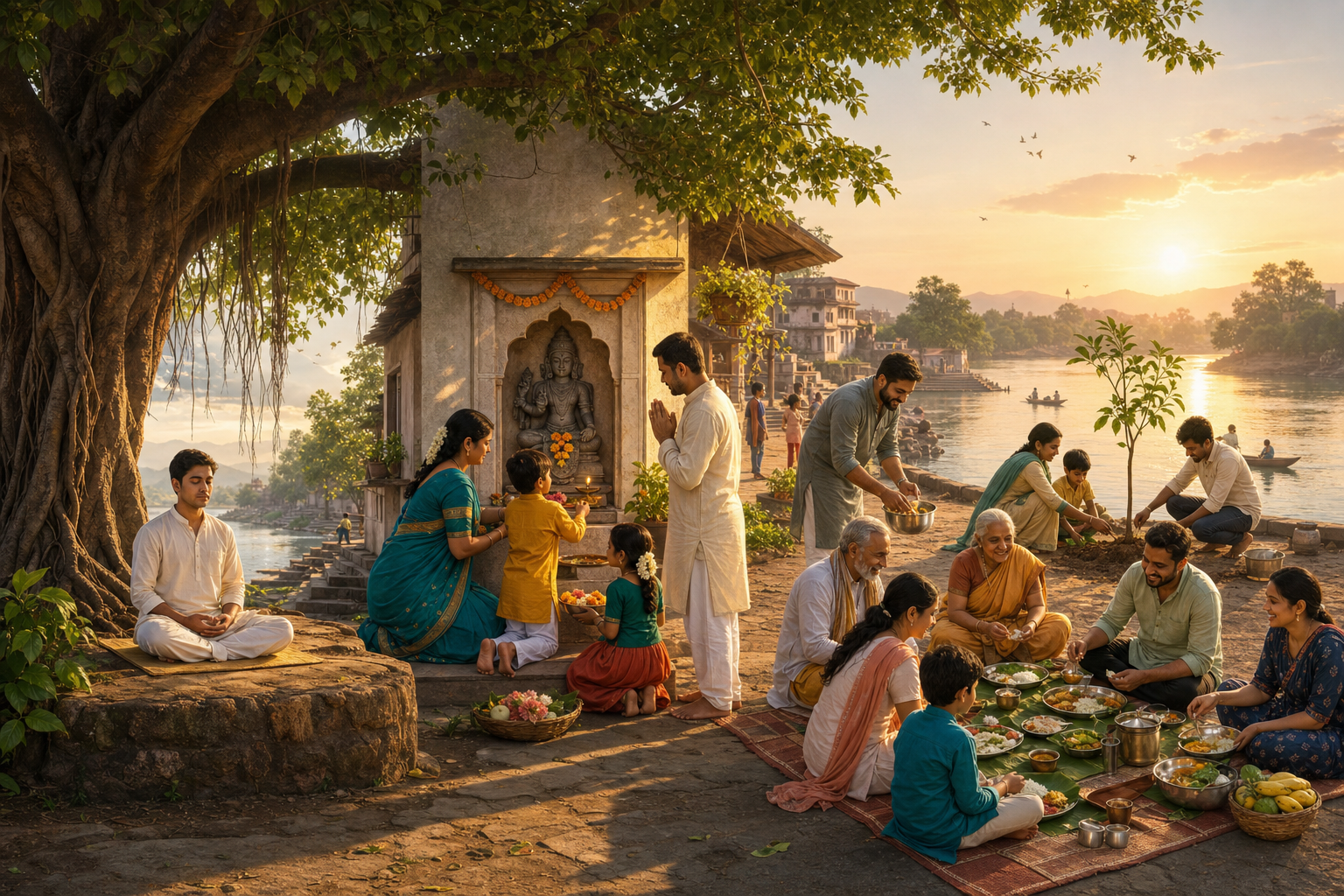
A contemplative sequence you can actually use
You do not have to settle every dispute between darśanas before beginning practice. You do need enough consistency to avoid mixing incompatible claims whenever convenient. If you belong to a lineage or inherited family practice, let that tradition provide the primary vocabulary. If you are still learning, choose one divine form and one method long enough to understand what they ask of you.
- Begin with the form rather than trying to leap over it. Attend to the mūrti, name, mantra, or remembered presence of your iṣṭa-devatā. Note the particular attributes instead of replacing them with a vague idea of cosmic energy.
- Establish the relationship. Offer attention, gratitude, prayer, or japa. Saguṇa practice trains the mind to gather around a sacred center and places the ego in relation to something it does not control.
- Contemplate one metaphysical feature. With Viṣṇu, you might attend to the dark depth that supports visible life. With Śiva, you might attend to ash as the destination of acquired status and bodily possession. Keep the contemplation tied to the actual icon.
- Turn toward the knower. Notice sensations, thoughts, and the sense of being a separate doer. Then ask what is aware of those changes. The Māṇḍūkya Upaniṣad uses waking, dream, and deep sleep to direct attention toward turīya, the awareness that is not merely another passing state.
- Return to the world through a specific obligation. Let recognition produce restraint from harm, honest speech, service, or responsible care for a living place. If nothing changes in how you treat another being, the metaphysics has remained conceptual.
This movement from form to awareness does not discard the deity. Bhakti protects non-dual language from becoming self-flattery; jñāna protects devotion from shrinking into a transaction for desired outcomes. You approach the Divine as other, discover divine presence as the ground of awareness, and return able to honor difference without experiencing it as absolute separation.
Three errors that can imitate realization
- Ego inflation: The mahāvākya that identifies Ātman with Brahman does not declare your personality omnipotent. Ahaṁkāra — the constructed I-notion that claims experience and action — is precisely what inquiry places under examination.
- Ethical bypass: Calling the world an appearance does not make another being’s suffering irrelevant. If beings participate in one field of reality, ahiṁsā, compassion, service, and ecological care become tests of understanding rather than optional decoration.
- Flattening every form: Unity is not sameness. A Śiva mantra, a Vaiṣṇava icon, a Śākta account of power, and a Sāṅkhya analysis of nature do not become identical because they belong to a shared civilization. Learn each teaching in its own grammar before drawing a synthesis.
These checks matter because metaphysical language can conceal the very ego it is meant to expose. Ask not only whether an idea sounds elevated, but what it asks you to surrender, perceive more carefully, and do differently.
Key takeaways
- Separate Brahman, Īśvara, a particular devatā, the cosmos, and the individual self before judging a Hindu claim about divinity.
- Manifestation usually describes dependence, expression, or divine self-articulation, not a craftsman producing an independent object from outside himself.
- Do not assign one theory to all Hindu traditions: Advaita, Viśiṣṭādvaita, Śaiva-Śākta systems, and Sāṅkhya-Yoga make materially different claims.
- Read a mūrti through its complete visual grammar. Viṣṇu’s dark hue and Śiva’s white ash communicate complementary metaphysical functions, not a moral color code.
- Test non-dual insight by its effects on attention and conduct. Less egoic possession, less harm, and more disciplined service are better evidence than grand declarations.
The next time you stand before a mūrti, leave aside the forced choice between literal deity and mere symbol. Ask which dimension of reality the form makes present, how its attributes train your perception, and what response it requires from you. Carry one answer into your next act of restraint, worship, or service. That is where divine manifestation stops being a theory and begins to reorder a life.
References
- DharmaRenaissance Blog — Before the Beginning: The Profound Self-Awakening of Consciousness in Sanatana Dharma
- DharmaRenaissance Blog — Vishnu’s Dark Hue, Shiva’s White Ash: Deep Iconography, Metaphysics, and Dharmic Unity
