

You may know Dwadashi from the panchanga and recognise the Sri Chakra on an altar, yet still wonder how a lunar phase and a field of triangles belong to the same spiritual system. The useful question is not which list you should memorise first. It is how to read Shakti through two coordinates: when her power is encountered and where her function is situated.
Keep those coordinates distinct, and Sri Vidya becomes easier to approach without oversimplifying it. Lunar time presents a sequence of divine powers. Sacred geometry arranges powers by enclosure, direction and relation to the centre. The two maps illuminate one reality, but they do not automatically create a one-to-one correspondence.
Begin with two coordinates: time and sacred space
In Sri Vidya, time is not an empty container in which worship happens. The lunar fortnight can be contemplated as a spiritual movement, with its phases associated with forms of Shakti. The Sri Chakra makes a complementary claim through geometry: divine functions can be approached through an ordered field of enclosures rather than as an unstructured collection of deities.
This gives you a simple reading discipline. When you meet a goddess associated with a tithi, ask a temporal question: what quality of Shakti is disclosed at this point in the lunar sequence? When you meet Yoginis associated with an avarana, ask a spatial question: what role does this group have within the movement from the outer enclosures toward the centre?
| Coordinate | Question to ask | Sri Vidya example | Common mistake |
|---|---|---|---|
| Lunar time | When is this Shakti encountered? | Vijaya at Dwadashi | Treating a tithi as nothing more than a numbered date |
| Sacred geometry | Where does this group function? | Ten Kulottirna Yoginis in the fifth avarana | Reading every triangle as an interchangeable symbol |
| Three-dimensional form | How is the ordered cosmos made visible? | Mahameru as the raised form of the Sri Chakra | Seeing tiers and elevation as decoration rather than structure |
The numbers must also remain in their proper roles. Twelve identifies Dwadashi’s place in lunar time. Ten identifies a group of Yoginis and triangles within an avarana. Numerical details help you locate a power within its own map; they do not, by themselves, prove a correspondence between the maps.
Read Vijaya at Dwadashi as a quality of sacred time
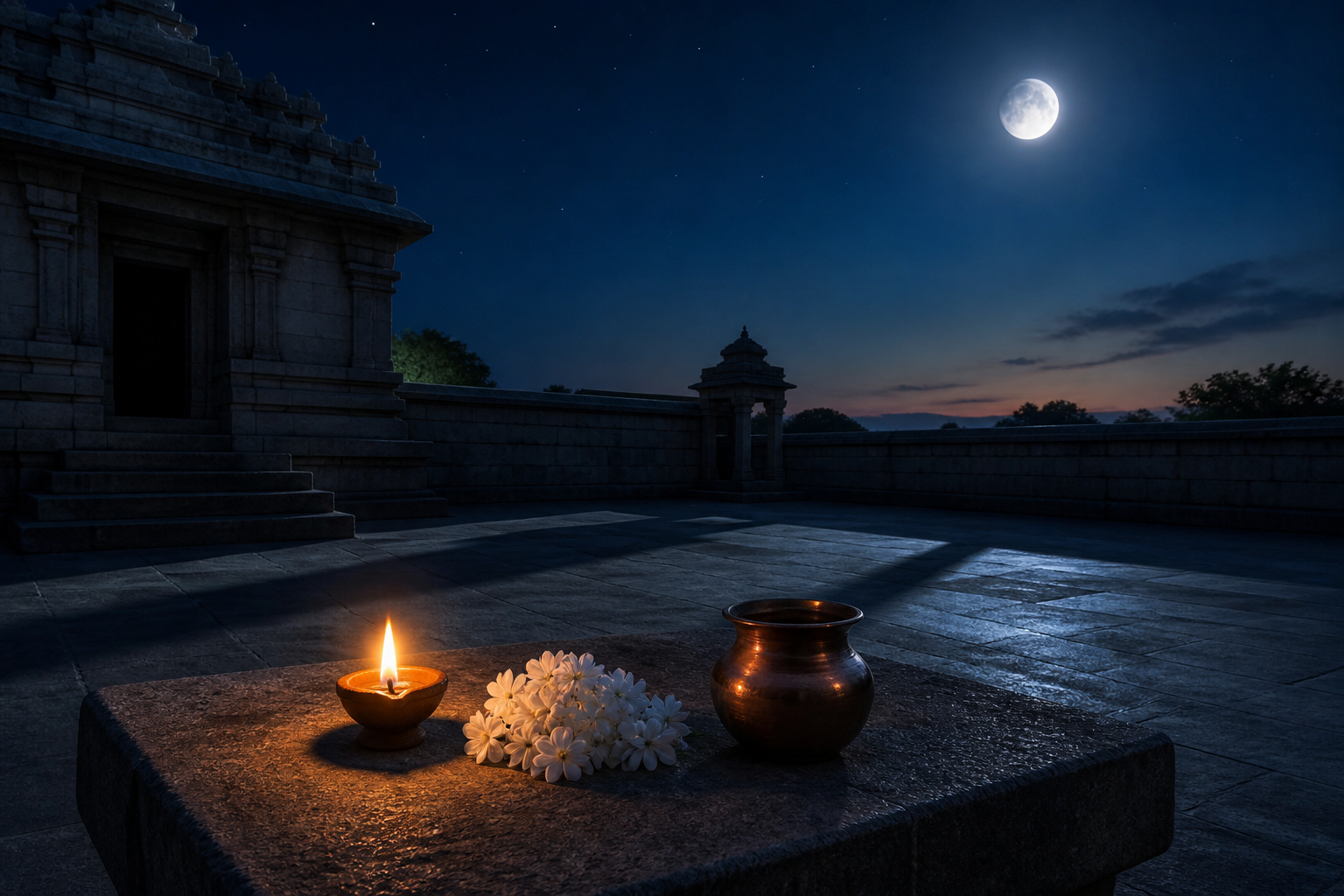
Vijaya is the Shakti of Dwadashi, the twelfth lunar phase, within this Sri Vidya framework. Her name places victory at a precise point in the lunar movement. That is more meaningful than attaching a general idea of success to any convenient day.
A tithi is a lunar division, not simply the twelfth date printed on a civil calendar. If timing matters to your observance, use a panchanga appropriate to your place and tradition rather than counting twelve ordinary calendar days. This small distinction prevents the most basic error in lunar practice: retaining the name of the tithi while losing its actual temporal setting.
Victory also needs careful interpretation. If Vijaya becomes only a divine instrument for defeating another person, the contemplation contracts around the ego. A more demanding question is: what must be brought into right order? Victory may then concern steadiness over distraction, completion over abandonment, truth over self-deception, or dharmic action over convenient avoidance. You do not have to pretend that all victories are inward, but you should examine the quality of the end you are seeking and the means by which you seek it.
For a non-initiatory Dwadashi reflection, keep the practice modest and exact:
- Confirm that the relevant tithi is Dwadashi through the panchanga you actually follow.
- Name one undertaking that requires a rightful completion, not a vague wish for success.
- Ask what habit, fear or unfinished duty obstructs that completion.
- Choose one concrete action that advances the undertaking without violating dharma.
This is a way to study the meaning of Vijaya in lived time. It is not a substitute for a lineage’s formal worship. If a practice depends on initiation or a prescribed ritual sequence, learn that sequence from a qualified teacher rather than reconstructing it from a calendar entry.
Read the fifth avarana as a field of related powers
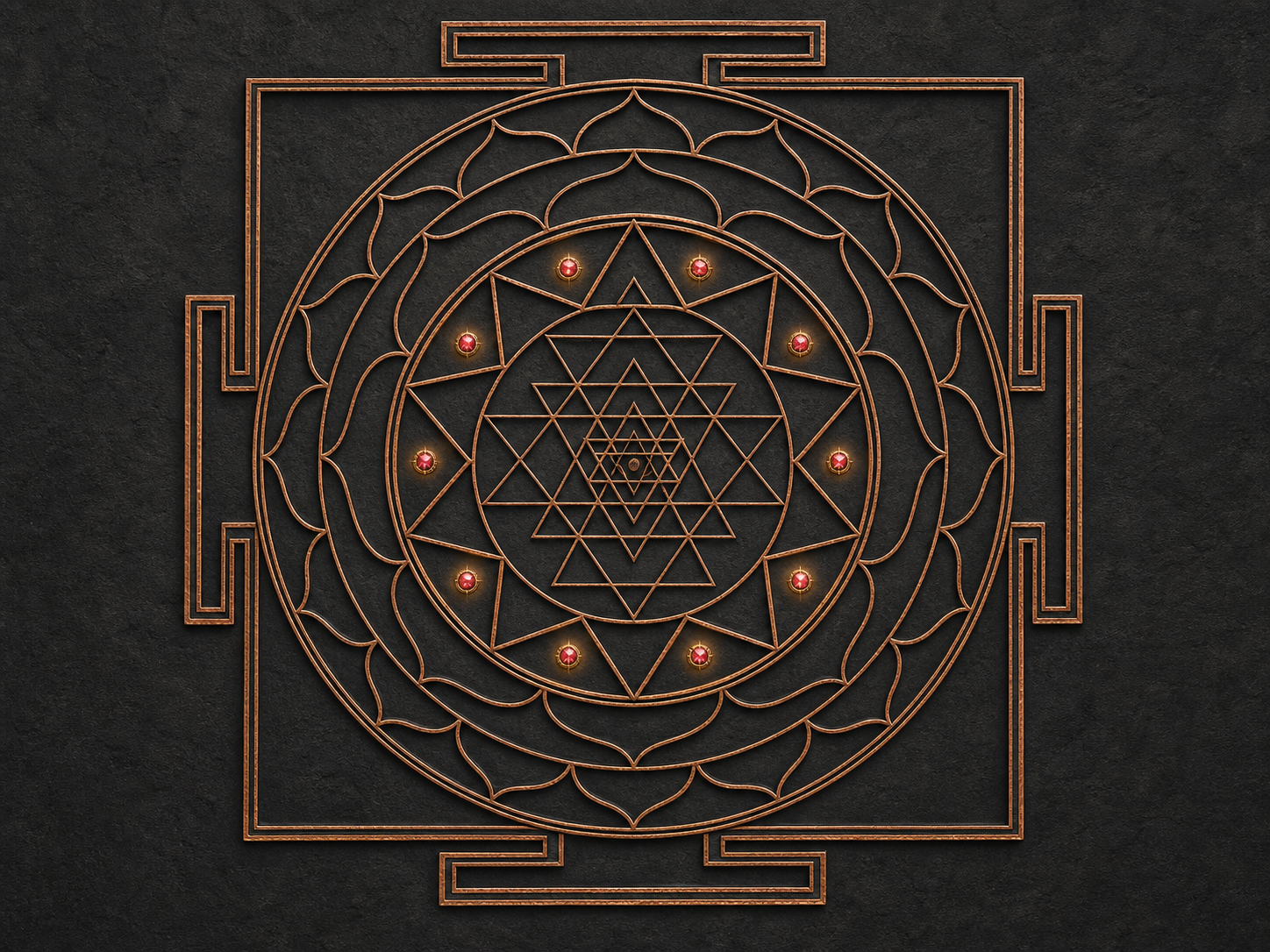
The Sri Chakra should not be approached as a page of isolated triangles. An avarana is an enclosure, and its identity comes from position, composition and function within the whole. The fifth avarana contains the ten outer members of the inner triangular field, called the bahirdasara, and is associated with ten Kulottirna Yoginis. It is also designated the Sarvaartha Sadhaka Chakra.
The practical lesson lies in the order of reading. First locate the enclosure. Then identify the geometric group. Next identify the collective class of Shaktis. Only after that should you study individual names, mantras or ritual functions from an authority accepted in your lineage. Reversing that sequence encourages a common confusion: collecting deity names without understanding the sacred architecture that gives them context.
You can apply the following four checks whenever you study an avarana:
- Location: Can you point to the enclosure on an accurate Sri Chakra diagram?
- Number: Do you know whether the number refers to triangles, presiding powers, phases or something else?
- Collective identity: Can you name the group before trying to interpret its individual members?
- Function: Are you using the enclosure’s traditional designation, or supplying a meaning from visual resemblance alone?
These checks matter because a triangle is not a free-floating emblem whose meaning can be invented afresh. Its orientation and placement belong to a network of relationships. Moving inward through the Sri Chakra is therefore not the same as browsing a gallery of symbols. It is an encounter with ordered differentiation held within unity.
Nothing in these two coordinates, by itself, assigns Vijaya to one of the ten triangles of the fifth avarana. Vijaya as a tithi Shakti and the Kulottirna Yoginis as an avarana group answer different questions. If a lineage makes a direct correspondence, that correspondence should be learned from an explicit lineage authority, not inferred from the fact that both belong to Sri Vidya.
Use Mahameru to see hierarchy, relation and ascent
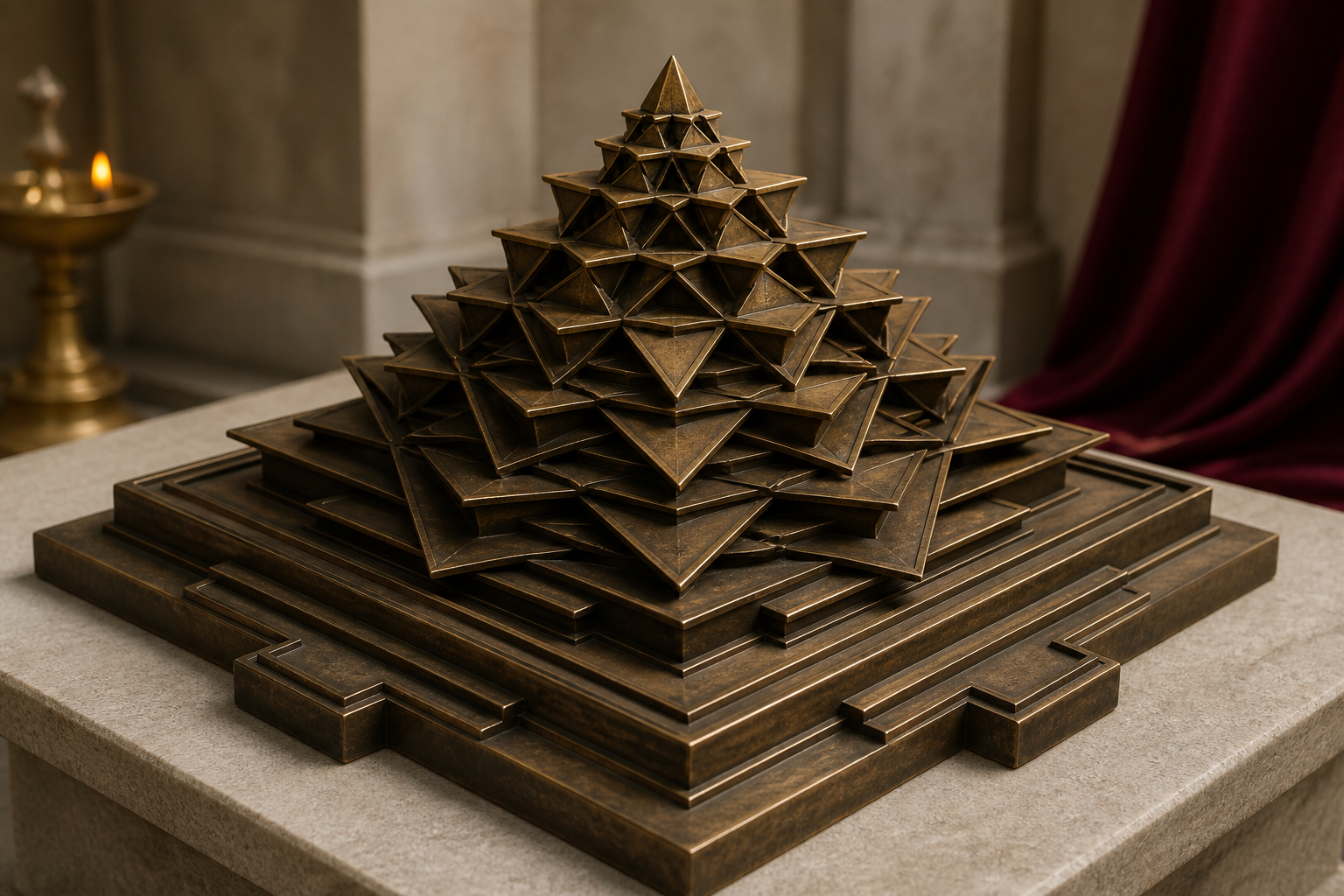
A flat diagram makes boundaries, intersections and symmetry easier to inspect. Mahameru presents the Sri Chakra in a three-dimensional, tiered form that embodies the cosmos geometrically. Elevation adds a visual sense of ascent while preserving the principle of ordered enclosures.
If you have access to both a Sri Chakra diagram and a Mahameru, study them side by side. Find the relevant enclosure on the diagram before looking for its place in the raised form. Then observe three relationships: outer and inner, multiplicity and centre, horizontal enclosure and vertical ascent. This exercise is more reliable than trying to identify a tier from a photograph whose angle may conceal or distort the structure.
The central point should not make you dismiss the surrounding powers as spiritually unimportant. The enclosures show how multiplicity is ordered around unity. The centre gives the field orientation; the field makes the approach to the centre intelligible. In the same way, the culminating meaning of a lunar sequence does not make its individual phases disposable.
Build a study practice that does not invent correspondences
Sri Vidya presents many names, numbers and geometric divisions, so the temptation to create a grand chart immediately is strong. Resist it. A small notebook with separate columns for lunar and geometric information will protect you from joining items merely because their symbolism appears similar.
- Record the coordinate. Mark each entry as temporal, geometric or explicitly connecting both.
- Copy the traditional locator. For temporal entries, record the tithi. For geometric entries, record the avarana and geometric group.
- Separate stated meaning from reflection. Write inherited names and designations in one column and your contemplative response in another.
- Flag every inferred link. If no explicit authority establishes a correspondence, label it as a question rather than a conclusion.
- End with one application. Translate the contemplation into a dharmic action you can actually perform, without presenting that personal application as formal doctrine.
This method lets sacred geometry remain more than artwork and lunar observance remain more than date-keeping. It also preserves an essential humility: your reflection may be fruitful without becoming a claim about what an entire tradition teaches.
Key takeaways for your next study session
- Sri Vidya can be read through two complementary coordinates: Shakti unfolding in lunar time and Shakti ordered in sacred geometry.
- Vijaya belongs to Dwadashi in the temporal map; contemplate victory in relation to rightful completion and dharmic means.
- The fifth avarana is a structured group of ten triangles and ten Kulottirna Yoginis, not a collection of interchangeable symbols.
- Mahameru gives three-dimensional form to the ordered enclosures of the Sri Chakra and helps you notice ascent, hierarchy and relation to the centre.
- Do not create a direct tithi-to-triangle correspondence unless an explicit authority within the relevant lineage establishes it.
- Keep inherited teaching, personal reflection and formal ritual instruction clearly distinguished.
At your next Dwadashi study, place the panchanga and an accurate Sri Chakra diagram beside each other. Locate Vijaya in time and the fifth avarana in space, but leave the line between them undrawn unless your tradition supplies it. That disciplined pause is not a failure to synthesise. It is how a living sacred system is approached without reducing it to a chart of attractive coincidences.
References
- Hindu Blog — Vijaya: The Goddess of Dwadashi Tithi
- Hindu Blog — 10 Kulottirna Yogini Goddesses or Shaktis of 5th Avarana
