
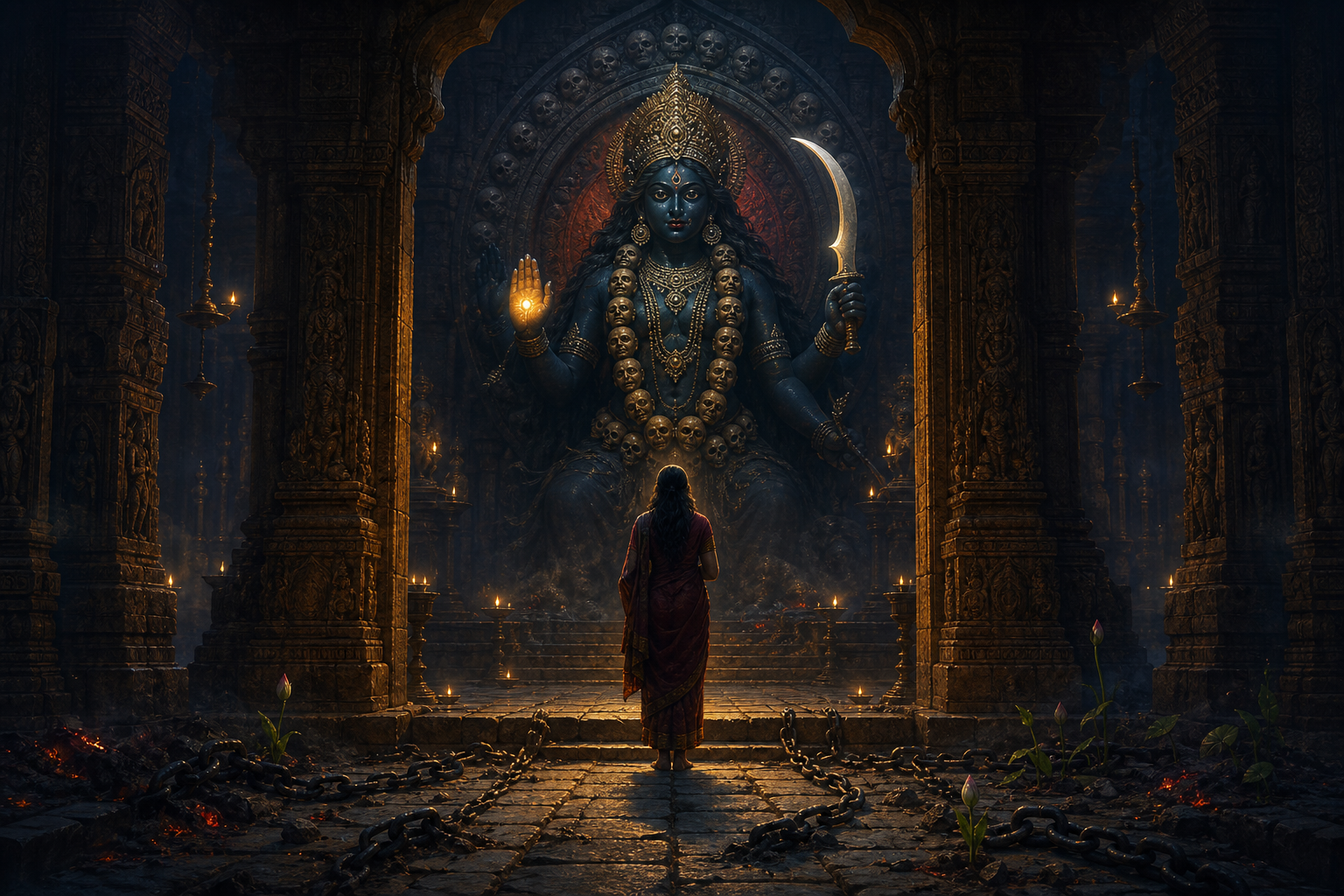
A dark Goddess, a garland of severed heads, a throne of skulls, or Shiva disguised as a hunter may leave you unsure how to respond. Should you take the image literally, treat it as a psychological metaphor, or reject it as religious violence? Each of those reactions can miss the discipline encoded in the symbol.
Fierce divine imagery asks a demanding question: what must be ended, mastered, or surrendered before your strength can serve dharma? If you learn to ask that question carefully, the image becomes a guide to conduct rather than an object of either fear or fascination.
Fierceness is a moral grammar, not a celebration of violence

The first mistake is to assume that a frightening form must represent evil. In Shakta thought, darkness can signify time, dissolution, mortality, and the hidden ground from which renewal becomes possible. Kalaratri means the Night of Time or Night of Death. Her dark radiance, unbound hair, three eyes, and garland of severed heads place the forces people cannot control under the sovereignty of Shakti.
This symbolism does not ask you to enjoy destruction. It asks you to stop pretending that nothing ends. Relationships change, identities fail, institutions decay, consequences arrive, and death cannot be negotiated away. Kalaratri gives sacred form to that truth. She is fierce because reality is sometimes fierce, not because cruelty has become holy.
The Panchamundi Asana makes a related claim. An asana is a stable seat, so the Goddess seated above five skulls is not overwhelmed by mortality or limitation. The five can be contemplated as the senses, elements, sheaths, or afflictions. The icon therefore shifts your attention from death as spectacle to self-mastery as the basis of spiritual authority.
Shiva’s Kirata form adds another dimension. Arjuna undertakes tapasya for the power required in the approaching Dharma-Yuddha. When the demon Mook charges in the form of a boar, Arjuna and the mysterious hunter both strike it. Their dispute becomes a contest that Arjuna cannot win. Only after his confidence has been broken open by reverence does he recognize Shiva and receive the Pashupatastra. Courage, defeat, recognition, and humility are inseparable parts of the episode.
These images share a strict ethical test. If your interpretation makes you more boastful, vindictive, or eager to dominate, you have misread the fierceness. If it makes you more truthful about consequences, more disciplined in the use of power, and more capable of compassionate action, the symbol is doing its proper work. A fierce deity does not certify your anger. The deity places your anger on trial.
Read the image through ending, ordeal, and enthronement

Fierce iconography is not a code in which every object has one fixed translation. The five skulls alone support several coherent contemplative frameworks. You need a disciplined method more than a single final definition. Three movements offer such a method.
- Identify the ending. Ask what the image refuses to preserve. Kalaratri embodies kala, the movement of time that brings forms and cycles to completion. In your life, the required ending may be a deception, a compulsive habit, an unjust advantage, a stale role, or the belief that you can avoid grief by refusing change. Name the ending precisely. Saying “I must release negativity” is too vague to guide conduct; saying “I must stop using contempt to avoid a difficult conversation” gives you something you can act on.
- Identify the ordeal. Mook’s charging boar can be contemplated as the tamasic surge that interrupts concentrated effort: anger, fear, restlessness, delusion, or raw impulse. The interruption does not automatically prove that your practice is profound, nor does every obstacle carry a supernatural message. Its practical value lies in showing you what happens when attention meets resistance. Notice the first impulse without immediately obeying it. Then ask whether the situation needs restraint, courageous action, or both.
- Identify the seat. The Goddess does not merely destroy the five; she sits steadily above them. That distinction matters. Spiritual practice is not a war against the body, senses, or world. It is the cultivation of a stable relationship to them. Choose one Panchamundi frame for a period of contemplation: the five senses, the five elements, the five sheaths, or the five afflictions of avidya, asmita, raga, dvesha, and abhinivesha. Do not switch frameworks whenever one becomes uncomfortable. Stability lets the symbol expose a pattern instead of merely entertaining the mind.
Ending without ordeal can become avoidance: you declare something finished but never face the attachment beneath it. Ordeal without enthronement can become endless combat: you start defining yourself by the enemies you oppose. Enthronement without ending can become spiritual decoration: you admire composure while protecting the very habit that destroys it. The three movements belong together.
Inner symbolism does not reduce the deity to your psychology
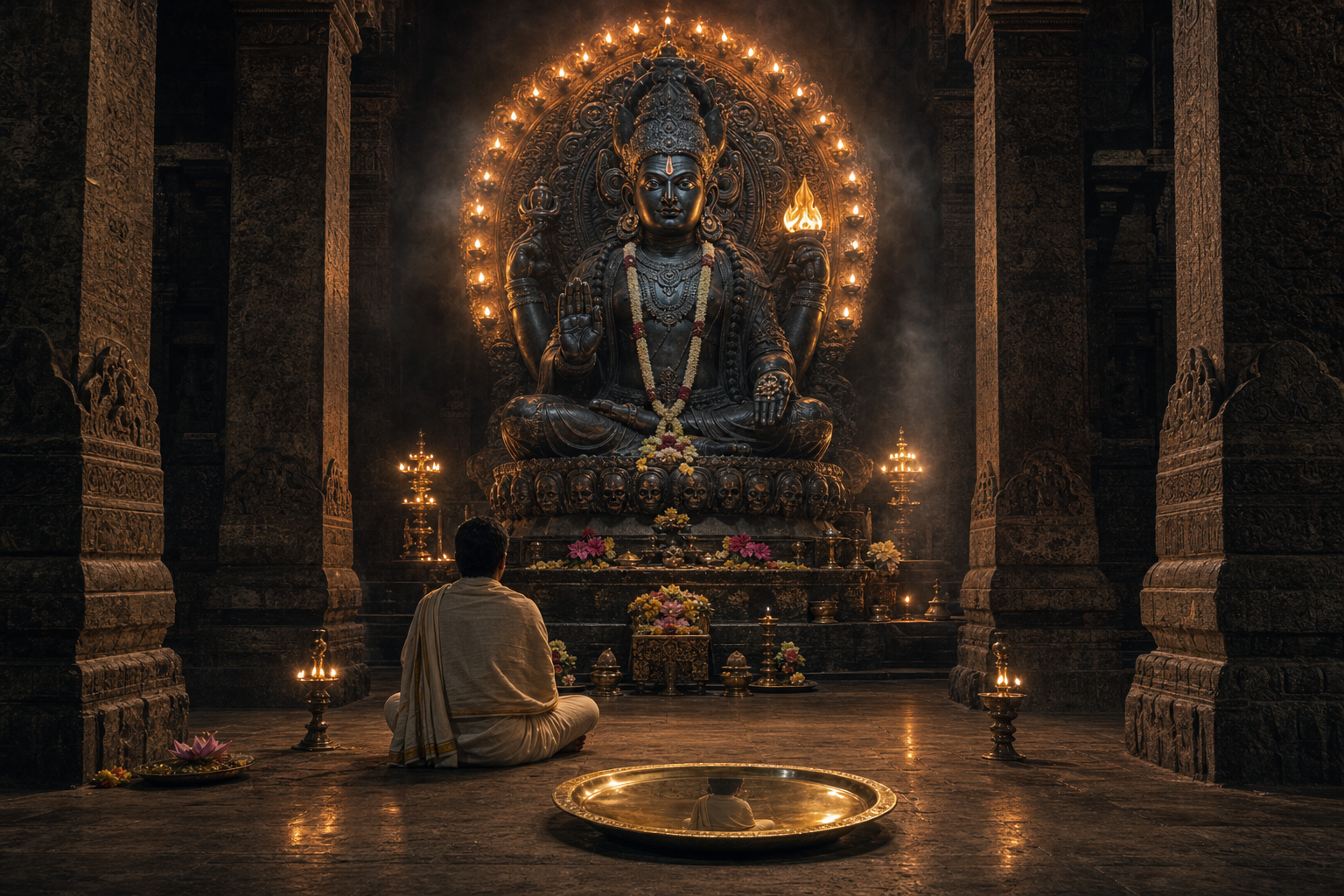
It is possible to use a sacred image as a mirror without claiming that the deity is nothing more than a mental state. Hindu practice can approach Devi or Shiva as divine presence, cosmic power, theological reality, and inward teacher. Those dimensions need not cancel one another.
This distinction protects both devotion and discernment. If Kalaratri is reduced to “my shadow,” her sovereignty over time, death, karma, and renewal disappears into a private self-help exercise. If the image is kept entirely outside you, however, it becomes easy to worship divine victory while ignoring anger, pride, greed, or fear in your own conduct.
Hold the outer and inner meanings together. Kalaratri can be revered as Shakti while you examine your fear of endings. Shiva can be worshipped as Mahadeva while Arjuna’s failed contest reveals the limits of ego. The Panchamundi throne can remain sacred Tantric iconography while you ask which sense, attachment, or affliction currently governs your decisions.
The soul-carrier motif associated with Kalaratri adds a further safeguard. Some regional retellings and devotional interpretations understand her as guiding the fallen toward the realms shaped by their karma. Fierceness here does not erase moral consequence, and compassion does not pretend that choices were harmless. The fallen are neither reduced to refuse nor excused from responsibility. This is a mature model for facing loss: honor the person, acknowledge the consequence, and refuse both sentimental denial and dehumanization.
Do not confuse transformation with either rage or passivity
Fierce symbolism is easily distorted in two directions. One distortion uses dharma as a religious label for personal aggression. The other praises detachment so vaguely that it excuses cowardice, silence, or indifference to injustice. The Kirata encounter corrects both.
Arjuna does not receive divine power merely because he is brave or because his austerity is intense. His readiness to act must be joined to humility, recognition, and submission to a larger moral order. Power without humility can serve adharma. Humility without courage can become an alibi for inaction. The disciplined union of the two is what turns force into capacity for righteous service.
Before calling any response “fierce compassion,” test it with concrete questions:
- What fact am I refusing to admit because it threatens my pride, comfort, or group loyalty?
- What duty is actually mine, rather than one I have claimed in order to control someone else?
- Am I protecting a boundary, or looking for sacred language to justify retaliation?
- What is the least harmful, truthful, and sufficient action available?
- Which consequences and grief must I acknowledge even if my decision is necessary?
- After acting, will I remain accountable for repair, restraint, and the welfare of others?
Apply this filter first in ordinary conflicts, where ego most often impersonates righteousness. A delayed reply written after composure may be fiercer than an immediate denunciation. A clear refusal may be more compassionate than resentful compliance. Accepting correction may require more courage than winning an argument. Returning an unfair advantage may be a more authentic offering than performing an elaborate devotion while keeping the benefit.
The test is not how forceful the act looks. The test is whether it serves truth without feeding hatred, protects what should be protected without enjoying another’s humiliation, and accepts responsibility for foreseeable costs. Dharma is not established by the intensity of your feelings.
Turn darshan into one ethical action
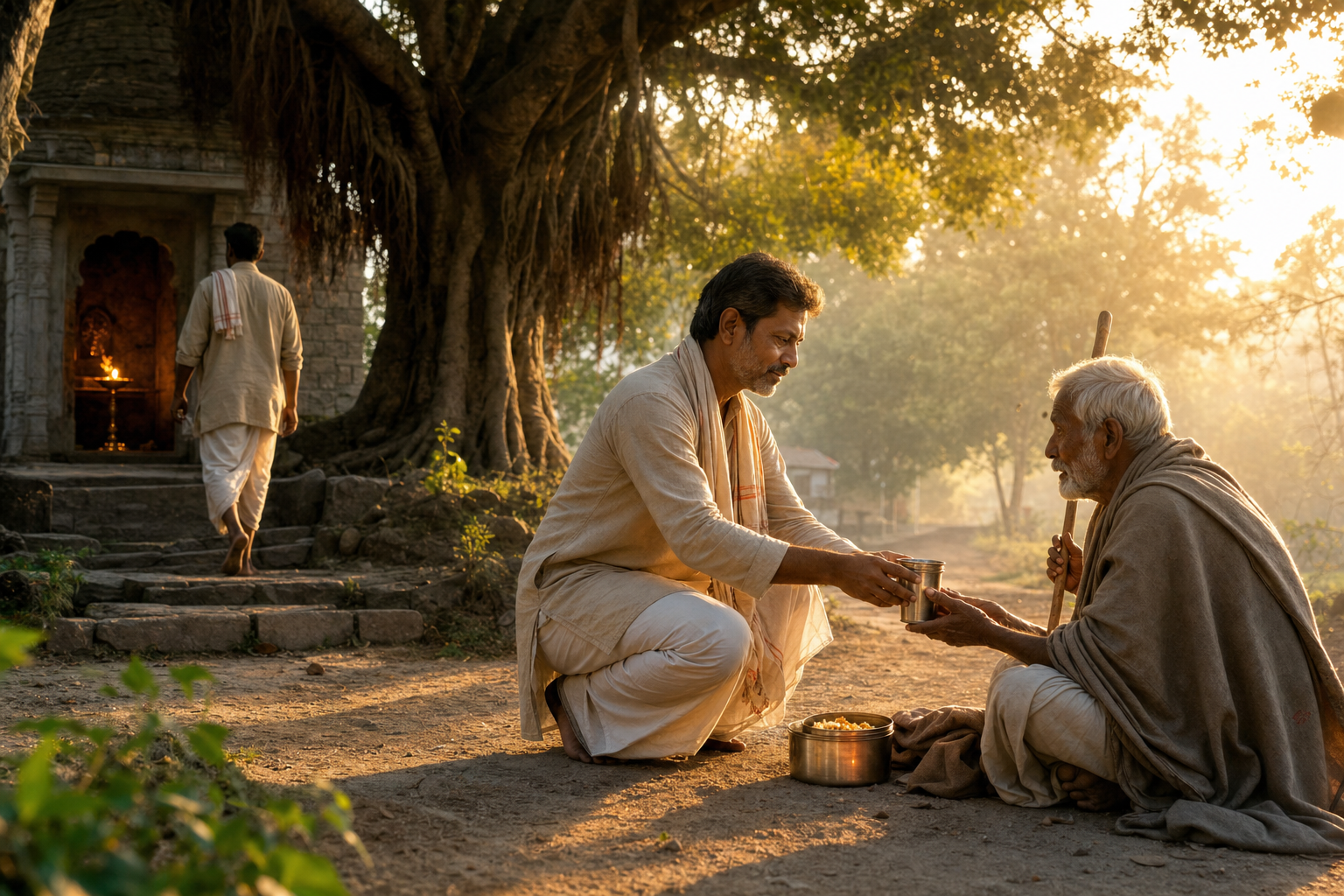
You do not need to imitate specialized Tantric rites to learn from fierce iconography. If you participate in a living lineage or temple tradition, follow its authorized form of worship. For personal reflection, keep the practice simple, respectful, and tied to conduct.
- Become physically steady. Sit in a stable posture and let the breath settle without forcing it. The purpose is not to manufacture an extraordinary state. It is to become composed enough to notice what the image evokes.
- Describe before interpreting. Observe the darkness, hair, eyes, weapons, skulls, posture, gesture, animal, or battlefield without immediately calling any feature good or bad. Description slows projection.
- Name the reaction. Is there fear, attraction, disgust, excitement, grief, or resistance? Use an exact word. “This is intense” conceals more than it reveals.
- Locate the inner obstruction. Ask what currently behaves like the charging boar, the unmastered sense, or the attachment threatened by time. Choose one obstruction, not an inventory of every flaw you possess.
- Find its dharmic opposite. Anger may require patience or a clean boundary. Pride may require accepting correction. Greed may require generosity or restitution. Fear may require truthful speech. Delusion may require study and counsel. Do not select the virtue that sounds grandest; select the one the situation actually demands.
- Make the insight observable. Choose one action at the next real opportunity: withhold the contemptuous message, apologize without defending yourself, finish a neglected duty, decline an unethical request, return what is not yours, or offer service without seeking recognition.
- Close without self-congratulation. Dedicate the practice toward clarity, non-harm, and the welfare of beings. Then watch whether your conduct changes. The image has not completed its work merely because contemplation felt powerful.
Keep the formula narrow: one symbol, one obstruction, one action. Grand resolutions often protect the ego by producing a feeling of transformation without requiring a difficult decision. A specific act gives the symbol somewhere to live.
Let Dharmic parallels clarify difference as well as kinship
Fierce transformation appears across Dharmic traditions, but it does not appear in identical theological forms. Respectful comparison looks for shared ethical pressure while preserving each path’s own language and commitments.
Buddhist contemplation of anicca places impermanence at the heart of insight. Mara and the five hindrances give practitioners ways to recognize the forces that disrupt awakening. This can illuminate Kalaratri’s association with time and Mook’s disruption of tapasya, but a Buddhist account of impermanence should not simply be relabelled as worship of Devi.
Jain discipline identifies kashayas such as anger, pride, deceit, and greed as bonds requiring inner conquest. The five mahavratas orient that conquest toward ahimsa, truth, non-stealing, disciplined chastity, and non-possession. This sharpens the ethical meaning of mastery: victory over an inner enemy must reduce harm and attachment, not give the practitioner a new identity as a conqueror.
Sikh teaching names kam, krodh, lobh, moh, and ahankar as five thieves. Remembrance, humility, righteous living, hukam, and nirbhau join inward discipline to courageous responsibility. The saint-soldier ideal helps expose the false choice between spiritual gentleness and the defense of what is right.
Use these parallels to ask a better question within your own tradition: what does fearlessness look like when governed by non-harm, humility, remembrance, or wisdom? Do not build a convenient mixture by stripping every path of its differences. Shared civilizational concerns become more meaningful when Hindu, Buddhist, Jain, and Sikh disciplines are allowed to remain distinct.
Key takeaways
- Fierce divine imagery exposes destruction, mortality, ego, and consequence; it does not make cruelty sacred.
- Read the symbol through three movements: what must end, what ordeal reveals your attachment, and what must become steady under awareness.
- An inward interpretation can deepen devotion without reducing Devi or Shiva to psychological metaphors.
- Judge every interpretation by conduct. Genuine fierce grace produces courage with humility, power with restraint, and truth with compassion.
- Use one symbol to identify one obstruction and complete one observable ethical action.
- Honor parallels among Dharmic traditions without treating their deities, doctrines, vows, and practices as interchangeable.
The next time a fierce sacred image unsettles you, do not rush to tame it or turn it into a banner for anger. Stay with its demand long enough to name what must end. Then let your next truthful, restrained, and courageous act become the answer.
References
- DharmaRenaissance Blog – Fierce Grace on Kurukshetra: Goddess Kalaratri’s Sacred Role and Soul-Carrying Symbolism
- DharmaRenaissance Blog – Arjuna and Kirata Shiva vs. Demon Mook: Powerful Spiritual Lessons on Inner Courage
- DharmaRenaissance Blog – Panchamundi Asana Symbolism: The Goddess’s Awe-Inspiring Throne and the Triumph Over Human Limits
