
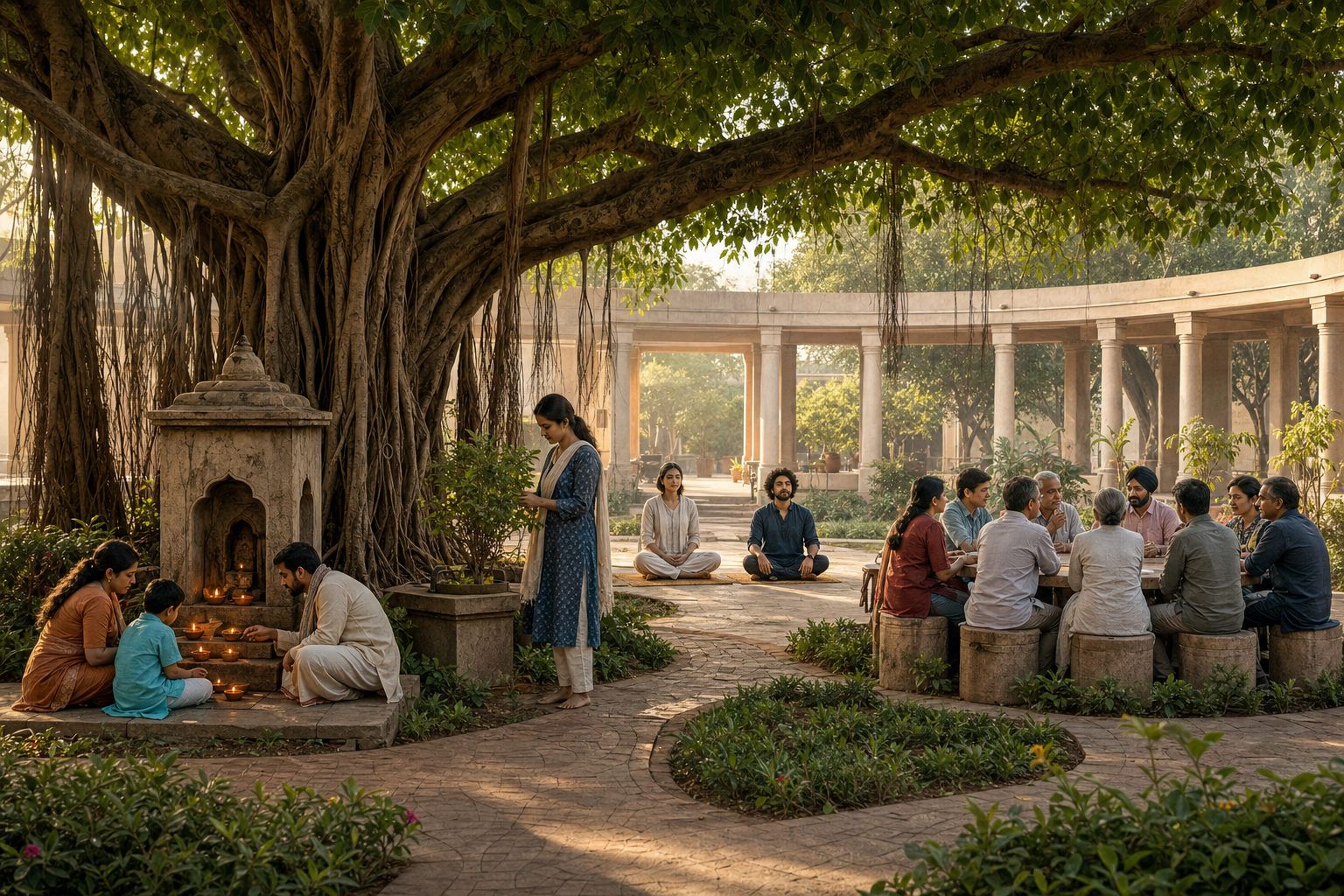
Someone uses Hindutva as a badge of pride. Someone else uses it as an accusation. You are then expected to answer several questions at once: Does Hindu unity require one theology? Does defending Hindu interests commit you to every political act performed in the Hindu name? Can civilizational confidence coexist with equal citizenship?
You do not need a slogan broad enough to cover all of that. You need a way to separate spiritual practice, civilizational belonging, political ideology, and constitutional duty. Once those layers are clear, you can defend Hindu dignity without surrendering either plurality or judgment.
Separate the four layers before choosing a side
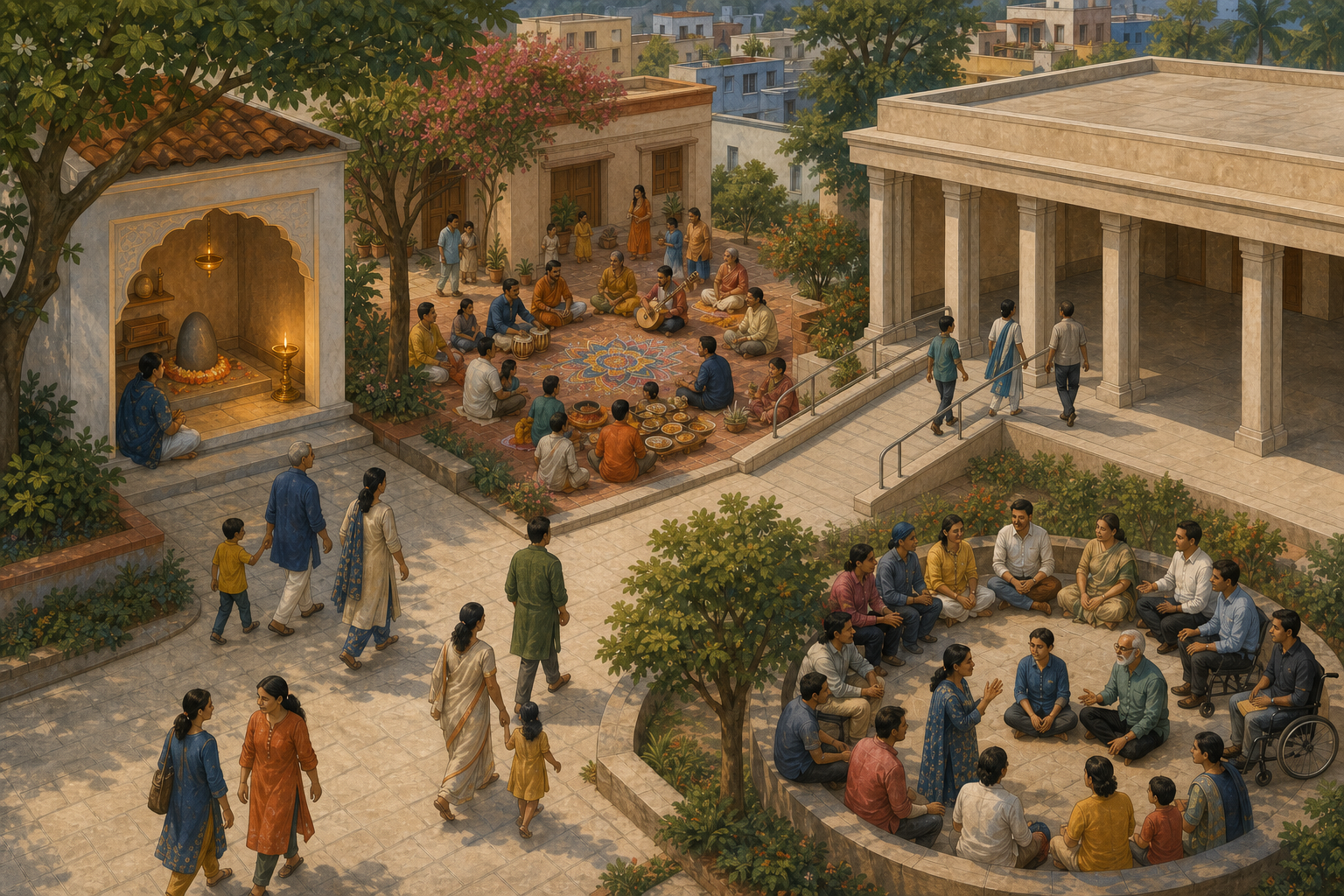
Many arguments about Hindu identity become unproductive because one word silently changes meaning halfway through the exchange. Hindu may refer to a practitioner, a family inheritance, a civilization, a demographic category, or a political constituency. Hindutva may refer to cultural self-articulation, a defined ideological tradition, an organization, a party platform, or a hostile caricature assembled from all four.
Hindutva is best understood as a modern political-civilizational articulation of Hindu identity. It is neither a synonym for every Hindu religious tradition nor something wholly disconnected from Hindu history. That distinction gives you a more accurate map:
| Layer | Question it answers | Evidence or standard that belongs here |
|---|---|---|
| Hindu religious life | How do I understand reality and practise dharma? | Texts, sampradaya teachings, sadhana, ritual, reason, and lived experience |
| Hindu civilizational identity | What inheritance, memory, and sacred geography connect us? | History, languages, institutions, pilgrimage, art, social memory, and cultural continuity |
| Hindutva | How should Hindu civilizational identity be expressed in public and political life? | Ideological writings, organizational conduct, policy, historical accuracy, and public consequences |
| Constitutional citizenship | What may the state do, and what does every citizen receive? | The Constitution, equal rights, due process, freedom of conscience, and rule of law |
These are distinctions, not sealed compartments. Religious convictions influence public choices. Political conditions affect temples and communities. Civilizational memory shapes both. But influence is not identity: a party does not exhaust a civilization, and a civilization does not place every political proposal beyond criticism.
When a conversation heats up, ask one question before answering: Which layer are we discussing? If someone criticizes a particular law, discuss that law. If someone insults Hindu worship, address the prejudice. If someone makes a claim about Savarkar, examine Savarkar’s formulation. Do not let an assertion in one category convict everything in the others.
Hindu plurality is an architecture of unity, not its failure

Hindu plurality is sometimes treated as an embarrassment to be explained away before Hindus can present a united front. That reverses the tradition’s own logic. The Rig Veda 1.164.46 gives a durable grammar in Ekam sat vipra bahudha vadanti: reality is one, while the wise speak of it in many ways. Unity is not achieved by deleting names and forms. It is approached through them.
Many Hindu schools distinguish nirguna Brahman, the Absolute beyond attributes, from saguna Brahman, the Divine encountered through qualities and form. Shaiva, Vaishnava, Shakta, Smarta, and other traditions do not erase their real theological differences. They show that shared civilization does not require a single authorized image, liturgy, metaphysics, language, or route to liberation.
Ishta-devata makes this principle personal. Your chosen form of the Divine can fit your temperament and lineage without requiring you to declare every other form false. At the social level, local deities, rivers, mountains, village protectors, and regional festivals entered wider sacred networks without losing every local feature. Hindu civilization often integrated by creating relationships, not by demanding replacement.
This also corrects the familiar claim about 330 million gods. The Sanskrit word koti can mean a class or category as well as a crore, while early Brahmana enumerations identify thirty-three deities or functional groupings. Later devotional abundance should not be reduced to an arithmetic census of competing supreme beings. Nor should it be defended with invented numerology about chromosomes or other biological counts; that claim has no textual or scientific foundation.
Cognitive and systems-based explanations can illuminate why this plurality lasts. Personified forms make abstract powers easier to remember, love, and teach. A tradition with household worship, great temples, local festivals, pilgrimage routes, and many devotional lineages also behaves like a distributed network: cultural meaning can continue even when one institution is disrupted. These explanations describe human transmission and resilience. They do not constitute scientific proof of a theological proposition, and you weaken the case when you pretend that they do.
If you need to explain Hindu plurality briefly, use three moves:
- Begin with the underlying unity: many names and forms can disclose dimensions of one reality.
- Explain the practical function: ishta-devata lets devotion meet differences of temperament, family, region, and stage of life.
- Acknowledge real disagreement: Hindu schools do not all make identical claims, but disagreement need not become mutual exclusion.
This is stronger than saying that everything is merely symbolic or that every Hindu secretly believes exactly the same doctrine. Hindu plurality is valuable precisely because meaningful difference is allowed to remain meaningful.
Judge Hindutva by what it protects, permits, and produces
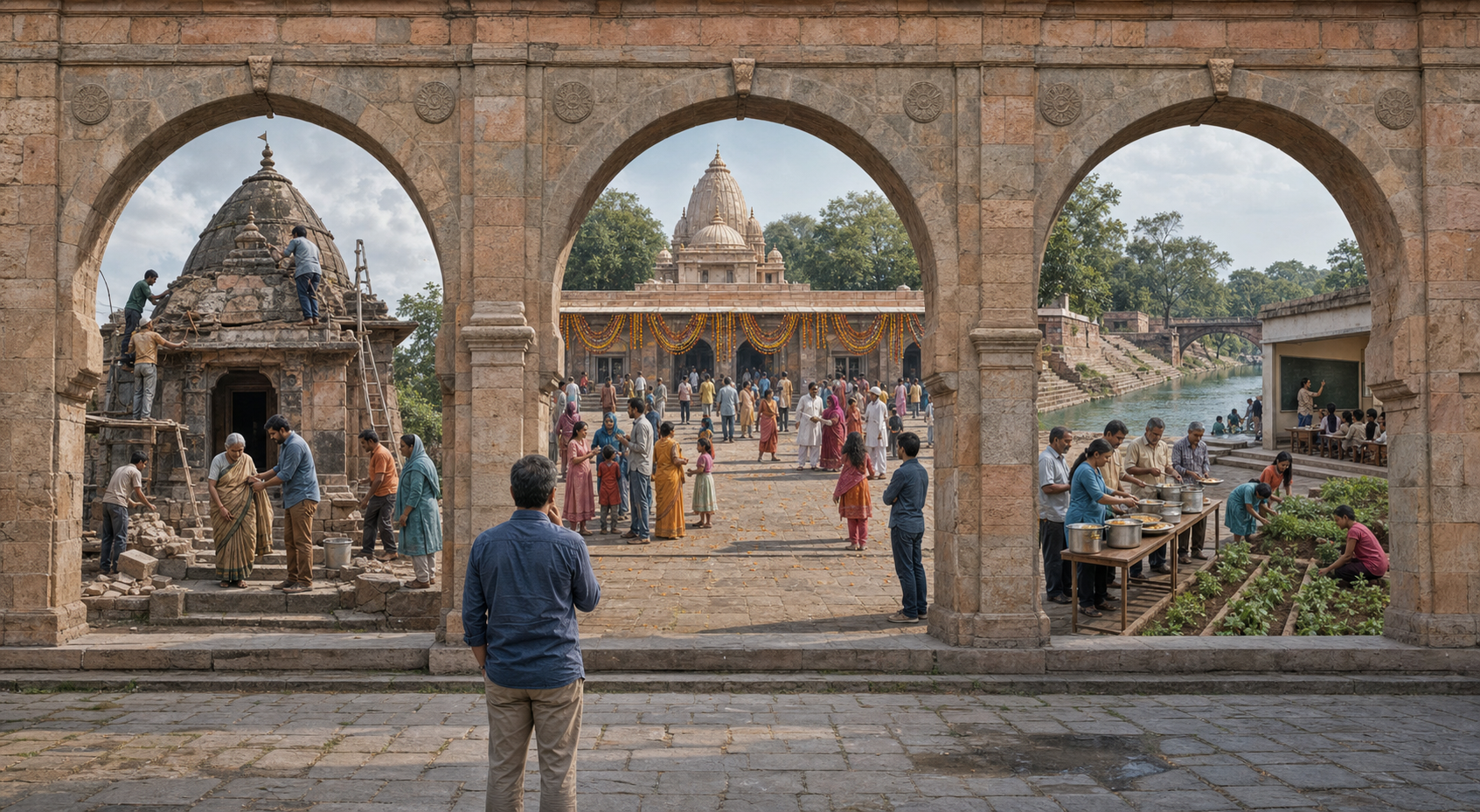
Hindutva arose from the problems of a particular historical period: colonial rule, cultural reform, anti-colonial nationalism, and the search for collective self-definition in the late nineteenth and early twentieth centuries. V. D. Savarkar’s 1923 Essentials of Hindutva offered one influential formulation, connecting Hindu identity to Bharat as both pitribhumi and punyabhumi, fatherland and holy land. The RSS, founded in 1925, later became a major institutional carrier of Hindutva-oriented organization and civic activity. These are historically situated formulations and institutions, not timeless definitions accepted by every Hindu.
Supporters commonly seek civilizational self-respect after colonial subordination, consistent laws across communities, renewed heritage institutions, and greater confidence for Dharmic perspectives in global forums. Those are serious aims. They should be argued on their merits rather than dismissed merely because they are expressed in Hindu civilizational language.
Declared aims are not enough, however. Political ideas operate through institutions, incentives, rhetoric, and power. Critics therefore raise questions about homogenization, simplified history, majoritarian overreach, and the treatment of minorities. A pro-Hindu response should examine whether those criticisms identify actual conduct. It should not accept collective accusations without evidence, but neither should it use civilizational loyalty to make evidence irrelevant.
Use five tests whenever a Hindutva claim, policy, or campaign asks for your support:
- Truth: Can its historical claims survive primary evidence, reputable scholarship, and inconvenient counterexamples? Pride built on a falsehood remains fragile.
- Plural freedom: Does it leave room for different sampradayas, deities, philosophies, regions, languages, and forms of sadhana? Hindu unity becomes self-defeating if one internal form is made compulsory for all.
- Civic parity: Is the same legal principle applied to allies and opponents, majority and minority? Equal accountability cannot mean selective punishment dressed as equality.
- Lawful means: Does the action respect nonviolence, due process, and the dignity of persons? A legitimate cultural grievance does not authorize intimidation or collective blame.
- Correctability: Can leaders and supporters acknowledge an error, repair harm, and revise a claim? Cultural confidence does not require cultural infallibility.
India’s constitutional protections for conscience and religion are located in Articles 25-28. The Supreme Court has at times described Hindutva as a way of life, and that phrase remains debated. A judicial phrase cannot serve as a blank cheque: it does not turn every political program called Hindutva into constitutional doctrine, nor does it prove that Hindutva is merely private spirituality. Spiritual plurality, political mobilization, and constitutional adjudication remain distinct questions.
The most defensible form of Hindu civilizational politics is therefore neither apologetic nor unconditional. It can oppose anti-Hindu hatred, demand fair treatment for temples and communities, recover neglected history, and still reject an unsupported claim or an unjust act performed in the Hindu name.
Turn identity pressure into a disciplined public practice
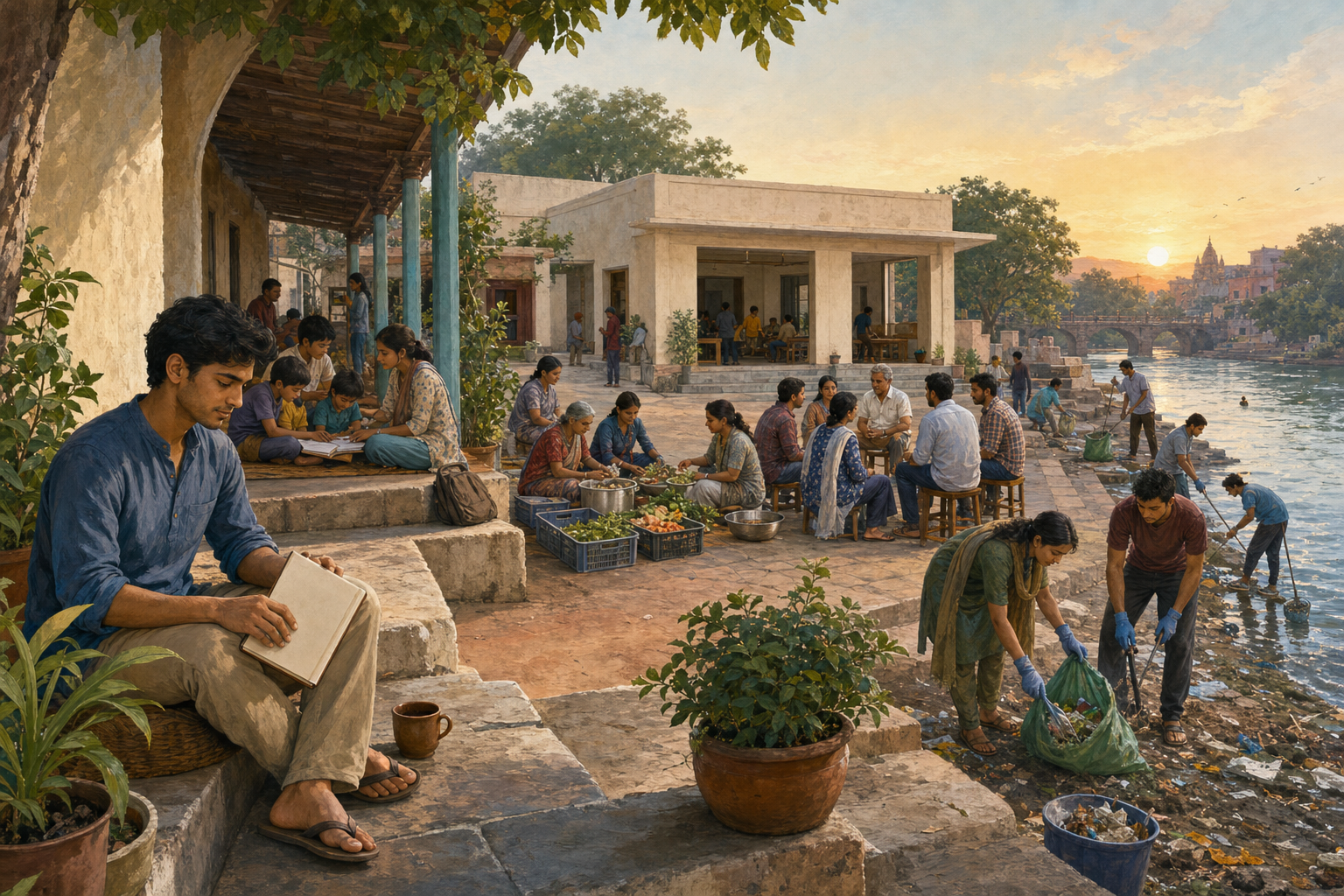
Online debate pushes you toward instant allegiance. An edited clip, a vandalized temple, a slogan at a protest, and a government policy can all be compressed into one viral narrative. The 2022 disturbances in Leicester and temple vandalism carrying political graffiti in Australia in 2023 illustrate how local grievances, transnational politics, disinformation, and social-media amplification can intersect. A single-cause explanation may be emotionally satisfying before it is evidentially sound.
Before sharing or condemning a claim, run this sequence:
- Remove the label. Rewrite the claim without Hindu, Hindutva, nationalist, secular, or extremist. You will often discover that the actual allegation concerns a named policy, speech, organization, or incident.
- Name the actor. Distinguish an individual, a party, the state, an organization, and a religious community. Do not transfer responsibility from one to another without evidence.
- Classify the claim. Is it historical, theological, legal, statistical, or moral? Each requires a different kind of support.
- Recover the context. Find the full speech, original statement, complete image, date, location, and immediate sequence of events before relying on a clipped version.
- Apply symmetry. Ask whether you would accept the same evidence and language if the communities were reversed.
- Choose a proportionate response. Correct a factual mistake, contest a policy, report targeted hatred, or decline an outrage cycle. These are different actions.
This method also helps you distinguish policy criticism from Hinduphobia. Legitimate criticism normally names an actor or decision, supplies contestable reasons, and leaves open the possibility of an answer. Anti-Hindu prejudice treats Hindus as collectively suspect, mocks sacred practices as inherently inferior, excuses threats against Hindu people or institutions, or assigns group guilt without evidence. A criticism can be harsh without being hateful, while prejudice can hide behind academic or political vocabulary. Examine the structure of the claim, not only its tone.
You can prepare for these conversations by writing a private three-sentence identity statement:
- Practice: Name the sadhana, deity, philosophy, or family tradition that actually shapes your Hindu life.
- Civilization: Name the inheritance you want to preserve, such as sacred geography, temples, languages, knowledge traditions, festivals, or historical memory.
- Citizenship: Name the public standard you will apply even when it inconveniences your own side, such as equal rights, evidence, nonviolence, due process, or freedom of conscience.
This statement keeps other people from drafting you into their definition. It also reveals gaps. If your political identity has no sadhana behind it, begin with practice and study. If your spirituality has no concern for threatened institutions or public fairness, make room for civic responsibility. If your civilizational loyalty excuses whatever allies do, restore an independent moral standard.
Relations among Hindus, Buddhists, Jains, and Sikhs require the same precision. Jain anekantavada, Buddhist karuna, Sikh sarbat da bhala, and Hindu affirmation of multiple approaches provide strong ethical ground for cooperation. They do not make the traditions interchangeable. Shared seva, inter-tradition study circles, and heritage preservation work build unity without forcing another community to surrender its name or theology. Kinship is most credible when difference is respected rather than annexed.
FAQ: choices you may have to make
Does Hindu pluralism mean every claim is equally true?
No. Pluralism protects inquiry and more than one route to understanding; it does not abolish standards of evidence or coherence. Hindu, Buddhist, and Jain traditions developed vigorous debate because alternatives were taken seriously enough to examine. Plurality gives a claim a hearing, not immunity from criticism.
Can you value Hindutva without endorsing every party or organization?
Yes, if you state what you mean and retain independent judgment. You may support civilizational confidence, heritage renewal, or equal treatment while opposing a particular policy, historical distortion, or abusive act. A political organization must earn support through conduct; it cannot inherit permanent approval merely by invoking Hindu civilization.
Must Dharmic unity erase the boundaries among religions?
No. Cooperation is not absorption. Hindus, Buddhists, Jains, and Sikhs can recognize related ethical vocabularies, histories, and civilizational experiences while preserving distinct scriptures, authorities, disciplines, and self-understandings. Unity imposed through unwanted relabeling reproduces the very homogenization that Dharmic plurality should resist.
What can you say when someone asks whether you are a Hindu nationalist?
Ask what nationalist means in that conversation, then answer the components rather than accepting an undefined package. A clear response might be: I support Hindu dignity, cultural continuity, and accurate history. My civic standards are constitutional equality, evidence, and nonviolence. If you mean a particular policy or organization, name it and we can discuss it directly.
Before your next campus discussion, workplace exchange, or family debate, write your three-sentence identity statement and fact-check one claim you have been repeating. You do not have to settle the whole meaning of Hindutva in one encounter. Make one distinction accurately, defend one principle consistently, and refuse one false choice. That is how a modern Hindu identity becomes both confident and trustworthy.
References
- DharmaRenaissance Blog – Hindutva for Gen Z: A Definitive, Nuanced Guide to Origins, Intent, and Global Debates
- DharmaRenaissance Blog – Many Gods, One Reality: Scientific, Historical, and Philosophical Logic of Hindu Plurality
