

You may have a riverbank that needs care, a festival route that becomes difficult to navigate, a community kitchen under strain, or young people who know several religious labels but no local institution well. A mandir, vihara, Jain tirtha, and gurdwara can stand near one another while their committees meet only when a crisis forces them to.
If you are trying to change that, do not begin with a declaration of unity. Begin with a place, a problem that everyone can see, and a form of service that lets people become dependable to one another. Shared work creates the trust that a statement of principles can only describe.
Choose the shared place before the shared slogan

A large civilizational idea can inspire people, but it does not tell a volunteer which gate needs supervision or who has permission to catalogue a manuscript. A place gives your coalition a boundary. It reveals the people affected, the assets already present, the duties being neglected, and the authorities whose consent will be needed.
This is more than convenient project management. Dharmic understandings of place join spiritual meaning to civic responsibility. Hindu ideas such as sthala-mahima, kshetra, and tirtha treat locality as morally and spiritually significant. Buddhist interdependence directs attention to relationships among beings and habitats. Jain ahimsa asks communities to restrain harmful use of resources. Sikh sangat and seva turn the locality into a field of fellowship and service.
These concepts should lead to a practical question: what does this place require from us now? Walk the site together before holding a strategy meeting. A conference room encourages people to defend institutional positions; a shared walk makes blocked access, unmanaged waste, lost stories, damaged vegetation, or an overburdened volunteer desk visible to everyone.
- Define the actual boundary. Name the ghat, grove, neighborhood, pilgrimage corridor, library network, kitchen service, or heritage precinct you intend to serve.
- Map assets before listing deficiencies. Record sacred spaces, water and shade, archives, kitchens, skilled volunteers, local crafts, oral knowledge, donor relationships, and existing public services.
- Notice when the place changes. Ordinary use, festival use, school visits, weather, and pilgrimage peaks may reveal different needs.
- Identify the present custodians. Include ritual authorities, facilities workers, teachers, cooks, musicians, archivists, accessibility users, nearby residents, and the people who quietly solve problems without holding formal titles.
- Select a bounded need that requires cooperation. If one institution can complete it alone without losing anything important, it is unlikely to build durable cross-community trust.
The first useful artifact is a community asset map, not a manifesto. Keep it simple enough to revise after every site walk. It should show what exists, who cares for it, where responsibility is unclear, and which relationships already cross institutional lines. This prevents the coalition from treating the neighborhood as an empty field awaiting leadership.
Turn distinct traditions into complementary responsibilities
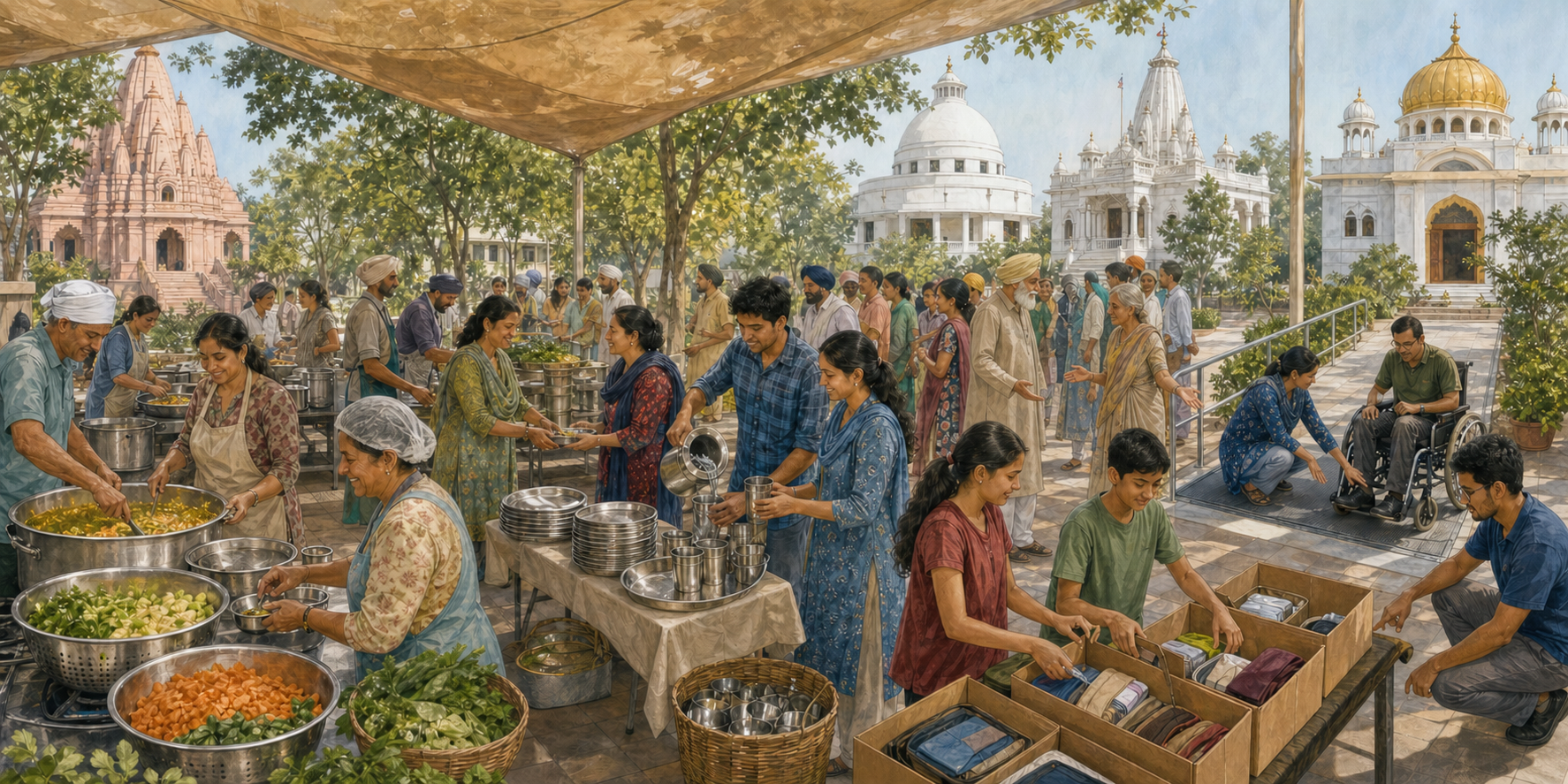
Dharmic unity does not require a merged theology, a common ritual, or an agreement that doctrinal differences are unimportant. It requires a shared civic outcome, honest boundaries, and enough respect for each community to explain its participation in its own language.
A Hindu group may understand river stewardship through the dignity of a tirtha or kshetra. A Buddhist sangha may emphasize interdependence and compassion. A Jain organization may begin with ahimsa, restraint, and anekantavada. A Sikh sangat may frame the same work through seva and Sarbat da Bhala. These are bridges into action, not exhaustive definitions of four internally diverse traditions.
Write a short coalition charter before collecting funds or announcing a public program. It should settle the matters most likely to produce resentment later:
- The place and need being addressed, stated in ordinary language.
- The shared outcome, such as safer access, less festival waste, preserved recordings, healthier vegetation, or a more reliable food service.
- The activities that are inside and outside the project.
- The right of every participating tradition to retain its own doctrine, worship, symbols, dietary discipline, and custodial rules.
- A prohibition on using shared service for competitive proselytism or institutional recruitment.
- The decision process, including which questions belong to the coalition and which remain with the host institution.
- Volunteer expectations, financial approvals, safety responsibilities, and a confidential route for grievances.
- The conditions under which a pilot will be adopted, revised, paused, or ended.
The host site must remain recognizably itself. Hospitality does not require a gurdwara, mandir, vihara, or Jain institution to become a neutral event hall. Separate the host-led devotional component from the jointly governed service component, then offer an optional learning component in which each tradition describes itself. That structure protects ritual integrity while making participation intelligible to visitors.
This layered approach is particularly useful in the diaspora, where a sacred institution can serve as sanctuary, classroom, cultural anchor, and civic bridge at the same time. Music, food, exhibition panels, close reading, and guided participation offer different points of entry. Children may enter through activity, elders through familiar forms, and first-time visitors through plain explanations. Bilingual captions and clearly defined etiquette reduce confusion without simplifying the tradition into a generic spirituality.
Shared service should come before ambitious theological dialogue when the groups have little history together. Cleaning a riverfront, improving a kitchen roster, or preserving an oral archive tests reliability in a way that a ceremonial photograph cannot. Once participants have seen one another keep commitments, difficult conversations become less speculative and less vulnerable to stereotypes.
Give authority to the people already carrying the place
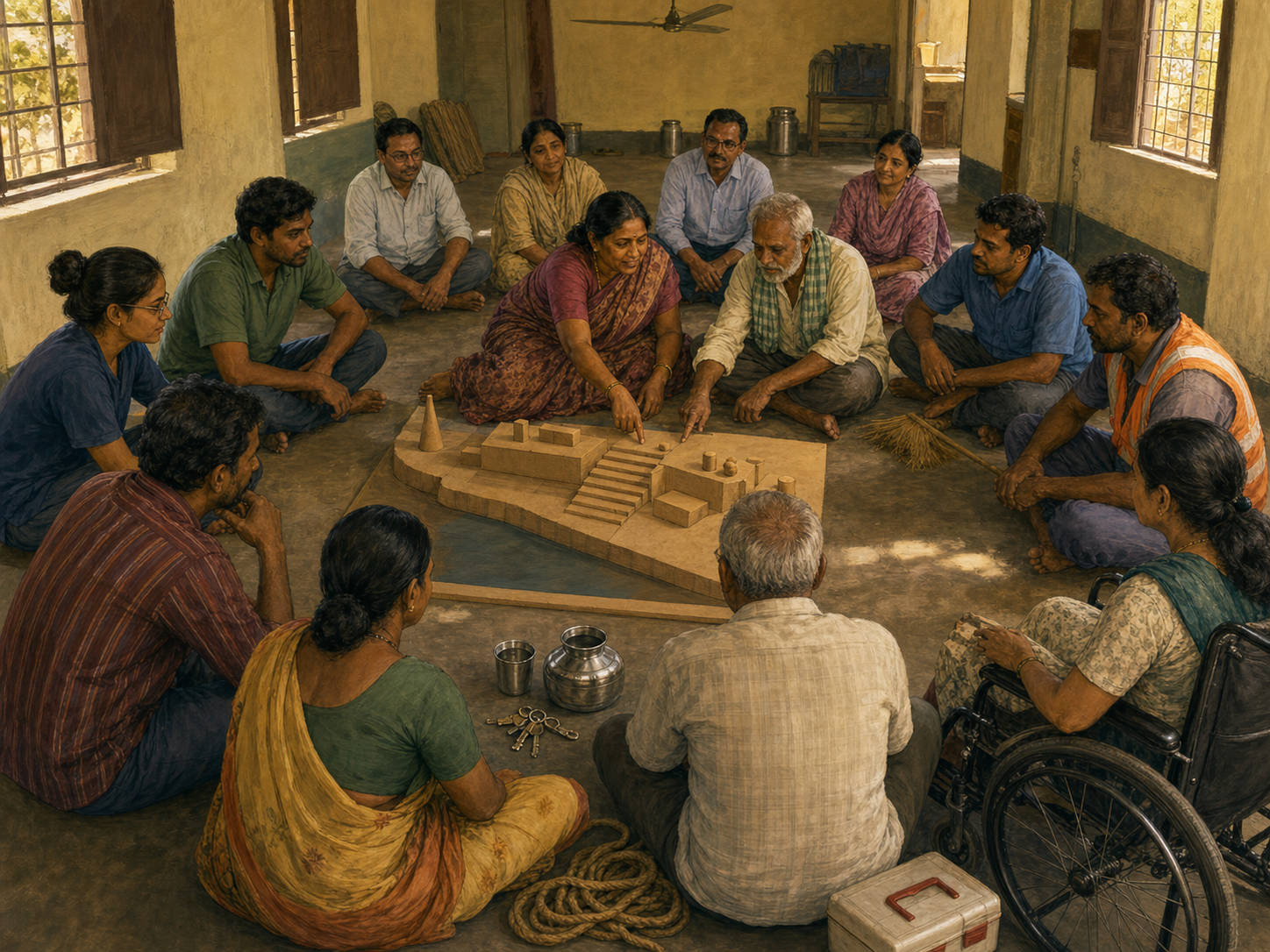
Formal titles do not always show where a community’s real knowledge resides. Look at who maintains volunteer rosters, teaches children, prepares food, preserves songs, guides elders, notices unsafe crowd movement, remembers donor restrictions, or knows which local family can repair a ritual object. If those people are asked to deliver the work but excluded from decisions, the coalition has confused representation with leadership.
Women are frequently central to precisely these forms of continuity. Their leadership already spans sanghas and satsangs, kitchens, environmental work, music and oral heritage, committee governance, crafts, and community education. Inviting women to appear on a program while withholding access to budgets, schedules, safety decisions, or evaluation is not inclusion. It is additional labor without corresponding authority.
Test every leadership role with direct questions:
- Can this person make the decisions needed to fulfill the role?
- Can they see the relevant accounts, plans, permissions, and prior commitments?
- Can they stop or escalate an activity that threatens safety, dignity, ritual integrity, or custodial rights?
- Can they speak to the wider coalition without their report being filtered by a separate committee?
- Can they train a successor so that the work does not depend indefinitely on personal sacrifice?
Then map the connectors, not only the office-holders. A respected music teacher may link families across institutions. A kitchen coordinator may already share suppliers with another community. A heritage volunteer may know local schools, librarians, and craftspeople. Healthy connectivity needs both close internal relationships and bridges between groups. Maintain any directory by consent, collect only information needed for the work, and give participants control over how they are contacted.
For a complex project, use a RACI map: record who is responsible for doing the work, who is accountable for the decision, who must be consulted, and who must be informed. This is especially valuable when a municipal permission, ritual protocol, public-safety question, or donor restriction falls outside the coalition’s authority. Ambiguity that feels polite at the first meeting usually becomes blame when a deadline is missed.
Volunteer commitments also need to reflect actual capacity. Service-Level Expectations are often better suited to volunteer ecosystems than punitive service agreements. Ask people what they can reliably deliver, record the handoff if they cannot, and review recurring overload. Begin with good intent and correct ordinary gaps privately. Harassment, financial misconduct, repeated boundary violations, and safety concerns are different: route them through the published protocol and apply clear consequences. Ahimsic speech does not require institutional passivity.
Run one 90-day pilot with visible rules and measures

A coalition becomes credible when it completes a useful cycle of work. Choose a pilot tied to a named place, dependent on contributions from more than one institution, reversible if the design fails, and measurable without intrusive data collection. Suitable projects can include a river or ghat stewardship cycle, a shared food-service improvement, safer festival movement, sacred-grove care, an accessibility initiative, or the preservation of manuscripts and oral traditions.
Commitment, connectivity, compassion, and creativity provide useful checks throughout the pilot. Commitment asks whether promises are reliable. Connectivity asks whether information and responsibility cross institutional boundaries. Compassion asks whether people are treated with dignity, including when something goes wrong. Creativity asks whether the coalition can adapt without severing the practice from its Dharmic purpose.
Days 0-30: define the work and establish a baseline
Complete the site walk, stakeholder map, asset inventory, and coalition charter. Set 4-6 shared objectives and key results that describe both completion and change. Assign roles, identify permissions, record ritual and data boundaries, and agree on the communication channel. Measure the starting condition before intervention; otherwise the final report will show activity without establishing whether the place improved.
If the project involves food safety, structural work, crowd management, emergency response, or environmental intervention, obtain the applicable permissions and competent technical review. These are not suitable areas for informal experimentation merely because the labor is voluntary.
Days 31-60: operate at a scale that exposes weak handoffs
Run the service under normal conditions before expanding it to the largest festival or busiest pilgrimage period. Keep a decision log and an incident log. Hold a weekly ten-minute retrospective focused on what to start, stop, and sustain. The purpose is not to conduct a general discussion of everyone’s performance. It is to locate practical friction: missing supplies, conflicting instructions, inaccessible information, unclear ritual authority, overloaded volunteers, or a handoff that depends on one unavailable person.
Protect the pilot from mission drift. A river-cleaning group should not quietly become a platform for doctrinal resolutions. An archive team should not publish restricted material merely because digitization is technically possible. A community kitchen collaboration should not alter a host institution’s dietary or ritual discipline without its explicit authority.
Days 61-90: evaluate, report, and make a deliberate decision
Compare the result with the baseline, collect the experience of users and volunteers, review accounts, and document unresolved risks. Then adopt the pilot, revise it, pause it, or end it. A respectful sunset is better than preserving an ineffective activity to protect reputations. Publish a plain-language community report explaining what was attempted, what changed, what was spent, what was learned, and who will own the next decision.
Do not judge the work by outputs alone. A balanced evaluation distinguishes outputs, outcomes, and lived experience:
| Measure | Question | Place-based examples |
|---|---|---|
| Output | What did the coalition complete? | Stewardship cycles held, volunteers trained, recordings preserved, access improvements installed |
| Outcome | What condition changed? | Lower litter load, less food waste, more reliable access, stronger biodiversity signs, broader participation in decisions |
| Experience | How did people encounter the change? | Safety, dignity, spiritual fulfillment, clarity of learning, confidence in the grievance process |
Money and data require explicit stewardship. Publish expense categories, approval roles, and reporting intervals. If diaspora groups contribute resources, use a transparent memorandum of understanding while leaving ritual priorities and site-specific decisions with on-site custodians. If you digitize manuscripts, photographs, music, or oral histories, settle access, reuse, attribution, and withdrawal rights before uploading anything. Openness does not erase custodial ownership or ritual sensitivity.
Communicate the result through the place itself. Show the safer route, restored grove, cleaner water’s edge, better-organized kitchen, accessible catalogue, or trained volunteer corps. Cultural advocacy is strongest when neighbors can inspect a shared benefit and understand how each tradition contributed without surrendering its identity.
Key takeaways: decide these matters at the first meeting
- Name the exact place and the visible need. Do not organize around unity as an abstraction.
- Agree on a civic outcome, not a common creed. Let each tradition state its own reason for serving.
- Record ritual, dietary, data, financial, and proselytism boundaries before launching the work.
- Give decision rights and information access to the people who already carry operational responsibility, especially women whose labor is often treated as informal.
- Use a 90-day pilot to test commitments, handoffs, safety, and community value before scaling.
- Measure outputs, outcomes, and experience against a baseline, then publish a plain-language account.
- Keep a confidential grievance route and clear consequences. Compassion and accountability belong in the same system.
Your next meeting should end with a site-walk date, a draft charter, named role owners, and a baseline question. If it ends only with a photograph and a broad declaration, the difficult decisions have merely been postponed.
Begin where people already pray, serve, remember, and depend on one another. Improve that place together, report honestly, and repeat what proves worthy of trust. That is how Dharmic unity becomes visible without becoming uniform.
References
- DharmaRenaissance Blog – Women of Faith 2026: Pride in Place, Dharmic Unity, and Place-Based Resilience
- DharmaRenaissance Blog – ISKCON at 60 in The Hague: Nauka-vihara Boat Festival and Gita Expo Inspire Unity
- DharmaRenaissance Blog – Mastering the Big Four C’s: Commitment, Connectivity, Compassion, Creativity for Dharmic Unity
