

If you came looking for a Hindu version of “the end of the world,” the first distinction matters most: pralaya is not one event. The term can describe an ending already taking place around you, a temporary withdrawal of manifested worlds, the reabsorption of material creation, or liberation from bondage.
Keep those four scales separate and the subject becomes much easier to understand. You can then read a cosmological account without mistaking a pause for a final ending, or a teaching about moksha for a prediction of cosmic destruction.
Pralaya means dissolution, not absolute annihilation
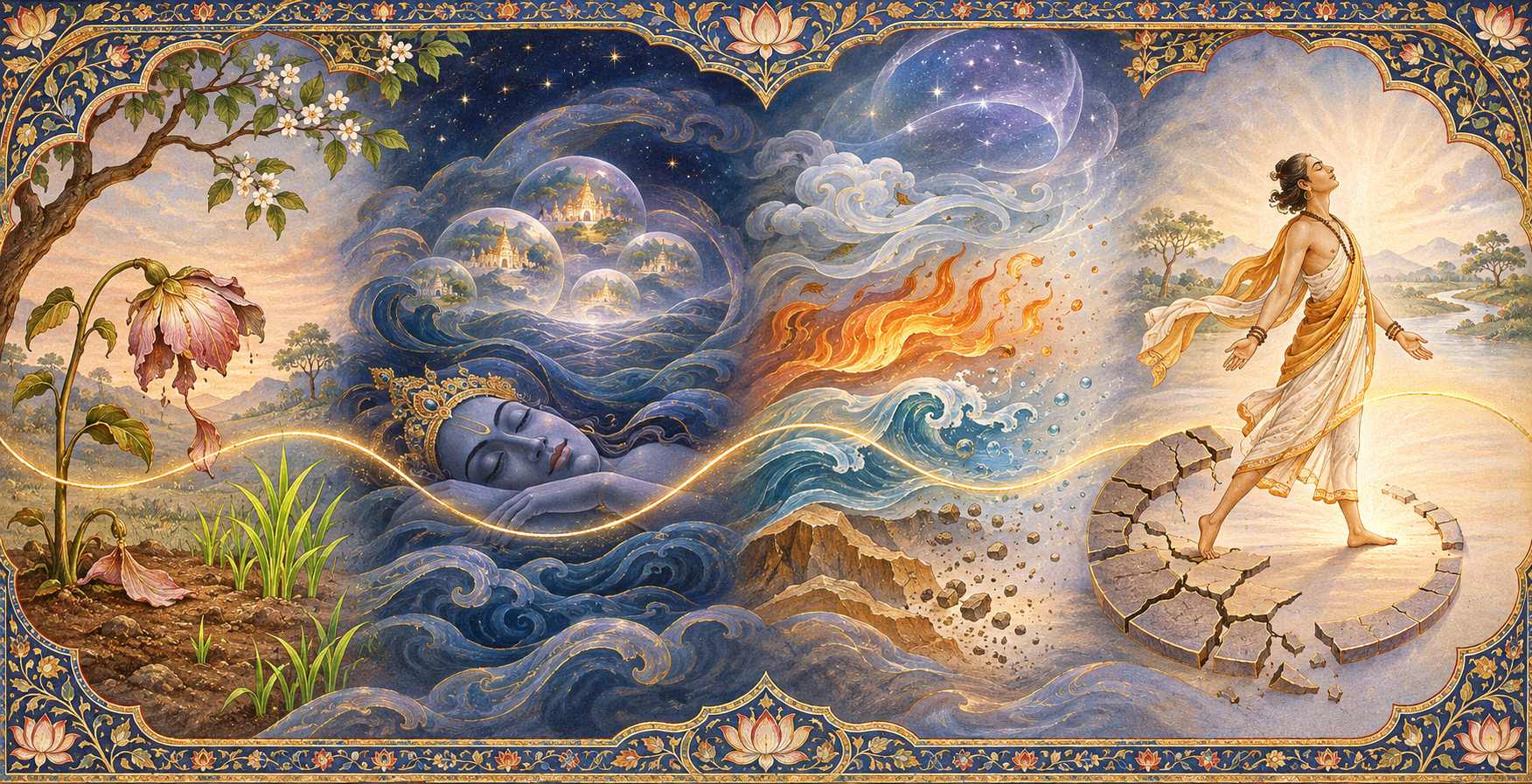
Hindu cosmology generally works with recurring manifestation, preservation and withdrawal rather than a single creation followed by an irreversible end. A widely used fourfold account of pralaya distinguishes nitya, naimittika, prakritika and atyantika pralaya.
“Dissolution” is the safer English word because it leaves room for something to become unmanifest without being reduced to sheer nonexistence. A visible form can end while its causes, its underlying potential or the reality beyond it remains. In some forms of pralaya, manifestation returns. In another, the cosmos need not disappear at all.
The easiest reading error is to assume that every use of pralaya refers to the same catastrophe. Before assigning a meaning, ask four questions: What is dissolving? What remains? Does manifestation return? Is the teaching about the cosmos, or about a being’s release from bondage? Those questions will usually identify the intended form.
The four forms of pralaya at a glance
| Form | Scale | What dissolves | What continues or remains | How to recognise it |
|---|---|---|---|---|
| Nitya pralaya | Continuous or ordinary | Passing conditions, bodies and individual configurations | The wider causal process and other manifested forms | The account concerns constant change, death, sleep or the passing of states |
| Naimittika pralaya | Periodic and cosmic | A manifested cosmic order during a recurring interval | The deeper causal basis and the possibility of renewed manifestation | The worlds withdraw at a cosmic junction and later emerge again |
| Prakritika pralaya | Complete material reabsorption | The differentiated material cosmos and its constituent principles | Prakriti in an unmanifest condition, with ultimate reality not reduced to nothingness | The process reverses manifestation itself rather than merely suspending a cosmic period |
| Atyantika pralaya | Spiritual and liberative | Ignorance, false identification and bondage | Reality; the external cosmos may continue for others | The decisive subject is moksha, not a cosmic timetable |
The table reveals an important asymmetry. The first three can be read as kinds or levels of withdrawal within cosmic and embodied existence. Atyantika pralaya changes the axis of the discussion. It concerns freedom from the cycle rather than another stage inside it.
Read each pralaya on its proper scale

Nitya pralaya: dissolution is happening now
Nitya means continual or regular. This form directs your attention away from a distant cosmic ending and toward the instability of conditioned forms. Bodies die, experiences pass, relationships between things change, and no particular configuration remains fixed forever. Depending on the exposition, death, sleep or the moment-by-moment passing of states may be used to illustrate this level of dissolution.
Do not turn this into the careless claim that nothing matters because everything changes. Its practical force runs in the opposite direction. You should recognise a conditioned form as conditioned, value it without demanding permanence from it, and notice how attachment converts change into suffering. When a discussion focuses on continuous perishability rather than a scheduled cosmic event, read it first through nitya pralaya.
Naimittika pralaya: a recurring cosmic withdrawal
Naimittika pralaya is a periodic dissolution associated with a junction in the cosmic cycle, commonly described in relation to the close of a day of Brahma. Manifested worlds withdraw for an interval, but this is not the destruction of every possible basis of manifestation. Creation can unfold again when the interval ends.
The operative word is recurring. If an account includes withdrawal followed by renewed manifestation, you are dealing with a cosmic pause or reset, not a once-for-all conclusion to existence. This prevents a common mistake: translating a cyclic cosmology into the linear language of one final apocalypse.
Prakritika pralaya: material manifestation returns to its source
Prakritika pralaya reaches deeper than the periodic withdrawal of worlds. It is associated with the completion of the greater cosmic span represented by Brahma’s lifetime. The differentiated material order resolves into prakriti, primal nature in its unmanifest condition. What unfolded into distinguishable principles and forms is understood as returning toward its causal ground.
It is more accurate to picture the reversal of manifestation than a universe being smashed into nothing. Even the expression “total dissolution” needs a boundary: it is total with respect to the manifested material cosmos. It is not necessarily a declaration that absolutely nothing remains. When a description includes the reabsorption of material principles themselves, it has moved beyond naimittika pralaya into prakritika pralaya.
Atyantika pralaya: the end of bondage
Atyantika pralaya is the one most likely to be misunderstood if you approach pralaya only as physical destruction. Here the ending is spiritual: ignorance, false identification and bondage cease through liberation. The world does not have to vanish for this dissolution to occur. The decisive change is that the liberated being is no longer bound by the cycle of conditioned existence.
This is not another name for bodily death. Death, by itself, belongs to conditioned existence and does not establish liberation. Nor is atyantika pralaya an event to place on a cosmic calendar. It answers a different question: not “When will the universe withdraw?” but “What must end for bondage to end?”
How to handle apparently conflicting definitions
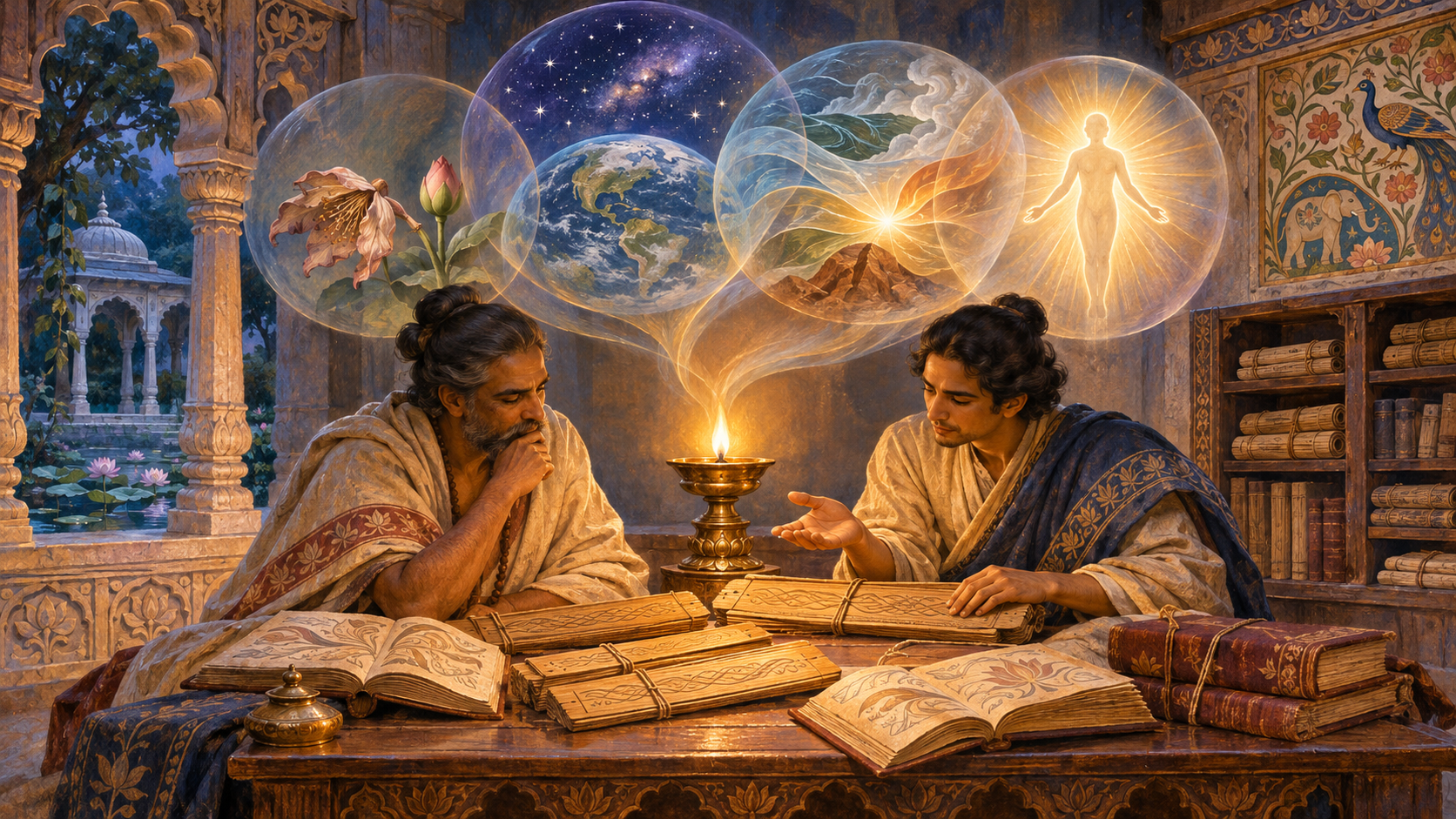
You may encounter slightly different emphases when these terms are explained. One exposition may use sleep to clarify ordinary dissolution, while another foregrounds death or continuous change. Cosmological descriptions may also differ in how much detail they give about which worlds or principles withdraw. Do not force every presentation into identical wording.
First, identify the subject. If the subject is a passing embodied condition, the relevant category is likely nitya. If it is a recurring withdrawal of manifested worlds, look to naimittika. If differentiated material nature itself is being reabsorbed, the scale is prakritika. If ignorance and bondage end, the teaching is atyantika.
Second, look for a return. Renewed manifestation after a cosmic interval is the clearest sign that the dissolution is naimittika rather than prakritika. Continuous replacement of particular forms points instead toward nitya.
Third, separate time from liberation. Nitya, naimittika and prakritika can be arranged by the extent of conditioned dissolution. Atyantika cannot be understood merely as the longest item on that timeline. It is release from bondage, not the final frame of a cosmic sequence.
Finally, ask what the teaching is trying to loosen. A cosmological passage may loosen the assumption that the present world-order is permanent. A teaching about atyantika pralaya targets the deeper assumption that the conditioned self is one’s ultimate identity. The shared language of ending serves two connected but distinct purposes.
Key takeaways
- Pralaya is better understood as dissolution or withdrawal than as absolute annihilation.
- Nitya pralaya is the continual passing of conditioned forms and states.
- Naimittika pralaya is a periodic cosmic withdrawal after which manifestation can resume.
- Prakritika pralaya is the reabsorption of differentiated material creation into unmanifest prakriti.
- Atyantika pralaya is liberation through the ending of ignorance and bondage; the external universe need not disappear.
- To classify any account, ask what dissolves, what remains, whether manifestation returns and whether the subject is cosmology or moksha.
The next time you meet the word pralaya, do not translate it automatically as “the end of the world.” Mark the scale first. A passing state, a recurring cosmic interval, material reabsorption and liberation are not four descriptions of one explosion. They are four ways of seeing what ends, what endures and what it means to become free.
References

Leave a Reply
You must be logged in to post a comment.