
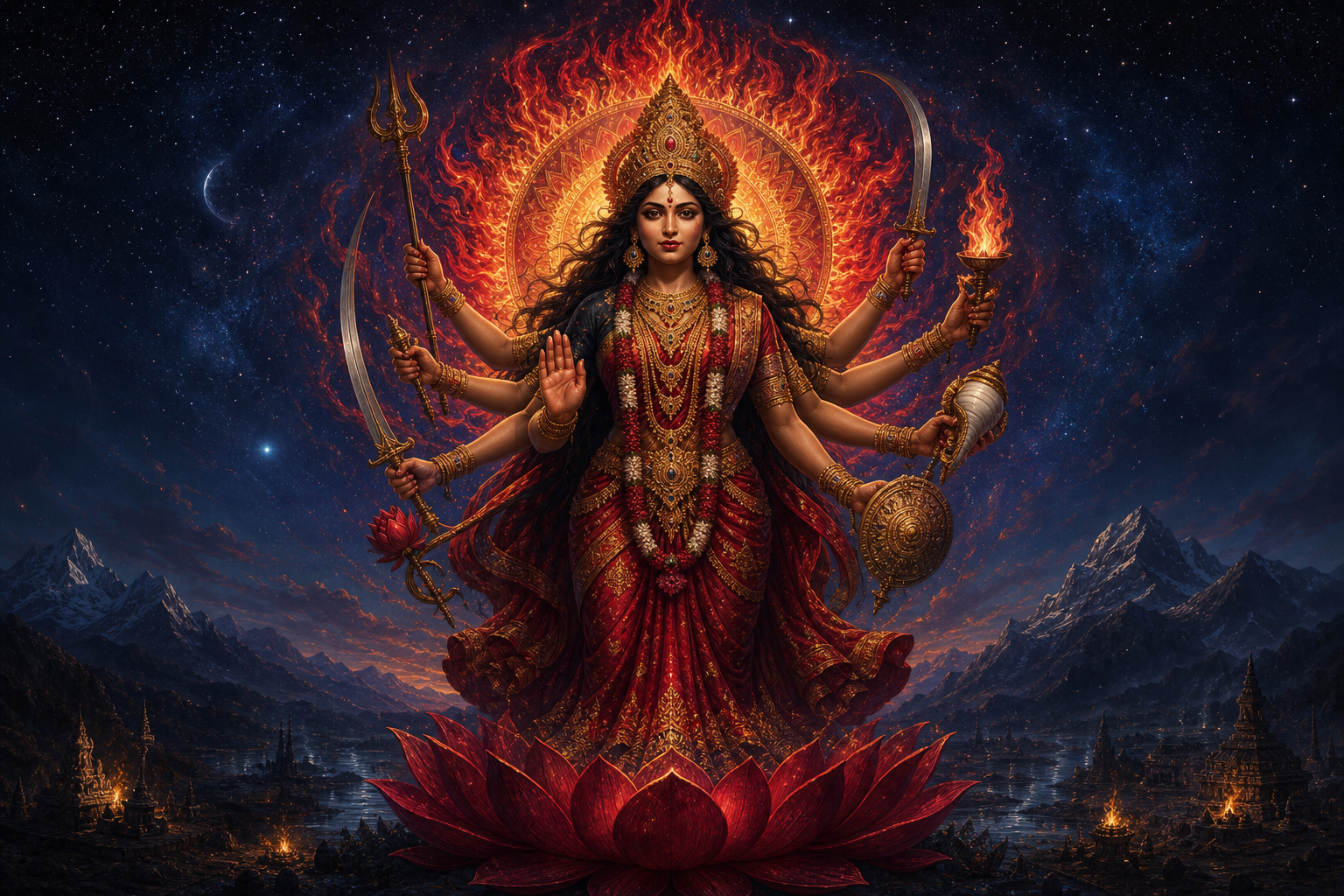
Fierce Shakti imagery makes a demanding claim: divine compassion cannot be understood only through softness. Armed hands, skulls, dark colors, battle scenes, and cremation grounds form a sacred vocabulary for protection, impermanence, disciplined power, and liberation.
Read together, the source articles connect this visual vocabulary to a larger theology. The fierce Goddess is not a frightening exception to an otherwise gentle divinity. She is the dynamic Absolute acting against ignorance and disorder, while her iconography shows what that action means on cosmic, ethical, and psychological levels.
Fierceness begins with a theology of divine power
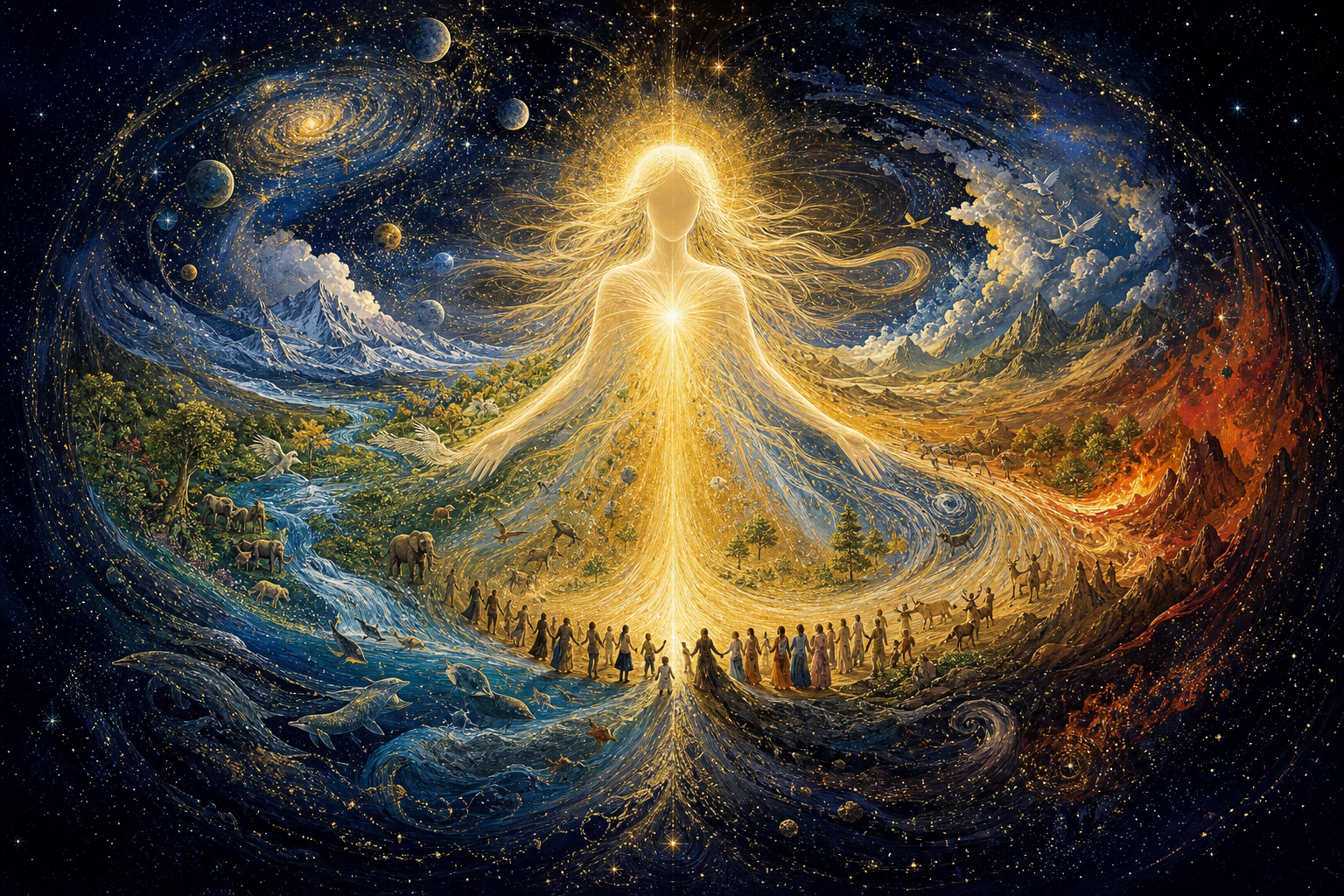
The deepest interpretive question is not why a loving Goddess sometimes becomes fierce, but whether love and fierceness were ever truly separate. In DharmaRenaissance’s discussion of the Devi Upanishad, the declaration Aham Brahma Swaroopini is read as identifying Devi with Brahman itself. On this account, Shakti is not an accessory possessed by a distant Absolute. She is the power of being, knowing, manifestation, and liberation.
This metaphysical frame changes the meaning of fierce forms. Durga, Kali, Chandi, and Chamunda need not be treated as divine personalities who periodically abandon serenity for anger. They represent ways in which ultimate reality creates, sustains, corrects, dissolves, conceals, and liberates. The same source presents Devi as both beyond attributes and accessible through attributes: transcendent reality can therefore appear through color, gesture, weapon, personality, and story without being confined by them.
The article on Mangala Chandi brings this principle into focus through her name. It interprets mangala as auspicious welfare and Chandi as formidable protective power. Their conjunction makes an important theological point: auspiciousness may require intervention. Grace can preserve and nourish, but it can also confront whatever prevents life from flourishing.
Iconography turns doctrine into a visual argument
The sources consistently treat sacred images as visual theology rather than decoration. Multiple arms, weapons, mudras, ornaments, animals, bodily features, and settings communicate different functions of Shakti. Their meanings are contextual rather than mechanical; a symbol can support several related readings, and regional or devotional variations do not necessarily amount to theological contradiction.
Hands, weapons, and disciplined agency
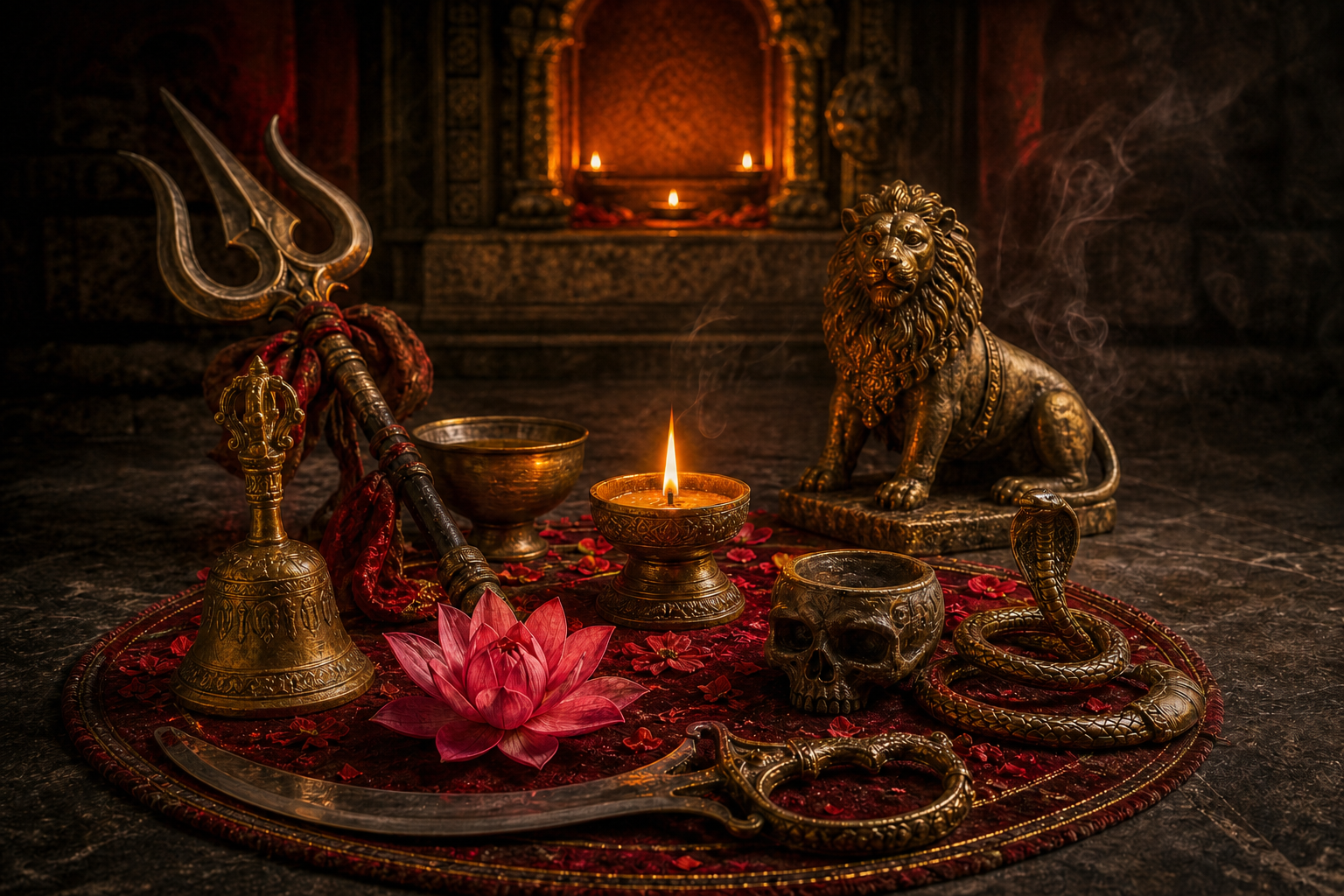
Multiple arms signify the Goddess’s capacity to protect, bless, nourish, restrain, and overcome disorder at once, according to the Mangala Chandi article. Weapons specify the character of that agency. The sword can signify discrimination that cuts through illusion; the trident can indicate mastery over threefold structures such as the gunas or divisions of time; a noose can represent the restraint of harmful tendencies; and a shield can convey protection. These are presented as possible symbolic readings, not as a single universal code.
Open hands modify the meaning of the weapons. The same article associates abhaya mudra with fearlessness and varada mudra with generosity. An image that holds a weapon while granting refuge is not visually confused. It distinguishes between the force that threatens dharma and the devotee who seeks protection. Power and reassurance appear in the same body because protection requires both.
Skulls, darkness, animals, and places of death
The source on Tantric Goddess imagery explains that a severed head can represent ego, ignorance, false speech, or the limited mind. It presents Kali’s garland of heads as variously associated with letters, speech, finite identities, or forms consumed by time. A corpse can signify inert consciousness without Shakti, ignorance, or the temporary condition of the body. Such interpretations prevent symbolic death from being mistaken automatically for an endorsement of literal violence.
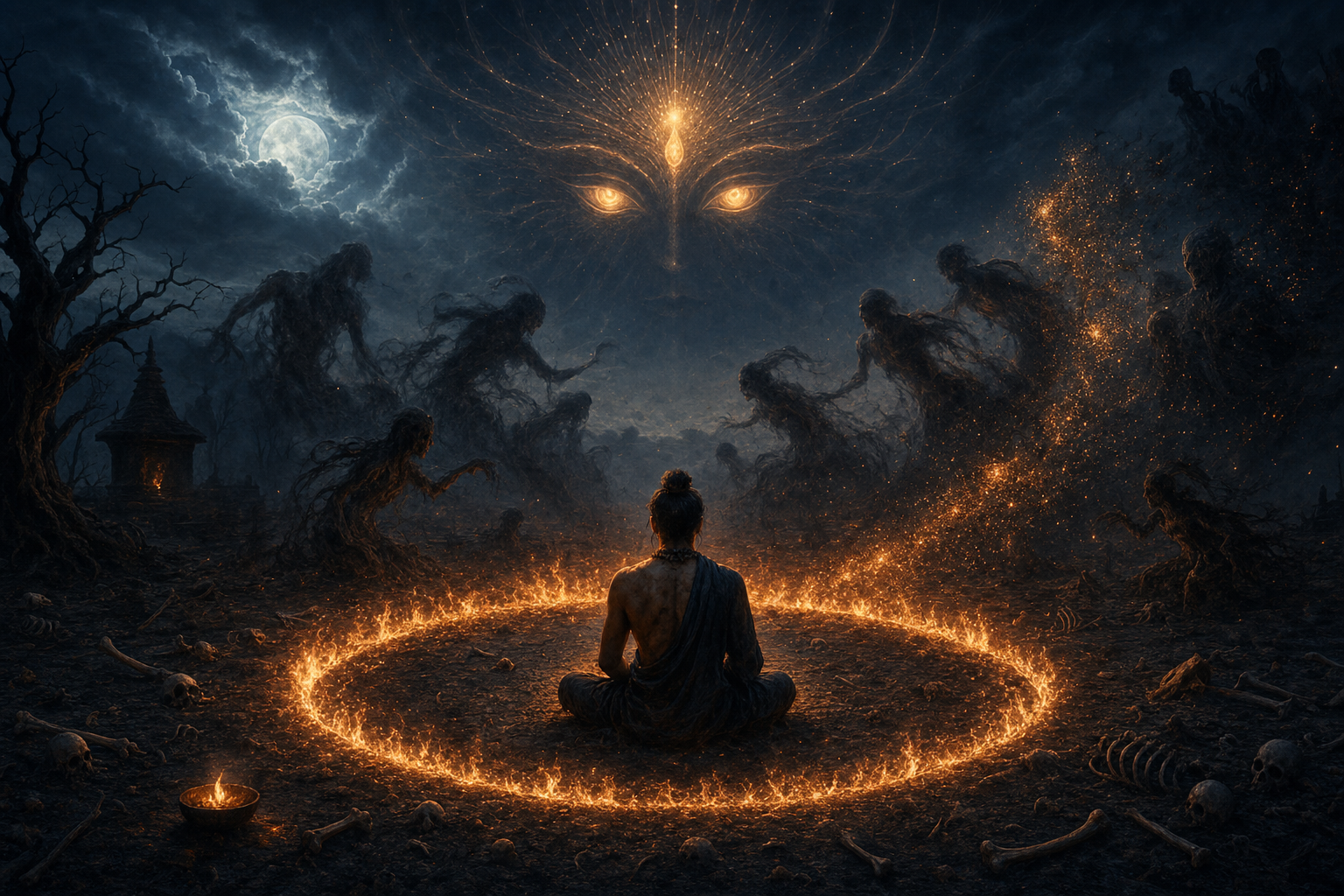
The cremation ground intensifies this teaching by placing the Goddess where social distinctions and bodily pretensions finally collapse. Chamunda’s emaciated form and skull ornaments similarly confront impermanence and the stripping away of worldly pride, according to the same source. These images refuse to make mortality invisible; their terror lies partly in exposing conditions that ordinary life allows people to postpone acknowledging.
Color and animal imagery add further layers. The Mangala Chandi article associates red with life-force, courage, fertility, and sacred intensity; gold with radiance and auspicious prosperity; and white with purity or clarity. It cautions that black or dark hues in fierce forms need not signify evil, instead linking them with time, mystery, cosmic depth, and the absorption of limitation. A lion or tiger can represent primal strength brought under divine direction. The controlling principle is not force alone, but force governed by wisdom.
Fierce motherhood gives destruction a moral direction
The maternal title is central to these images, but the sources resist reducing motherhood to consolation. The article on Shakti’s fierce motherhood describes the mother as one who nourishes, guards, corrects, refuses harmful indulgence, and draws protective boundaries. On this reading, tenderness and severity are different responsibilities of the same protective intelligence.
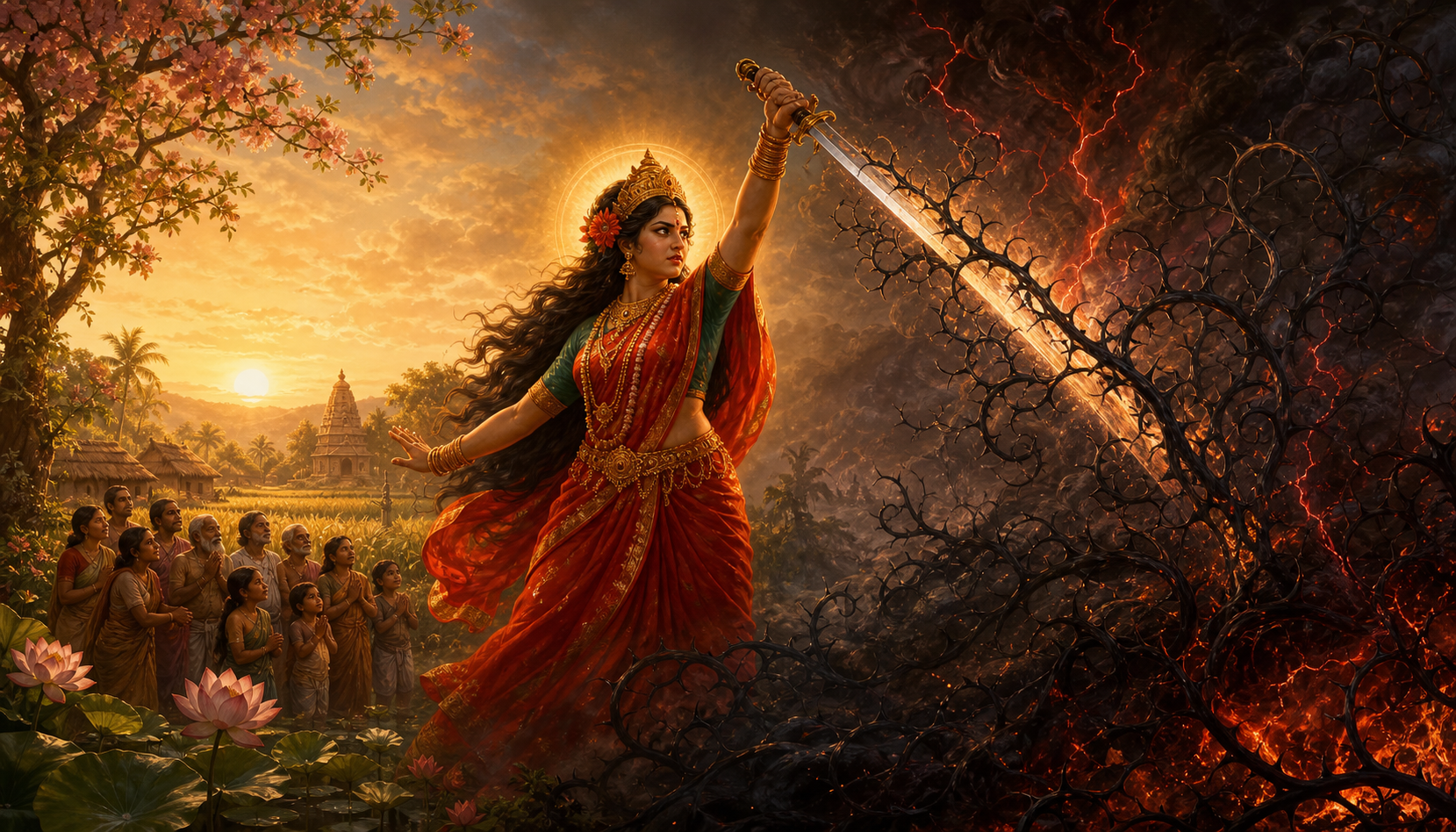
The article uses the Devi Mahatmya’s account of the gods’ combined powers taking form as the Goddess to explain why divine protection becomes concentrated and active when cosmic order is overwhelmed. It reads Mahishasura’s shape-shifting and buffalo form as images of unstable ego, inertia, ignorance, and crude force. Durga’s battle consequently works on more than one level: it depicts a cosmic conflict while also mapping the struggle against pride, greed, resentment, addiction, fear, and self-deception.
This framework also supplies a boundary between fierce compassion and aggression. The sources do not treat every destructive act as sacred merely because it is forceful. Destruction acquires religious meaning when it is ordered toward protection, the removal of ignorance, and the restoration of dharma. In the fierce-motherhood article’s formulation, Durga’s battlefield represents active energy directed by lucid purpose, not chaos sanctified after the fact.
Mangala Chandi makes the same point through auspiciousness: force is legitimate within her symbolism because it serves welfare. The Tantric-imagery article adds an ethical challenge by contrasting discomfort with symbolic violence against indifference to actual exploitation and environmental destruction. Fierce iconography can therefore redirect moral attention. It asks whether outward calm is genuine peace or merely avoidance of suffering and injustice.
Key takeaways
- Fierce forms express Shakti’s protective and liberating activity rather than a lapse from divine compassion.
- Weapons symbolize discriminating, restraining, and corrective powers; mudras show that the same Goddess also grants refuge and blessing.
- Skulls, corpses, darkness, and cremation grounds confront ego, impermanence, time, and the collapse of constructed identity.
- Iconographic meanings are contextual and sometimes plural, so regional variation should not be forced into a single rigid code.
- Sacred destruction is distinguished from aggression by its orientation toward protection, clarity, welfare, and restored dharma.
A responsible reading holds several levels together
Two interpretive errors flatten fierce Shakti imagery in opposite ways. A purely literal reading can turn ritual symbols into sensational scenes of cruelty. A purely psychological reading can reduce living deities and traditions to metaphors for private self-improvement. The sources support a layered approach in which an image may operate simultaneously as divine presence, theological statement, ritual focus, cosmic narrative, ethical instruction, and map of inner transformation.
This layered method is especially important for Tantric material. The Tantric-imagery article describes Tantra as a broad field encompassing mantra, yantra, ritual, meditation, temple worship, subtle-body disciplines, and philosophical inquiry. It also emphasizes discipline, lineage, and initiation, cautioning against reductions of Tantra to sensational imagery, occultism, or unrestrained indulgence. The unsettling image belongs to a structured religious world, not to an isolated catalogue of shocking symbols.
The sources also converge on a productive paradox: composure need not mean passivity, and terror need not mean malevolence. A serene face can indicate mastery over immense force; a fearsome setting can reveal liberating truth; a maternal figure can carry weapons without ceasing to be compassionate. The visible contradiction prompts the viewer to examine simplistic divisions between gentle and fierce, beautiful and terrible, spiritual and powerful.
Future engagement with fierce Shakti traditions will be most illuminating when images are encountered alongside their theological, devotional, and ritual contexts. Learning that visual grammar allows discomfort to become inquiry and prevents either fear or familiarity from ending interpretation too soon.
References
- DharmaRenaissance Blog — Devi Upanishad Reveals Durga as Brahman: The Powerful Truth of Shakti
- DharmaRenaissance Blog — Mangala Chandi’s Powerful Dual Grace: Sacred Iconography, Symbolism, and Inner Meaning
- DharmaRenaissance Blog — Why Hindu Tantric Goddess Imagery Reveals Sacred Truth Beyond Fear
- DharmaRenaissance Blog — Why Shakti’s Fierce Motherhood Matters: Compassion, Power, and Sacred Duty