
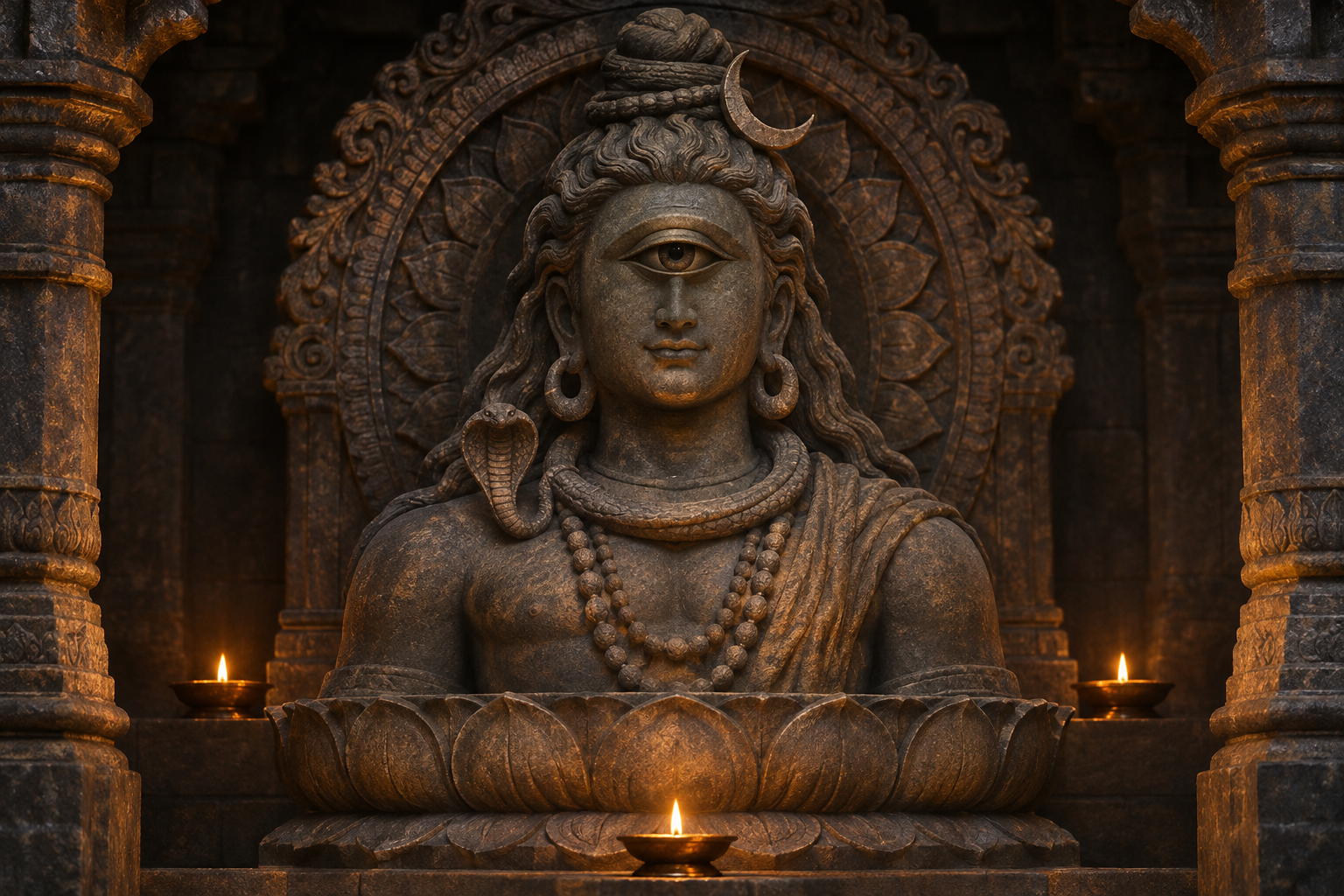
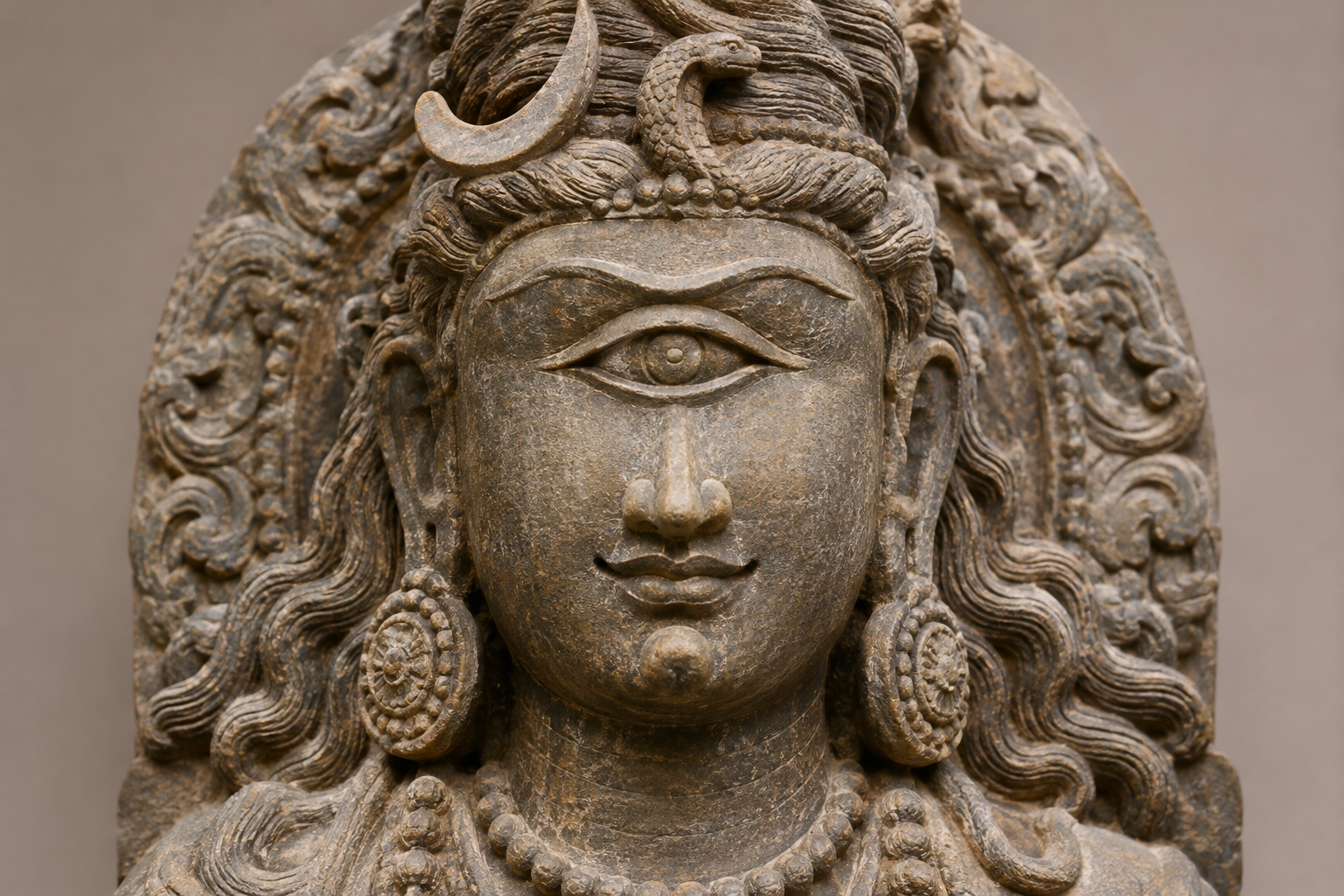
You are standing before a Shiva image described as Ekanetra, and the single eye creates an immediate puzzle. Is it damage, an unfamiliar version of Shiva’s third eye, or a literal depiction of a one-eyed deity? None of those assumptions is a safe starting point.
Read the eye as concentration rather than deficiency. Ekanetra turns sight into a theological statement: the many partial ways of seeing are gathered into one undivided vision. Once you understand that principle, the form becomes easier to recognize, interpret, and approach in contemplation.
The single eye signifies unified vision, not diminished sight
The name gives you the first clue. Eka means one, while netra means eye. A purely anatomical reading stops there and asks why an eye is absent. An iconographic reading asks what oneness does to the meaning of sight.
In this form, one does not mean less. It means gathered, integrated, and undivided. The eye is therefore better understood as a sign of knowing: a vision that is not scattered among competing standpoints. Ekanetra embodies a single, unified vision rather than an incomplete capacity to see.
This distinction matters whenever you encounter Hindu sacred art. The bodily feature is often the doorway into the meaning, not the whole meaning. If you treat the image as an attempt at naturalistic portraiture, the single eye looks anomalous. If you treat it as sacred iconography, the eye becomes a compact expression of a metaphysical idea.
You should therefore resist two quick conclusions. Do not assume that an apparently missing eye represents damage until the object’s condition and provenance support that conclusion. Do not assume that every unusual eye on a Shiva image is simply another treatment of the familiar third-eye motif. The name, Shaiva setting, and intended function of the form must guide the reading.
Why Ekanetra belongs within an Agamic map of manifestation
Shaiva thought can speak of Shiva as undivided Absolute Reality while also presenting distinct divine forms. That is not a contradiction within the Agamic framework. A particular form makes a particular function, quality, or spiritual relationship available to contemplation without implying that Shiva has been divided into separate ultimate beings.
Ekanetra should be read within that movement from the unconditioned to the intelligible. The absolute cannot be exhausted by any image, yet a sacred image can disclose one aspect with unusual precision. Here, the precision lies in the unity of vision.
The relevant Agamic setting includes the Vidyeshvaras, whose name means Lords of Knowledge. That association keeps the interpretation anchored in knowledge rather than physical peculiarity. Ekanetra is not interesting merely because the figure has one eye; the form is meaningful because its distinctive vision has a place within an ordered Shaiva understanding of divine knowledge and function.
Keep three levels distinct when you explain the image to someone else. Shiva is the undivided reality. Ekanetra is a particular manifest form. The single eye communicates the form’s emphasis on unified knowing. Collapsing those levels produces two opposite errors: treating the image as the whole and only definition of Shiva, or dismissing it as an arbitrary artistic variation.
How to identify what you are actually looking at
A single visual feature rarely establishes the identity of a sacred figure by itself. If you are examining a temple image, museum object, photograph, or illustration, use the following questions before assigning a meaning.
| What you notice | Tempting conclusion | Better question |
|---|---|---|
| Only one eye is visible | The object must depict Ekanetra | Does the label, inscription, provenance, or Shaiva context identify the form? |
| An eye occupies a prominent position | This must be Shiva’s familiar third eye | Is the image emphasizing an additional eye, or reducing vision to one unifying eye? |
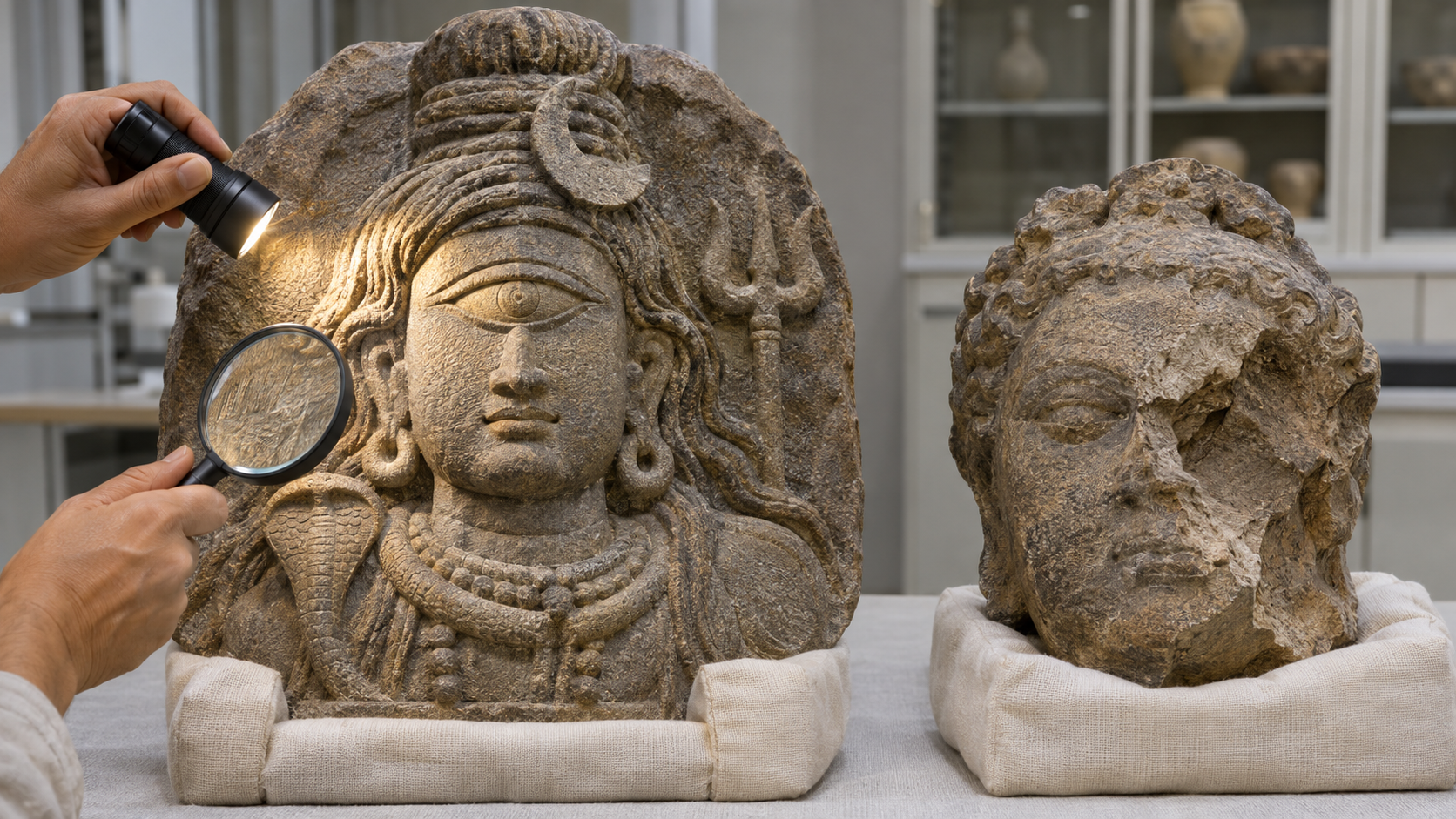
| One side of the face is worn or broken | The asymmetry is intentional symbolism | Could damage, erosion, angle, or restoration account for what is missing? |
| The name Ekanetra appears in a caption | The name describes anatomy and nothing more | What does unified vision communicate in the surrounding Shaiva framework? |
The distinction between Ekanetra and three-eyed Shiva is especially useful. In the familiar three-eye motif, the additional eye expands the symbolism of sight. In Ekanetra, the controlling idea is concentration into one vision. Counting eyes is therefore only the beginning; you must ask whether the composition communicates addition or unification.
Condition also matters. A damaged two-eyed face can appear one-eyed in a photograph, while a frontal composition may obscure a feature that is clear from another angle. Check more than one view when possible. If a reliable identification is unavailable, describe what you can see without pretending that the identity is settled.
This method protects the sacred image from two kinds of carelessness. It prevents a theological symbol from being reduced to bodily abnormality, and it prevents every damaged or visually unusual Shiva image from being assigned an esoteric identity it may not possess.
Using the icon in contemplation without inventing a ritual
You do not need to manufacture an elaborate practice around Ekanetra. Unless you are following instructions from a qualified lineage or temple tradition, treat the following as a way of contemplating the symbol, not as a prescribed Agamic ritual.
- Look at the single eye before trying to explain it. Notice how strongly it pulls your attention toward one centre.
- Name a situation in which your own vision is fragmented. Separate what you fear, what you desire, what you know, and what you merely assume.
- Ask what a more unified view would include. Do not erase genuine differences; look for the standpoint from which they can be seen together without denial.
- Choose one action consistent with that fuller view. The symbol becomes useful when integration changes how you speak, decide, or respond.
Unified vision is not the same as rigid certainty. A person can cling to one opinion and still see very little. Ekanetra points instead toward an inward coherence in which perception is no longer ruled by whichever impulse happens to be loudest.
That makes the form relevant beyond art history. You can bring it to a divided family decision, a moral conflict, or a moment of spiritual confusion. The practical question is not, “How do I force every difference into one answer?” It is, “From what deeper centre can these differences be seen truthfully?”
Key takeaways for reading Ekanetra Shiva
- Ekanetra means the single-eyed form, but the eye should be read as unified vision rather than diminished sight.
- The form belongs within a Shaiva Agamic understanding in which the undivided Shiva manifests in distinct forms with particular functions and spiritual meanings.
- The connection with the Vidyeshvaras, the Lords of Knowledge, directs interpretation toward knowledge and conscious vision.
- Ekanetra should not automatically be confused with the familiar three-eyed representation of Shiva or with an image altered by damage.
- A sound identification uses the name, Shaiva context, provenance, condition, and overall iconography together.
The next time you meet this form, begin with one disciplined question: what has the artist concentrated into the single eye? That question will take you further than merely counting features. It lets the image do what sacred iconography is meant to do—move your attention from visible form toward the reality the form makes present.


References

Leave a Reply
You must be logged in to post a comment.