

You have travelled for hours, an elder in your family is exhausted, and the official queue looks uncertain. Then someone offers quick darshan for cash. The shortcut can sound like mercy at precisely the moment when fatigue makes verification difficult.
A well-governed temple should never force you to choose between physical hardship and a secret payment. Every legitimate route to darshan should be visible before you arrive, governed by published rules, issued through an official channel, and capable of being audited afterward.
The alleged quick-darshan racket at Trimbakeshwar, one of the 12 Jyotirlingas, led to the arrest of a sitting temple trustee and others. Individual culpability must be determined through due process. The governance lesson does not need to wait: whenever insiders or intermediaries can create access outside the recorded system, the system is inviting exploitation.
Fair access does not mean one identical queue for everyone

Fairness begins with equal spiritual dignity, not rigid sameness. A devotee with a disability may need physical assistance. Senior citizens may require a less demanding route. Families with children may need a queue designed around safety and movement. During Shravan, Maha Shivaratri, and other peak periods, timed entry may be necessary simply to keep the pilgrimage manageable.
The decisive distinction is between assistance and influence. Assistance responds to a defined need under a rule available to everyone who meets the same condition. Influence gives someone an advantage because of money paid off the books, personal connections, political standing, or an official’s discretion.
Every priority route should therefore pass six tests:
- Purpose: The temple states why the route exists, such as accessibility, crowd management, or another clearly defined operational need.
- Eligibility: A devotee can determine in advance who qualifies without negotiating with a priest, trustee, guard, or intermediary.
- Capacity: The allocation comes from a disclosed and controlled quota rather than an unlimited pool of discretionary passes.
- Issuance: The pass is obtained only through named official channels and enters the same booking record used by the temple.
- Verification: Gate staff apply the same check to everyone using that route.
- Review: Auditors can reconstruct who authorized the allocation, when it was issued, whether it was used, and how any exception was approved.
A published fee does not automatically make priority access fair. If a paid lane quietly consumes capacity while ordinary devotees receive no information about availability or waiting time, the temple has formalized privilege without solving the underlying problem. If any paid facility is retained, its price, quota, booking channel, cancellation rule, and effect on the general queue should be public. The baseline darshan route must remain credible rather than being deliberately degraded to push people toward payment.
The same discipline should apply to any VIP or exceptional quota. Personal details need not be published, but the number of slots allocated, used, cancelled, and left unused can be disclosed in aggregate. Privacy is compatible with accountability; secrecy about the size and operation of a quota is not.
One booking inventory must govern every entry channel

Black markets grow in the gap between visible scarcity and hidden supply. If the public website says no slots are available while a counter, trustee’s office, outside agent, or staff member can draw from an unrecorded pool, a broker suddenly has something valuable to sell.
The remedy is not merely an app. It is a single source of operational truth. Online bookings, assisted bookings, accessibility allocations, on-site counters, cancellations, and any authorized exceptional quota should all write to one real-time inventory. A slot must not exist in one person’s notebook, messaging account, or private spreadsheet.
A workable access chain looks like this:
- The system releases a known quantity of slots for stated time windows and access categories.
- The devotee books through an official website, kiosk, or assisted helpdesk connected to the same inventory.
- The system issues a QR-coded, time-bound, non-transferable pass and a verifiable receipt.
- Any cancellation returns through the official system, with reissue recorded rather than informally transferred.
- Gate staff validate the pass against the live record instead of relying on a screenshot, verbal assurance, or handwritten note.
- After the operating period, a separate team reconciles issued, cancelled, scanned, rejected, and unused passes.
Cashless issuance reduces off-ledger collection, but it should not exclude devotees who lack a smartphone, digital payment account, or confidence with online booking. An assisted counter can solve that problem as long as the operator uses the same official inventory, produces a receipt, and cannot create an unrecorded pass. Digital inclusion means providing help into the controlled system, not maintaining a shadow system for people who need help.
The physical queue must match the digital promise. Signs at transport points and entrances should identify official channels, access categories, required documents, current waiting conditions, and the location of the helpdesk. The wording should be multilingual and consistent with the website and booking receipt. When online instructions and gate instructions differ, intermediaries gain room to claim that only they understand the real process.
Time-window and location checks can make resale harder, but automation should support judgment rather than replace it. Booking analysis can flag repeated reservations tied to the same device, identity cluster, payment instrument, or unusual cancellation pattern. An alert is a reason for human review, not proof of wrongdoing and not a sufficient basis for an unexplained denial of darshan.
A useful public dashboard does not need to expose personal information. It can show aggregate bookings, cancellations, attendance, unused capacity, exceptional-quota usage, and complaint volumes. Those figures allow devotees and trustees to see whether the published system resembles what actually happened at the gates.
No insider should control allocation, entry, and reconciliation
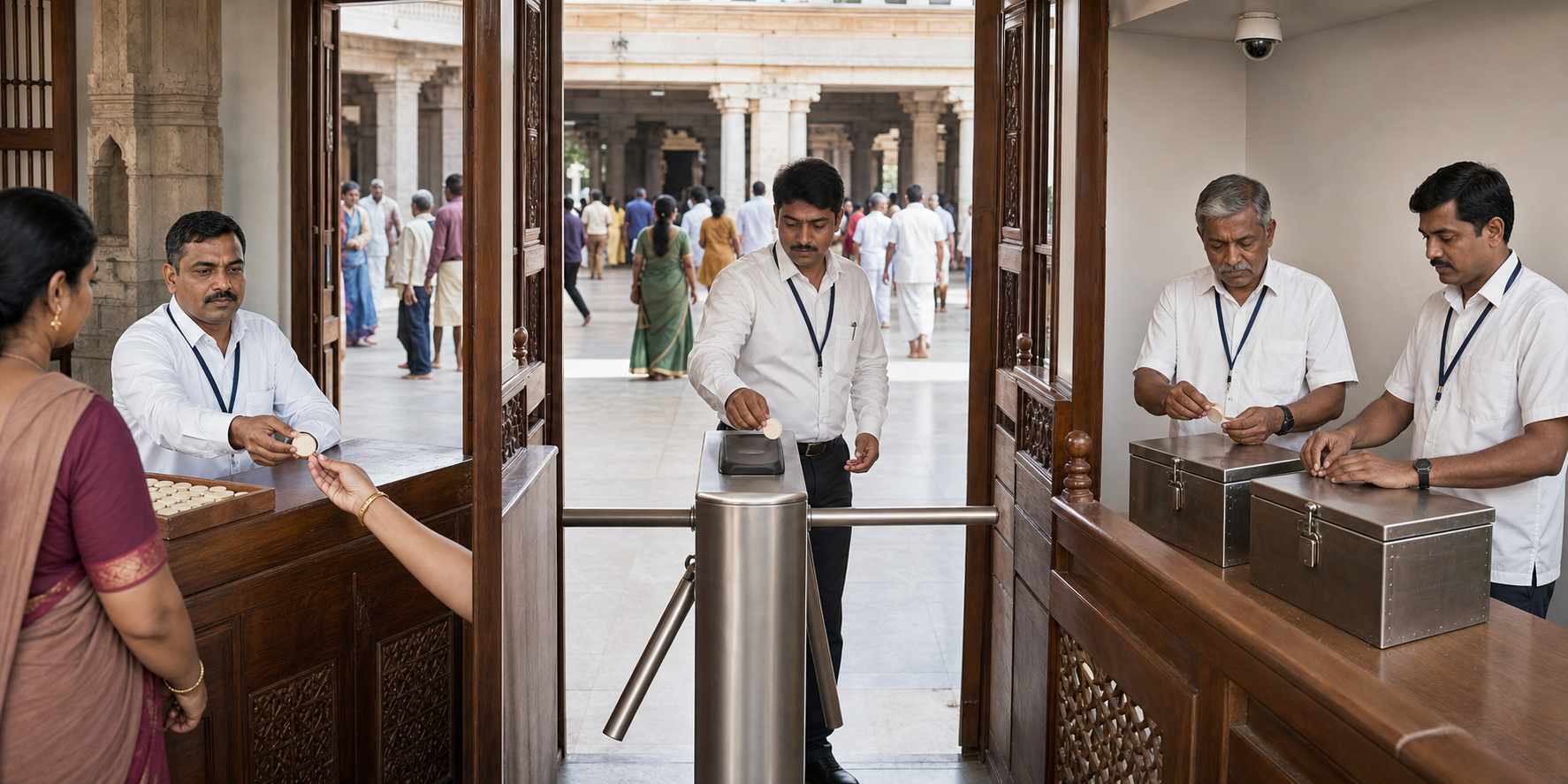
Technology cannot protect a queue if one person can create a slot, approve it, wave the holder through, and later certify the records as correct. The most important internal control is separation of duties.
- The allocation team configures inventory and releases slots but does not validate entry at the gate.
- The gate team scans valid passes but cannot create or edit bookings.
- The reconciliation team compares allocations with actual entries but cannot alter the original logs.
- Trustees review policies, exceptions, audit findings, and performance summaries but do not distribute personal passes outside the system.
Access permissions should follow job roles, not seniority or informal influence. Every manual override should record the operator, time, reason, approving authority, and affected slot. Credentials should belong to individuals rather than being shared by a counter or department; otherwise, investigators cannot tell who performed an action.
Annual third-party audits are useful, but a financial audit alone may not reveal queue manipulation. An access audit should examine booking logs, manual overrides, quota usage, scanner records, CCTV-supported crowd flow, reconciliations, and grievance outcomes. Surprise checks matter because a process observed only on a scheduled audit day may not resemble routine operations.
In Maharashtra, the Maharashtra Public Trusts Act, 1950 places temple trusts within a framework of fiduciary responsibility, financial transparency, and adherence to their religious and charitable purposes. Legal compliance is the floor. A dharmic institution should also be able to show devotees that trustees and staff are held to a clear code of conduct, supported by a published sanctions matrix for proven misconduct.
A protected whistleblower channel should sit outside the immediate reporting line of the person being reported. Staff, priests, volunteers, vendors, and devotees need a way to submit evidence without sending it back to the same local official whose conduct may be in question. Complaints should receive a tracking number, defined ownership, and a recorded resolution.
When an incident is detected, the first institutional duty is to preserve evidence: booking records, payment trails, access logs, relevant messages, and CCTV footage. The trust should cooperate with investigators, communicate verified facts without declaring guilt prematurely, and disclose the corrective controls adopted after the review. A defensive public-relations response cannot substitute for an operational repair.
What you can do when planning darshan or facing a tout
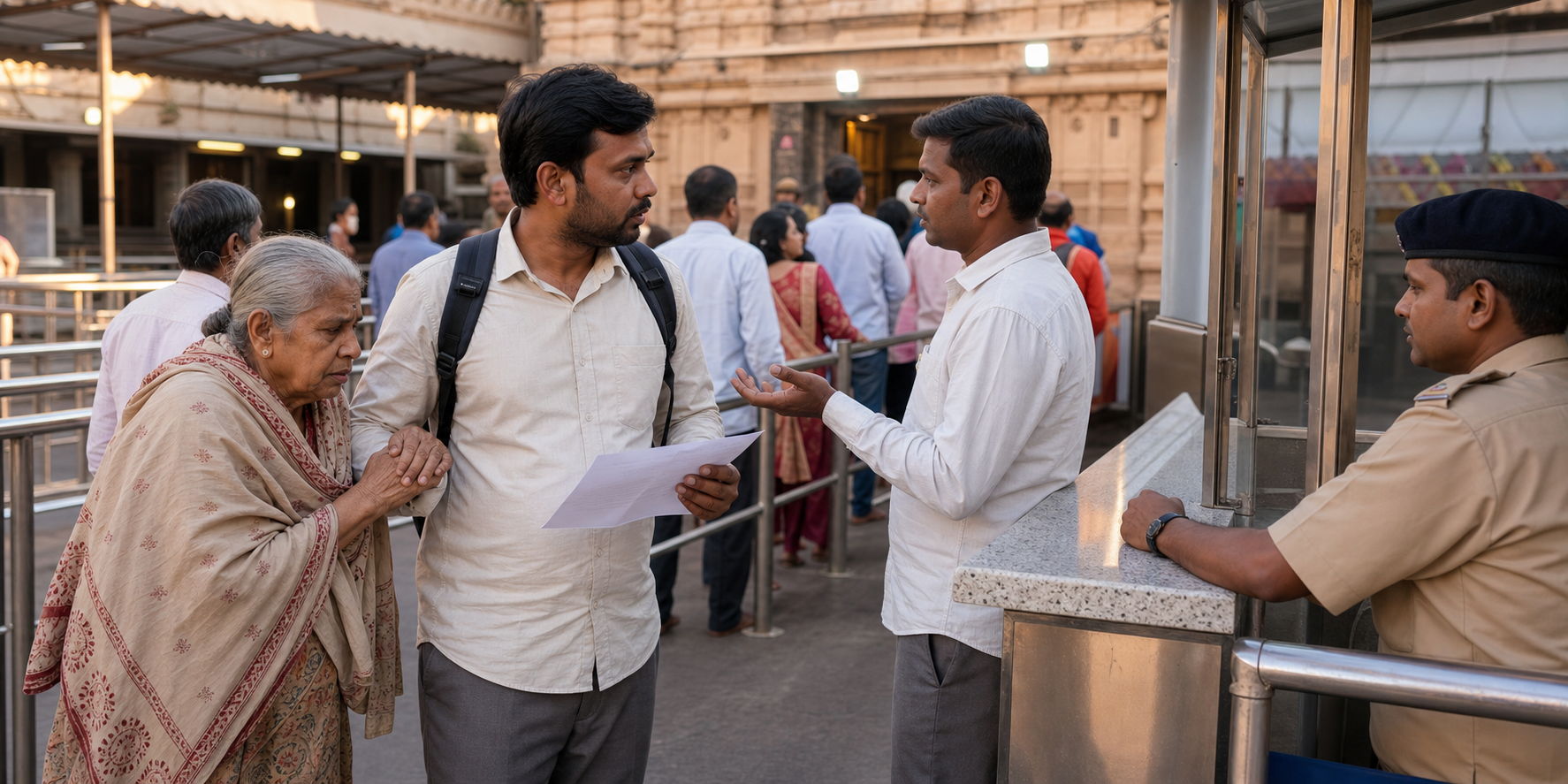
You cannot redesign a temple’s governance from the queue, but you can reduce your exposure and create a usable record when something is wrong.
- Verify before travelling. Find the temple’s stated booking channels, access categories, fees, identification requirements, cancellation rules, and helpdesk details. Save the relevant confirmation or screenshot because instructions may be difficult to locate once you reach a crowded entrance.
- Arrange assistance in advance. If you are travelling with a senior citizen, a person with a disability, a child, or anyone who cannot tolerate a long queue, identify the published assistance route before arrival. Do not assume that the only alternative will be an improvised payment at the gate.
- Inspect the transaction. A legitimate pass should identify the official issuer, date or time window, access category, and verification method. A uniform, lanyard, religious role, or political connection does not by itself prove that a person is authorized to sell access.
- Ask one direct question. If someone offers faster entry, ask where the option is publicly listed and whether you will receive an official receipt. If the route cannot be found in the published rules and the payment would go to an individual, decline it.
- Protect your information. Do not surrender an original identity document, share a one-time payment code, or send money to a personal account merely because someone promises entry.
- Report facts, not conclusions. Record the date, approximate time, location, amount requested, exact promise, phone number or payment details, and any receipt or message. Use the official helpdesk, grievance channel, on-site security, or law-enforcement channel appropriate to the situation. Do not create a confrontation in a dense crowd.
- Keep the case number. A complaint without an acknowledgement can disappear. Retain the tracking number and any evidence you submitted so that you can follow up through the proper channel.
If you have already paid, preserve the receipt, message, transaction record, or pass rather than deleting it out of embarrassment. Those details may reveal how the scheme operated. Describe what happened without publicly declaring an individual guilty on the basis of appearance, hearsay, or an unverified name; a false accusation can harm an innocent person and weaken a legitimate inquiry.
Temple managers should treat these reports as operational intelligence, not merely public-relations complaints. Repeated references to the same gate, time window, payment account, device, or type of promise can reveal a control failure before it becomes a larger scandal.
The dharmic standard can be measured
Satya requires that the published rules describe the real system. Ahimsa requires crowd management that does not make vulnerability a source of profit. Dharma requires office-holders to treat authority as a responsibility held in trust, not as private inventory that can be traded.
This is why access governance is not a merely administrative concern. A family may save for the journey, travel a long distance, and accept physical discomfort as part of pilgrimage. Learning that another person bought a secret advantage does more than waste money or time. It damages confidence that the sacred institution will receive devotees with equal dignity.
Key takeaways
- Every legitimate route to darshan should be published before the devotee reaches the gate.
- Accessibility assistance must be governed by objective rules and kept distinct from patronage or purchasable influence.
- All bookings, cancellations, quotas, and manual exceptions should enter one real-time, auditable inventory.
- Allocation, gate validation, and reconciliation should be performed by separate roles.
- Aggregated booking and quota data should be public without exposing devotees’ personal information.
- Complaints and whistleblower reports need protected channels, tracking numbers, preserved evidence, and documented outcomes.
If you govern a temple, begin by tracing one slot from release to booking, gate scan, reconciliation, and dashboard disclosure. Any point where the record depends on a private message, shared credential, verbal approval, or unexplained override is a reform priority. If you represent devotees, ask for three concrete things: a public map of every access route, aggregate quota reporting, and a grievance system that produces a trackable response.
The goal is not to remove hospitality, assistance, or human judgment from pilgrimage. It is to ensure that help never requires influence, convenience never conceals exploitation, and no broker can sell what a sacred institution is duty-bound to govern fairly.