
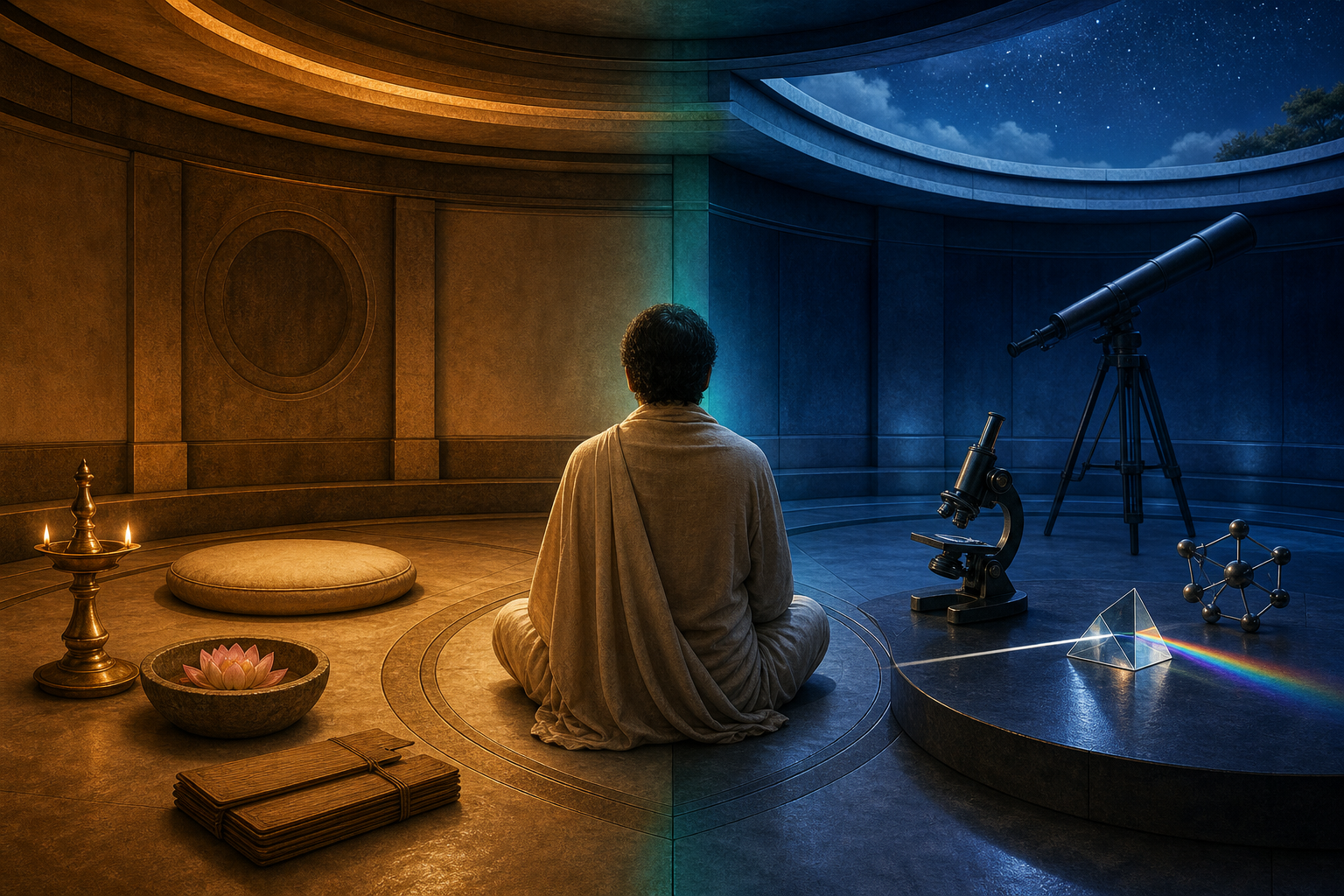
You may be trying to decide whether modern science has made the soul, karma or divine agency intellectually untenable. Or perhaps you are uneasy with the opposite claim: that quantum physics has already proved what the rishis knew. Neither conclusion is careful enough to trust.
You do not have to choose between respect for scientific evidence and confidence in Dharma. You do have to distinguish what an experiment observes, what a philosophy infers and what a spiritual discipline asks you to verify through practice. Once those questions are separated, the real agreements and disagreements become much easier to see.
Start by separating evidence, metaphysics and practice

Science investigates measurable patterns. It asks what happens under specified conditions, whether the result can be detected and whether other investigators can examine it. Metaphysics asks a different question: what kinds of things, properties and causes must exist for reality to be as it is? A Dharmic path adds a third question: what must you understand and practise to reduce bondage, ignorance, ego or suffering?
Confusion begins when an answer at one level is treated as an automatic answer at every level. General anaesthesia can interrupt ordinary conscious experience, cerebral injury can damage language or memory, and drugs can alter mood, attention and perception. Those observations make one point unavoidable: human experience is deeply dependent on the condition of the embodied nervous system.
Dependence, however, is not the same proposition as identity. The evidence does not by itself decide whether consciousness is identical to neural activity, produced by it, expressed through it or irreducible while still depending on it during embodied life. The first two are materialist interpretations. The latter possibilities belong to non-reductive or dual-aspect approaches, including several Dharmic accounts. Each requires arguments beyond the bare observation that brain and experience change together.
The same discipline must be applied in the other direction. A profound meditation, a remembered mantra or an experience of unity may transform your life. Its personal force does not, by itself, establish a public theory of cosmology or neurobiology. First-person experience is evidence about experience. Moving from that experience to a claim about the ultimate structure of reality requires an additional philosophical step.
This is also why methodological naturalism should not be confused with metaphysical naturalism. A laboratory normally restricts itself to causes that can be operationally defined and publicly tested. That rule makes scientific inquiry workable. The further claim that only scientifically measurable causes can exist is a philosophical conclusion, not a reading delivered directly by an instrument.
When you encounter a dramatic claim about Dharma and science, divide it into three sentences. Write down the observation, the metaphysical interpretation and the practical implication separately. If the observation is sound but the interpretation does not follow, retain the evidence and reject the overreach. If a practice is beneficial but its cosmic explanation remains untested, you can acknowledge the benefit without pretending that every metaphysical question has been settled.
Dharma does not offer one uniform theory of the self
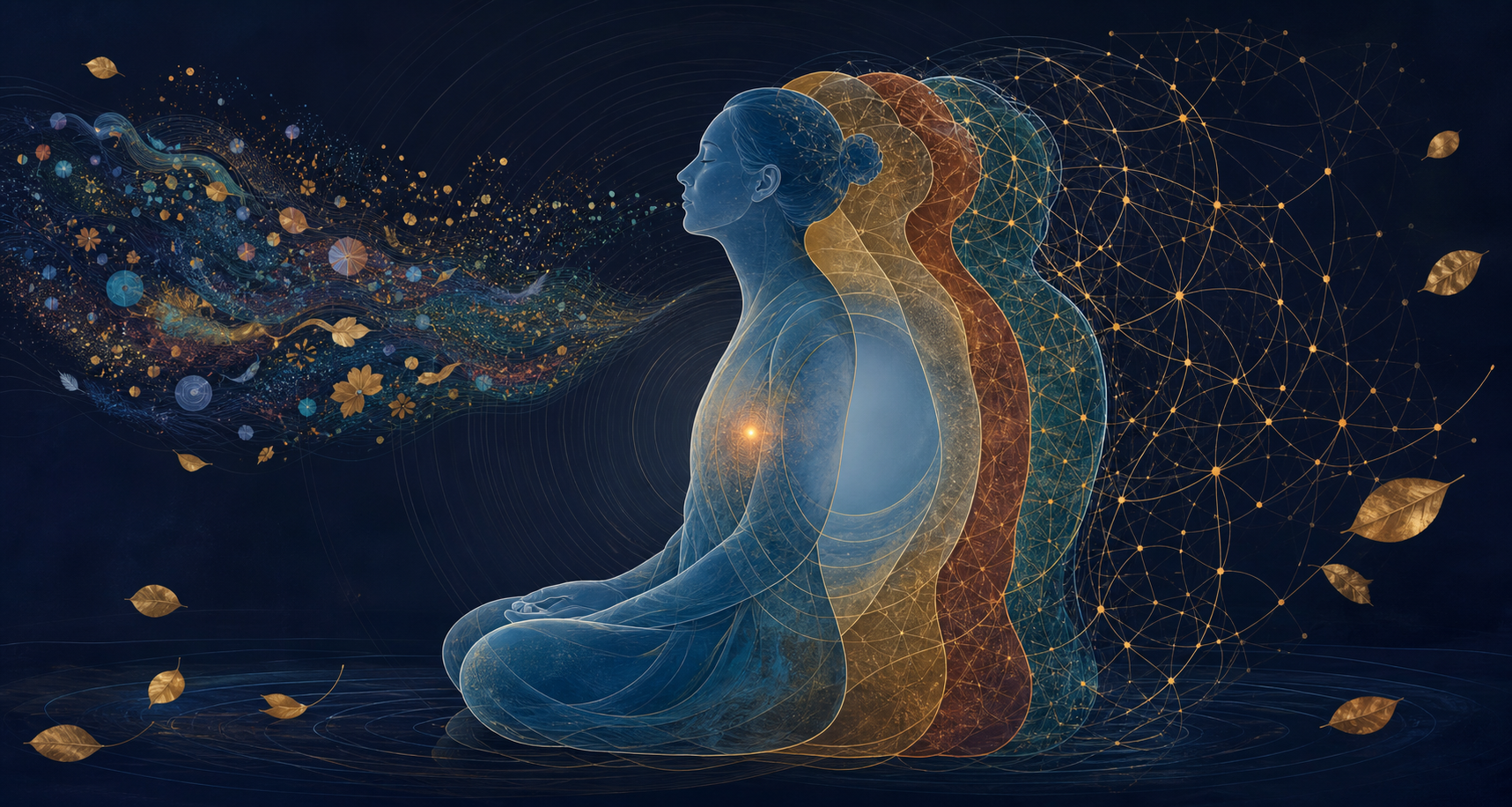
The expression “Dharmic metaphysics” names a family of conversations, not a single creed. Hindu, Buddhist, Jain and Sikh traditions share disciplined attention to mind, conduct and liberation, but they do not give interchangeable answers about the self. Even within Hindu traditions, the relation among consciousness, mind, matter and the Divine is interpreted through distinct schools.
| Dharmic framework | Account of personhood | What conditions ordinary experience | Question to carry into dialogue with science |
|---|---|---|---|
| Vaishnava Sāṅkhya | The conscious jīva or puruṣa is distinct from prakṛti. | Mind, intelligence, ego, senses, body, guṇas, karma and time participate in embodied life. | Can consciousness use an embodied system without being reducible to that system? |
| Buddhist analysis | No permanent, independent self is found among the five conditioned aggregates. | Form, feeling, perception, formations and consciousness arise through dependent conditions. | How is the experienced self constructed and maintained as a process? |
| Jain metaphysics | Jīva is distinguished from ajīva. | Karmic bondage conditions the soul’s cognition and conduct. | How should moral intention and disciplined restraint enter an account of mind? |
| Sikh thought | Embodied life is oriented toward Ik Oṅkār rather than an isolated, self-sufficient ego. | Haumai obscures right perception; simran, seva and community reshape life. | How do remembrance, meaning and participation affect an embodied person? |
Vaishnava Sāṅkhya makes an especially useful distinction for the modern mind-body debate. It enumerates twenty-four material principles, including cosmic intelligence, ego-function, subtle and gross elements, mind and the sensory and motor faculties. Details of enumeration can vary, including how buddhi relates to mahat, but the central point is clear: mind is subtle matter within prakṛti. Mind is not simply another name for the conscious self.
That distinction corrects a common mistranslation. Calling manas or buddhi “non-physical” in ordinary English can make them sound identical to pure consciousness. They are not identical within this framework. Manas coordinates sensory and mental activity, buddhi discriminates, and ahaṅkāra generates the appropriating sense of “I” and “mine” within conditioned existence. The jīva is the conscious principle associated with experience, while a subtle body mediates memory, desire and intention through the gross body.
Theistic Sāṅkhya adds Paramātmā, kāla, svabhāva and karma to this layered picture. Paramātmā names divine immanence within beings; kāla conditions transformation; svabhāva concerns dispositional nature; and karma connects morally charged action with consequence. These are metaphysical categories. They may guide the interpretation of experience, but they should not be presented as if a microscope had detected a jīva or a brain scan had measured karma.
Buddhism prevents a different mistake. Anātman does not merely replace a Western soul with a subtler hidden soul. The five-skandha analysis examines the person as conditioned form, feeling, perception, formations and consciousness. Jainism, by contrast, explicitly distinguishes jīva from ajīva and describes karmic bondage in relation to the soul. Sikh teaching locates embodied life within the unity of Ik Oṅkār and treats haumai, remembrance and service as central to transformation. These differences coexist with shared commitments to disciplined attention and ethical formation; they should not be erased to manufacture an artificial consensus.
Before comparing any Dharmic claim with science, therefore, name the tradition, school and technical term. “Does science refute the Hindu mind?” is too vague to answer. “Does neural dependence contradict the Vaishnava distinction between subtle mind and conscious jīva?” is a real philosophical question. Precision is not a concession to scepticism. It is how a serious tradition avoids being reduced to slogans.
Layered causation leaves no need for a God of the gaps

A.C. Bhaktivedanta Swami Prabhupada’s description of the material universe as “complete in itself” carries an important implication. Material processes can possess their own stable order and be investigated on their own terms. Divine dependence does not require a missing physical mechanism into which God must be inserted.
Consider the simple act of raising your hand to serve another person. Physiology can describe neural signalling, muscular contraction and bodily movement. Psychology can examine attention, memory and intention. Ethics can ask whether the act is generous, manipulative or careless. A Vaishnava account can place it within the agency of the jīva, the conditioning of karma and the sanction of Paramātmā. These descriptions do not automatically compete because they are not all answering the same question.
Yet it would be equally careless to declare that every level adds a separate force. Higher-level causation can sometimes mean that the organisation of a system constrains what its parts do. The form of an organism, the rules of a language or the purpose of a planned action can explain patterns without introducing an extra measurable push alongside physical forces. If someone claims that a subtle or divine cause produces a specific physical deviation, however, that more concrete claim needs corresponding evidence. “Different level of explanation” cannot be used as a shield against every possible test.
The language of physical causal closure also needs care. Science searches for physically describable conditions of physical events, and that method has immense explanatory success. The metaphysical assertion that every physical event has a wholly sufficient physical cause, with no room for any other kind of agency, goes beyond the mere practice of seeking mechanisms. Dharmic philosophers can contest that assertion, but they still owe a coherent account of how intention relates to embodied action.
Vaishnava Sāṅkhya supplies such an account through the subtle body: intention, memory and desire are mediated through manas, buddhi and ahaṅkāra into gross embodiment. This is a metaphysical model of the interface, not an established neuroscientific mechanism. Its value is conceptual: it refuses both the idea that consciousness is a late, powerless by-product and the idea that embodied causation can be ignored.
Karma introduces another level, but it must not be confused with a familiar physical force. Karma is a moral-causal order linking intention, action and consequence across time. A physical equation describes measurable quantities; karma interprets responsible agency within a larger moral ecology. Calling both “law” does not make them the same kind of law, and no responsible dialogue should pretend otherwise.
The same caution applies to the guṇas. Sattva, rajas and tamas describe patterned dispositions and transformations within prakṛti. They are not alternative names for particles, fields or the phases of matter. An analogy between stable guṇa-patterns and law-like regularity can illuminate the intelligibility of nature. An asserted one-to-one identity with a modern scientific quantity would require evidence that this metaphysical vocabulary does not itself provide.
Divine action can then be understood without waiting for physics to fail. Paramātmā is conceived as immanent, while Bhagavān remains transcendent; finite causes retain their integrity under divine sustenance and guidance. Within that theology, an extraordinary event need not be an ontological tear in nature. It may be interpreted as an atypical alignment of divine will, karmic trajectories and material conditions within a coherent order. This layered account preserves both regularity and agency, but it does not turn a theological interpretation of a miracle into a laboratory result.
Quantum indeterminacy should be handled with the same restraint. An indeterminate physical model may leave more than one outcome open, but openness is not evidence of a chooser, a purpose or a divine intention. A theology may ask whether divine agency works through lawful possibilities. It cannot simply announce that quantum mechanics has detected God. Dharma gains nothing when scientific uncertainty is treated as vacant territory waiting for a spiritual label.
Consciousness is the meeting point, not a settled victory

Modern consciousness research has moved far beyond the image of a person as a collection of independent mechanical parts. Global Neuronal Workspace theories focus on the widespread availability of information; Integrated Information Theory focuses on integration; predictive-processing approaches examine hierarchical prediction; and enactivism stresses the dynamic relation among brain, body and environment. These approaches offer different accounts rather than one settled doctrine.
They also do not dissolve the central philosophical difficulty. Neural correlates can show when particular reports, perceptions or capacities appear. They do not yet explain, to everyone’s satisfaction, why some physical processes are accompanied by felt experience at all. The multiplication of neural correlations has therefore not closed the hard problem of consciousness.
This open problem creates legitimate space for Dharmic philosophy, but not an automatic victory for any one school. Vaishnava thought can argue that consciousness belongs to the jīva rather than matter. Buddhist analysis can question whether the apparent owner of experience is anything more than conditioned aggregates. Jainism can defend the reality of jīva and its karmic bondage. Sikh practice can examine how haumai distorts an embodied life oriented toward the Divine. The scientific difficulty is an invitation to careful comparison, not proof that one of these positions has already won.
What contemplative evidence can and cannot establish
Dharmic traditions contribute more than speculative propositions. They preserve repeatable disciplines of attention, breath, ethical restraint, remembrance, ritual and service. Neurophenomenology pairs carefully described first-person experience with brain and bodily measurement, while contemplative research examines changes in attention, affect, behaviour and large-scale neural activity. Meditation, Yoga-based movement and prāṇāyāma can produce measurable psychophysiological effects.
Those effects matter, but efficacy and ontology are different claims. If meditation steadies attention, that result is compatible with materialism, non-reductive accounts and several Dharmic metaphysics. Neural plasticity following practice shows that disciplined intention participates in changing an embodied system. It does not, on its own, prove an eternal self, no-self, karmic matter or divine immanence.
You can make personal inquiry more honest by defining the intended effect before beginning a practice. Are you examining attention, reactivity, compassion, remembrance or a claim about ultimate identity? Keep a consistent practice, record the relevant change and avoid rewriting the goal after the result appears. This will not turn private practice into a controlled trial, but it will help you distinguish observation from expectation and interpretation.
If you use meditation, breath regulation or Yoga in relation to anxiety, depression or another health concern, treat the practice as supportive rather than as a substitute for qualified medical or psychological care. Intensity and method should be adapted to the person’s condition, capacity, culture and consent. A spiritual explanation should never become a reason to ignore serious symptoms or stop treatment without professional guidance.
Replace four familiar slogans with defensible claims
“Neuroscience has disproved the soul” is too strong. A defensible statement is that conscious capacities are tightly dependent on brain and body during embodied life, and any account of the self must explain that dependence.
“Meditation proves Dharmic metaphysics” is too strong. A defensible statement is that disciplined contemplative practice can alter experience, behaviour and measurable bodily processes, while the metaphysical interpretation remains a further question.
“Quantum physics confirms the rishis” is too strong. A defensible statement is that modern physics challenges some everyday intuitions about matter and causation, but resemblance between two vocabularies is not evidence that their concepts are identical.
“All Dharmic religions teach the same truth” is too strong. A defensible statement is that Hindu, Buddhist, Jain and Sikh traditions share serious disciplines of ethical and contemplative transformation while maintaining substantial differences about selfhood, matter, karma and the Divine.
Key takeaways for evaluating a Dharma-and-science claim
- Classify the claim. Decide whether it is an empirical observation, a metaphysical interpretation, an ethical judgement or a practical instruction. Do not let evidence for one category silently stand in for all four.
- Name the actual tradition. Replace “Dharma says” with the school, text and technical term involved. Vaishnava jīva, Buddhist anātman, Jain jīva and Sikh haumai should not be blended into a generic spiritual self.
- State the strongest evidence and its limit. Brain-experience correlations establish embodied dependence. They do not alone establish materialist identity, and contemplative effects do not alone establish a cosmic doctrine.
- Keep analogy distinct from equivalence. Guṇas are not particles, karma is not a physical force, prāṇa should not be casually equated with scientific energy, and quantum indeterminacy is not evidence of divine selection.
- Ask what would count against the claim. A statement protected from every possible observation may still have religious or philosophical meaning, but it should not be advertised as an experimentally confirmed result.
- Preserve the purpose of practice. Dharmic disciplines are directed toward transformation of attention, conduct, attachment, ego and suffering. Their value is diminished, not enhanced, when they are marketed as premature scientific triumphs.
Begin with one sentence you currently believe about consciousness, karma, meditation or divine action. Rewrite it so that the observation, philosophical inference and Dharmic commitment are visible as separate parts. That small act of intellectual tapas makes the claim harder to misuse and more worthy of serious engagement. Dharma does not need gaps in knowledge or inflated analogies. It can meet science most confidently through precise terms, honest limits, disciplined practice and a refusal to confuse explanation with ultimacy.
References
- Dandavats – Bridging God and Science: Vaishnava Sāṅkhya’s Insights for Christian Theologies of Nature
- Dandavats – Beyond ‘Man a Machine’: La Mettrie, Mind-Body Science, and Dharmic Wisdom on the Soul
