
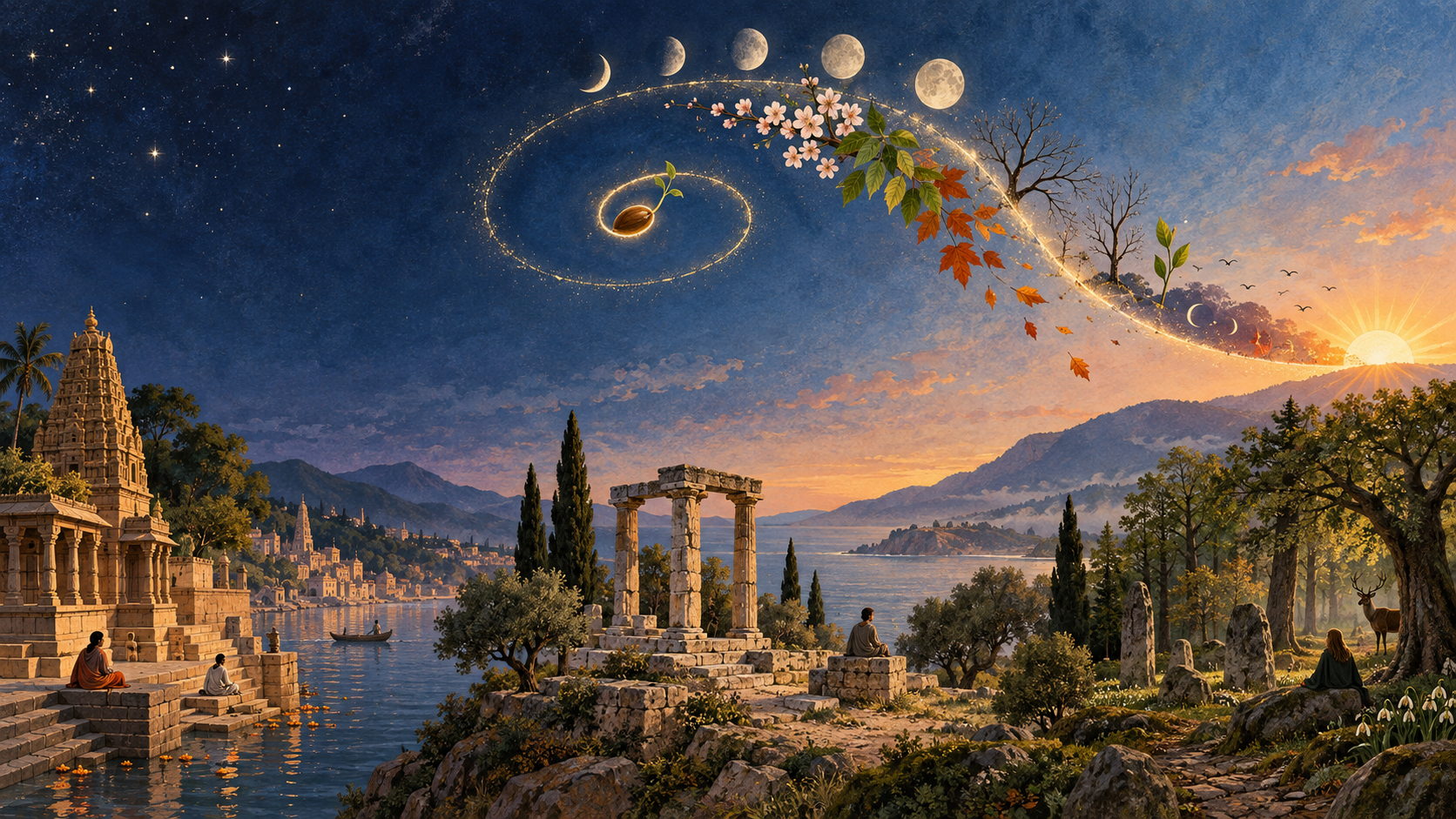
If you were taught to picture time as an arrow, cyclical time can be easy to misread. It may sound as though history goes nowhere, every event repeats exactly, or individual choices cannot change anything. None of those conclusions follows merely from the image of a cycle.
A better approach is to ask what returns, what changes, and what survives the turning. That gives you a practical way to read Hindu and pagan accounts of cosmic, seasonal, and human renewal without flattening distinct traditions into a single theory.
Begin with the cycle, not with a timeline
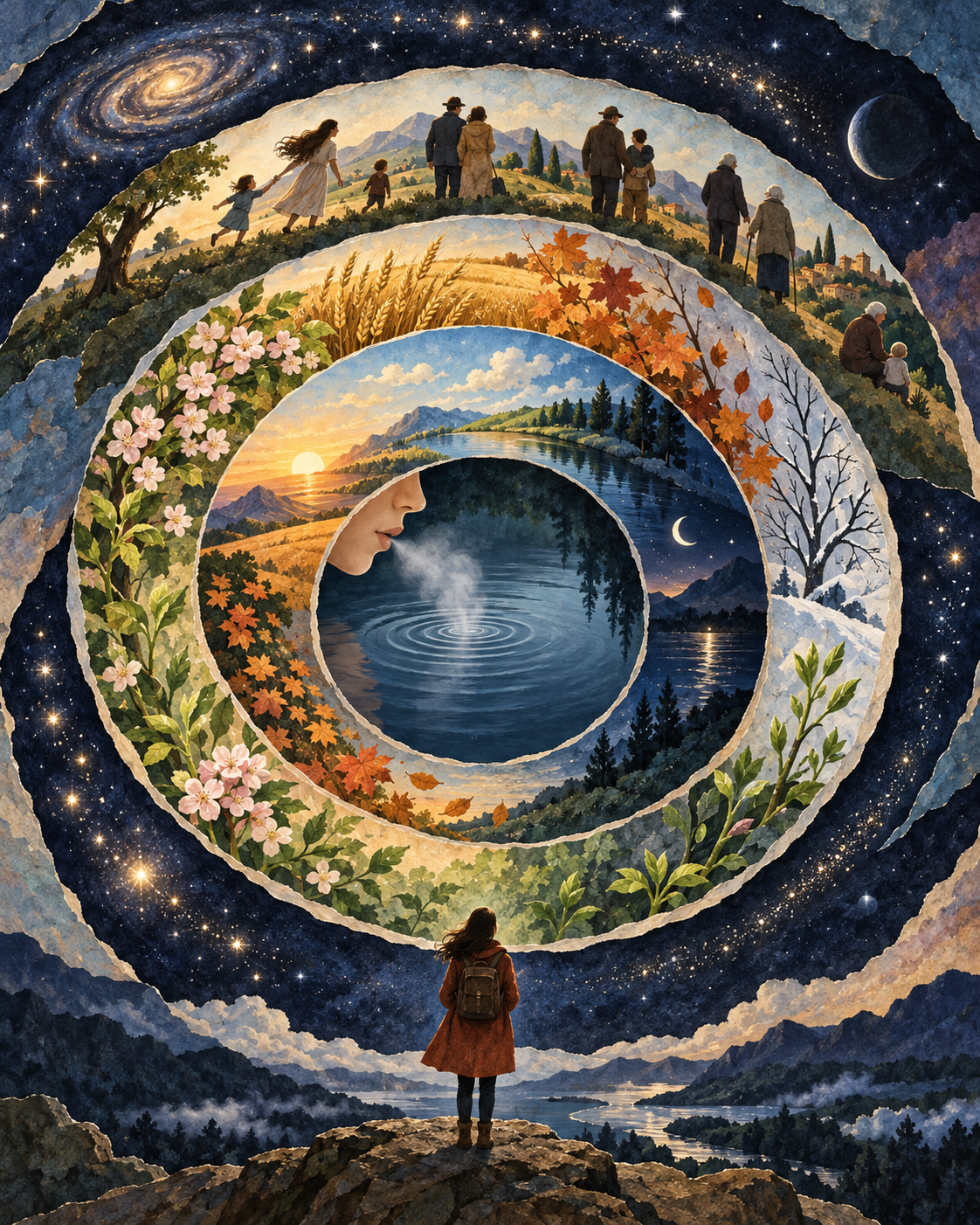
A linear picture arranges events between a beginning and a final conclusion. A cyclical picture makes another possibility visible: an ending can become the condition for a new beginning. The universe is therefore understood through recurring movements rather than through one irreversible cosmic sequence.
The simplest working model contains creation, preservation, destruction, and renewal. Treat these as functions within a cycle, not as four isolated events:
- Creation gives form to what was absent, latent, or unorganised. Ask what kind of order is coming into being.
- Preservation sustains that order. Ask which relationships, duties, boundaries, or conditions keep it viable.
- Destruction ends or dissolves an established form. Ask precisely what is ending rather than assuming that everything disappears.
- Renewal opens another phase of becoming. Ask what the new beginning carries forward and what it does not restore.
This is why a cycle is not necessarily a perfect circle. A recognisable phase may return without reproducing every previous event. Dawn returns, but it is not yesterday’s dawn. A season returns, but the field, the people tending it, and the consequences of earlier choices may all be different. When you encounter a cyclical account, do not ask only, “Where does it start?” Ask, “What makes transition possible?”
Similarity does not make Hindu and pagan traditions interchangeable
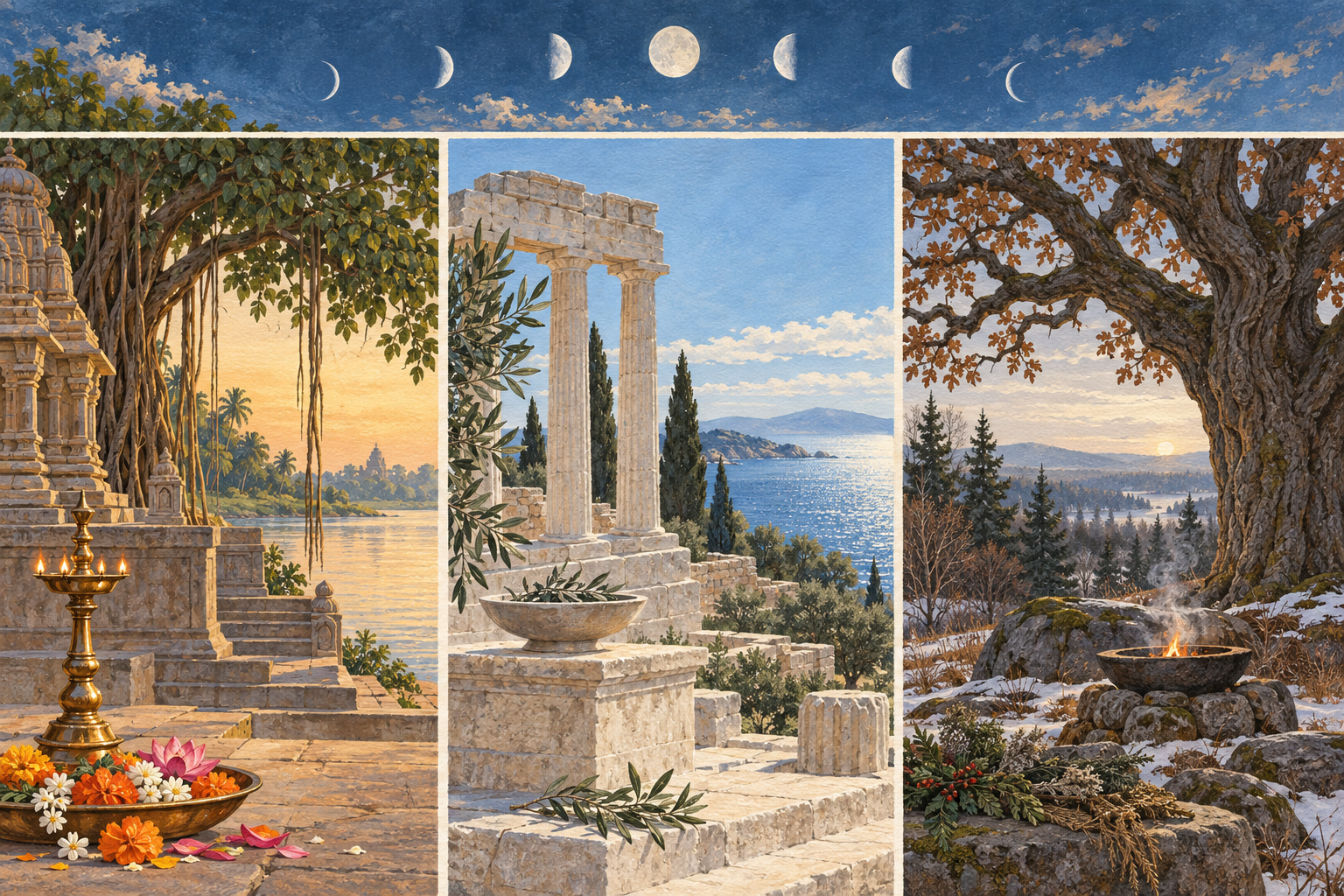
“Pagan” is a broad umbrella, not the name of one creed with a universal doctrine. Hindu thought is also internally diverse. A shared cyclical structure can reveal a meaningful family resemblance, but it does not prove that every tradition has the same gods, metaphysics, rituals, moral teachings, or account of liberation.
This distinction matters because comparison can go wrong in two directions. You can overlook a real similarity because the names and symbols differ, or you can notice one similarity and declare the traditions identical. The first approach prevents understanding; the second manufactures agreement.
When you compare two accounts of cyclical time, test the resemblance with five questions:
- Scale: Is the cycle cosmic, seasonal, social, ritual, personal, or some combination of these?
- Agency: Does the transition occur through divine action, an impersonal order, human participation, or several of these at once?
- Continuity: What crosses the boundary between the ending phase and the next beginning?
- Purpose: Is the cycle meant to explain the universe, orient communal practice, guide conduct, or illuminate spiritual life?
- Exit or participation: Is the human aim to live rightly within recurring processes, to become free from a particular cycle, or to understand the cycle from another standpoint?
If the answers differ, keep the differences. “Both are cyclical” should begin the comparison, not conclude it. It is also not evidence, by itself, that one tradition borrowed from another or that both descend from a single historical system.
Read a cyclical account in five passes

You do not need a complete map of comparative religion before you can read carefully. Use the following sequence whenever a myth, teaching, festival, or philosophical discussion presents time as recurring.
- Name the scale. Write down what is actually cycling. Do not move casually from a seasonal pattern to a claim about the entire universe, or from cosmic dissolution to a prediction about your private life.
- Mark the transitions. Identify where formation becomes maintenance, where maintenance fails or completes its work, and where an ending creates the conditions for renewal. The turning points usually reveal more than the labels do.
- Look for the carrier of continuity. Something may connect successive phases: order, memory, consequence, possibility, identity, or a sacred principle. Name only what the account itself permits you to name.
- Separate return from duplication. Ask whether the next phase repeats a pattern, restores a former state, or produces a genuinely new expression. These are different claims.
- Find the demand on the participant. Determine whether the cycle asks people to observe, remember, preserve, relinquish, celebrate, act, or seek freedom. This is where cosmology becomes lived orientation.
A compact reading note can therefore fit on one page: “What cycles? What ends? What remains? What returns? What must a person do?” If you cannot answer one of those questions, leave the space blank. An acknowledged gap is more useful than a confident addition the tradition never made.
Four common misreadings obscure the idea
“If time is cyclical, nothing matters”
Recurrence does not erase consequence. Even in an ordinary recurring process, the quality of one phase affects what becomes possible in the next. Preservation can succeed or fail; endings can leave different inheritances; renewal can begin under different conditions. Cyclical form alone therefore does not establish fatalism.
When someone uses a cosmic cycle to dismiss responsibility, ask for the missing step in the argument. How does recurrence supposedly make this action inconsequential? Unless the tradition supplies that connection, the conclusion has been imported rather than demonstrated.
“Destruction is automatically good”
Destruction may have a structural place in a cycle without becoming a moral permission slip. Explaining that forms end is not the same as praising every act that causes loss. Cosmic dissolution, the completion of a ritual phase, the end of a season, and deliberate harm are not interchangeable merely because all can be described with the language of endings.
Keep the scale visible. Never use a metaphysical pattern to excuse violence, neglect, or avoidable damage in human life.
“Renewal restores everything exactly as it was”
Renewal means that an ending is not necessarily absolute finality. It does not automatically promise the recovery of every lost form. If an account intends exact repetition, it must establish exact repetition; the word “cycle” cannot do that work on its own.
“A tradition must choose one kind of time”
Linear and cyclical descriptions answer different questions. A person’s life can move from birth toward death while days, seasons, observances, and generational patterns recur. A tradition can recognise irreversible events within a larger rhythm of renewal. Before declaring two accounts contradictory, check whether they are describing time at the same scale.
Put cyclical time to work without reducing it to a slogan
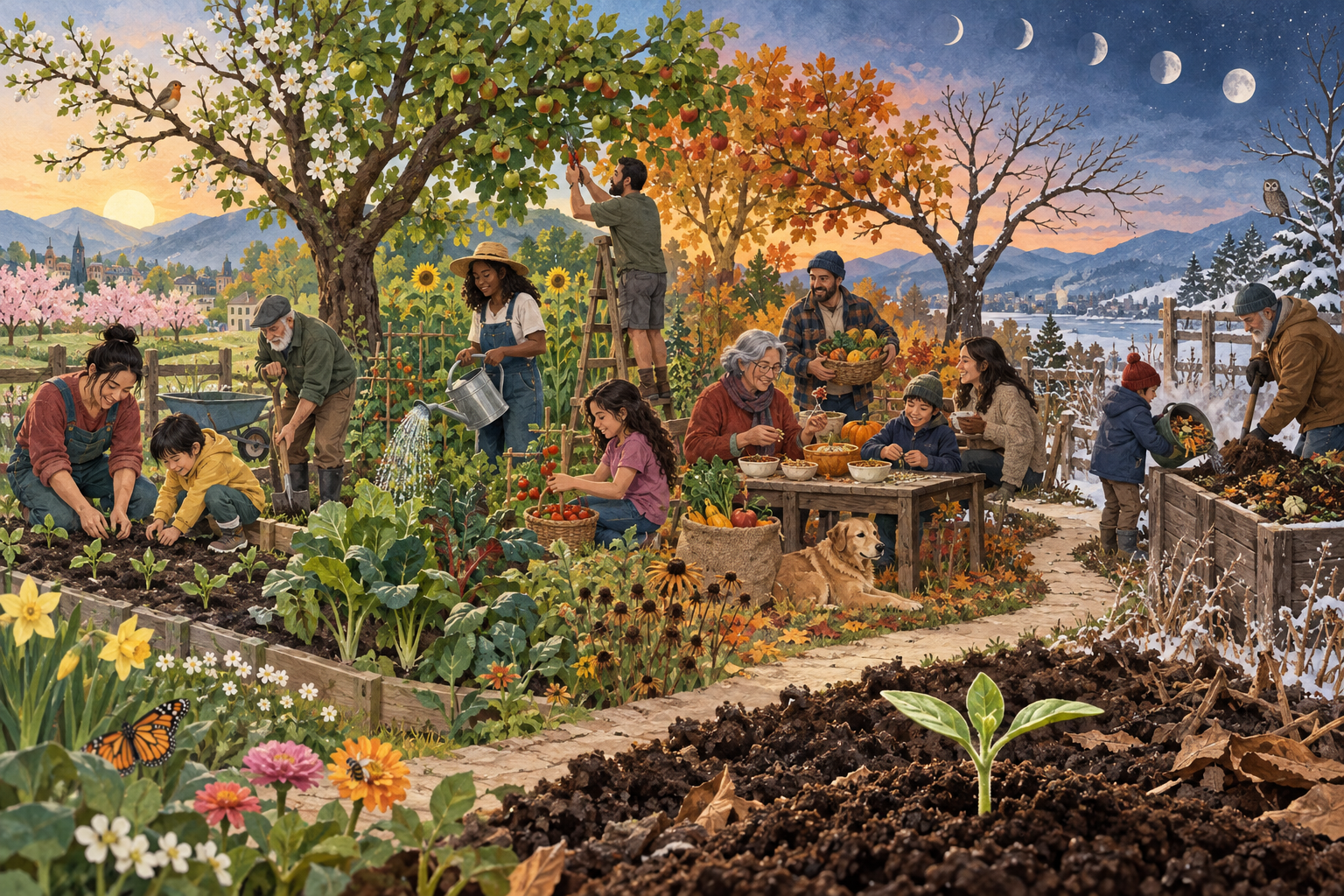
You can use the four movements as a discipline of attention. This does not turn your personal routine into proof of a cosmological teaching. It simply lets the pattern expose work that a progress-only mindset often misses.
- Creation: What are you actually beginning, and what form must it take before it can be sustained?
- Preservation: What requires regular care rather than another dramatic beginning?
- Ending: What has completed its purpose, and what would be damaged by keeping it artificially alive?
- Renewal: What can begin now because space, knowledge, or capacity has become available?
Use these questions at a natural turning point: the close of a project, a recurring observance, a seasonal change, or a deliberate period of reflection. Write one concrete answer under each heading. If all your answers concern beginnings, you may be neglecting maintenance and completion. If all concern destruction, you may be calling exhaustion a philosophy.
Do not impose renewal language on every painful loss. A cyclical worldview can help you recognise that change continues, but it does not require you to pretend that suffering is pleasant, deserved, or immediately meaningful. The practical lesson is readiness for transition, not compulsory optimism.
Key takeaways
- Cyclical time presents endings as phases within recurring processes of creation, preservation, destruction, and renewal.
- A returning pattern does not necessarily mean an exact replay of previous events.
- A shared cyclical structure does not make Hindu and pagan traditions doctrinally identical.
- Good comparison identifies the scale, agency, continuity, purpose, and human response in each account.
- Cyclical time does not, by itself, justify fatalism, harmful destruction, or the erasure of real loss.
The next time you meet the claim that a tradition sees time as cyclical, pause before accepting either a vague similarity or a sweeping conclusion. Write down what cycles, what ends, what continues, what returns, and what is asked of you. Those five answers will take you much closer to the living meaning of the idea.
References

Leave a Reply
You must be logged in to post a comment.