
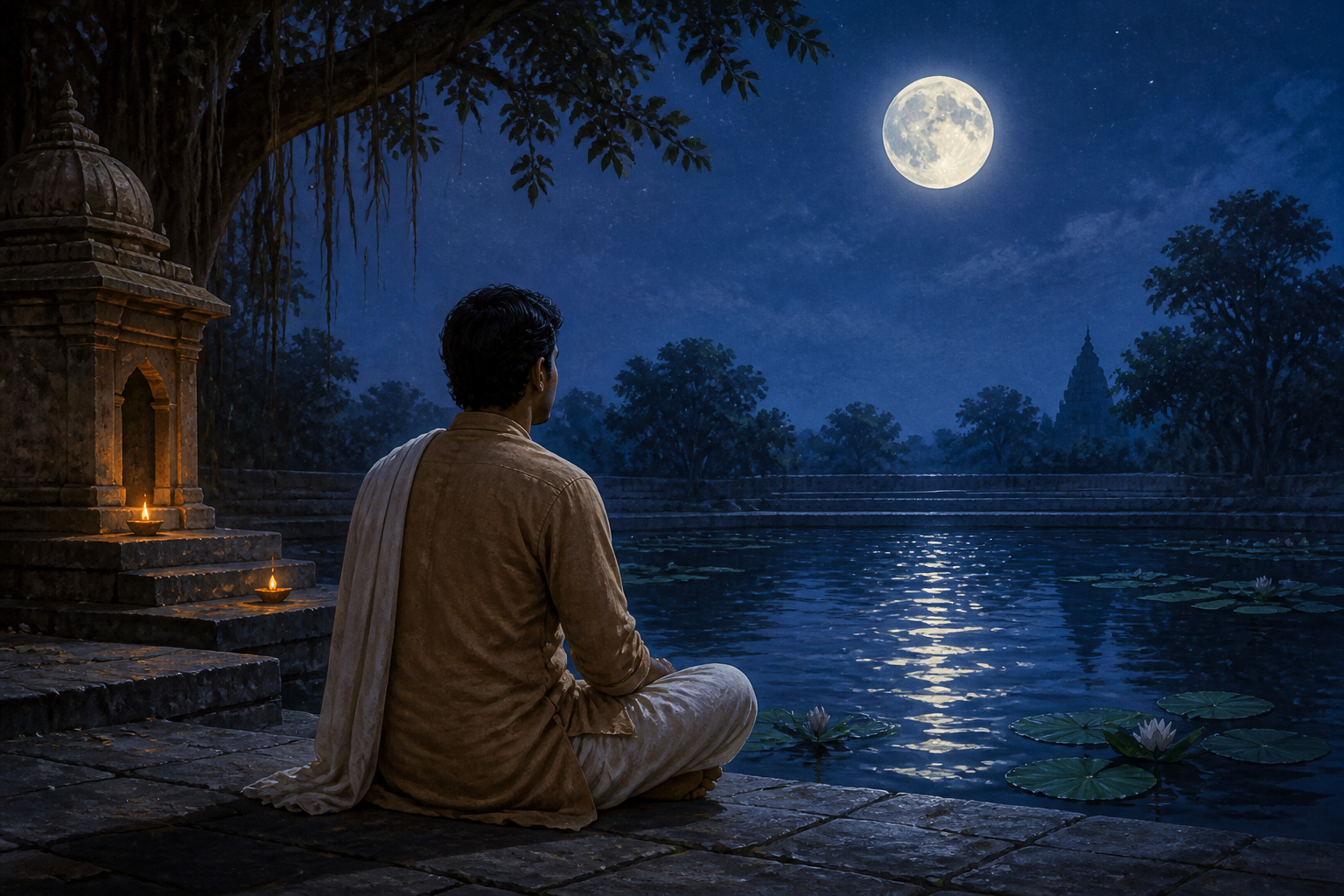
You notice a sharp change in mood, look at the Moon, and wonder whether Hinduism says Chandra caused it. The tempting answers are too simple: either dismiss the connection as superstition or hand responsibility for your inner life over to the sky.
Chandra offers a more useful way to think. The lunar image can help you notice that mental states change, separate a passing condition from a command, and return your conduct to dharma. You can honour the traditional connection without turning it into fate, an excuse, or a medical diagnosis.
What Chandra means when Hindus connect the Moon and mind
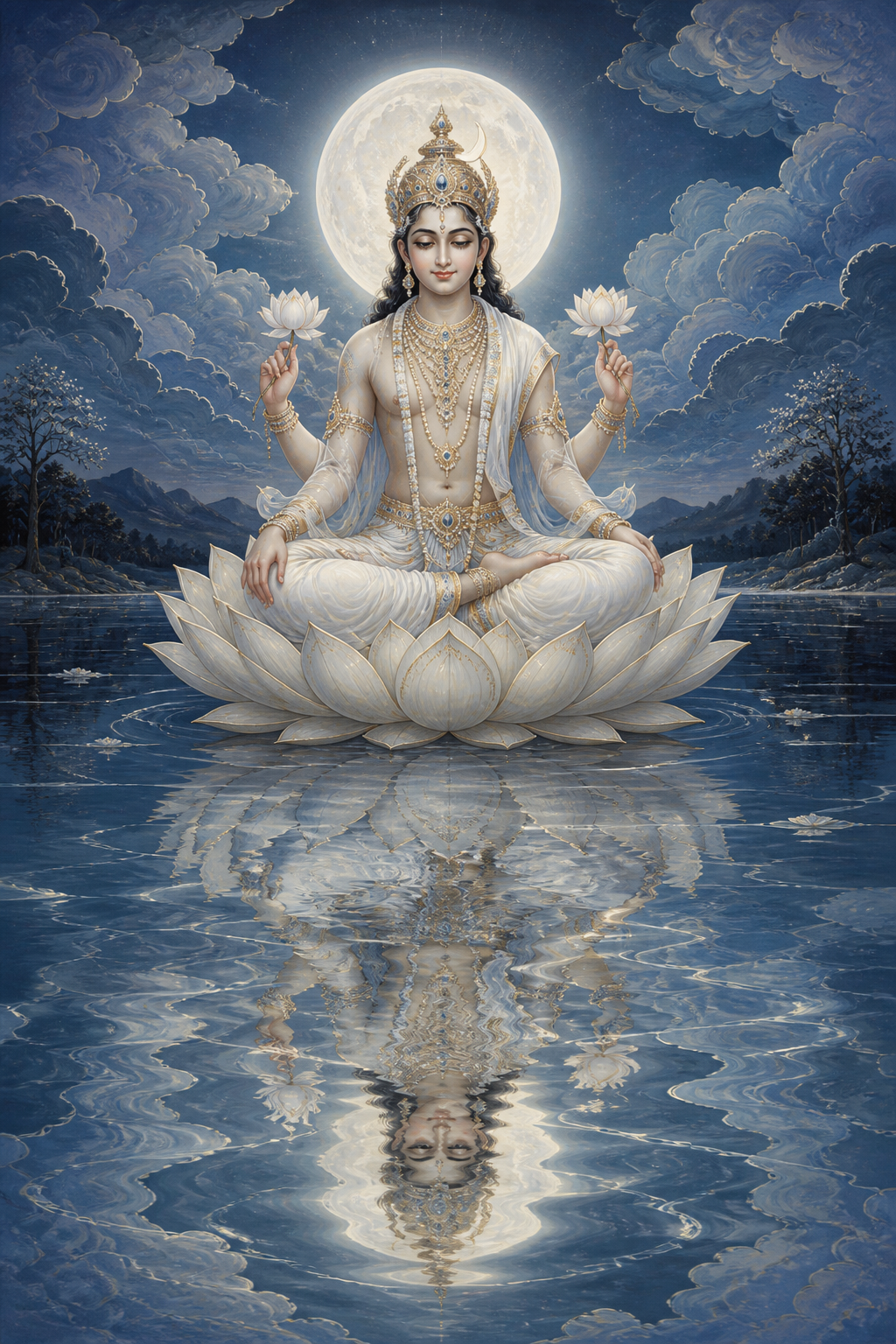
Chandra is not merely the physical Moon within Hindu thought. Chandra is also a deity and a graha. The Navagraha framework places nine celestial powers in relation to distinct domains of human life, with Chandra associated with the mind and changes of mood.
That association can appear at several levels, and confusion begins when those levels are treated as interchangeable:
- At the symbolic level, the changing appearance of the Moon gives you an image for the changeability of mental and emotional life.
- At the devotional and astrological level, Chandra is understood as a cosmic influence rather than as a decorative metaphor.
- At the personal level, the association invites you to observe your mind and govern your response more carefully.
Keep each claim at its proper level. Symbolic meaning is not laboratory proof of a biomedical mechanism. Devotion should not be reduced to psychology alone. A pattern in your own diary does not become a universal law simply because it feels convincing.
The lunar analogy is powerful because the change is visible. The Moon appears to wax, become full, wane, and recede into darkness, yet it does not become a different object every time its appearance changes. In the same way, a thought or mood may be genuine without being permanent. It may deserve attention without deserving obedience.
This distinction changes what you do. Instead of asking only, “Why do I feel this?”, ask, “What is this state asking me to notice, and which response remains mine to choose?” Chandra then becomes a prompt for awareness rather than a verdict about your behaviour.
Read the lunar image without turning it into fate

A changing state is not a fixed identity
The mind often speaks in identities: “I am angry,” “I am confused,” or “I am incapable of acting clearly.” Lunar symbolism encourages more precise language: anger is present; confusion has arisen; clarity is obscured for the moment.
This is not wordplay. An identity feels total and demands loyalty. A condition can be observed, questioned, and allowed to pass. When you name the condition rather than becoming it, you create room for a dharmic choice.
Use Chandra as a mirror, not an alibi
“Chandra made me do it” is not a spiritually serious reading of influence. Even if you accept that a graha affects the mind, influence does not erase agency. Dharma still concerns the response you choose under the conditions you have been given.
When your mood changes, use three questions:
- What changed within me: energy, attention, patience, or emotional tone?
- What changed around me: an event, conflict, obligation, disappointment, or interruption?
- What action remains right even if this mood does not improve immediately?
The third question is the safeguard. It prevents cosmic language from becoming a way to blame the Moon, another person, or destiny for conduct that remains yours. You may not control the arrival of every inner state, but you can often control whether you send the reactive message, deepen the quarrel, neglect a duty, or pause before acting.
A sacred symbol is not a diagnosis
The traditional word “mind” is broader than a modern clinical category. A connection between Chandra and mood should therefore not be used to label a health condition, explain every psychological symptom, or decide that professional care is unnecessary.
If changes in mood are severe, persistent, frightening, or disruptive to ordinary functioning, seek qualified medical or mental-health support. Lunar reflection may remain part of your spiritual life, but it is not a substitute for assessment or treatment. The safe boundary is simple: use Chandra to deepen observation, never to dismiss suffering that needs care.
A one-cycle practice for observing the mind
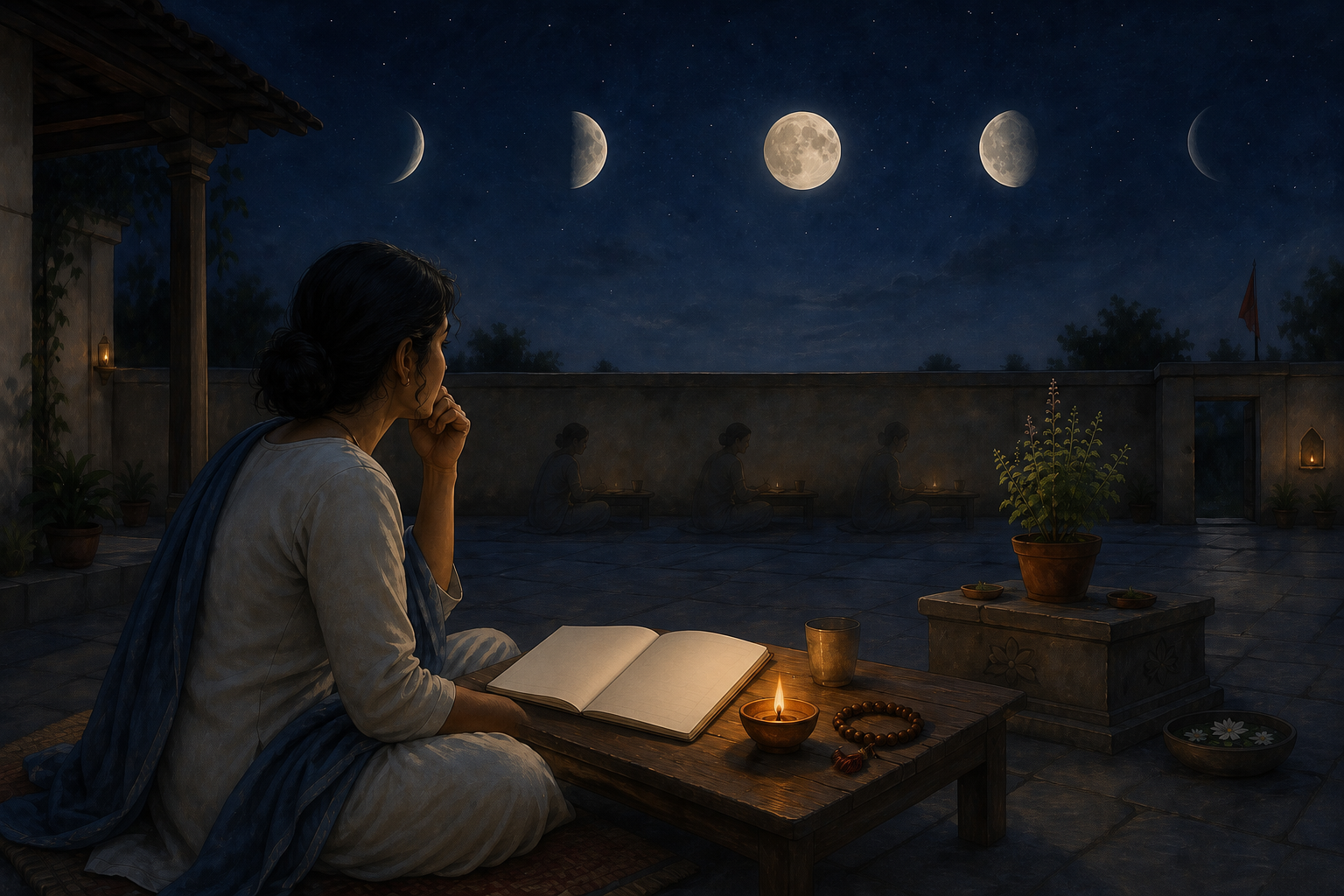
You do not need to settle every metaphysical question before working with Chandra’s symbolism. Observe one lunar cycle with enough discipline to catch both patterns and exceptions. The exercise is not a prediction system, a ritual prescription, or a scientific experiment. It is a structured form of self-observation.
- Begin with a neutral question. Write, “What relationship, if any, do I notice among the Moon’s appearance, my mental state, and my conduct?” Do not begin by deciding what the Moon must cause.
- Make a short entry at roughly the same point in your daily routine. Consistency makes comparison easier and reduces the chance that one dramatic moment will define the whole cycle.
- Describe the day before interpreting it. Note the important events, pressures, duties, conflicts, or changes that may have affected you.
- Describe the mind in plain language. Words such as calm, restless, clear, distracted, heavy, or alert are more useful than declaring yourself “under lunar influence.”
- Record only what you actually observe about the Moon: clearly visible, partly visible, not visible, or not checked. If you do not know the phase, do not invent precision after the fact.
- Choose one response that serves dharma. You might delay a reactive communication, complete an obligation, make an apology, ask for clarification, or postpone a consequential decision until you can examine it calmly.
- At the end of the cycle, look for repetitions and counterexamples. If similar moods appeared under different lunar conditions, record that. If the expected pattern did not appear, record that too.
Counterexamples are especially important. Without them, a journal can become a machine for confirming whatever you believed before you began. A calm night during a phase you expected to be difficult tells you something. So does a troubled day when you did not observe the Moon at all.
Judge the exercise by the quality of attention and conduct it produces, not by whether it proves a sweeping theory. If it helps you catch irritation before it becomes cruelty, uncertainty before it becomes paralysis, or emotional intensity before it becomes a careless decision, the symbolism is already doing practical work.
If your family, temple, teacher, or sampradaya already gives you a specific Chandra practice, keep that inherited context intact. A private journal can accompany the practice, but it should not pretend to replace lineage, ritual instruction, or qualified guidance.
Key takeaways
- Within the Navagraha framework, Chandra is connected with the mind and changes of mood.
- The Moon’s changing appearance gives you a practical image for mental states that are real but not necessarily permanent.
- Traditional influence should not be confused with compulsion. Your response remains a matter of agency and dharma.
- Use lunar observation to ask better questions about your mind, not to predict every feeling or excuse harmful conduct.
- Track a complete cycle with neutral notes, ordinary causes, and counterexamples instead of forcing events to fit a belief.
- Do not use sacred symbolism to diagnose a condition or replace appropriate healthcare.
The next time your mood shifts, look at the Moon if it is visible, but then return to what is within reach. Name the state honestly. Notice the concrete conditions of your day. Choose one action that remains right whether the feeling stays or passes.
Chandra’s most useful lesson is not that you are helpless before change. It is that change should make you attentive. Let that attention become disciplined conduct.
References
