

You may be doing puja because you need help: relief from a family problem, success in your work, protection from loss, or a more fortunate next life. Then an uncomfortable question appears. If you want something from Bhagavan, is your worship really bhakti, or is it only a transaction?
You do not have to pretend that you are free of desire. You do need to distinguish a temporary reward from an eternal spiritual aim. Once that distinction is clear, you can bring your desires into prayer without allowing them to become the purpose of your relationship with the Divine.
Swarga rewards merit; Vaikuntha reorients the self
Swarga is a temporary reward-realm associated with Indra and the devas. It is heavenly in the sense that it offers extraordinary enjoyment, but it is not eternal liberation. Punya, or accumulated merit, produces the favorable result; when the merit sustaining that result is exhausted, the heavenly condition also ends.
This does not make punya worthless. Dharmic conduct, generosity, restraint, and responsibility remain good. The mistake is treating the pleasant fruit of good conduct as the highest possible spiritual destination. A refined experience is still an experience with a beginning and an end.
Vaikuntha has a different meaning within Vaishnava traditions. It is the abode of Vishnu or Narayana, and its defining good is not superior consumption. It is unbroken relationship with Bhagavan through loving service. The devotee is not trying to acquire a better collection of pleasures but to become wholly available to the Divine.
This distinction also prevents a common misunderstanding: Vaikuntha is not simply another name for a more luxurious Swarga. Swarga answers the desire to enjoy the fruits of merit. Vaikuntha answers the desire to belong to and serve Bhagavan. One remains within the logic of reward; the other changes the center of the self.
Hindu traditions do not all describe liberation in identical language. Some emphasize realization of the Self, some speak of freedom from rebirth, and Vaishnava schools may differ in their theological explanations. The practical distinction here is specifically a bhakti distinction: a conditioned result eventually passes, while devotion seeks the eternal rather than an improved temporary condition.
It is not wrong to pray for help

Desire-based prayer can be an honest beginning. When you are frightened, ill at ease, responsible for a family, or facing uncertainty, asking Bhagavan for help is more truthful than performing artificial detachment. Bhakti does not require you to hide the condition of your mind.
The problem begins when the request silently becomes a contract: I performed this worship, so the Divine now owes me the outcome I selected. In that frame, puja is payment, a vrata is leverage, and disappointment is interpreted as betrayal. Bhagavan has been reduced to the distributor of results.
You can detect that bargain by asking what would remain if the desired result did not arrive. Would you still offer namaskara? Would you continue nama-japa? Would seva still be worthwhile? If the entire practice would be abandoned, then the result – not Bhagavan – is presently at its center.
That recognition is not a reason for shame. It is a diagnosis of motive. Call the request what it is, and then place it within a larger prayer: This is what I want, but do not let getting it or losing it separate me from dharma and devotion. Such a prayer does not eliminate desire instantly. It removes desire from the throne.
Redirect desire into bhakti through a repeatable practice
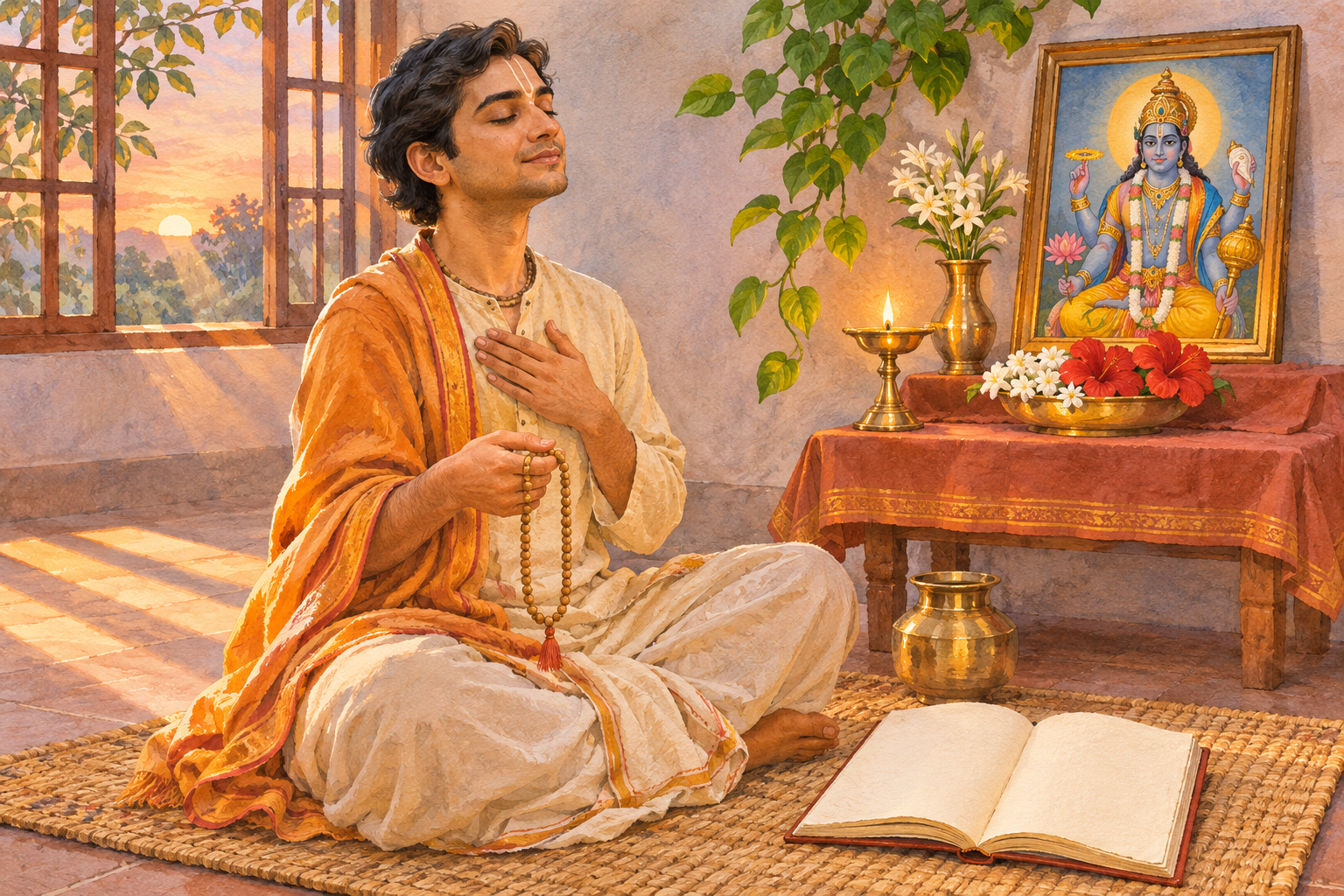
The movement from reward-seeking to devotion usually happens through repeated choices, not through one dramatic feeling. Use the following sequence whenever a strong desire enters your worship.
- Name the desired result plainly. Do not cover a wish for status with spiritual language or call fear detachment. Say what you want and why you want it. This helps you separate a real need from pride, rivalry, or the wish to control other people.
- Place the request beneath dharma. Ask that the result come only in a way that does not require dishonesty, cruelty, exploitation, or neglect of duty. If a desired outcome depends on adharma, devotion requires changing the desire rather than seeking divine assistance for it.
- Add an offering that survives either outcome. Choose a sustainable practice such as nama-japa, scriptural reading, temple service, care for someone in need, or another form of seva. Continue it whether the answer appears favorable or unfavorable. Avoid using severe or unsustainable austerity as an attempt to force the Divine.
- Offer success as carefully as failure. If the result comes, turn gratitude into responsibility instead of self-congratulation. Use the new opportunity dharmically. If it does not come, examine your practical decisions, accept what must be accepted, and keep the devotional practice intact.
- Study with a question that challenges transaction. For scriptural reflection, you can listen to A.C. Bhaktivedanta Swami Prabhupada’s 1974 class on Srimad Bhagavatam 7.6.24-30 while asking: Am I seeking Bhagavan, or mainly seeking what Bhagavan can give me?
This method does not require you to stop caring about work, health, family, or material duties. It changes the hierarchy. The desired outcome remains important, but it is no longer allowed to decide whether devotion continues.
Notice whether the center of worship is actually shifting
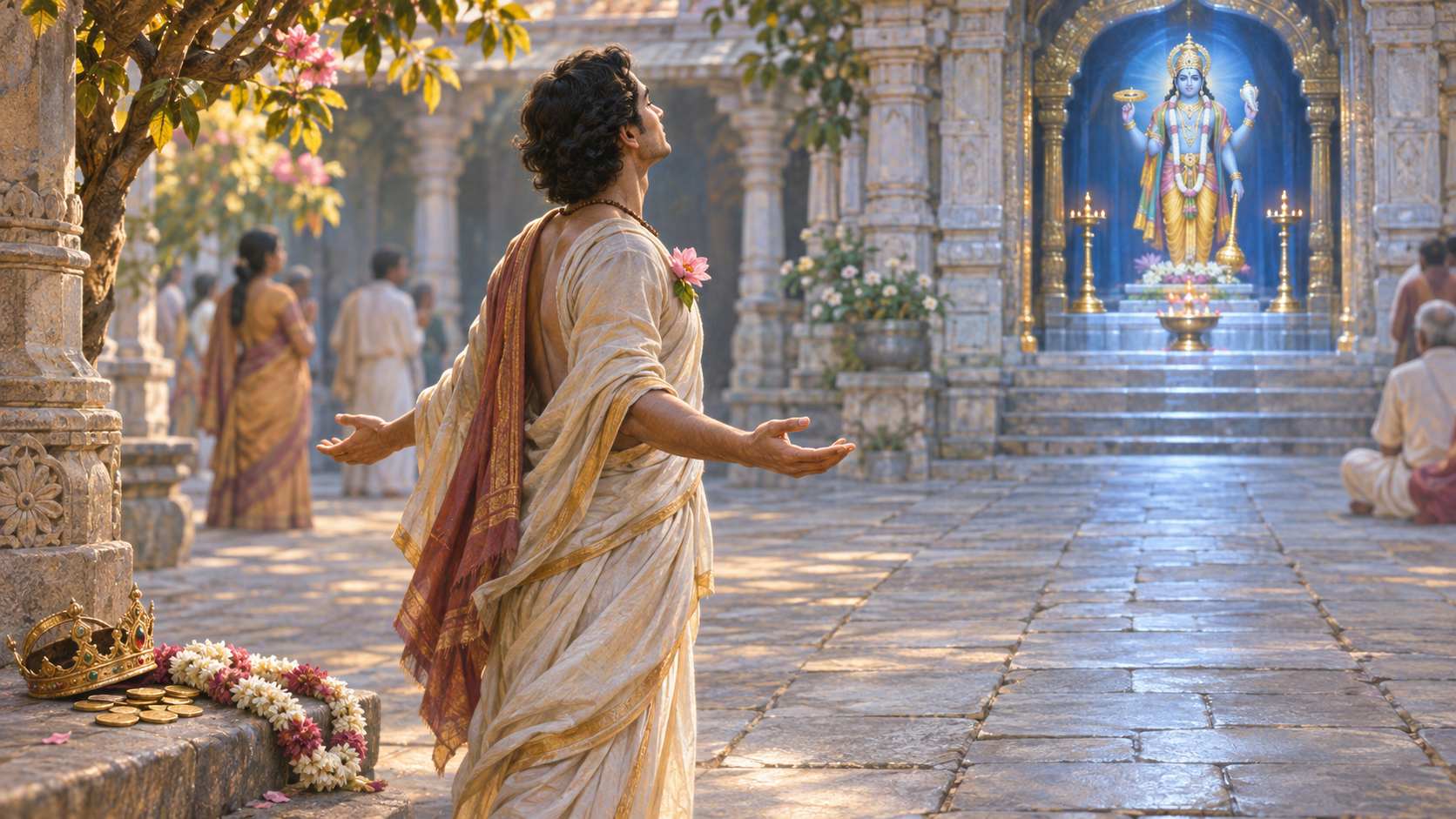
Spiritual progress is easy to confuse with pleasant emotion. A moving kirtan, a peaceful meditation, or an answered prayer may encourage you, but none by itself proves that the transactional habit has weakened. Look instead at what your practice does when conditions change.
- Your prayer becomes less controlling. You still ask, but you also ask for discernment, steadiness, and the ability to act according to dharma.
- Your practice survives disappointment. A setback may disturb you, but it does not make worship seem pointless.
- Good fortune increases responsibility. You treat prosperity, influence, or ability as something to use in service rather than as evidence of spiritual superiority.
- Another person’s success becomes less threatening. Envy loses some of its force because divine favor is no longer measured only through visible rewards.
- You stop keeping an account against Bhagavan. Worship is no longer a list of sacrifices presented as proof that a particular result is owed to you.
There is a subtler test as well. Heavenly ambition can return in spiritual clothing. You may stop seeking ordinary pleasure but begin seeking recognition as an advanced devotee, a prestigious role, or certainty that you deserve a superior destination. The object has changed, but the bargaining mind remains. When you notice this, return attention to service that does not advertise you.
Eternal devotion does not mean that you must already feel uninterrupted love or concentration. Human attention fluctuates. In practice, it means that you repeatedly return to Bhagavan as the end of the path, not merely as the means to another end.
Key takeaways for your next prayer
- Swarga is a desirable but temporary fruit of merit; it is not the final freedom sought by bhakti.
- Vaikuntha, in the Vaishnava understanding, is defined by eternal relationship and service to Bhagavan rather than by intensified enjoyment.
- Asking for help is not hypocrisy. The decisive question is whether devotion continues when the request is denied, delayed, or fulfilled differently.
- A prayer becomes less transactional when you place the request beneath dharma and attach it to a practice that survives every outcome.
- Measure the direction of your devotion by steadiness, responsibility, and reduced bargaining – not merely by spiritual emotion or favorable events.
At your next puja, do not suppress the request that brought you there. State it truthfully, place it beneath dharma, and make an offering you intend to continue whatever happens. That small change begins teaching the heart to seek Bhagavan, not only Bhagavan’s gifts.
References
- Hindu Blog – Difference Between Swarga And Vaikunta In Hinduism
- Dandavats – Srimad Bhagavatam Text 7.6.24-30, 1974, Speaker Srila Prabhupada

Leave a Reply
You must be logged in to post a comment.