

You see an unequal conflict. One side has the state, the institutions, the money or the weapons; the other speaks in the language of resistance. The moral shortcut arrives almost automatically: the weaker side must be the just side.
Barbarik’s dilemma shows why that shortcut can become dangerous. You should protect people from oppression, but you should never let present weakness substitute for an examination of conduct, aims and future power. Compassion needs discernment, especially when someone wants your voice, vote, money or public loyalty.
Barbarik’s vow turns sympathy into a fatal loop
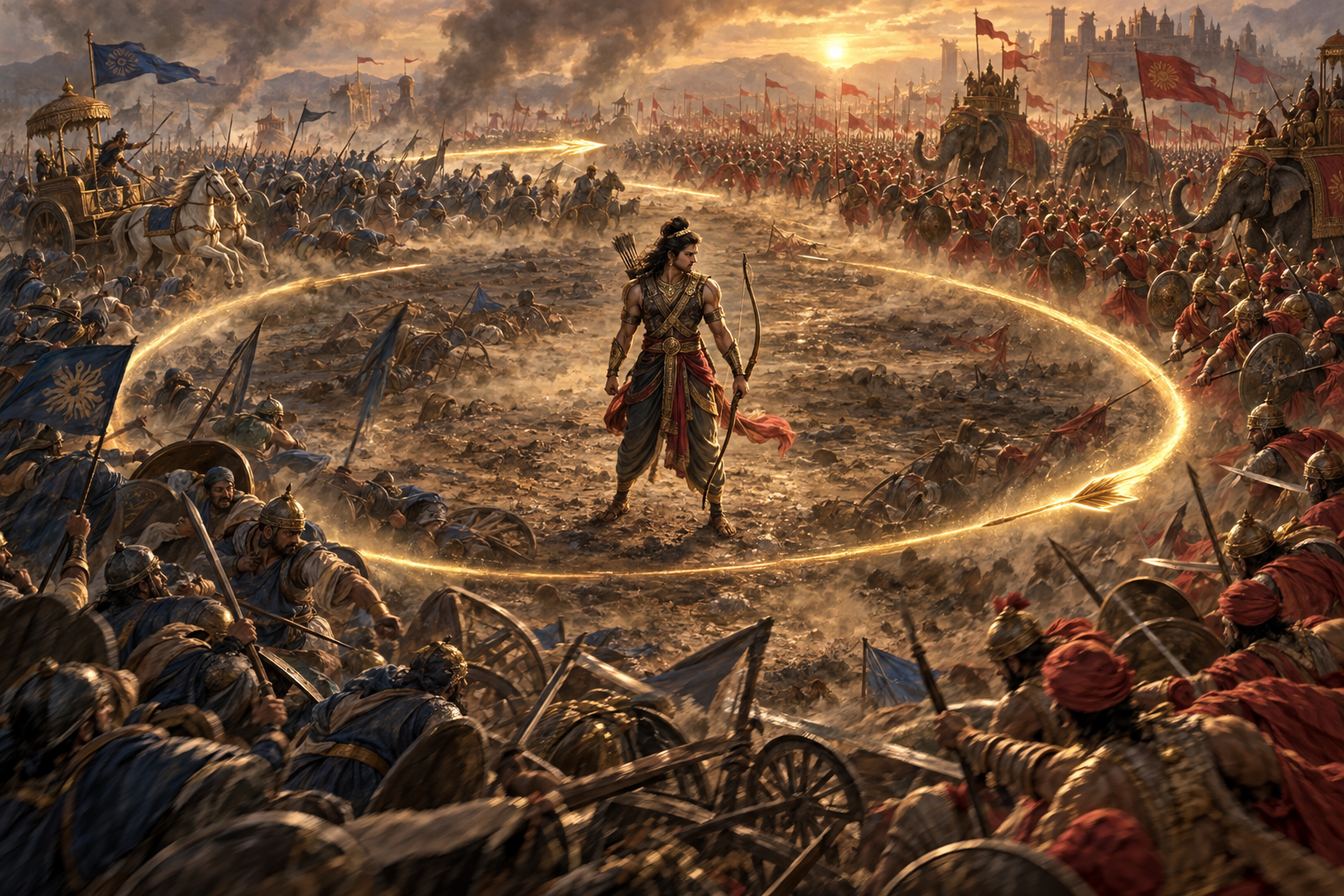
Details vary across popular tellings, but the moral structure of Barbarik’s story is remarkably clear. He is an exceptionally powerful warrior who promises to fight for whichever side is weaker. The vow sounds compassionate. It appears to place strength at the service of those most likely to be defeated.
Yet his intervention would change the very condition that determines his loyalty. Once his power rescues the weaker army, that army becomes the stronger one. Barbarik must then cross over. Every victory creates a new underdog, and every switch produces another reversal. His commitment is not anchored to dharma, truth or the conduct of either army. It is anchored to a moving comparison of strength.
That is the underdog reflex in its purest form: treating disadvantage as proof of righteousness. It confuses a circumstance with a character. A person can be vulnerable and still lie. A movement can suffer repression and still intend to repress others. A powerful institution can act unjustly without making every opponent of that institution just.
Krishna’s intervention prevents Barbarik’s immense capacity from entering the war under a morally unstable rule. The point is not that power itself is corrupt or that the weak should be abandoned. It is that power guided by a defective principle can magnify harm far beyond its benevolent intention.
You can detect this error by asking one immediate question whenever weakness is offered as the main argument for a cause: What would this actor do if it acquired the power it presently lacks? If nobody will discuss that future, the moral case is incomplete.
Weakness changes what protection is owed, not what is true
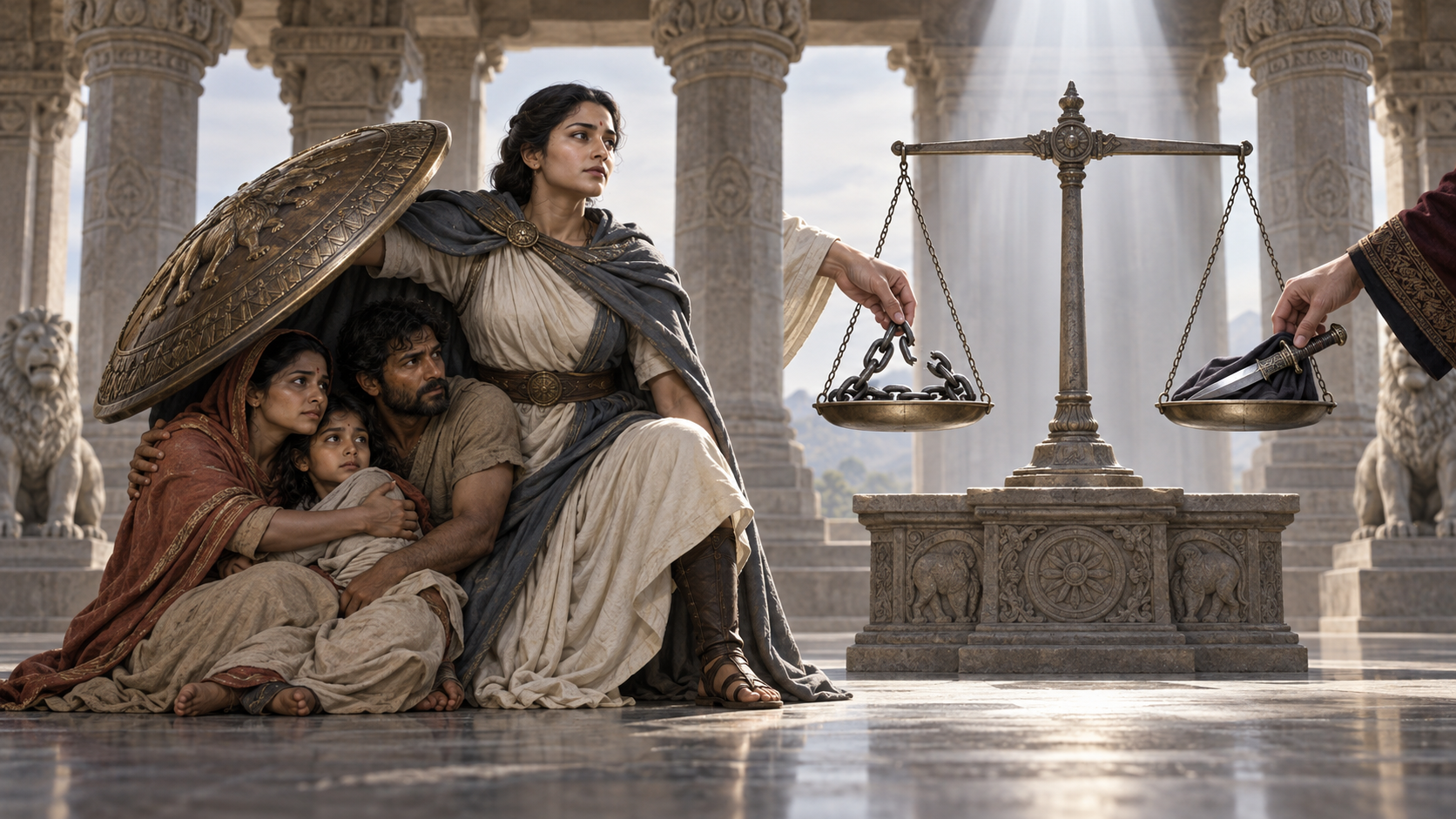
A dharmic judgement has to hold several truths at once. The vulnerable may require urgent protection. Their factual claims still require evidence. Their leaders, methods and political programme still require scrutiny. None of these inquiries cancels the others.
Protection concerns the person. Civilians should not be attacked for belonging to the wrong community. Prisoners should not be tortured. Women should not lose their dignity because their rulers or supposed liberators claim an emergency. These protections do not depend on whether you approve of the person’s faction.
Agreement concerns the claim. A movement may correctly identify a particular injustice while misdiagnosing its cause or demanding an unjust remedy. You can acknowledge the valid grievance without accepting the entire ideology attached to it.
Endorsement concerns the actor. Before giving an organisation your trust, examine how it behaves when challenged, what it permits its own supporters to do and what social order it proposes to create. Suffering can explain conduct, but it does not automatically justify conduct.
This distinction also blocks the reverse error. Strength is not evidence of righteousness either. A dominant side cannot excuse abuse by pointing to the extremism of its enemies. Dharma is not a scoreboard on which the side with fewer weapons receives moral purity and the side with more weapons receives moral guilt. It judges acts, duties, purposes, restraints and foreseeable consequences.
Use a simple reversal test. Describe the disputed act without naming the faction, religion, caste, nation or ideology involved. Would you judge the same act differently if the two sides exchanged identities? If so, sympathy may have displaced principle.
Tehran shows why you must examine tomorrow’s ruler

In the autumn of 1978, Michel Foucault visited Tehran twice. He saw unarmed collective resistance confronting the Shah’s army and interpreted the uprising as the emergence of a new kind of political spirituality. The drama of apparently powerless people facing a powerful state captured his moral imagination.
On 6 November, Atoussa H., a leftist Iranian living in exile in Paris, warned the Western liberal left about what Islamic rule could mean in practice. She pointed to coercive punishments elsewhere and argued that a society seeking liberation could accept a cure worse than its disease. Her concern was not whether the existing regime deserved opposition. It was what the ascendant opposition would do with victory.
The warning soon became concrete. Compulsory veiling followed the revolution, and women protested in the streets. Homosexuals were executed. The secular left that had marched alongside the Islamists was then destroyed by them.
Foucault responded the following week without seriously answering her prediction or evidence. He objected instead that she had merged different forms of Islam and dismissed them as fanatical. Distinguishing a civilisation or religion from a particular political project is necessary. But that valid distinction cannot be used to avoid a precise question about laws, punishments and the treatment of dissenters.
The failure was not opposition to the Shah, nor was it respect for a non-Western religious vocabulary. It was allowing the spectacle of resistance to eclipse an inquiry into the prospective regime. The people with the least institutional power at the beginning of a revolution may possess the strongest organisation, the clearest ideology and the least tolerance for rivals once the old order falls.
When you hear a warning from someone whose freedom would depend on a movement’s victory, separate three questions. What exactly does the person predict? What evidence supports that prediction? Does the movement’s defender answer those points, or merely challenge the critic’s identity, motives or tone? A rebuttal that never reaches the predicted conduct is not a rebuttal.
Use a dharmic test before choosing a side

Ask six questions in this order
- What is the exact injustice? Name the act, rule or deprivation. If the claim remains at the level of oppressor and oppressed, you cannot test it or identify a proportionate remedy.
- What principle makes it wrong? State a rule you would apply to an ally as well as an enemy: no collective punishment, no forced religious conformity, no deliberate attack on non-combatants, no suppression of peaceful dissent. A principle that changes with the actor is factional loyalty.
- What remedy is actually being requested? Protection from abuse, correction of a law and transfer of total power are different requests. A just grievance does not establish that every proposed remedy is just.
- What order does the actor intend to build? Look past slogans about liberation. Ask what happens to political rivals, religious minorities, women, dissenters and former allies after victory. Refusal to specify the end state is itself useful information.
- How does the actor behave inside its own camp? Notice whether disagreement is answered, silenced or punished. A movement that treats internal critics as traitors is showing you how it may govern people who cannot simply leave.
- What would make you withdraw support? Decide your red lines before enthusiasm or group pressure takes over. If no tactic, lie or atrocity could change your allegiance, you are no longer making a moral judgement.
The order matters. Starting with the actor’s identity invites inherited loyalty or hostility. Starting with a concrete wrong and a consistent principle makes it harder to excuse the same conduct when your preferred side commits it.
Choose the narrowest level of support the facts justify
Support is not a single switch. You can distinguish four levels, each requiring more evidence than the one before it:
- Human protection: defending people against an immediate abuse, regardless of faction.
- Agreement with a claim: accepting that a particular grievance is valid.
- Limited cooperation: working with an actor toward one defined remedy while retaining public boundaries.
- Political or moral endorsement: trusting the actor’s broader methods, programme and use of future power.
You may have strong grounds for the first level and weak grounds for the fourth. That is not inconsistency. It is moral precision. You can oppose compulsory veiling without endorsing every rival of the government imposing it. You can condemn state violence without romanticising every revolutionary organisation. You can defend a community’s civil rights while rejecting leaders who demand impunity in that community’s name.
When you speak publicly, bound your support in one sentence: I support this specific protection or claim because of this principle; that support does not extend to these tactics or this ideology; I will withdraw it if this red line is crossed. If you cannot complete all three parts, do more examination before lending your name.
Recognise the rhetoric that disables judgement
- Scoreboard morality: The actor with less power is treated as right by definition, even when the disputed act has nothing to do with the power imbalance.
- Victimhood laundering: Real suffering is used to cleanse unrelated lies, coercion or cruelty.
- Future-tense evasion: Questions about rule after victory are dismissed as distractions from present oppression.
- Critique deflection: A concrete warning is answered with an accusation about the critic’s motives, identity or insufficient sympathy.
- Selective universality: A moral rule is invoked against an enemy but renamed resistance, necessity or self-defence when an ally violates it.
These moves work because they turn scrutiny into a sign of disloyalty. Refuse that frame. The more power an actor seeks, the more scrutiny it owes. The more vulnerable its alleged beneficiaries are, the more carefully you should examine whether they will be free under its proposed order.
Key takeaways
- Present weakness can create a claim to protection, but it cannot establish moral innocence.
- Judge a cause through its conduct, remedy and proposed end state, not its current place in the balance of power.
- Apply the same rule to allies and adversaries; reverse the identities when you need to test your consistency.
- Separate protection of people, agreement with a grievance and endorsement of a movement.
- Set your red lines before offering public support, and withdraw that support when the lines are crossed.
The next time an unequal conflict demands an instant declaration of loyalty, pause before you repost or enlist. Name the specific injustice, the universal rule and the future order you would be helping to create. If the last question has no credible answer, protect the vulnerable without handing their leaders a moral blank cheque. That is how you keep compassion under the guidance of dharma.
References

Leave a Reply
You must be logged in to post a comment.