

You may believe the Divine is everywhere and still behave as though worship ends at the temple door. The split appears when ritual care is meticulous but speech becomes careless, work becomes merely transactional, or an opponent is treated as less than human.
If you have wondered whether divine omnipresence makes temple etiquette pointless, Avvaiyar’s answer offers a better way to think. Honour sacred forms, but do not mistake them for boundaries around God. The temple should train your vision for the rest of life.
The deeper question inside a priest’s rebuke
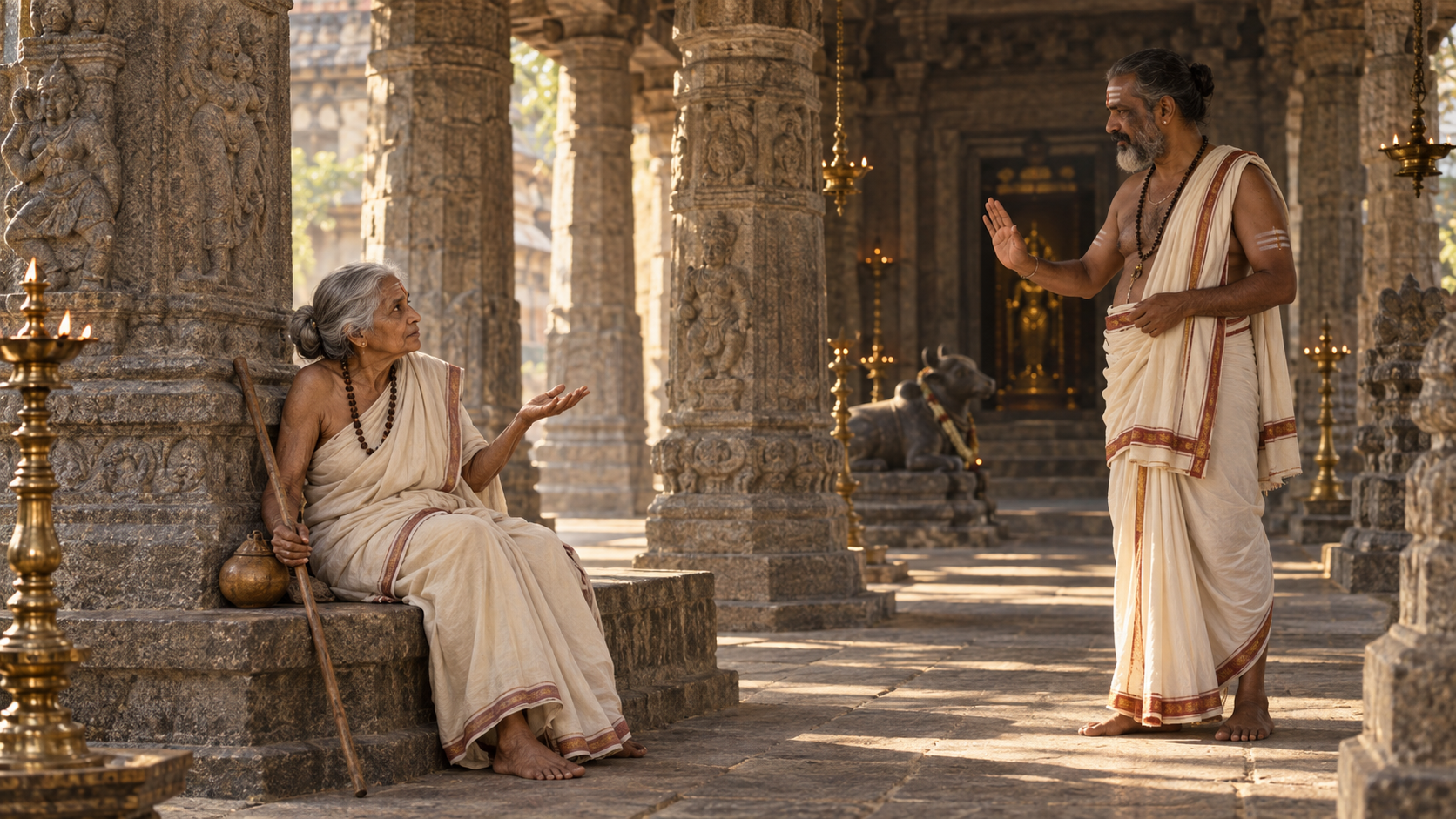
In a remembered encounter, Avvaiyar, the revered Tamil poet-saint and devotee of Murugan, was resting with her legs extended toward a temple. A passing priest objected because her feet were pointing toward the deity. She answered with a disarming request: “Show me a place without God.”
The priest’s concern operates at the level of bodily orientation: which direction should the feet face? Avvaiyar moves the question to a more fundamental level: in which direction is the Divine absent? If God is truly all-pervading, changing the position of the body cannot produce a godless direction.
That does not make the reply a licence for deliberate offence. Avvaiyar’s challenge is sharper than “manners do not matter.” It exposes the mistake of treating a gesture of reverence as though it were a map of God’s limits. Your posture can express humility or carelessness, but it cannot confine the Divine to one side of a room.
Why omnipresence does not make the temple meaningless

A common misreading runs like this: if God is everywhere, no place can be more sacred than another, so temples and their customs are unnecessary. That conclusion confuses divine presence with human attention. The Divine may be everywhere while your awareness remains scattered, selective, and easily distracted.
- Presence is not the same as attention. Omnipresence describes the Divine; concentration describes the devotee. A sacred setting gathers an attention that ordinarily wanders.
- A focal point is not a border. A murti, sanctum, or temple can direct devotion without implying that God ceases to be present beyond it.
- Etiquette disciplines the worshipper. Bowing, removing footwear where required, keeping silence, and respecting local customs train humility. They are not measures taken to protect an otherwise vulnerable deity.
- Reverence must travel. If careful conduct exists only before the deity and disappears at the threshold, the form of worship has not yet reshaped the worshipper.
When you visit a temple, follow its customs with sincerity. Community, continuity, and humility matter. But carry the principle in both directions: do not use omnipresence to dismiss sacred discipline, and do not use sacred discipline to imagine that the world outside is spiritually empty.
The real test begins outside the sanctum

“God is everywhere” can remain a comfortable sentence because a sentence asks little of you. Avvaiyar’s question becomes demanding when you apply it to the person, place, or task you habitually regard as beneath your concern.
Begin with speech. Before repeating something humiliating about an absent person, ask whether you would use the same words while standing before the deity. If not, omnipresence has revealed a gap between your worship and your conduct. The useful response is not vague guilt; it is to stop, remove the needless contempt, and say only what truth or duty requires.
Then examine work that receives no recognition. A task does not become spiritually worthless because nobody applauds it. If the Divine is not restricted to visibly religious activity, honesty in an ordinary responsibility can express the same inner orientation as a formal act of worship. Do the hidden part with the care you would bring to an offering.
Conflict is the harder test. Seeing divine presence in another person does not mean declaring every belief, intention, or action righteous. Omnipresence is not moral indifference. You may have to oppose deception, cruelty, exploitation, or adharma firmly. The discipline is to resist the wrong without making hatred your method or denying the human dignity of the wrongdoer.
When a confrontation is necessary, ask two separate questions: What must be stopped? What response stops it without making me imitate it? Keeping those questions separate prevents spiritual language from becoming either passivity or a cover for vengeance.
A practical way to carry Avvaiyar’s insight into the day

The following exercise is a practical application of the lesson, not a ritual attributed to Avvaiyar. Use it after puja, temple worship, or a quiet moment of remembrance.
- Begin with one place of focused reverence. Bow before the murti, sit at your home altar, or recollect the Divine in silence. Let the act gather your attention.
- Name one place you mentally exclude. It may be your workplace, a crowded road, a difficult household setting, or the company of someone who irritates you.
- Complete one concrete sentence. Say inwardly, “If the Divine is present there too, I will…” Finish with an observable action: speak without ridicule, complete a neglected duty, listen before answering, or refuse wrongdoing without abuse.
- Use irritation as the reminder. When the chosen situation arises, do not wait to feel serene. Pause long enough to remember that sacred presence is not cancelled by your discomfort.
- Review conduct rather than mood. At the end of the day, ask whether your words and actions reflected the insight. If they did not, choose the precise response you will change next time.
This practice joins temple reverence to daily conduct. The temple supplies focus; ordinary life tests whether that focus has become vision. Each side corrects the other. Without sacred focus, omnipresence can become a vague slogan. Without daily application, temple devotion can become compartmentalised.
Key takeaways
- Avvaiyar’s reply challenges the idea that the Divine can be confined to one location or direction.
- Temple etiquette remains valuable because it forms the devotee’s attention and humility, not because God exists only inside the temple.
- Belief in omnipresence should change how you speak, work, exercise power, and handle conflict.
- Recognising divine presence in a person does not require approving harmful conduct; firm resistance and refusal to dehumanise can coexist.
- The most useful application is specific: carry one quality of your worship into one predictable encounter beyond the shrine.
The next time you bow before the deity, choose one encounter after worship in which you will preserve the same reverence. Avvaiyar’s question then ceases to be merely a clever answer. It becomes a discipline of seeing, and your ordinary day becomes the place where that vision must prove itself.
References

Leave a Reply
You must be logged in to post a comment.