
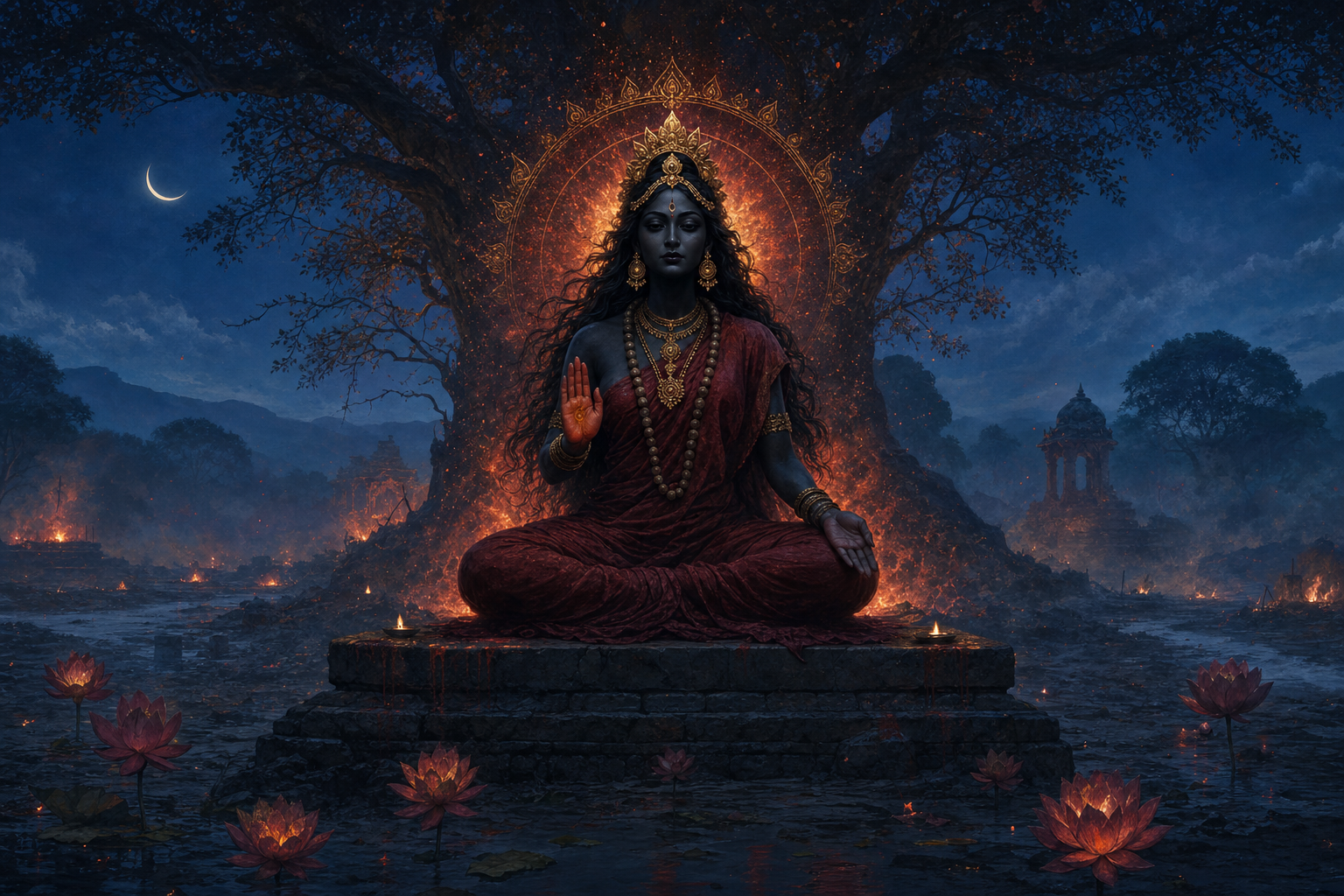
If you have encountered Aghoreshwari in a list of fierce Devis or an online account of Tantra, your immediate question is probably simple: who is she, and is her worship something you should attempt? A sound answer begins by separating recognition from ritual.
Aghoreshwari is identified as a fierce and sovereign expression of Shakti within a southern Tantric current, with the cremation ground forming a central part of her sacred setting. That tells you something important about her theological character. It does not give you a portable ritual system, a mantra to copy, or permission to imitate practices detached from their lineage.
Start with what the name and form actually establish
Aghoreshwari belongs to the fierce register of Shakta tradition. Fierce does not mean evil, demonic, or opposed to dharma. It describes a mode in which divine power is encountered without the reassuring forms through which human beings usually seek security.
The name joins Aghora with Ishvari, the feminine sovereign. A translation that reduces her to a ‘goddess of horror’ therefore misses the religious problem carried by the name. What appears terrible to a mind attached to permanence, control, social identity, and bodily continuity is not necessarily outside divine reality. Aghoreshwari confronts the worshipper with Shakti where ordinary reassurance no longer works.
This gives you a useful first question. Do not begin by asking whether the Goddess is pleasant. Ask what this form refuses to hide. A nurturing form may meet suffering through protection and consolation. A fierce form may disclose the instability that made such protection seem necessary. These are not rival moral personalities; they are different religious encounters with divine power.
Keep your working definition narrow: Aghoreshwari is a fierce, sovereign form of Shakti, associated with the cremation ground and situated within a southern Shakta-Tantric current. Treat every additional claim about her iconography, mantra, mythology, temple, or ritual as something that needs its own attestation.
The cremation ground is a theological claim, not a dare
In ordinary life, the body is surrounded by names, relationships, occupations, possessions, and ranks. The cremation ground exposes the limit of every one of them. Saying that Aghoreshwari abides there places Shakti at the point where social identity and bodily permanence can no longer sustain the person.
That setting can therefore be read as a declaration of divine sovereignty: no place marked by death, dissolution, fear, or exclusion stands outside Shakti. The Goddess is not powerful only in a decorated shrine or during an auspicious domestic observance. Her presence reaches the boundary that conventional life would prefer not to see.
This symbolic reading is useful, but it must not swallow the tradition. The cremation ground is not merely a modern metaphor for overcoming your fears. Aghoreshwari belongs to a living religious current in which sacred setting, deity, transmission, and practice may have meanings that cannot be reconstructed from psychology alone.
Use a three-layer test whenever you encounter a description of her:
- Theological layer: What does the description claim about Shakti? Here, the central claim concerns sovereignty that remains present amid mortality and dissolution.
- Symbolic layer: What does the cremation ground make visible? It strips away the usual supports of identity and forces attention toward impermanence.
- Ritual layer: What is a practitioner actually instructed to do, by whom, and within which transmission? Do not manufacture this layer when a named lineage, qualified teacher, or textual basis has not been supplied.
The distinction matters because sacred imagery is not automatically an instruction. A statement that the Goddess dwells in a cremation ground does not tell you to enter one. Never trespass at a cremation site, disturb remains, or attempt a transgressive rite because an online description made the setting sound spiritually powerful. Such conduct can be unlawful, dangerous, and profoundly disrespectful to grieving families and the dead.
Keep the southern current narrower than a lineage map
The phrase southern Tantric current supplies a placement, but not a complete map. On its own, a directional label does not establish a particular region, temple network, scripture, ritual classification, or chain of teachers. It should not be expanded into any of those claims without further evidence.
This is where many confident explanations go wrong. A name is linked to a familiar Goddess, a directional term is converted into geography, and a few generic Tantric elements are added until the result sounds complete. The confidence comes from filling gaps, not from preserving the tradition accurately.
Before accepting a detailed account, look for at least one of the following anchors:
- A named sampradaya or transmitting lineage that identifies Aghoreshwari and explains her place within its practice.
- A specific textual locus in an Agama, Tantra, ritual manual, commentary, or established liturgical collection.
- A documented temple or regional tradition with a continuing community of worship.
- A qualified teacher who distinguishes inherited teaching from personal interpretation.
- A clear explanation of whether another divine name is an equivalence, an association, an epithet, or merely a comparison.
Until one of those anchors is available, repeat only the limited identification you can support. Do not automatically collapse Aghoreshwari into Kali, Bhairavi, an Aghora tradition, or any other better-known category. Shakta traditions can relate divine forms through profound identifications, but such an identification has to arise from the relevant tradition. Visual resemblance or shared fierceness is not enough.
The same restraint applies in the other direction. You should not assume that every tradition using the language of Aghora worships Aghoreshwari, follows the same ritual sequence, or understands her in precisely the same way. Shared vocabulary may indicate a relationship; it does not prove ritual interchangeability.
Know where study ends and sadhana begins
You do not need initiation merely to learn that Aghoreshwari exists, understand the theological force of her cremation-ground setting, or reflect on what a fierce form of Shakti reveals. Public study and esoteric performance are different activities. Confusing them either makes Tantra needlessly inaccessible or makes demanding practices look casually reproducible.
A practical boundary has three circles:
- Study: Read carefully, compare terminology, identify the lineage behind a claim, and distinguish attested facts from interpretation.
- Personal devotion: You may offer a simple, respectful salutation to Devi in language you understand, provided you do not advertise it as an ancient Aghoreshwari ritual or a substitute for transmitted practice.
- Lineage sadhana: Mantra, nyasa, specialized visualization, prescribed offerings, and other esoteric procedures belong to the tradition that transmits them. These examples are categories of Tantric practice, not a claim that every Aghoreshwari lineage uses every one of them.
If you want more than study, seek a teacher who can name the transmission and explain its limits. A competent teacher should be able to tell you what is being given, what preparation it assumes, what ethical conduct accompanies it, and what you are not authorized to do. Initiation is not a magical permission slip, and it does not cancel ordinary judgment.
Be cautious when someone uses fear of a fierce deity to prevent reasonable questions. Claims of immediate powers, threats of supernatural punishment for leaving, pressure to conceal harm, or demands that violate consent and law are not made trustworthy by Tantric language. Privacy can serve a legitimate ritual purpose, but secrecy by itself proves neither lineage nor integrity.
The safest devotional posture is neither mockery nor theatrical terror. It is disciplined reverence. You acknowledge that the form may carry meanings deeper than your present knowledge, refuse to invent the missing instructions, and continue learning without pretending that intensity is realization.
Key takeaways for a careful reader
- Aghoreshwari is presented as a fierce, sovereign expression of Shakti within a southern Tantric current.
- Her cremation-ground setting places divine presence amid mortality, dissolution, and the collapse of ordinary social identity.
- Fierceness should not be confused with evil. It marks a form that does not soften the realities a practitioner is being asked to face.
- Sacred description is not ritual authorization. Never turn cremation-ground symbolism into improvised physical practice.
- The label southern current is not enough to establish a complete geography, lineage, scripture, or liturgy.
- Public study, personal reverence, and initiated sadhana are distinct. Keep them distinct in both your practice and your language.
Your next step can be modest and exact. Take any account of Aghoreshwari you encounter and make three headings in your notes: identity, symbolism, and practice. Record only what is actually supported, and leave the remaining spaces blank. If your interest develops into a call toward sadhana, find a teacher who can name the transmission and state its boundaries. Aghoreshwari is better approached through disciplined honesty than borrowed intensity.

References
