
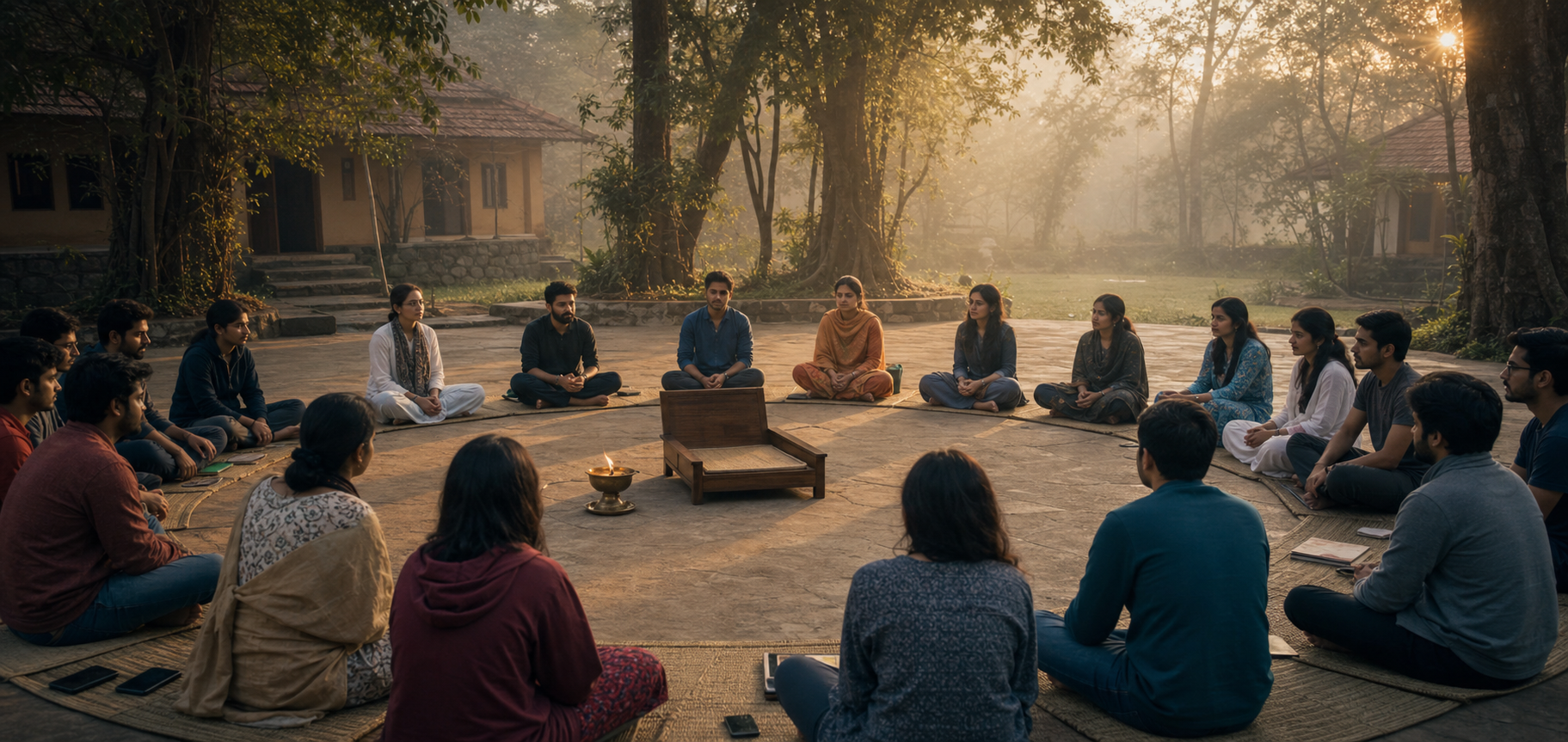
You may be considering an Advaita youth retreat because ordinary life leaves little room for sustained attention. You want more than inspiring talks, but you may reasonably wonder whether a residential camp can produce anything that survives the return to classes, work, family obligations and a waiting phone.
It can, but only if you treat the retreat as the beginning of a discipline rather than a complete spiritual experience. The real test is not how elevated you feel at the closing session. It is whether the teaching changes what you study, how you use your attention and how you meet other people once the protected schedule is gone.
A retreat should interrupt your pattern, not merely entertain you
A serious retreat changes the conditions under which you think. The 53rd Advaita Awakening Youth Retreat, held at Chinmaya International Foundation in Veliyanad, Kerala, from July 14 to 23, 2026, brought together young adults from different parts of Bharat. Intended for participants aged 18 to 32, the residential format placed study, practice and community inside the same daily rhythm.
That integration matters. When yoga or meditation is isolated from scriptural study, it can become a wellness routine without a philosophical centre. When study is isolated from silence and discipline, it can become an intellectual hobby. When both are isolated from community life, you never discover how quickly lofty ideas disappear in the presence of irritation, disagreement or inconvenience.
The Veliyanad schedule joined yoga, meditation, satsanga, stotra chanting, lectures and direct engagement with works associated with Adi Shankaracharya. Swami Swatmananda and Professor Gauri Mahulikar were among the teachers. Cultural evenings, games, a treasure hunt, heritage visits, temple visits and a screening on the life of Swami Chinmayananda broadened the experience beyond the lecture hall.
Games and outings are not automatically distractions from sadhana. In a well-designed retreat, they reveal whether participants can carry attentiveness, cooperation and restraint into informal situations. The question is whether each activity belongs to a coherent educational purpose. A crowded itinerary by itself proves nothing.
Before applying to a retreat, ask for enough detail to evaluate the container:
- Does the daily schedule make room for the body, voice, intellect and silence, or is it mostly a sequence of speeches?
- Will teachers explain a primary text and take questions, or will participants receive only simplified slogans?
- What is the actual policy on phones and outside communication? A vague appeal to reduce distractions is weaker than a clear boundary.
- Does the programme use participation, reflection and shared responsibilities, or does it leave the young person as a passive audience member?
- Are visits to temples and heritage places connected to the teaching, or included merely as tourism?
- What support, study direction or peer contact is available after departure?
If organisers cannot answer those questions, do not assume that a spiritual label guarantees spiritual depth. The value of residential withdrawal lies in its structure: fewer competing signals, a stable timetable, access to teachers and repeated practice. Choose the retreat whose structure supports the stated teaching.
Advaita has to pass from an idea into discernment

Advaita Vedanta teaches that Brahman is the ultimate non-dual reality and that Atman, the deepest Self, is not separate from Brahman. The experienced world is described through maya as appearance rather than independent ultimate reality. Adi Shankaracharya gave this vision durable intellectual form through commentaries on the Upanishads, Bhagavad Gita and Brahma Sutras.
This is easy to repeat and difficult to understand. Maya does not give you permission to call duties, suffering or other people irrelevant. If non-duality makes you more careless, contemptuous or self-important, the concept has been recruited by the ego rather than assimilated. A retreat should help you distinguish an Advaitic claim from a convenient misreading of it.
The traditional movement of Advaita learning is useful here: shravana, attentive reception of the teaching; manana, rigorous reflection that resolves doubts; and nididhyasana, sustained contemplation through which the teaching is inwardly assimilated. Use all three while you are at the retreat.
- During shravana: write the teacher’s claim precisely. Do not replace it with the version you expected to hear.
- During manana: record the point you cannot reconcile. Ask, for example, how Atman differs from personality, how maya differs from sheer nonexistence, or why ethical discipline remains necessary in a non-dual vision.
- During nididhyasana: sit with the teaching after the explanation ends. Notice the identities, fears and preferences to which the mind immediately returns.
Chanting can steady attention and preserve a teaching in memory, but accurate sound is not the same as comprehension. After learning a verse or passage, state its meaning in your own words and identify the misunderstanding it corrects. If you can only reproduce the teacher’s phrasing, the idea has not yet become your understanding.
Keep separate notes for teaching, practice and unresolved questions. This simple distinction prevents a moving experience from being mistaken for doctrinal clarity. It also gives you something useful to bring to a teacher or study group after the retreat.
Build the bridge home before you leave
A residential timetable is borrowed scaffolding. Meals arrive at set times, sessions are announced, teachers are nearby and fellow participants are moving in the same direction. At home, every element has to compete with existing habits. Waiting until after the retreat to design your continuation plan makes discontinuity the default.
Before departure, make a small continuation card. Give it the fields Practice, Cue, Place, Text, Person, Obstacle and Recovery. Fill each field with an answer concrete enough to follow on an ordinary working day.
- Fix the cue. Attach practice to an event that already happens reliably, such as waking, bathing or returning home. A wish to practise when free is not a schedule.
- Define a sustainable practice. Choose a short sequence you can keep when enthusiasm is low: settling the body, meditation or japa, a stotra or selected passage, and a brief reflection. Expand it when time permits without making the expanded version the condition for beginning.
- Name the text and teacher. Do not drift through unrelated videos after receiving a coherent course of instruction. Continue with the text, commentary or study direction given by a qualified teacher, and save unresolved questions for an appropriate forum.
- Protect satsanga. Exchange contact details with a participant who wants disciplined continuity, not just camp photographs. Agree on a regular check-in centred on practice and study.
- Restore a boundary around attention. Recreate part of the retreat’s separation from outside noise. Put the phone beyond reach during practice and decide in advance what would constitute a genuine interruption.
- Write the recovery rule. If you miss the practice, resume at the next established cue. Do not wait for a festival, a new month or another burst of motivation.
The Obstacle field is important because predictable friction is easier to handle than vague failure. If mornings are unstable, choose a more reliable cue. If your household does not share the practice, explain the quiet period without demanding that everyone participate. If you cannot understand the assigned text alone, arrange access to a teacher or serious study group instead of substituting random commentary.
Do not measure continuity by whether the atmosphere of the retreat can be reproduced. It cannot. Measure whether you return to the discipline without being carried by the group. Notice whether you catch distraction earlier, examine reactions more honestly, listen more carefully and remember the teaching during conflict. Dramatic inner states are a poor attendance register.
Your notes should also include a question that remains alive. A good question keeps study from becoming mechanical. It may concern the witness and the mind, the place of devotion in Advaita, the relation between knowledge and action, or the practical meaning of seeing unity amid difference. Carrying a real question home is more valuable than carrying a notebook filled with conclusions you have not examined.
Key takeaways
- A worthwhile Advaita retreat integrates scriptural teaching, contemplative practice, disciplined routine and community life.
- Evaluate the teachers, texts, device boundaries, participatory method and post-retreat support before you apply.
- Use shravana, manana and nididhyasana so that listening develops into reflection and assimilation.
- Design your home practice before departure by fixing its cue, place, text, companion, likely obstacle and recovery rule.
- Judge continuity through steadier practice and better conduct, not through nostalgia for the retreat atmosphere.
Spiritual continuity must become cultural continuity
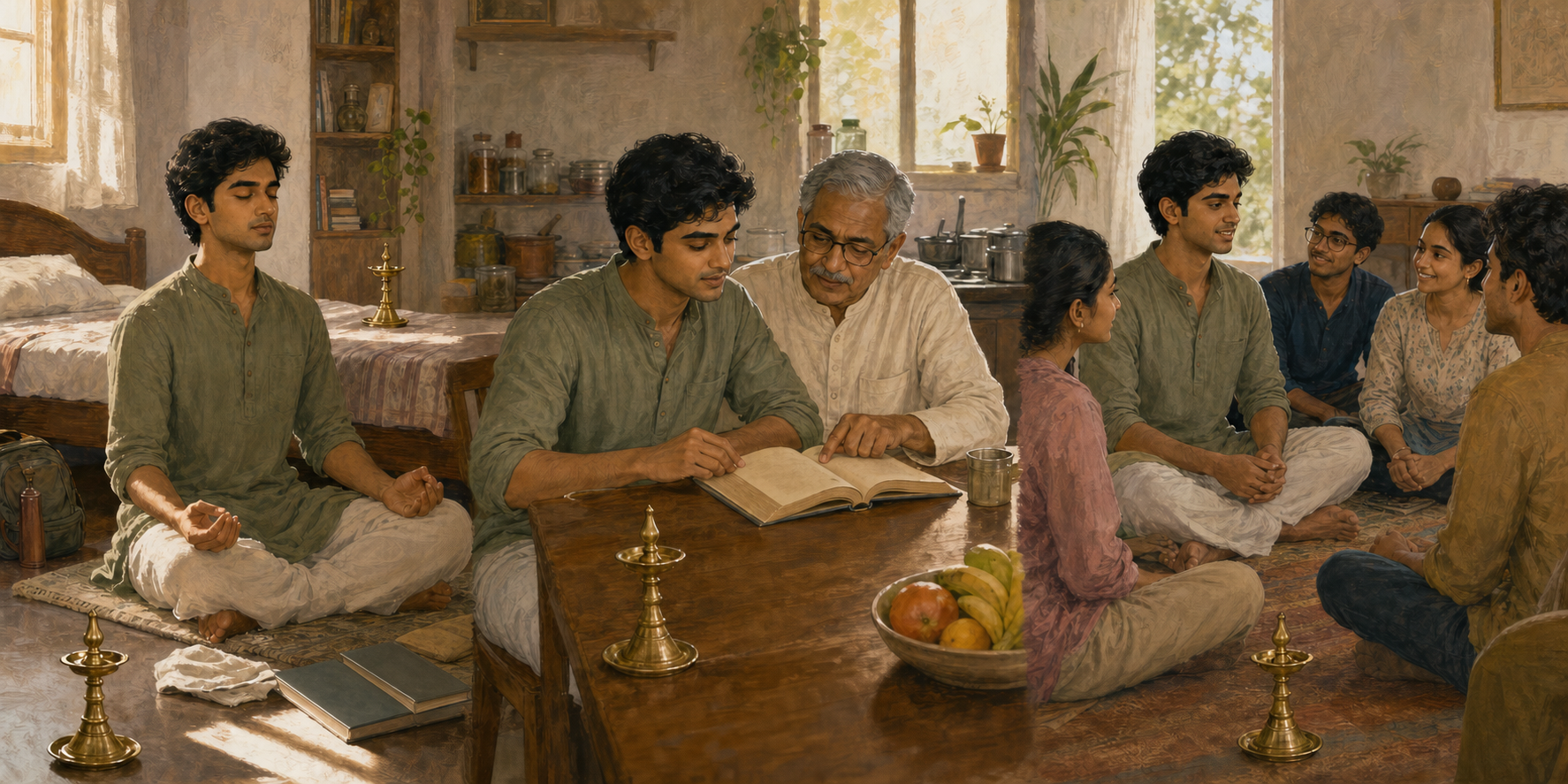
The setting at Chinmaya International Foundation carries unusual significance. Its Adi Sankara Nilayam is associated with Shankaracharya’s maternal home, placing young participants in the Kerala landscape connected with his beginnings. His later journeys across Bharat, the establishment of mathas in different directions and the remembered Kerala-to-Kashmir reach of his intellectual life show that spiritual transmission in Bharat has never depended on geographical sameness.
That history offers a demanding model of unity. Civilizational unity is not uniformity of language, region, ritual or temperament. It is the capacity to recognise a shared ground while allowing disciplined traditions to retain their forms. A youth retreat contributes to that continuity when it helps participants encounter another region of Bharat as part of their own inheritance rather than as an exotic destination.
The programme operates under the Acharya Shankar Sanskritik Ekta Nyas, an initiative connected with the Department of Culture of the Government of Madhya Pradesh. Its retreats aim to form Shankar Doots, or ambassadors of Shankaracharya’s message, alongside wider initiatives associated with the Statue of Oneness at Omkareshwar and Ekatma Dham.
An ambassador of Advaita should not be reduced to a distributor of slogans. The more credible task is to make the teaching visible in conduct. In a family disagreement, that means refusing to dehumanise the other person. In a study circle, it means reading a text carefully enough to separate doctrine from social-media shorthand. In professional life, it means not using spiritual language to conceal dishonesty or evade responsibility. In community work, it means helping create the conditions through which another young person can study, practise and ask difficult questions.
Public institutions can provide venues, teachers, access and cultural scale. They cannot perform continuity on your behalf. That work passes through the participant, the household, the guru-shishya relationship, the study circle and the repeated return to sadhana.
If you are choosing a retreat, request the full schedule, teacher details, texts and continuation expectations before committing. If you have already returned from one, complete your continuation card and contact a serious practice companion before the memory becomes merely pleasant. The legacy of oneness moves forward when the next ordinary day is brought into the discipline.
References
