
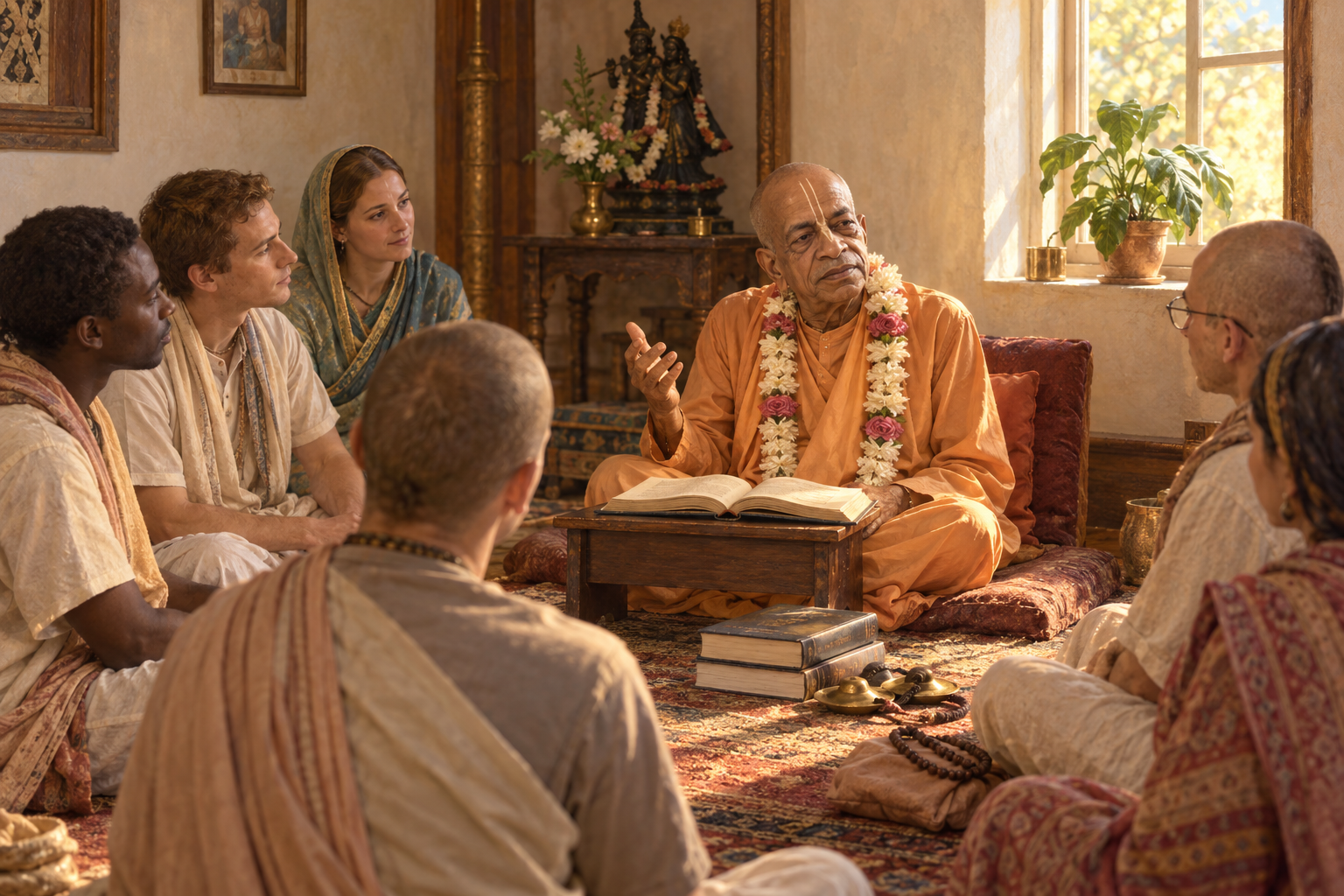
You may honor Srila Prabhupada and still wonder what devotional service asks of you before work begins tomorrow. Is bhakti a feeling, a schedule of religious activity, obedience to a guru, or a living relationship with Krishna?
His life joins the answer to the practice. Hear with attention, keep Krishna at the center, and convert the abilities you already possess into service. This matters because religious busyness can coexist with a self-centered motive. The test of bhakti is not how spiritual an activity looks, but whom it is meant to please.
Read his life as a sequence of offerings

A.C. Bhaktivedanta Swami Prabhupada’s 1965 voyage to America is often remembered as an extraordinary passage from Bharat to the West. Its practical meaning, however, lies deeper than the drama of travel. He accepted unfamiliarity in order to transmit Krishna-bhakti. The governing choice was service over personal ease.
His intellectual work expressed the same choice. Prabhupada edited an English version of Bhakti Rasamrita Sindhu, bringing the theology of devotional relationship into a form that new readers could approach. Accessibility did not require replacing Krishna with an undefined ideal. The language could cross a cultural boundary while the object of devotion remained precise.
Devotees continue to hear retellings of Srila Prabhupada-lilamrita because a remembered life can train judgment. Yet biography becomes sadhana only when admiration leads to a changed decision. Otherwise, even a saint’s sacrifices can become spiritual entertainment.
When you hear an episode from his life, pause before moving to the next one. Ask four questions:
- What duty did he recognize in this situation?
- What comfort, habit, or social expectation could have distracted him?
- What principle remained fixed when the surrounding culture changed?
- What is the smallest faithful expression of that principle available to you now?
This keeps you from confusing imitation with following. You do not need to reproduce the external circumstances of Prabhupada’s life. You need to notice the principle directing his action and apply it within your actual responsibilities. His journey may prompt one person to teach, another to translate, another to support a temple, and another to make a neglected household duty into a careful offering.
Devotional service changes the center of action

Within Srila Prabhupada’s Gaudiya Vaishnava teaching, Krishna is not an impersonal symbol onto which a devotee projects private meaning. Krishna is the eternal Supreme Person and the source of spiritual relationship. His complete attraction is understood through the fullness of wealth, strength, influence, beauty, knowledge, and renunciation. Devotional service therefore has a definite recipient.
This makes bhakti different from using religion for self-improvement alone. Discipline, clarity, and peace may arise, but they are not the final object. If you chant only to become calmer, serve only to be admired, or study only to defeat someone in debate, the activity may look devotional while the ego remains at its center.
Before calling an action seva, use three checks:
- Object: Can you state clearly that the act is for Krishna’s satisfaction, rather than merely attaching His name afterward?
- Manner: Is the act honest, attentive, and compatible with dharma? Good intention does not turn careless or harmful conduct into devotional service.
- Claim: Can you complete it without demanding recognition, control, or a particular emotional reward?
These checks apply equally to visible and hidden work. A temple responsibility performed for status can remain ego-driven. Cleaning, preparing food, earning honestly, caring for a dependent, or helping a congregation can become part of devotional life when Krishna is consciously remembered, the work is done properly, and possessiveness over the result is reduced.
This does not mean that motive must already be perfectly pure. Waiting for perfect motivation can become another excuse for inactivity. Begin the service, notice the mixed motive without defending it, and redirect your attention. Purification occurs through repeated return, not through declaring yourself pure in advance.
Rasa is relationship, not emotional display

One of Prabhupada’s important contributions was to preserve the relational depth of bhakti. Rasa means more than a passing mood. It points to the spiritual quality of exchange between Krishna and those related to Him. Human emotions are not dismissed, but material sense experience is understood as a distorted reflection of a deeper spiritual reality.
The tradition describes Krishna as the reservoir of rasa. It recognizes modes such as shanta, or peaceful regard; dasya, or service; sakhya, or friendship; vatsalya, or parental affection; and madhurya, or conjugal love. A wider account of twelve rasas associated with Krishna also includes wonder, humor, chivalry, mercy, anger, fear, and other forms of response. The point is not that every emotion is automatically spiritual. The point is that the full capacity for relationship has its origin and completion in the Supreme Person.
For a beginner, rasa should clarify the goal without becoming a role to perform. An emotional surge may be sincere as an emotion, but it is not by itself proof of a realized relationship. Visible intensity is especially unreliable when it disappears as soon as there is no audience.
Watch for four common mistakes:
- Choosing an elevated devotional identity while avoiding ordinary service.
- Trying to reproduce advanced emotion through gesture, vocabulary, or imagination.
- Using a claimed spiritual mood to excuse broken commitments or disregard for others.
- Judging another devotee’s inner life by outward expressiveness.
A sounder question is not, Which rasa belongs to me? It is, How can I serve faithfully today? Dasya, the disposition of service, gives you a practical place to stand. Hearing, chanting Krishna’s names, caring for sacred spaces, studying, assisting devotees, and completing an entrusted duty all train attention away from self-display and toward the one being served.
As practice matures, look for steadiness rather than spectacle. You should become more willing to serve when unseen, more careful with responsibility, less hungry for credit, and more attentive to Krishna as a person. These signs do not prove spiritual attainment, but they are more useful than attempting to classify every feeling.
A seven-day reset for your own practice

If your devotional life has become vague or mechanical, use the following seven-day sequence as a diagnostic reset. It is not a replacement for commitments received from your guru or established community. Keep those commitments intact and use this sequence to recover their center.
- Day one – name the recipient. Before your regular practice, say plainly that the time and attention are being offered to Krishna. Write down one reason you usually practice and notice whether it centers Krishna, your own relief, or other people’s approval. Do not edit the answer to make it sound devotional.
- Day two – hear before interpreting. Read a short portion of Bhagavad Gita, Bhagavatam, or a teaching of Srila Prabhupada slowly. Record what it reveals about Krishna, what it asks of the devotee, and one action it corrects. This prevents reading from becoming the collection of attractive quotations.
- Day three – chant with one-pointed attention. Keep the chanting commitment you have received. When attention wanders, return it to Krishna’s name without turning the lapse into either an excuse or a crisis. The meaningful action is the return.
- Day four – perform one unseen service. Choose a needed task that is unlikely to bring praise. Clean something, prepare something, correct neglected work, or help someone complete a responsibility. Do it well enough that another person does not need to repair it.
- Day five – examine your claim on the result. Notice what you expect after serving: thanks, agreement, influence, comfort, or a particular spiritual sensation. Offer the work without pretending that the expectation is absent. Then refuse to let that expectation decide whether the service was worthwhile.
- Day six – serve a relationship. Assist a devotee, family member, congregation, or guest in a concrete way. Listen carefully enough to discover what is actually needed instead of giving the help that best displays your own strengths.
- Day seven – review continuity. Mark which commitments you kept, where attention repeatedly wandered, and which form of service you can continue. Carry one sustainable practice and one concrete service into the next week. Do not add several new vows in response to one productive day.
At the end of the week, do not score the practice by emotional intensity. Ask whether you remembered the object of devotion more clearly, kept a promise more faithfully, and demanded less recognition for serving. If the answer is mixed, that is useful information. Adjust the practice and continue.
Key takeaways for steady bhakti
- Srila Prabhupada’s life is most useful when you read each episode as a decision about service, not merely as an inspiring event.
- Devotional service is directed toward Krishna; personal benefit may follow, but it is not the governing aim.
- A devotional appearance cannot compensate for a dishonest method, careless execution, or hunger for recognition.
- Rasa describes relationship with Krishna, not a spiritual personality type to assign yourself.
- Ordinary duties can become meaningful offerings when remembrance, dharmic conduct, attention, and reduced possessiveness are present.
- Consistency in hearing, chanting, and concrete service is a more dependable beginning than the pursuit of dramatic emotion.
Tomorrow, choose one fixed practice and one necessary act of service. State whom they are for before you begin. Keep them small enough to repeat and serious enough to require attention. Then let continuity, rather than spiritual self-description, show whether devotional service is becoming real in your life.
References
- Dandavats – HG Daivi Shakti Mataji || Srila Prabhupada Lilamrita || 11-10-2026
- Dandavats – Devotional Services

Leave a Reply
You must be logged in to post a comment.