
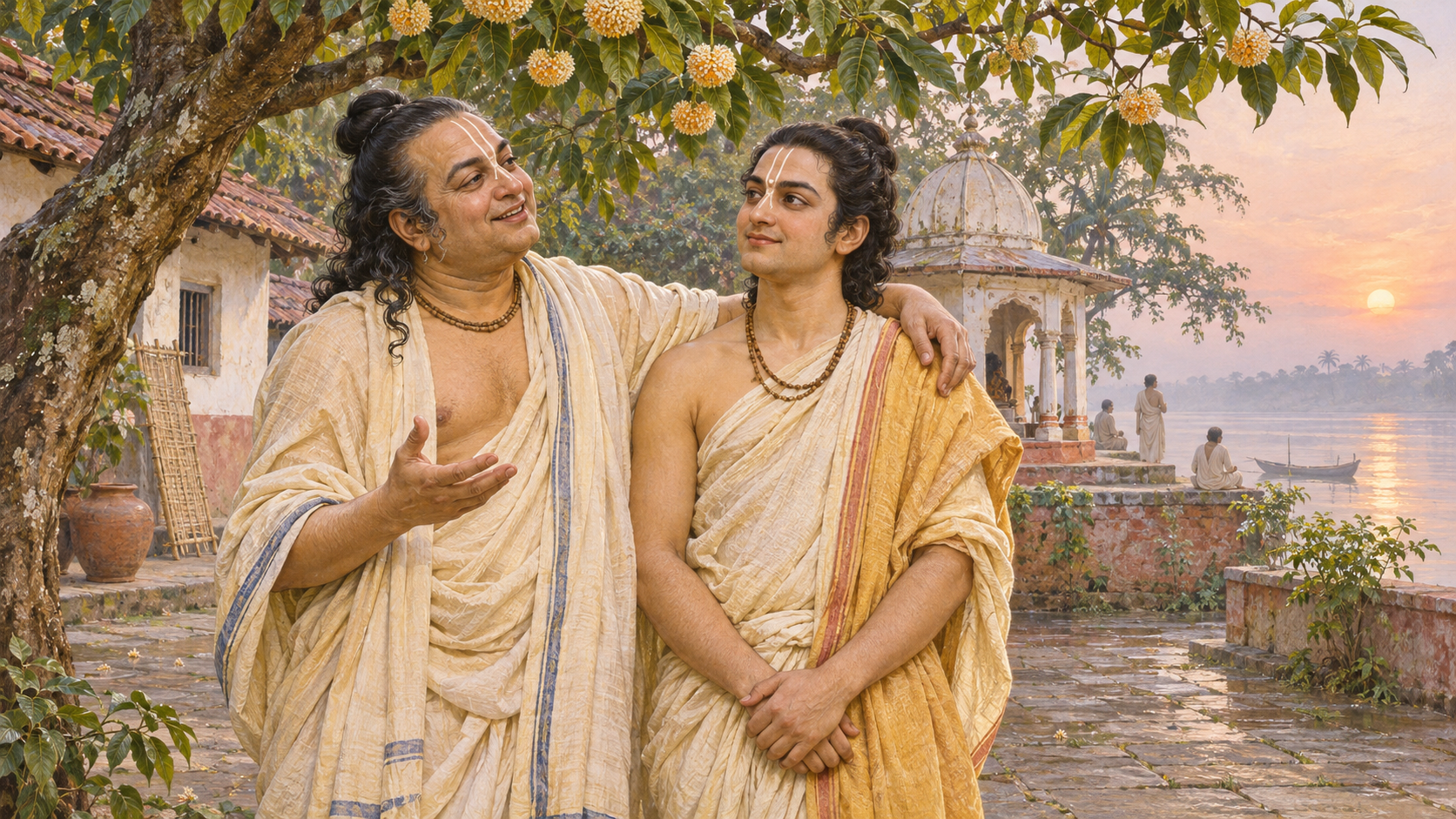
You may have encountered Sri Virabhadra simply as the son of Nityananda Prabhu and wondered what that relationship means for Gaudiya Vaishnava lineage. Does it describe a family connection, a teacher-disciple succession, leadership of a devotional community, or all three?
The careful answer begins by separating those possibilities. Doing so does not diminish Virabhadra. It prevents a sacred relationship from being burdened with claims that the word “son” cannot establish by itself.
Begin with the relationship that is actually stated
The clearest starting point is that Sri Virabhadra is identified as the son of Nityananda Prabhu. You can therefore speak confidently of a close family and household relationship. You should not automatically turn that statement into a complete chart of spiritual succession.
This distinction matters because religious traditions transmit more than ancestry. They transmit teachings, practices, responsibilities, forms of worship, initiation relationships and communal memory. A person may inherit a place within a revered household while also receiving spiritual instruction and public responsibilities. But each connection answers a different question and requires its own evidence.
Whenever you read that someone belongs to “Nityananda’s lineage,” replace that compact phrase with a complete question:
- Does lineage mean that the person belongs to Nityananda Prabhu’s family?
- Does it mean that the person received initiation or instruction from him?
- Does it mean that the person was entrusted with a particular devotional service?
- Does it mean that a later community traces its succession through that person?
If the speaker cannot say which meaning is intended, the claim is too vague to carry much historical or theological weight. Your first task is clarification, not acceptance or rejection.
Separate vamsha, parampara and sampradaya
Three ideas commonly become compressed into the English word “lineage.” Keeping them apart gives you a practical way to evaluate what you are reading.
| Term | What it describes | What you should look for |
|---|---|---|
| Vamsha | Family descent or kinship | An explicit statement of parentage or family relationship |
| Parampara | Transmission from teacher to disciple | A stated relationship of initiation, instruction or recognized spiritual formation |
| Sampradaya or branch | A continuing religious community and its inherited teaching | Subsequent teachers, shared practices, institutional memory and a traceable chain of transmission |
One person can stand within all three. The mistake is assuming that proof of one automatically proves the others. Sonship establishes a family relationship. It does not, without further evidence, establish every claim about initiation, exclusive authority, succession or the later history of a devotional branch.
This gives you a precise way to speak about Sri Virabhadra. You can say that he belongs to Nityananda Prabhu’s family line. If you want to describe him as a disciple, successor, leader or originating teacher of a particular branch, look for a tradition that states that relationship explicitly. Then identify whether the claim is accepted broadly or preserved by one community.
This discipline is especially important online, where “descendant,” “disciple,” “successor” and “representative” are often treated as interchangeable. They are not. A descendant comes through a family relationship. A disciple receives spiritual formation from a teacher. A successor assumes a recognized responsibility. A representative teaches or acts on behalf of a tradition. One person may fit several descriptions, but every description should be supported separately.
Let appearance-day remembrance become a method
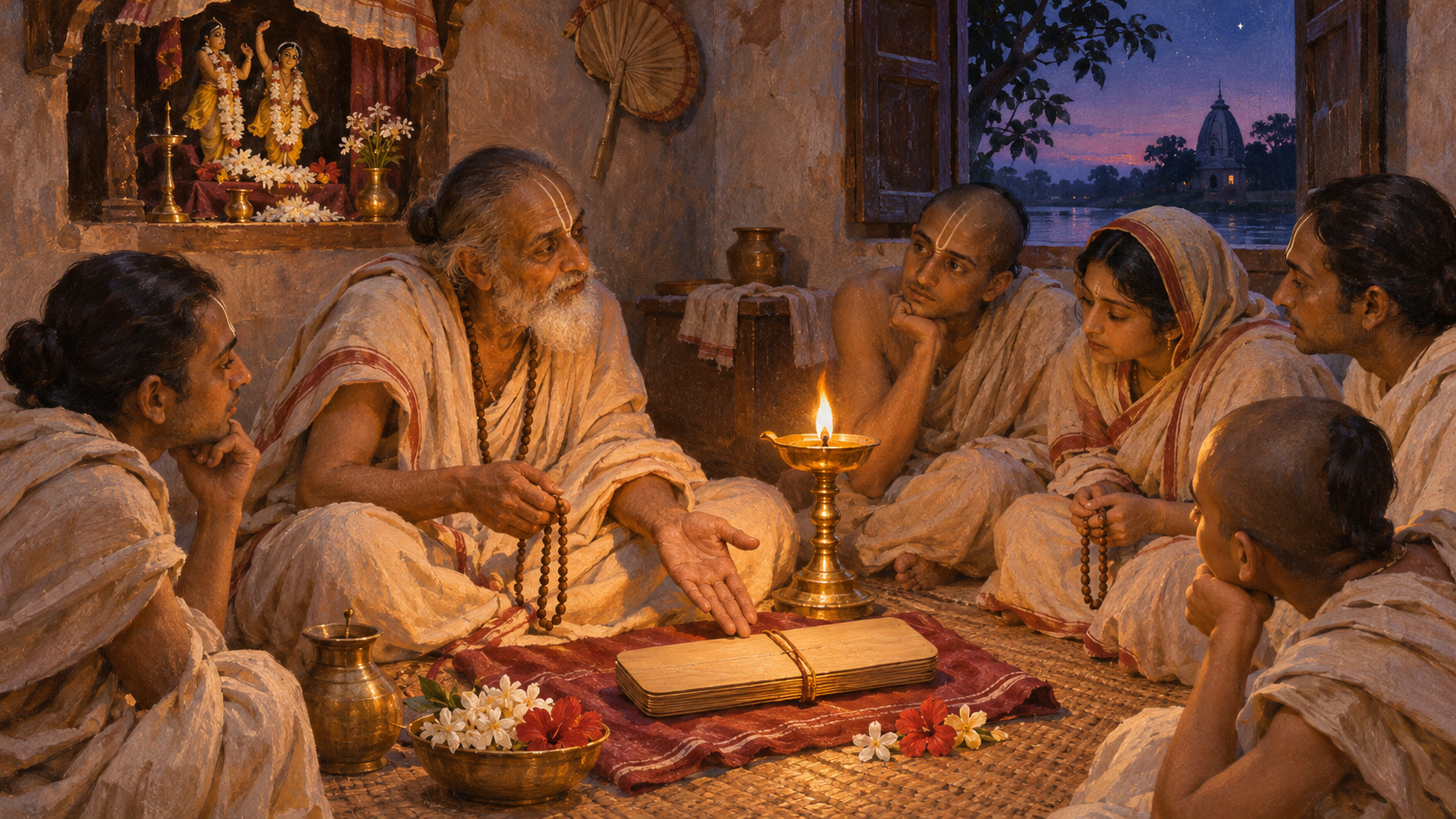
Sri Virabhadra is also remembered through an appearance-day observance. In Vaishnava practice, an appearance day is more than an occasion to place a historical name on a calendar. It is an invitation to remember a devotee through hearing, worship and service.
You do not need an inflated biography to observe the day meaningfully. A modest practice grounded in what you can verify is better than a confident collection of uncertain claims.
- State the known relationship accurately. Begin with Sri Virabhadra as the son of Nityananda Prabhu. Do not add titles of authority unless you know what tradition supports them.
- Read a traditional account with its setting intact. Note who is speaking, which community preserves the account and whether it describes kinship, instruction, service or succession.
- Join the devotional practice of your community. If your temple or household marks the day with nama-kirtana, hearing or worship, participate in that established form rather than inventing a ritual from scattered internet claims.
- Offer a concrete service. Help with the observance, support the temple, prepare prasada, assist another devotee or contribute to a community need.
- Record what remains uncertain. If you encounter a claim about initiation, leadership or descendants that you cannot verify, preserve it as a question. Do not repeat it as settled history.
This approach joins devotion with intellectual care. Precision is not coldness. When you refuse to embellish a sacred life, you protect the person being remembered as well as the community receiving the account.
Use five questions before repeating a lineage claim
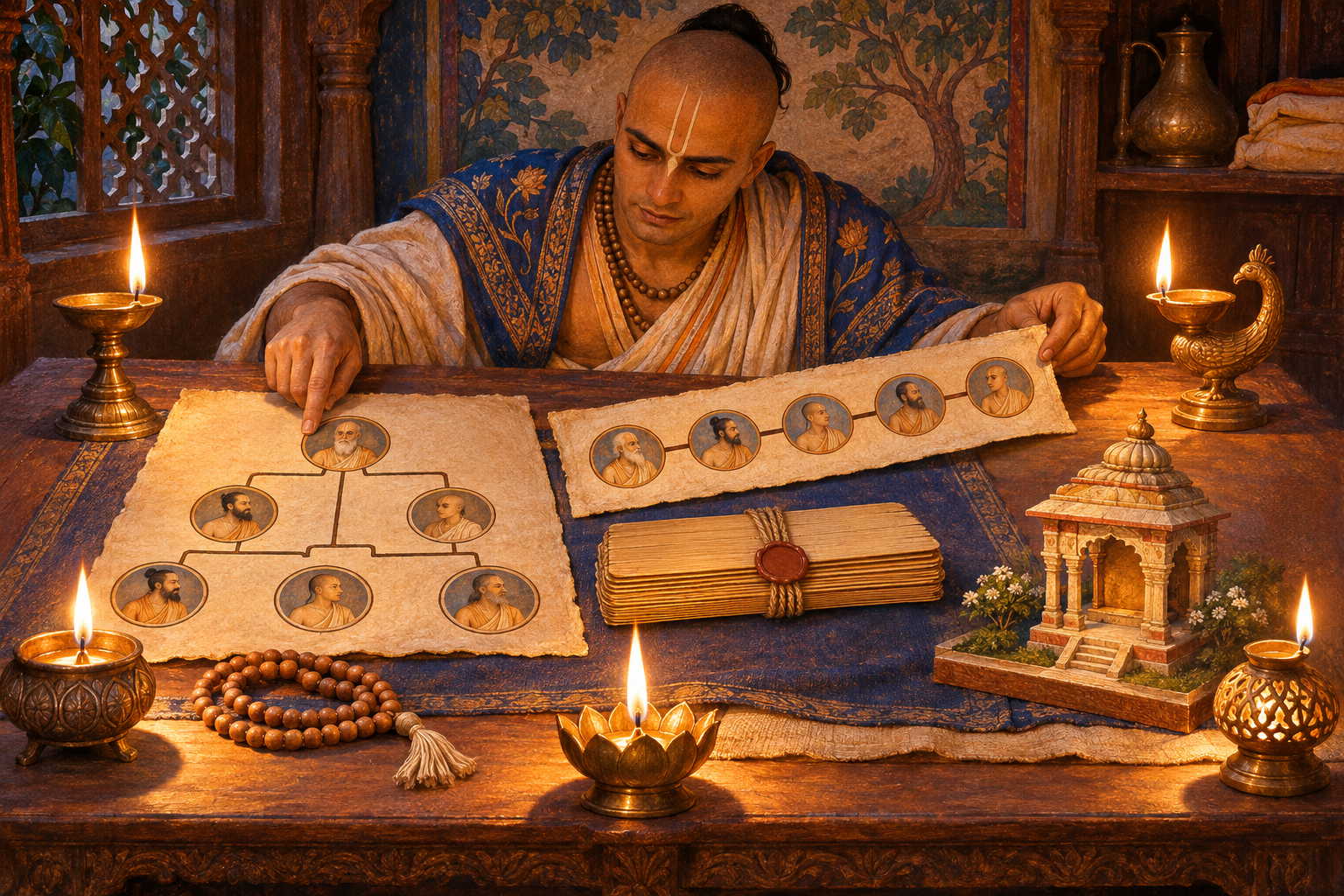
You can test almost any claim about Nityananda Prabhu’s lineage with the following questions. They are useful whether the claim appears in a lecture, family history, temple publication or social-media post.
- What exact relationship is being claimed? Replace “connected to” or “in the lineage of” with a precise term such as son, descendant, disciple, teacher, successor or member of a later branch.
- What kind of evidence would establish that relationship? Parentage needs genealogical testimony. Discipleship needs an account of instruction or initiation. Institutional succession needs recognition and continuity of responsibility.
- Who preserves the claim? Identify the named text, teacher, temple, family or devotional community. “Tradition says” is not yet specific enough.
- Is the claim shared or branch-specific? A community may faithfully preserve its own lineage without every other Gaudiya branch expressing the history in the same terms. Branch-specific does not mean false, but it should be labelled honestly.
- What conclusion is being drawn from it? A commemorative relationship, a teaching connection and a claim of exclusive authority have very different consequences. The stronger the conclusion, the more explicit the supporting chain must be.
Pay particular attention to exclusivity. The fact that a later community reveres Sri Virabhadra or traces its memory through him would not, by itself, prove that no other authentic form of transmission existed. Likewise, the presence of several devotional branches would not make his family relationship unimportant. These are different questions, and neither cancels the other.
Key takeaways
- Sri Virabhadra is identified as the son of Nityananda Prabhu; that is the firm starting point.
- Sonship establishes a family relationship, not every possible claim about discipleship, succession or exclusive authority.
- Use vamsha for family descent, parampara for teacher-disciple transmission and sampradaya or branch for a continuing religious community.
- When a lineage claim is vague, ask whether it concerns kinship, initiation, teaching, leadership or later institutional descent.
- Observe an appearance day through accurate remembrance, established devotional practice and concrete service rather than unsupported embellishment.
The next time you meet a claim about Sri Virabhadra and Nityananda Prabhu’s lineage, do one small thing before sharing it: rewrite “lineage” as the exact relationship being asserted. That single habit will make your study clearer, your speech more trustworthy and your remembrance more faithful.
References

Leave a Reply
You must be logged in to post a comment.