
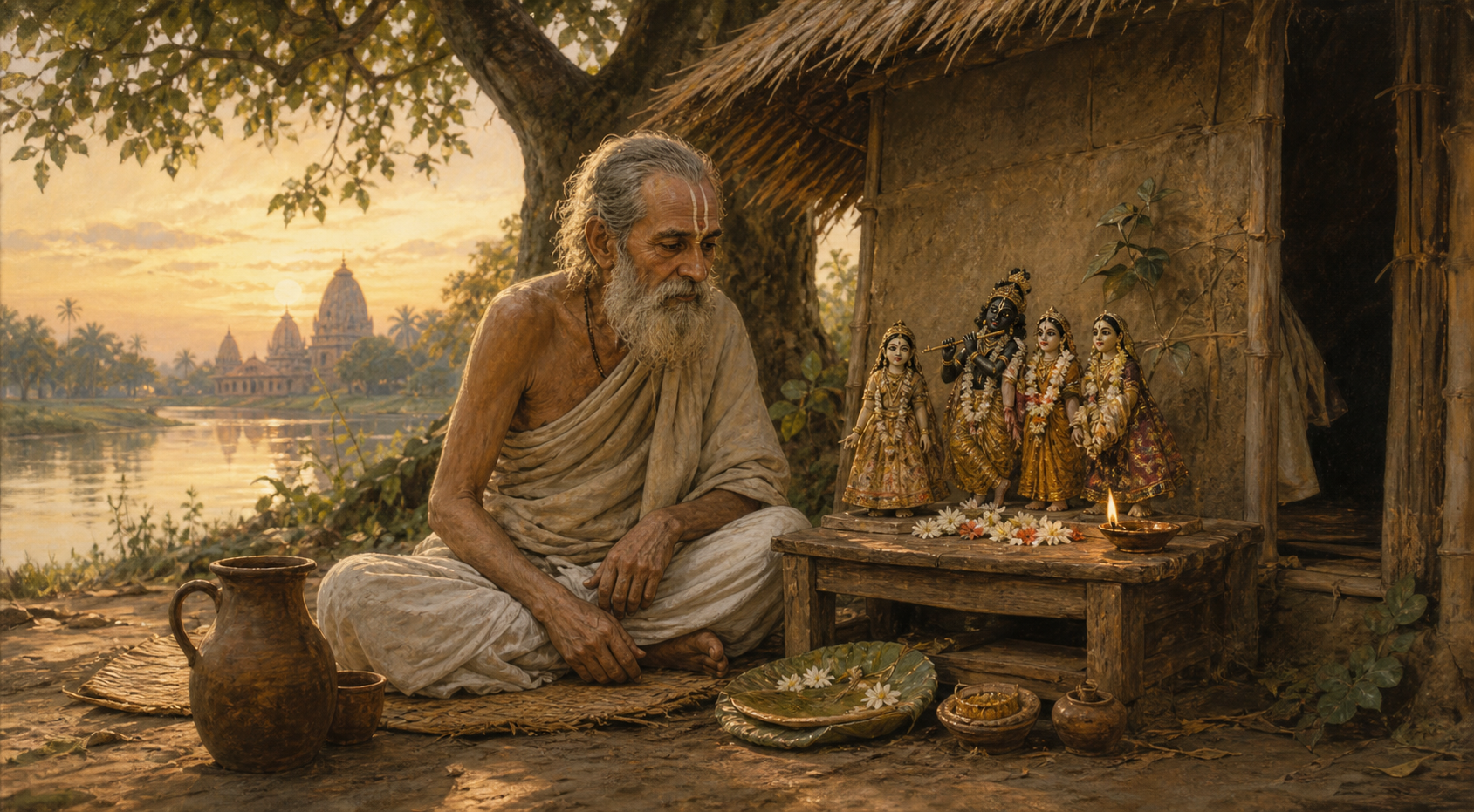
You may have encountered Sri Vamsidasa Babaji through a startling image: an austere sadhu speaking to his small Deities, serving them like members of his household, and paying little attention to how the outside world judged him. The important question is not whether you can reproduce his unusual life. You cannot, and you should not try. The useful question is what his life reveals about devotion when Krishna is no longer an idea but the center of one’s relationships and choices.
His example becomes practical once you separate its heart from its outward form. The heart was attentive, personal seva. The outward form was the life of an exceptionally renounced and spiritually absorbed Vaishnava. Your task is to cultivate the first without pretending to have attained the second.
Key takeaways
- Vamsidasa Babaji’s defining quality was not poverty, eccentricity, or solitude. It was his intimate relationship with Krishna through constant seva.
- He is remembered especially for serving Gopala with vatsalya, the affection and responsibility of a parent caring for a child.
- His disregard for ordinary conventions reflected an advanced state of absorption. It is not a method for beginners or a reason to neglect disciplined sadhana.
- You can follow the principle behind his life by making one daily act of worship more attentive, personal, clean, and dependable.
- The safest sign that remembrance is becoming genuine is not unusual behavior. It is less ego, steadier service, and greater care for Bhagavan and other beings.
From East Bengal to a life centered on Krishna

Born as Bhairava in Majitpur in East Bengal, in present-day Bangladesh, Vamsidasa came from a poor fishing household. He entered household life but eventually left it for the life of a renunciant. After receiving Vaishnava initiation, he became known as Vamsidasa Babaji.
That beginning matters. His detachment did not grow from social prestige, scholarly status, or material security. The direction of his life was away from possession and toward absorption. He came to be associated closely with Navadvipa, the sacred land of Sri Chaitanya Mahaprabhu, and lived in the manner of a bhajananandi: a devotee whose principal work is secluded hearing, chanting, remembrance, and worship rather than public preaching or institution-building.
This distinction helps you read his life accurately. A bhajananandi is not necessarily indifferent to other people, and a preacher is not necessarily less contemplative. The words identify the dominant form of service. Vamsidasa taught mainly by what his days revolved around. Food, travel, shelter, conversation, and effort were all subordinated to his Deities and his bhajana.
His outward life was radically austere, and his appearance could be disheveled or difficult for conventional society to understand. Yet respected Gaudiya Vaishnavas recognized spiritual substance beneath that exterior. His standing did not depend on making himself presentable to gain followers. Nor did he turn renunciation into a public performance.
You should notice what disappeared from his life as devotion deepened: concern for reputation, comfort, and control. You should also notice what did not disappear: service. Detachment was not emptiness. It cleared attention for a relationship he regarded as more real and more binding than social approval.
His Deities were not objects arranged on a shrine
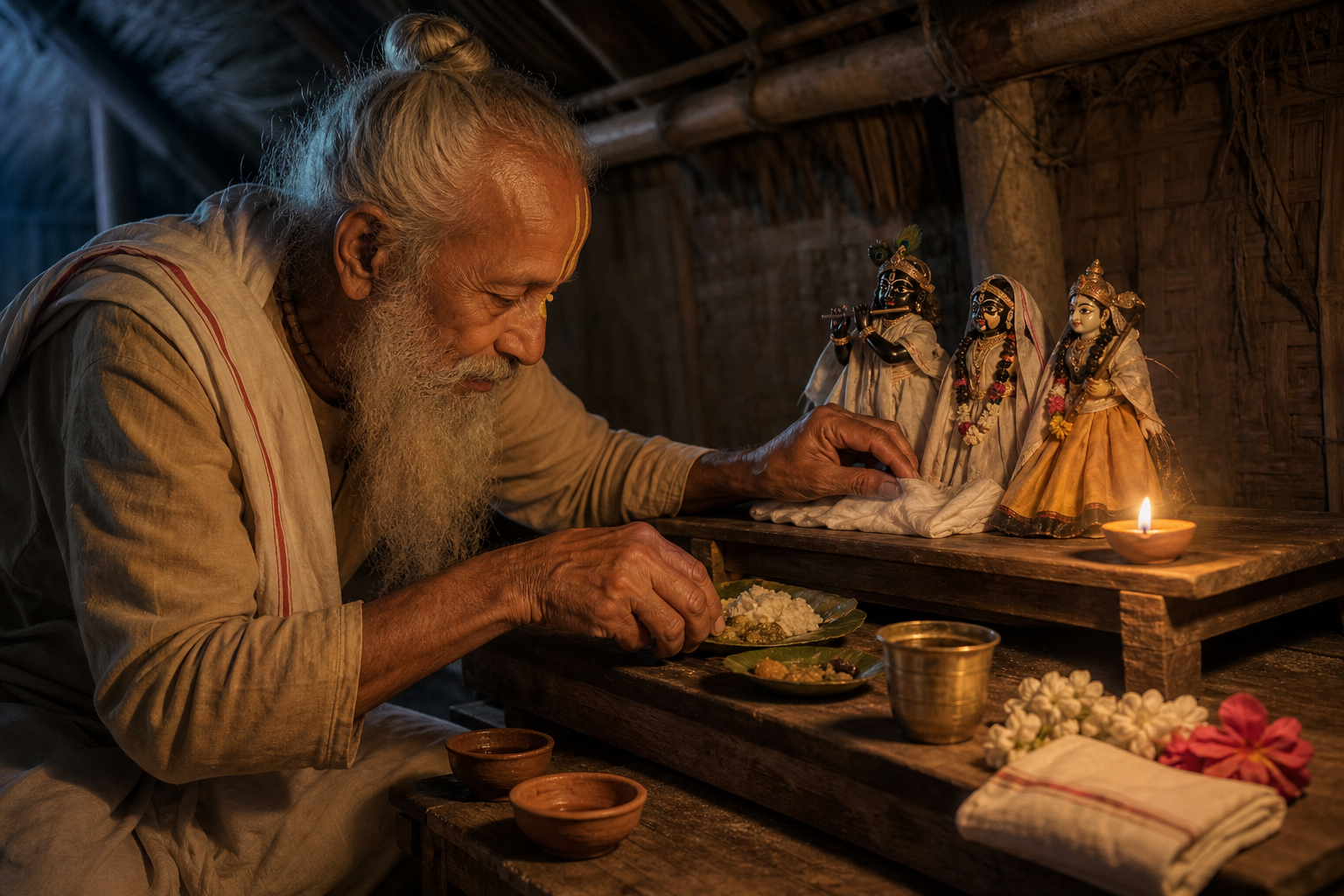
Vamsidasa Babaji worshipped Gaura-Nitai, Radha-Govinda, and Gopala. He spoke to his Deities, carried them with him, prepared offerings for them, and sometimes addressed them with the unguarded familiarity of family. Gopala was especially served in vatsalya-bhava, the devotional mood in which Krishna is loved as a dependent child.
Vatsalya is easy to sentimentalize. Its real demand is responsibility. A parent does not merely feel affection and then move on. A parent remembers whether the child has eaten, is properly dressed, is comfortable, and is safe. In Vamsidasa’s worship, love appeared as repeated attention. He gathered what was needed, cooked, offered, carried, protected, and conversed.
The remembered episodes can sound strange when removed from the theology of murti-seva. Within Vaishnava practice, the consecrated form is not treated as a decorative reminder of an absent God. Bhagavan graciously accepts service through the arca-vigraha, a form accessible to the devotee’s senses. Bathing, dressing, feeding, awakening, and resting the Deity are therefore acts within a relationship, not chores performed for an inert possession.
His affectionate conversations could include complaint, pleading, humor, and rebuke. Gaudiya Vaishnavas remember this freedom as a sign of intimacy, not irreverence. Formal distance had yielded to direct dependence and loving exchange.
You need not manufacture that manner of speech. Begin with the principle underneath it: stop treating worship as an item to complete. When you offer food, pause long enough to remember whom you are feeding. When you light a lamp, look at the Deity rather than at your next task. When you chant a name, hear it as an address. Relationship starts to enter ritual when attention remains with the person being served.
Why his holy eccentricity must not be imitated
Some readers become fascinated by the least transferable features of a saint’s life: unconventional dress, disregard for schedules, cryptic speech, extreme fasting, or indifference to social manners. Those features are dramatic. They are also where careless imitation begins.
Vamsidasa Babaji did not always follow the regulated external program expected of ordinary practitioners. Gaudiya tradition understands this in relation to his deep spontaneous absorption. That explanation does not convert irregularity into a recommended practice. It identifies an exceptional state in which loving remembrance had become continuous.
Vaidhi-bhakti, disciplined devotion guided by instruction, protects a practitioner whose remembrance is not yet spontaneous. A regular time for japa, standards of cleanliness, appropriate offerings, scriptural hearing, and accountable guidance are not obstacles to love. They create the conditions in which attention can become steady. Raga, mature spiritual attachment, is not another word for whim.
This gives you a clear test. If abandoning a rule leads to more distraction, self-importance, inconvenience for others, or neglect of duty, it is not Vamsidasa’s renunciation. It is ordinary preference wearing sacred language. Advanced absorption should not be claimed on the strength of disorder.
Use three questions when an extraordinary saintly behavior tempts you to copy it:
- What produced the behavior? In Vamsidasa’s case, the tradition points to continuous remembrance and love. If your motive is impatience with discipline, the resemblance is only external.
- What fruit does it produce? Genuine bhakti deepens service and diminishes ego. A practice that makes you careless, theatrical, or contemptuous of other devotees is moving in the wrong direction.
- What is your actual instruction? Follow the guidance appropriate to your stage, especially the instructions received from guru and the standards of your sampradaya. Do not extract an exceptional act from a saint’s life and make it outrank the path you were given.
This is also why household responsibilities cannot simply be dismissed as material. Caring for dependents, keeping commitments, earning honestly, and maintaining health may be part of your dharma. Leaving those duties without rightful discernment would imitate the silhouette of renunciation while missing its surrender.
Turn admiration into one dependable act of seva
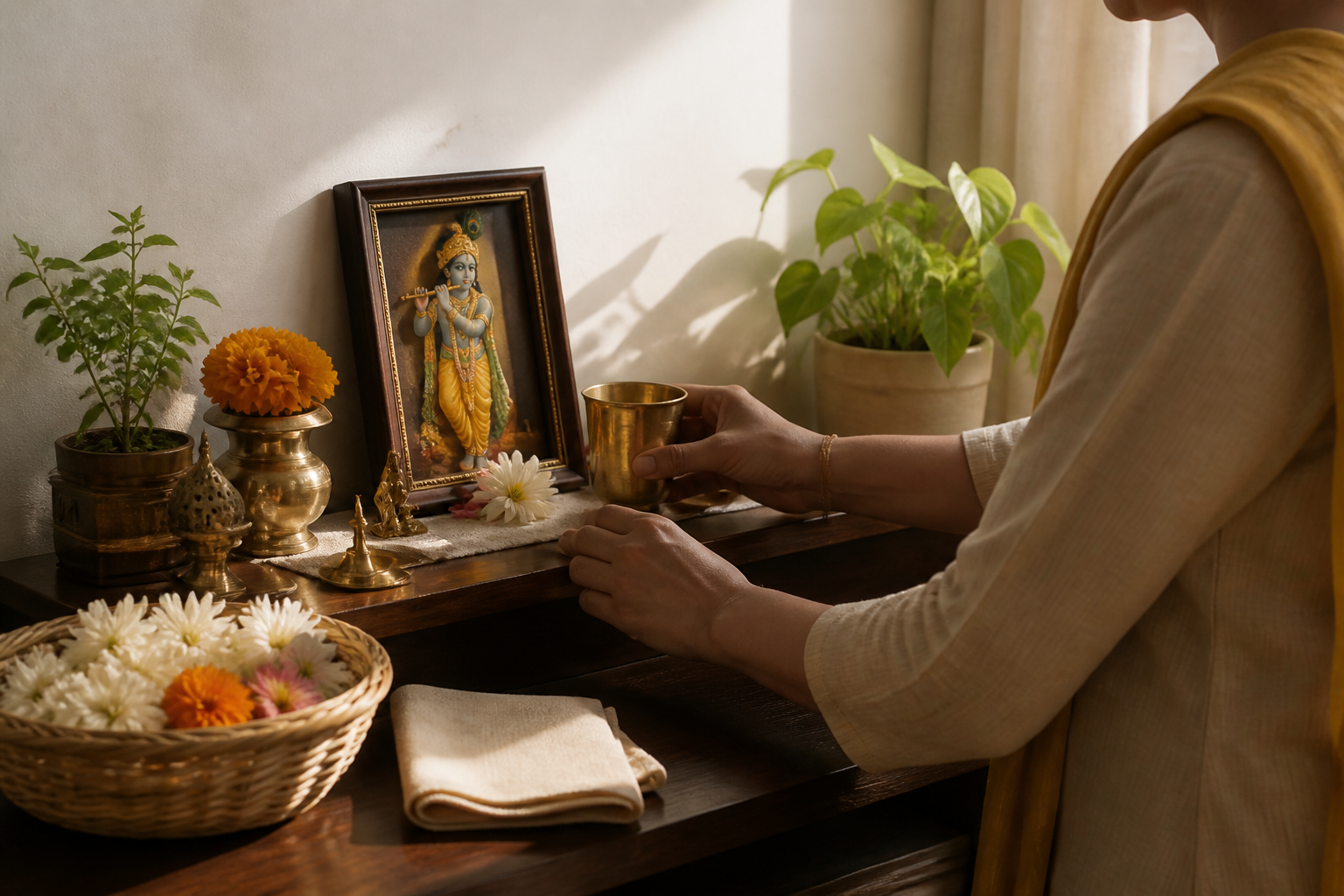
Vamsidasa Babaji’s life can change your practice without changing your clothes, address, occupation, or family situation. Start where his devotion was most concrete: make the Lord’s place in your day less theoretical.
- Choose one daily anchor. Select a service you can perform at a stable point in the day: refreshing the Deity’s water after bathing, offering the household meal before anyone eats, or sitting for your prescribed nama-japa before opening messages. Keep it small enough that a demanding day does not erase it.
- Prepare before you begin. Wash your hands, clear the place of worship, assemble what the service requires, and put the phone out of reach. This prevents the offering from becoming a trail of interruptions.
- Address Bhagavan personally. Use the mantra or prayer proper to your tradition, then add a plain and sincere sentence if appropriate: acknowledge what you are offering, ask that it be accepted, or admit that your attention is scattered. Specific address is better than pretending to possess elevated emotion.
- Include the unglamorous part. Clean the vessel, restore the altar, put materials away, and leave the space ready for the next service. Vatsalya becomes visible in care before and after the ceremonial moment.
- Protect regulation from imitation. Keep the commitments given by your guru or community. If you have not received formal instruction, favor simple nama remembrance, respectful worship, and reliable association over complicated vows copied from an advanced renunciant.
- Remove one rival to remembrance. It may be checking the phone during japa, buying more devotional objects than you can maintain, or consuming many teachings while practicing none of them. Simplicity is useful when it returns attention to seva.
At the next remembrance of Vamsidasa Babaji, you can honor him without imitating him. Hear or read his life, chant Krishna’s names, offer suitable food, distribute prasada, and examine the quality of your own service. Ask one exact question: where has familiarity made you careless with something you once offered attentively?
Then repair that one place. Refresh the neglected offering. Keep the promised time. Listen to the name you are chanting. Vamsidasa’s life points toward a devotion in which Bhagavan is not confined to the altar but becomes the person around whom the day is arranged. Let your next act of seva, quietly and without display, move in that direction.
References
