
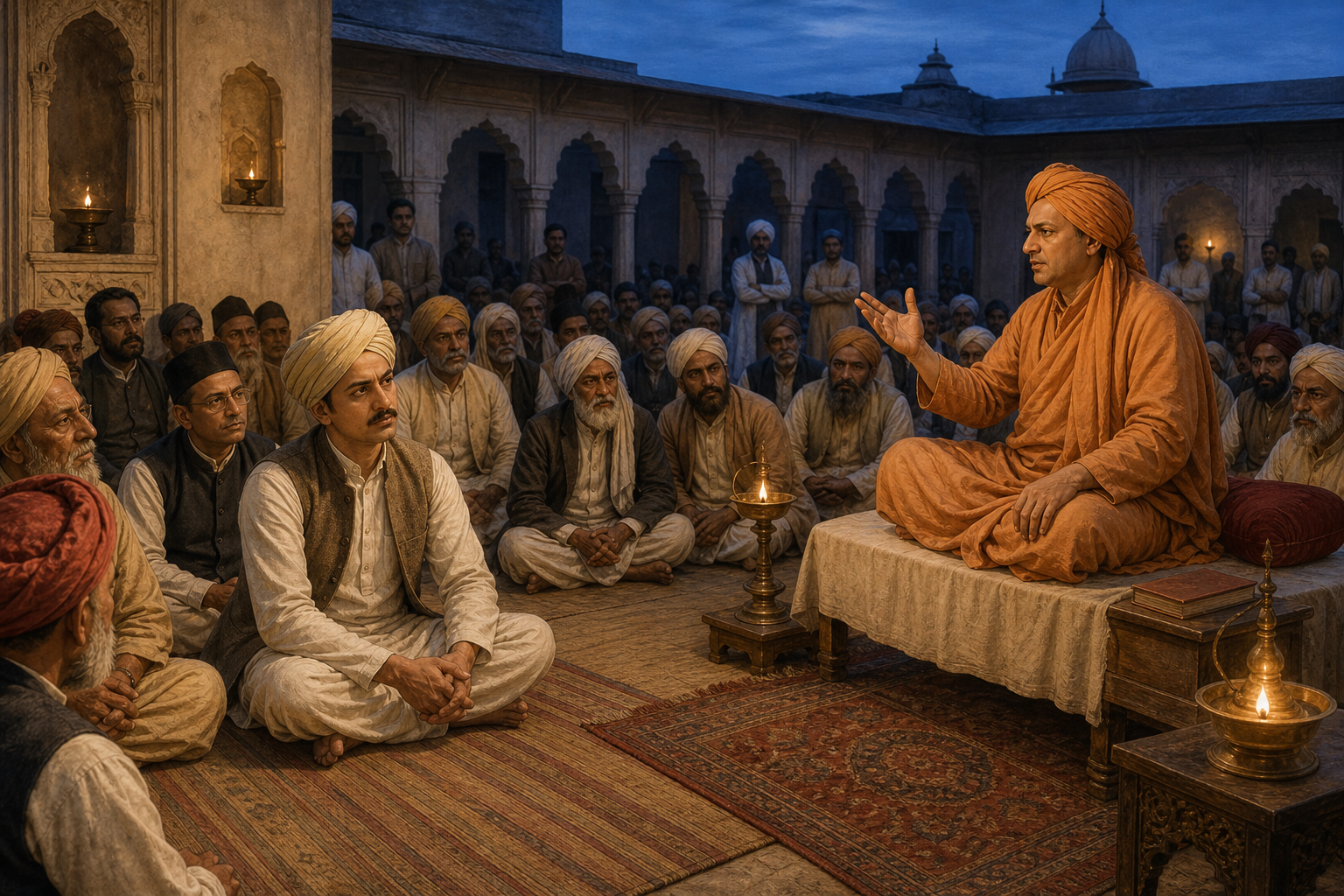
If you have heard this episode as a simple tale of a wayward young man meeting a saint and immediately becoming righteous, you have heard too little. Its real value lies in the sequence: a disciplined beginning, a loss of self-command, failure, an open path to official advancement, and then an encounter that redirected Munshi Ram toward the Vedic path.
For you, the important question is not whether one dramatic night can make a good story. It is how to recognize a genuine spiritual turning point without inventing dialogue, erasing the struggle that preceded it, or turning reform within Hindu Dharma into a sectarian contest.
The disciplined household behind the wayward youth
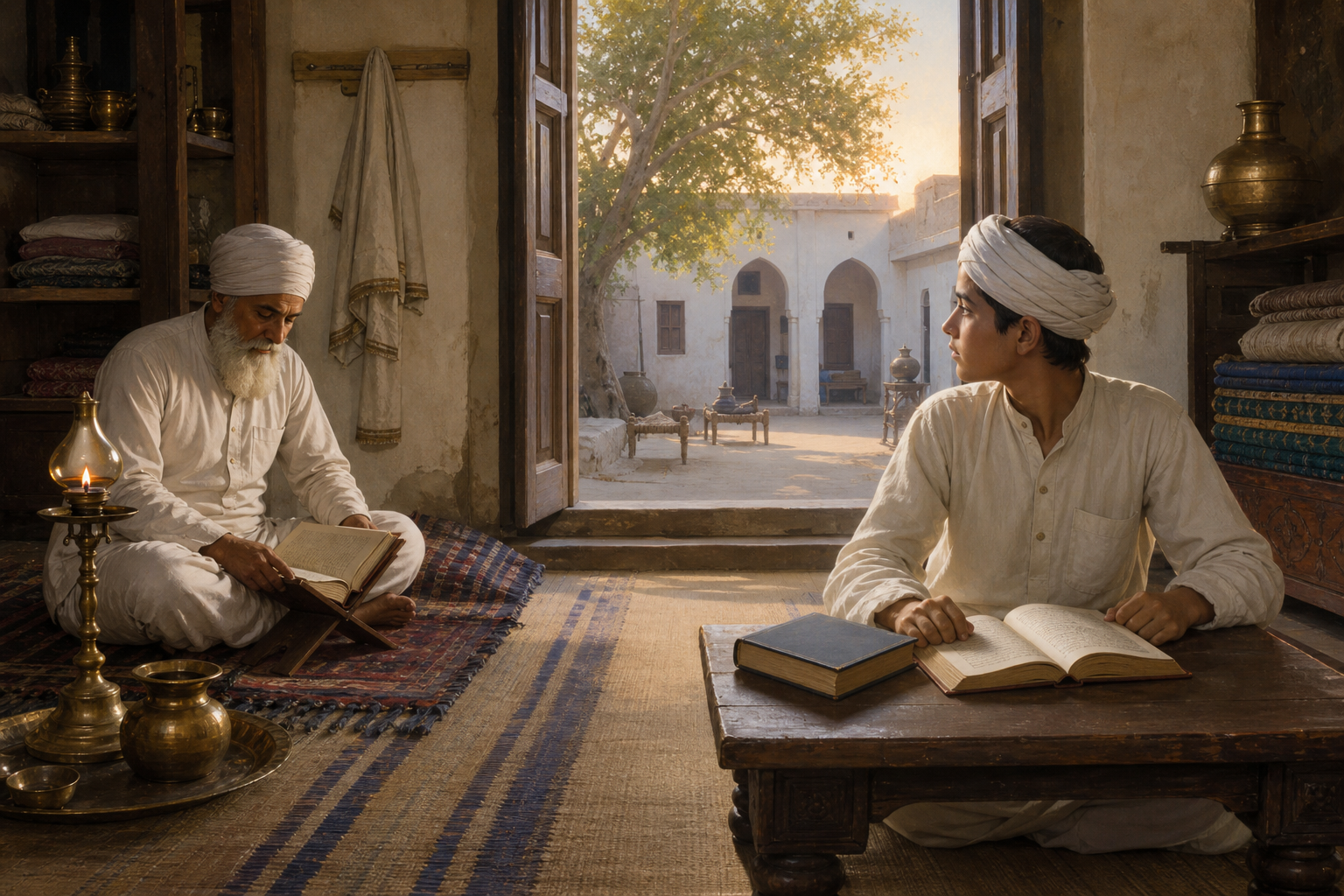
Munshi Ram was born in 1856 at Talwan in the Jullundar district. His father, Lala Nanak Chand, was a Khatri and a daroga, or police sub-inspector, in the Northwest Province. He was known for honesty and worshipped Shiva. Munshi Ram’s mother was deeply devoted to Shiva’s Shakti in the forms of Uma, Durga, and Kali.
This family setting matters. Munshi Ram did not begin life without Dharma, parental care, or an example of personal integrity. Nor was he an incapable student. He developed a powerful physique through regular exercise, possessed a naturally bright intelligence, and initially applied himself seriously to learning.
That combination prevents an easy explanation of his later decline. Lack of ability did not cause it. An irreligious home did not cause it. His early strengths were real, but they depended partly on a structure that he had not yet learned to reproduce within himself. Once the external supervision disappeared, inherited values and cultivated abilities did not automatically govern his conduct.
This is the first point to notice in your own reading of the episode: receiving a Dharmic inheritance is not the same as consciously choosing it. Family samskaras can give a person language, memory, and moral orientation. They cannot make every later decision on that person’s behalf.
Benares exposed the difference between talent and self-rule
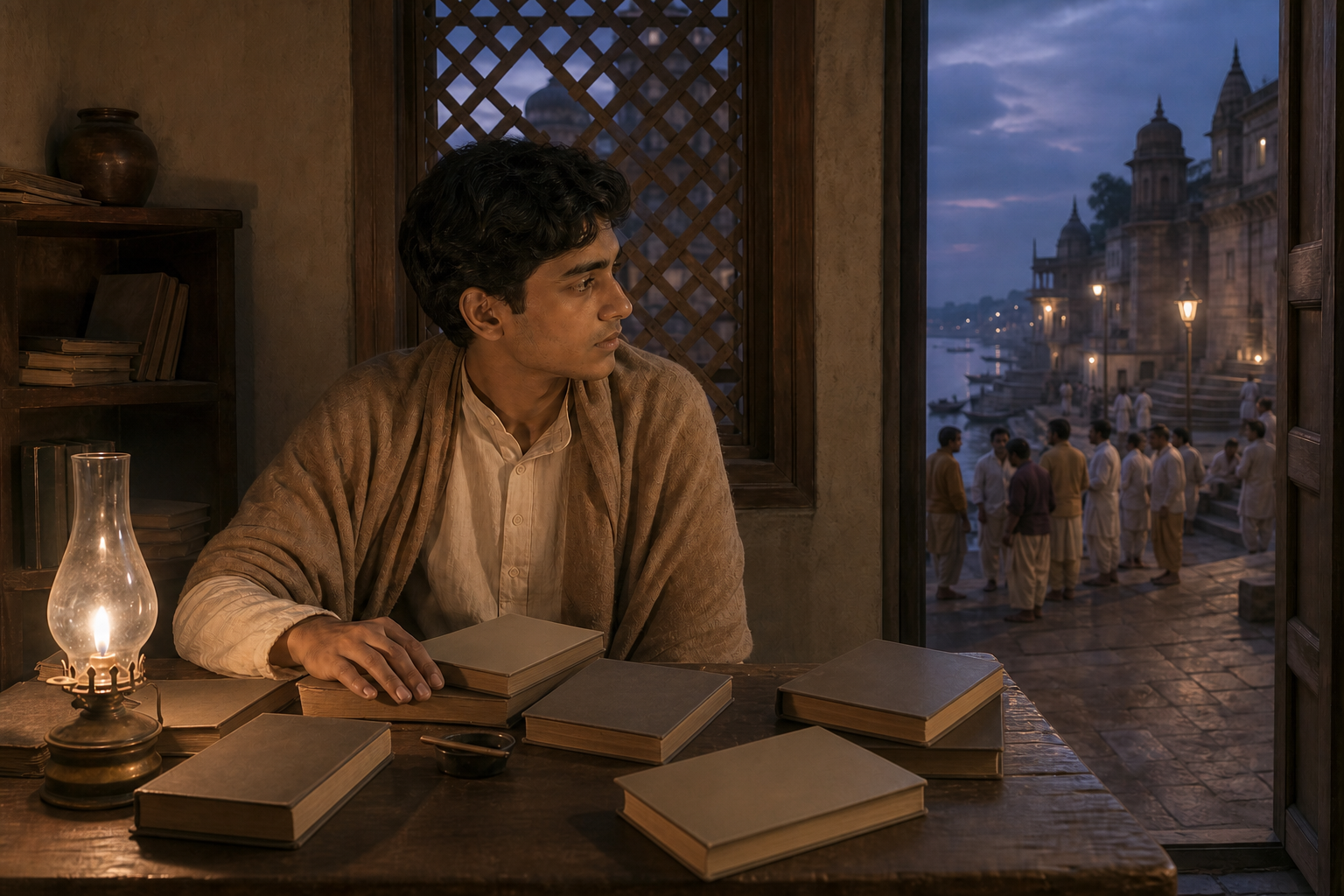
When Munshi Ram entered college at Benares and moved beyond his mother’s direct oversight, his habits deteriorated. Undisciplined living affected both body and mind, and he failed the First in Arts examination. The contrast is sharp: the young man who had trained his body and polished his intellect could not preserve either merely by remembering that he once possessed them.
It is tempting to embellish this phase with lurid details. That would obscure rather than clarify it. The established facts are sufficient: his conduct became destructive, its consequences reached his health and studies, and academic failure followed. No invented vice is needed to make the moral problem look serious.
Failure did not leave him without respectable prospects. He entered public service without graduating, and senior officials who were pleased with his father arranged an opening for him as a Naib Tehsildar. Such a position could have placed him on an ascending administrative path. Yet he did not choose to climb that ladder.
This detail changes how you should understand the crisis. Munshi Ram was not simply driven toward religion because every worldly door had closed. One door had closed through failure, but another had been opened through family standing and official goodwill. His deeper problem was direction: what kind of life was he willing to choose when ability, inherited identity, and conventional advancement no longer supplied an adequate centre?
What we can responsibly say about the encounter
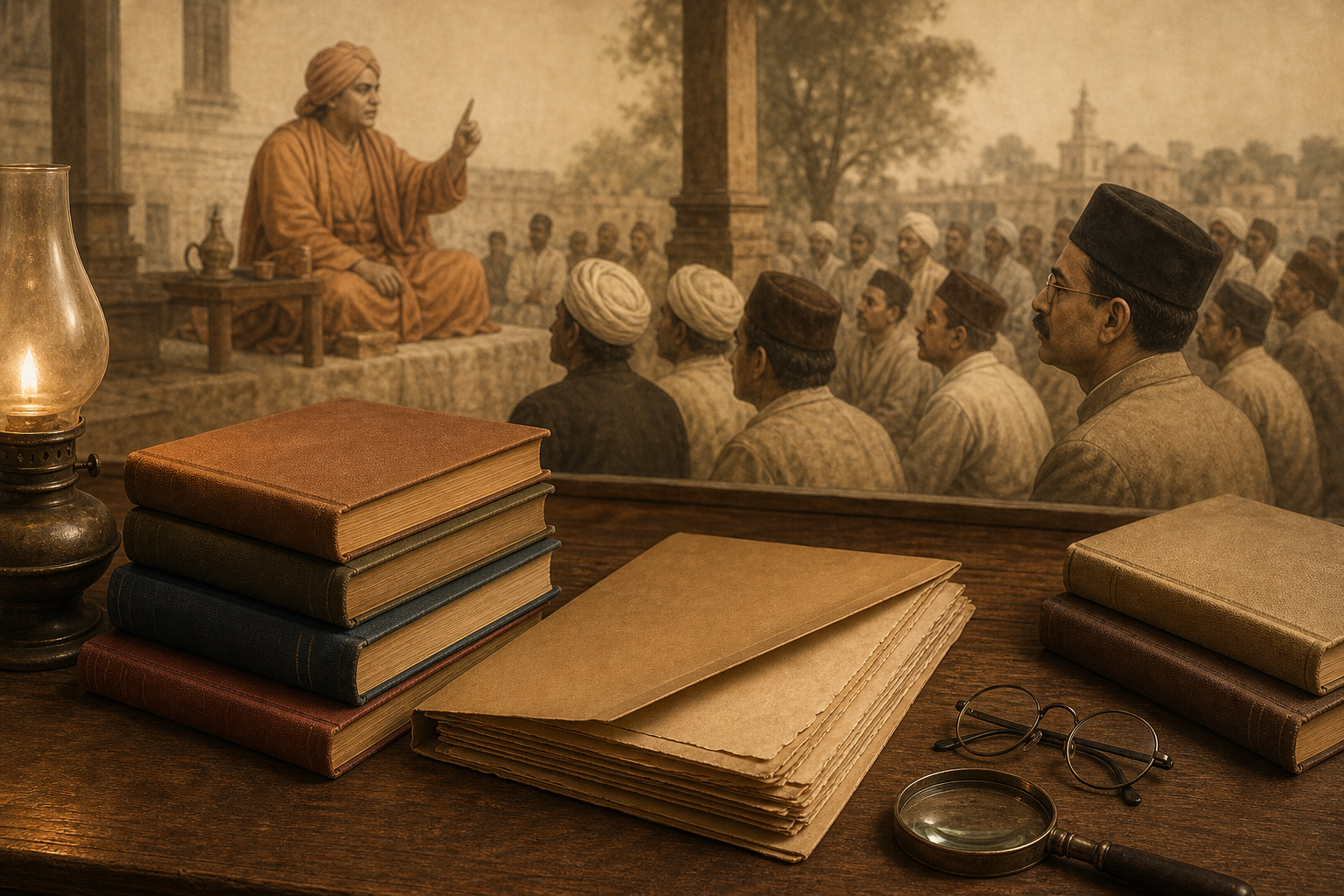
The firm historical core is modest but consequential: Munshi Ram encountered Swami Dayananda Saraswati, and that meeting became the night on which he discovered the Vedic path. We do not have enough detail here to reconstruct their conversation, assign Dayananda a convenient speech, or describe an instant vow. Those additions might make the scene more cinematic, but they would make it less trustworthy.
The encounter still makes sense as a turning point because Munshi Ram did not approach it as a blank slate. He brought the memory of a devout home, the experience of discipline, the humiliation of losing that discipline, academic failure, and dissatisfaction with a ready-made career route. Dayananda therefore met someone whose central question was no longer abstract. The gap between inherited Dharma and lived conduct had become personal.
A useful distinction follows. An awakening can be attached to a moment; reformation must be demonstrated through practice. The moment identifies a new orientation, but it should not be confused with all the effort required to live by that orientation. When you encounter dramatic conversion language in any spiritual biography, ask what changed afterward: choices, habits, loyalties, discipline, or service. Emotion may open the door. Conduct shows whether the person walked through it.
Munshi Ram’s agency also remains essential. A guru can teach, challenge, and embody a path, but the disciple must consent to be redirected. Earlier, Munshi Ram had exercised agency destructively and had also declined the administrative ascent prepared for him. The meeting with Dayananda matters because it placed that same capacity to choose before a different object: a Vedic way of ordering life.
Do not turn Dharmic reform into a sectarian caricature
Munshi Ram’s movement toward the Vedic path should not be misused as a verdict against the Shaiva and Shakta devotion of his parents. His father was remembered for honesty as well as Shiva worship, while his mother’s devotion provided the religious atmosphere of his childhood. The failure described in his youth was a failure of his own conduct, not proof that his parents’ forms of worship were morally empty.
The more accurate frame is reform within a Dharmic civilizational world. Munshi Ram inherited one lived expression of Hindu devotion and later encountered Dayananda’s Vedic orientation. The meaningful contrast is not between a supposedly godless childhood and a religious adulthood. It is between Dharma received through family and Dharma confronted as a personal demand.
This distinction helps you resist two equal distortions. One romanticizes inheritance, as though birth in a devout family automatically produces self-mastery. The other dismisses inheritance, as though a later teacher creates the seeker from nothing. Munshi Ram’s life points to a more demanding relationship: inheritance prepares the moral field, crisis exposes what has not been internalized, and conscious commitment determines what is cultivated next.
Key takeaways for reading and applying the episode
- Keep fact separate from dramatic reconstruction. Munshi Ram met Swami Dayananda and found a Vedic direction in that encounter. Do not add a location, speech, gesture, or promise unless reliable evidence supplies it.
- Look at the life before the meeting. His physical training, intellectual promise, devout household, decline at Benares, examination failure, and available administrative career explain why the encounter could address a real crisis rather than a passing curiosity.
- Do not mistake inherited identity for personal discipline. If you were raised within Dharma, ask which value actually governs a recurring decision when family oversight is absent.
- Do not romanticize collapse. Munshi Ram’s destructive phase gave urgency to his search, but the damage itself was not wisdom. You do not need to repeat a person’s fall in order to learn from the recovery.
- Judge a turning point by its demands. Name one habit, obligation, or use of time that your professed conviction should change. Decide what observable conduct would show that change, and review it on a date fixed in advance.
- Preserve both the guru’s role and the seeker’s agency. Dayananda could open a Vedic path before Munshi Ram; Munshi Ram still had to choose whether it would become more than an impressive encounter.
When you next return to this meeting, remember its movement rather than merely its drama: capacity was present, self-rule was lost, respectable advancement proved insufficient, and a Vedic direction became personally compelling. Then apply the same test to your own convictions. Identify where your inherited Dharma has become deliberate conduct, and where it still depends on someone else watching.
References
