
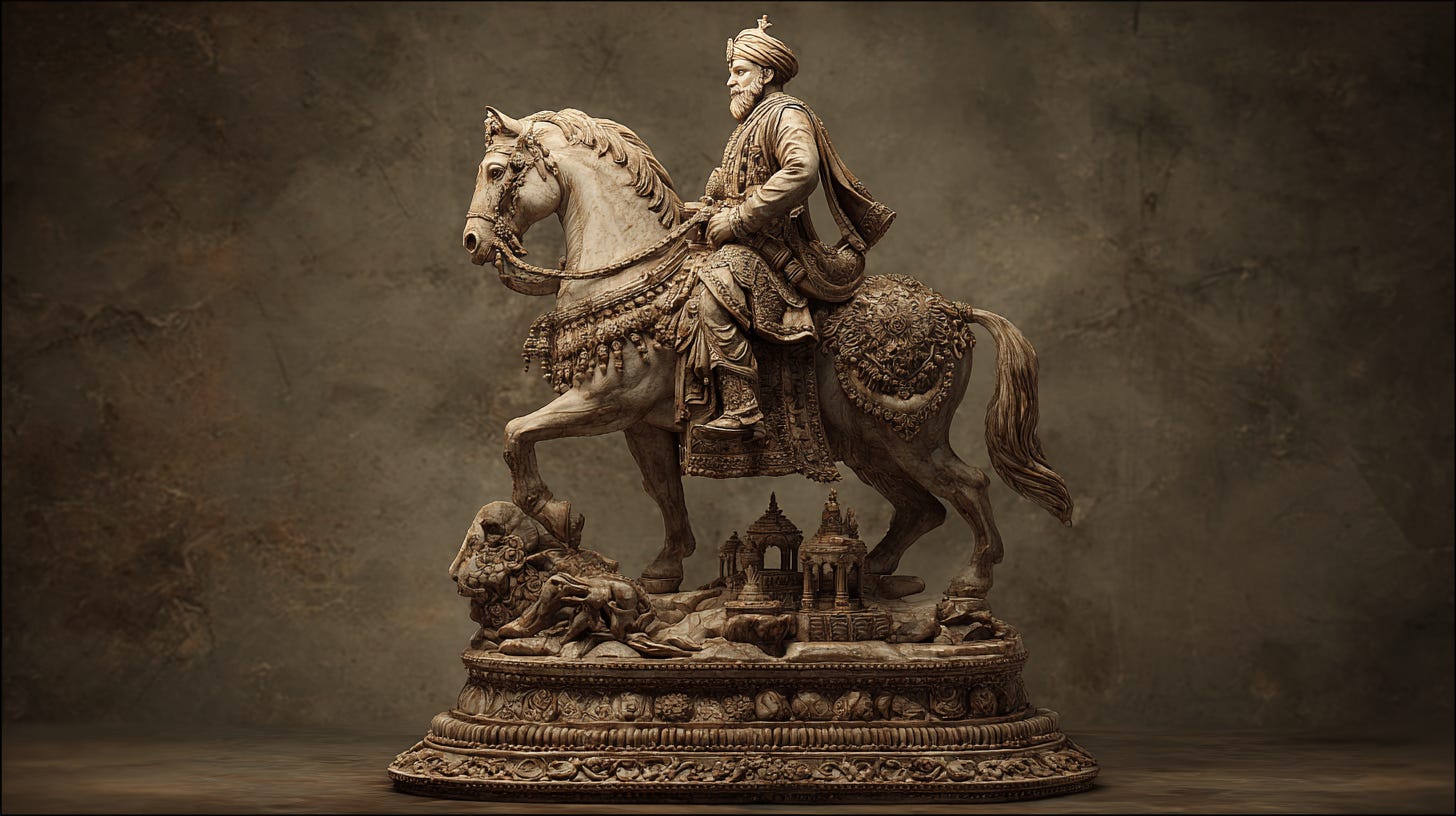
Chhatrapati Shivaji’s daily discipline, as portrayed by Acharya Jadunath Sarkar in Shivaji and His Times, offers a vivid window into the inner life of a statesman-sage. The day began with reverencebowing to the guru Ramdas Swami and to Jija Baiembodying the Sanatani synthesis of duty, devotion, and statecraft. This intimate portrait clarifies how spiritual anchoring informed political vision.
Sarkar’s evocation of Jija Bai underscores the formative force of the mother who shaped the young Shiva into a Murti of Kshatraan ideal of courage disciplined by Dharma. In the twilight of her life, she witnessed her son ascend to sovereign authority, not merely as a conqueror, but as a protector of sacred order. The scene crystallizes the civilizational ethos in which family, guru, and king moved in harmonious alignment.
On the long canvas of history, a singular tragedy punctuates Shivaji’s exalted life: he passed away at fifty. Coronated in 1674 and merging with Eternity in 1680, his brief reign as Chhatrapati invites a sober counterfactualhad he outlived Aurangzeb, the political map of Bharatavarsha might have evolved along markedly different lines. Even so, the institutions he set in motion continued to shape the Maratha Empire.
In the aftermath of his passing, Shambhaji ordered a meticulous enumeration of the late Chhatrapati’s possessions, mobilizing the clerkdom and supervising the process personally. The inventory’s scope was remarkable, offering a rare empirical cross-section of royal material culture, administrative order, and ritual life in the seventeenth century.
Two primary sources furnish this record in authoritative detail. The first is Krishnaji Anant Sabhasad’s biography, Śrī-Śiva-Prabhuce-Caritra (popularly known as the Sabhasad Bakhar), published in 1694 or 1697. The second is Shri Shiva Chhatrapatichi 91 Kalmi Bakhar (often referred to as the 91 Kalmi Bakhar) authored by Dattaji Triambak, a courtier of the late Chhatrapati; Jadunath Sarkar accurately styles it the Dattaji-Malkare Bakhar and translated it in 1907.
Leaves 42–44 of the Dattaji-Malkare Bakhar present an especially instructive inventory of Shivaji’s property. Beyond its intrinsic interest, the catalog illuminates social patterns, economic choices, ceremonial priorities, and the logistics of royal stewardship. While the original texts provide period weights and measures, scholars typically append contemporary equivalents in their editions and commentaries.
Taken together, these sources suggest the breadth characteristic of a seventeenth-century Hindu sovereign: carefully stored precious metals and jewels, royal regalia and textiles, arms and armor, ritual and courtly objects, as well as records reflecting systematic revenue and household administration. The completeness of the record speaks to the culture of accountability that undergirded Shivaji’s governance.
Yet, as Sarkar emphasizes, this treasure is not the most consequential inheritance. Paraphrasing the classic judgment often attributed to Grant Duff, the most formidable legacy was not territory or wealth, but the example, the system, the habits, and the spirit infused into the Maratha peoplean ethos of self-reliance, disciplined valor, and Dharma-aligned statecraft. This perspective aligns with a broader dharmic understanding in which ethical order, rather than material possession, secures civilizational resilience.
This Shivaji-spirit reshaped Maharashtra and radiated across Bharatavarsha. The Maratha Empire, built from the ground up, outlasted its founder and expanded as a pan-Indian force. In this historical arc, communities shaped by the broader dharmic traditionsHinduism, Buddhism, Jainism, and Sikhismcan recognize shared values: reverence for learning, duty to protect the vulnerable, ethical restraint in power, and commitment to cultural continuity.
For contemporary readers, the inventory does more than dazzle with royal abundance; it humanizes the king and clarifies his priorities. It affirms that material stewardship served higher aims: social order, spiritual protection, and the flourishing of a people. In that balanced vision of Kshatracourage in the service of Dharmaresides the enduring relevance of Shivaji’s example.
|| Satyam Shivam Sundaram ||
Inspired by this post on Dharma Dispatch.
