

You may have arrived wanting a simple answer: who was Changadeva, and what did he contribute to Indian astronomy? A simple answer would be convenient, but it would not be responsible. Changadeva is described as an 11th-century astrologer-mathematician who joined celestial study to mathematical reasoning, yet no individual treatise, rule, table, or worked calculation is named alongside that description.
That uneven record is not a reason to ignore him. It is a reason to read him carefully. By separating identity, chronology, genealogy, intellectual reputation, and demonstrated work, you can appreciate his place in Bharat’s knowledge traditions without turning an uncertain biography into settled history.
Begin with what mathematical astronomy actually means
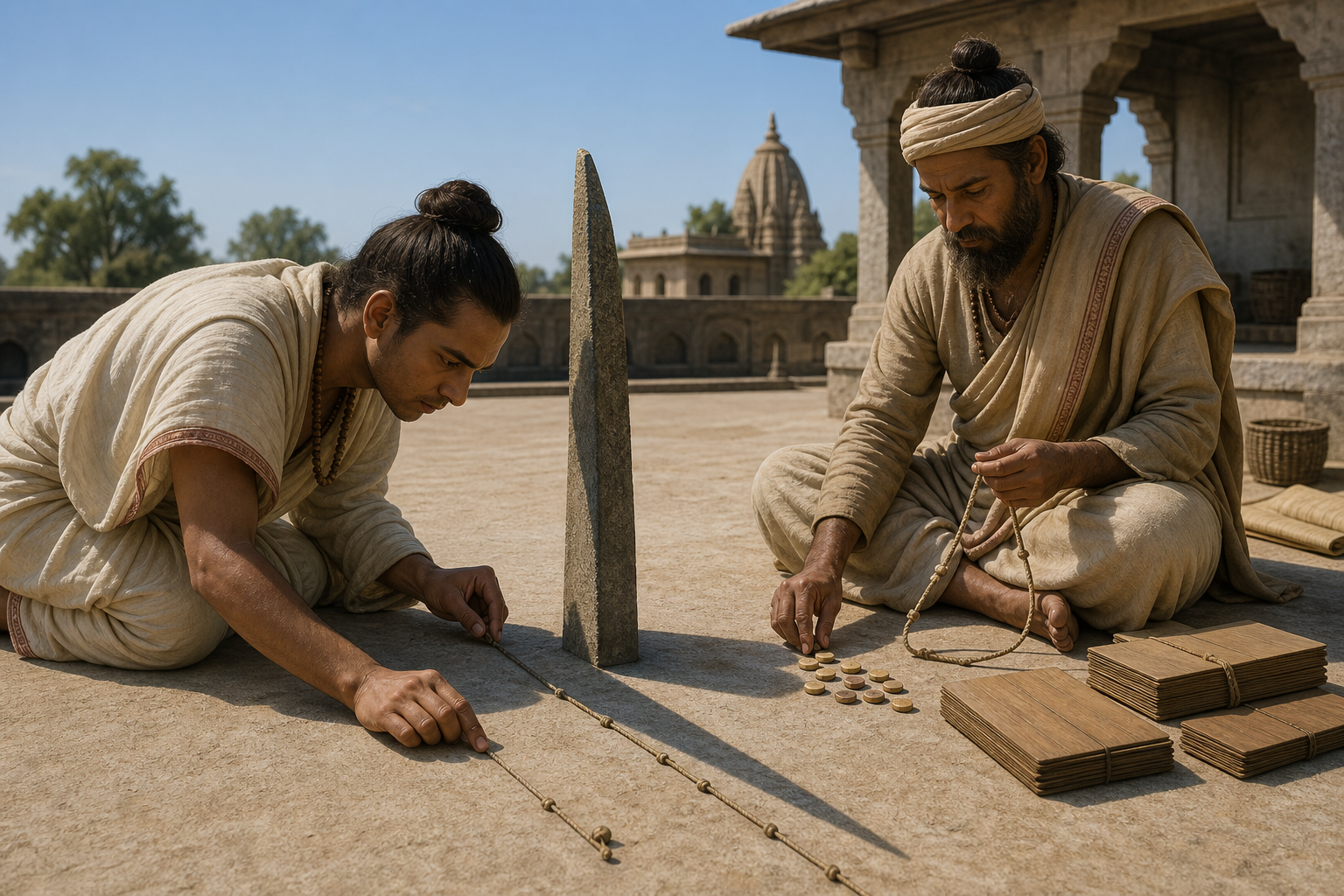
Mathematical astronomy is the use of calculation to reason about celestial phenomena. Observation supplies something to explain or predict; mathematics expresses relationships and produces results; interpretation gives those results a purpose within a larger intellectual system.
Changadeva is placed between jyotisha, glossed as astrology, and ganita, or mathematics. A modern reader should not picture these as two sealed departments. Scholars concerned with the heavens could share observations and computational practices even when the questions they asked or the meanings they assigned to results were not identical.
The description of Changadeva as a bridge is therefore best treated as an intellectual profile, not as the name of a particular discovery. When you encounter a claim about his achievement, test which of these three layers it actually supports:
- Observation: What celestial phenomenon, cycle, or relationship was examined?
- Computation: What inputs and numerical procedure produced the result?
- Interpretation: How was that result understood or used within jyotisha?
Without an identifiable observation, procedure, or result, words such as precision and analytical rigor remain descriptions of a reputation. They do not yet allow you to reconstruct Changadeva’s mathematics. This distinction prevents a common mistake: converting praise for a scholar’s qualities into an invented list of technical accomplishments.
Keep four different claims about Changadeva separate
Four claims are often bundled into a single confident biography, although each requires a different kind of support:
- Identity: The scholar is called Changadeva and also Chandradeva.
- Chronology: He is described as an 11th-century figure.
- Genealogy: He is identified as a grandson of Bhaskaracharya, or Bhaskara II.
- Intellectual role: He is remembered as an astrologer-mathematician who brought calculation and celestial study together.
These details all appear in the biographical account of Changadeva’s life and legacy, but their appearance together does not make them one piece of evidence. A name variant needs to be connected to the same person through manuscripts, editions, or another traceable context. A century label needs chronological support. A genealogical statement needs evidence for the relationship as well as consistency with the chronology. A mathematical contribution requires an identifiable work, procedure, commentary, or citation.
The most important warning concerns the combination of the 11th-century label and the claimed descent from Bhaskara II. Those statements must be chronologically reconciled before you use either one to reinforce the other. Until then, report them as claims: Changadeva is described as an 11th-century scholar, and he is identified in one biographical tradition as a grandson of Bhaskara II. Do not silently upgrade either phrase to certainly was.
Do not quietly convert biological descent into intellectual descent either. A family relationship, a teacher-student relationship, and participation in the same scholarly tradition are three different propositions. One cannot stand in for another merely because all three would fit an attractive story of continuity.
Read his intellectual setting as a working system
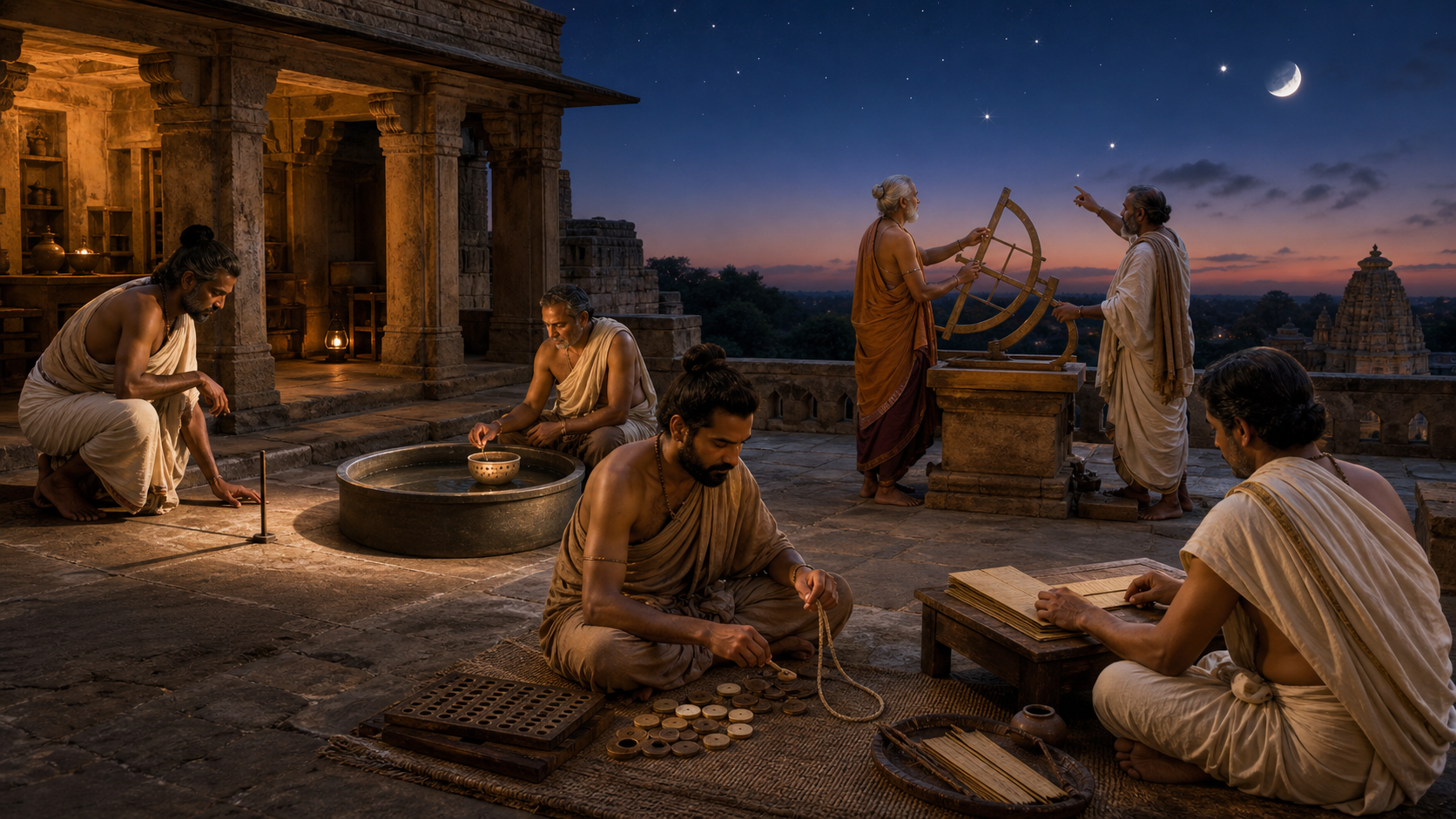
Changadeva’s remembered setting remains valuable even while parts of his biography await verification. It joins careful observation and refined calculation with Sanskrit manuscripts and guru-shishya transmission. This gives you a practical way to understand medieval Indian mathematical astronomy: not as a shelf of isolated results, but as knowledge that had to be calculated, interpreted, taught, preserved, and learned again.
When you read about any scholar from this setting, follow the complete chain rather than stopping at the celebrated name:
<!– wp:list {