
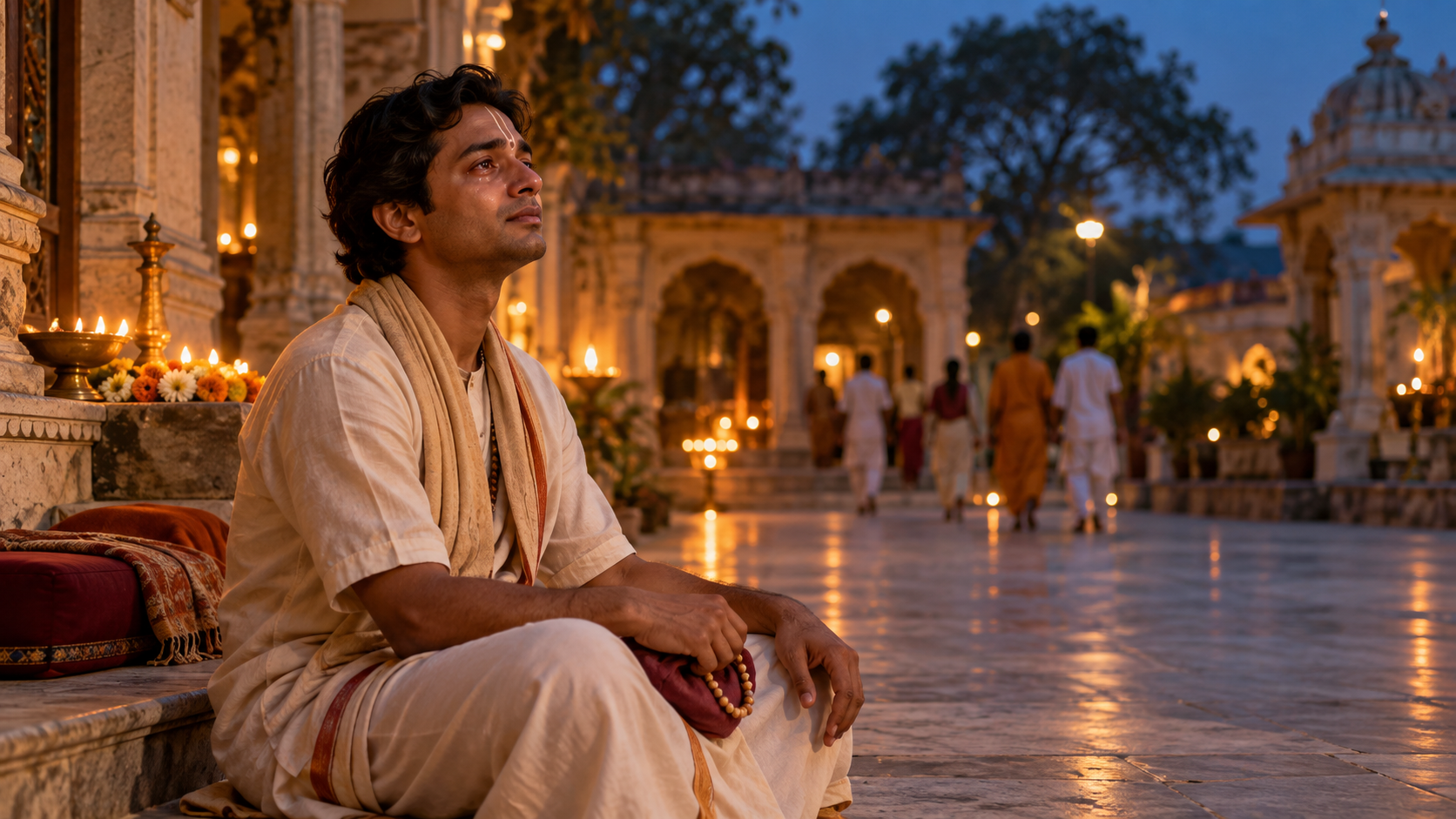
You may know how to arrive for seva, defend siddhanta, keep a vrata, or solve a practical problem. Yet when kirtana, darshan, or the memory of a guru moves you, you may have only two settings: say nothing, or wait until the feeling becomes overwhelming. Neither response helps you understand what is happening.
This is not a demand that you become publicly expressive. It is a way to make memory usable: notice the feeling, locate its devotional object, and let it shape your conduct. For many male practitioners, emotion within bhakti-rasa is not a side issue. It is where habits of restraint meet a path grounded in relationship.
Stop using emotional intensity as a spiritual score
Bhakti involves relationship, so it naturally awakens feeling. But the strength of a feeling does not establish the depth of devotion. Tears may arise from gratitude, grief, relief, temperament, music, exhaustion, or several causes at once. Calmness may indicate steadiness, discomfort, self-command, or emotional distance. Neither tears nor composure can serve as a certificate of realization.
In Vaishnava devotional vocabulary, rasa is more than emotional volume. It concerns the quality and orientation of a relationship with Bhagavan. A temporary mood is something you experience; devotional relationship gives that experience an object, a direction, and a place within practice. The useful question is therefore not, “How strongly did I react?” It is, “What did this feeling turn me toward?”
When a devotional moment affects you, examine it before explaining it. Move through these observations in order:
- Name what actually happened: a line in kirtana, an act of service, a remembered instruction, a gesture, a place, or an absence.
- Notice the bodily signal without making it the whole meaning: warmth, tension, stillness, tears, restlessness, or a change in breathing.
- Use an ordinary emotional word first: gratitude, grief, tenderness, shame, longing, fear, anger, affection, or relief.
- Identify the object of the feeling: Bhagavan, guru, another devotee, a neglected duty, a departed person, a former community, or your own lost expectation.
- Notice the impulse that follows: to pray, serve, apologize, withdraw, speak, seek attention, or repeat the experience.
This sequence prevents premature spiritual interpretation. “I feel that nobody values my service” is not a feeling alone; it combines an emotion with a conclusion about other people. A more truthful statement is, “I feel hurt and angry, and I think my service was overlooked.” That distinction makes both self-examination and conversation more honest.
Do not rush to give every inner movement a Sanskrit name. Plain language can protect you from exaggeration. Once you know what you are actually feeling, you can ask how it belongs within bhakti.
Turn memory into smarana, not nostalgia
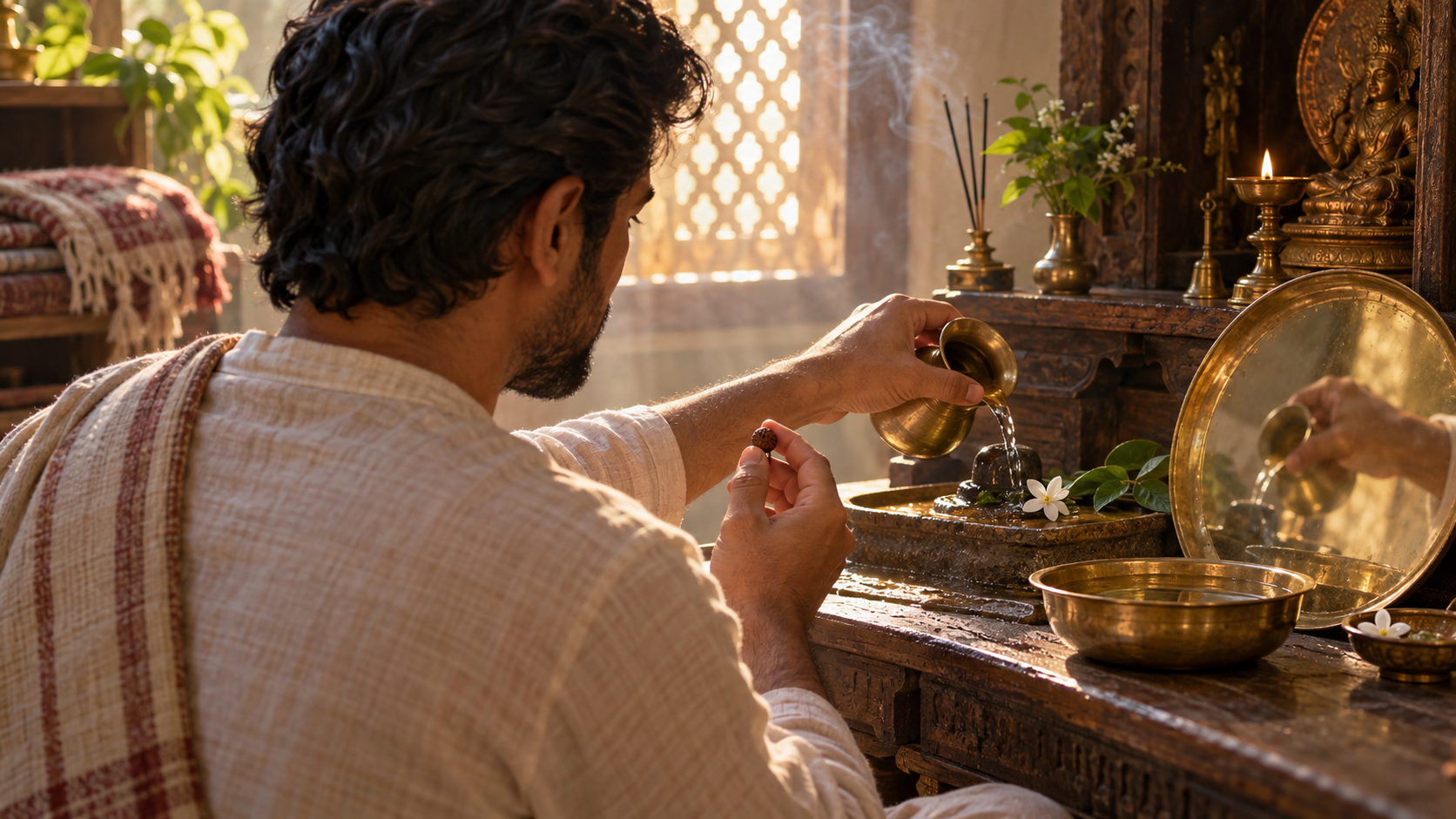
Memory can preserve devotion, but it can also preserve an idealized version of the past. Smarana becomes practice when remembrance returns your attention to Bhagavan, guru, teaching, or service and changes what you do now. Nostalgia asks you to revisit a cherished atmosphere. Devotional remembrance asks you to become responsible to what the memory reveals.
When you watch recorded pastimes of Srila Prabhupada, the devotional work begins after the viewing. A preserved scene gives the mind something concrete to return to, but repetition alone is not transformation. Notice what remained with you, why it mattered, and what it asks of your present practice.
Use this remembrance practice with a personal encounter, a narrated pastime, a teaching you heard, or a recorded scene:
- Choose a single scene. Do not compress an entire period of life into a vague claim that “everything was different then.”
- Describe only what you can honestly recall. Separate the words, actions, place, and sequence from meanings you assigned later.
- Complete the sentence, “When I remember this, I feel ___ because I value ___.” The second blank often reveals why the memory has devotional force.
- Ask where the feeling points. Gratitude may point toward service; grief toward prayer and acceptance; regret toward repair; affection toward care for the community that carries the teaching.
- Choose the nearest truthful response. Resume a neglected discipline, complete an assigned seva, thank someone, make an apology, protect time for japa, or revisit an instruction you have avoided.
Suppose a remembered gesture of attentiveness stays with you. You do not need to reproduce the mood or tell the story repeatedly. Give full attention to the person in front of you. If a memory of disciplined service produces admiration, bring that admiration into the duty you are postponing. Memory becomes formative when it acquires a present-tense verb.
Give male spiritual friendship a better grammar
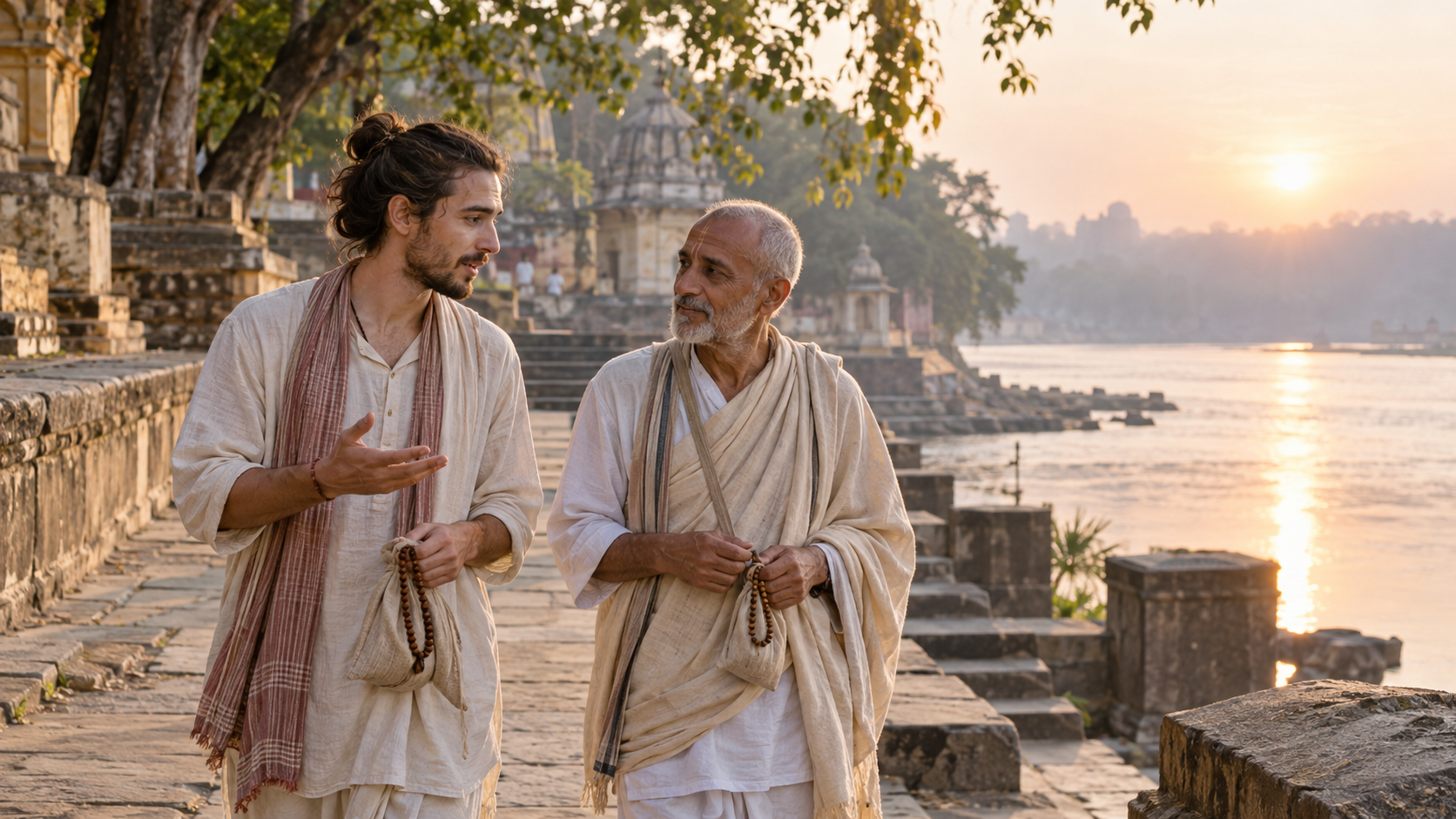
A men’s gathering can easily default to debate, advice, jokes, management, or the exchange of information. Those modes have value, but they may leave little room for precise devotional self-disclosure. The remedy is not a demand for dramatic vulnerability. It is a clearer structure for speaking and listening.
A useful sharing round can stay close to four questions: What exactly do you remember? What feeling does it awaken? What relationship or value does that feeling reveal? What will you do because you remembered it?
The person facilitating the conversation should protect several boundaries:
- Allow every participant to pass. Coerced disclosure teaches performance, not trust.
- Do not treat tears as success or calm speech as resistance. Attend to the truthfulness of the words.
- Do not interpret another man’s experience for him. Ask a precise question and let him name it.
- Do not answer grief with an immediate lecture. First reflect what you heard; offer counsel only when it is wanted or clearly required by the setting.
- Do not promise confidentiality casually. State what the group can genuinely protect and follow that agreement.
- Close with prayer, practice, or a concrete act of seva rather than trying to preserve an emotional high.
There is also a crucial difference between witnessing and fixing. If a devotee says that a memory of his teacher leaves him grieving, you need not remove the grief. You can ask what he misses, what remains unfinished, and what form of fidelity is still possible. That gives emotion room without allowing the gathering to become directionless.
Men also need permission to express affection without turning it into embarrassment or banter. A direct sentence such as, “Your steadiness helped me remain in practice,” is often more useful than a grand tribute. It names the gift, honours the relationship, and tells the other person what should be preserved.
Judge a feeling by its fruit, not its drama
An emotion can be sincere and still be confused. It may contain devotion, personal loss, wounded status, longing for community, and attachment to a former role at the same time. You do not protect bhakti by denying that mixture. You protect it by examining the mixture honestly.
Use these tests when a devotional memory feels especially powerful:
- Object: Can you say whom or what the feeling concerns, or is it only an attractive atmosphere?
- Truth: Does your account preserve what happened, including inconvenient details, or has reverence turned into embellishment?
- Fruit: Does the feeling produce prayer, humility, courage, responsibility, mercy, or better service?
- Freedom: Can you allow the feeling to remain private, or do you need other people to witness and validate it?
- Correction: Can the meaning you assign to the experience survive guidance from guru, sadhu, and shastra?
- Continuity: When the intensity fades, does any change in conduct remain?
These tests do not make emotion suspect. They keep emotion in its proper role. A feeling is a messenger and an offering; it is not final authority. No powerful memory authorizes harshness, grants special status, or proves superior closeness to a teacher.
Pay particular attention to nostalgia. It can make a former time seem sacred precisely because it no longer makes demands on you. You can praise yesterday’s community while withholding service from today’s. You can honour a departed teacher while ignoring the instruction that now feels difficult. Ask one corrective question: “What does this remembrance require of me in the life I actually have?”
If the only answer is “tell the story again,” the memory may still be precious, but your practice with it is unfinished. Look for the duty, repair, restraint, gratitude, or renewed discipline concealed inside the feeling.
Key takeaways
- Emotional intensity is not a reliable measure of spiritual advancement; direction and fruit matter more.
- Name an emotion in ordinary language before assigning it a devotional interpretation.
- Separate what you remember from what you inferred later, especially when reverence makes embellishment tempting.
- Convert remembrance into a present action: prayer, repair, discipline, gratitude, or seva.
- In men’s gatherings, protect the right to pass, refuse to rank visible emotion, and listen before advising.
- Let guru, sadhu, shastra, and the consequences of your conduct test the meaning you give an experience.
At the next kirtana, darshan, or remembered pastime that stirs you, pause before either hiding the feeling or displaying it. Name it plainly, identify whom it is for, and choose the nearest truthful act of seva. That movement from felt memory to responsible devotion is enough work for the moment.
References
- Dandavats – The Story Behind the Camera: Pastimes of Srila Prabhupada | Yadubara | MAN-tra 2026
- Dandavats – Men, Bhakti Rasa … and Emotions? | Partha | MAN-tra 2026

Leave a Reply
You must be logged in to post a comment.