
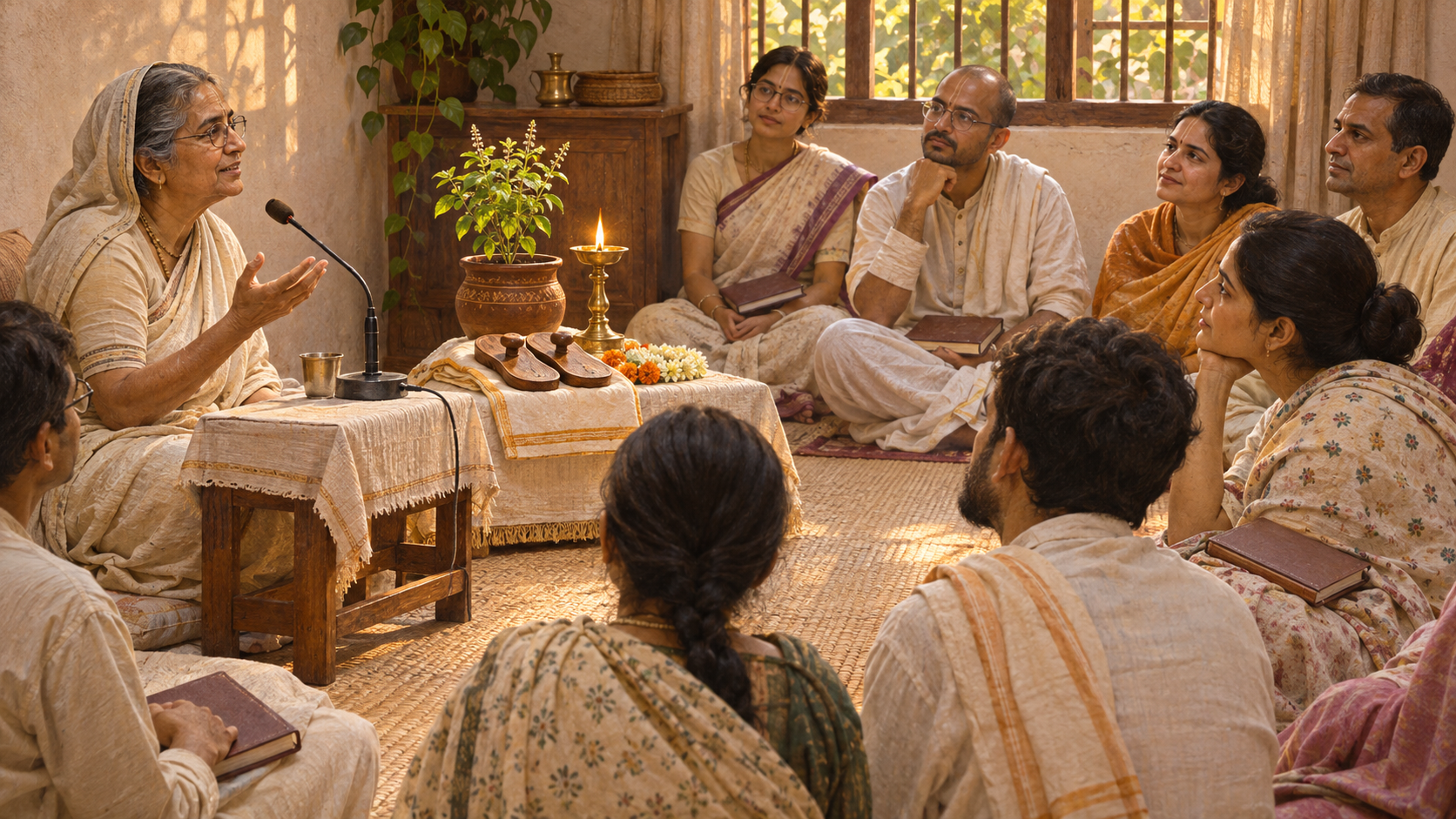
You may approach Daivi Shakti Mataji’s memories of Srila Prabhupada hoping to hear a cherished incident or discover an unfamiliar detail. Listen for those things, but ask a more demanding question as well: what should this remembrance change in the way you hear, serve, and speak about the acharya?
Daivi Shakti Mataji’s Prabhupad Lilamrita presentation invites both devotional attention and careful listening. Those duties belong together. Reverence keeps a sacred memory from becoming gossip; accuracy keeps it from becoming embellished legend.
What a Prabhupada recollection can give you
The word lilamrita joins lila, sacred activity or pastime, with amrita, nectar. That name points beyond the collection of biographical facts. Devotional remembrance is meant to nourish consciousness and service.
Formal teachings tell you what an acharya taught. Personal recollections can add another kind of understanding: what a disciple noticed, what made a lasting impression, and how an instruction was received in a particular relationship. This human scale matters. It can make qualities such as attentiveness, gravity, compassion, discipline, or urgency easier to recognise in practice.
Yet a recollection does not carry only one kind of information. As you listen, keep three layers distinct:
- The remembered event: what the speaker says happened, including any stated words, actions, people, place, or circumstances.
- The disciple’s understanding: what the speaker believes the encounter revealed about Srila Prabhupada or about devotional service.
- Your application: what you conclude should change in your own conduct.
All three can be valuable, but they are not interchangeable. A remembered personal instruction is not automatically a rule for every devotee. An interpretation may illuminate an event without being part of the event itself. Your response may be sincere without being the only possible response. Marking these boundaries does not drain a memory of devotion; it prevents you from making it say more than the witness actually said.
Use three passes instead of trying to capture everything

Constant pausing can turn devotional hearing into clerical work, while purely passive listening often leaves only a vague emotional impression. A three-pass method preserves both the mood and the details.
- First pass: hear without taking notes. Follow the speaker’s movement of thought. Notice which memory stays with you after the presentation ends. Do not decide too quickly what it proves.
- Second pass: return to the important passage. Record the timestamp and write down only what is needed to preserve the distinction between a direct quotation, a paraphrase, and your own inference. If the surrounding context changes the meaning, include it.
- Third pass: test the application. Ask whether your conclusion accords with Srila Prabhupada’s established teachings. A recollection can make a principle vivid, but it should not be used to bypass scripture, formal instruction, or the wider discipline of the tradition.
A useful note has four short lines: “What was remembered,” “What the speaker understood,” “What I inferred,” and “What I will do.” If you cannot fill the first three without mixing them together, listen again before sharing the incident.
Pay special attention to the scope of the language. “In this situation” is different from “in every situation.” “I understood” is different from “Srila Prabhupada explicitly instructed everyone.” “He said” carries a different evidentiary weight from “I felt that he wanted.” These are not trivial verbal distinctions. They determine whether you are preserving testimony or enlarging it.
Avoid the three habits that distort sacred memory

Stopping at sentiment
A recollection may move you deeply, but emotion alone is not yet assimilation. After hearing, identify one quality or principle that was actually supported by the memory. Then name one observable expression of it in your present service. “Be more devoted” is too vague. “Give undivided attention during the next service discussion” is something you can do and later examine.
Turning a particular exchange into a universal law
Acharyas instruct real people in real circumstances. The same words may contain a universal principle and a situational application. Your task is to separate them. Ask what problem was being addressed, who received the instruction, and whether the speaker presents it as a general teaching. If those details are absent, preserve the uncertainty rather than supplying a context from imagination.
Retelling from an impression rather than a record
Each casual retelling can smooth away qualifications and sharpen details that were originally uncertain. Before repeating a statement as a quotation, return to the recording. If you cannot check the exact wording, present it honestly as a paraphrase or as the speaker’s remembered understanding.
Preserve enough information for another person to find the passage: speaker, presentation title, date, link, and timestamp. For this presentation, the listed date is 22 November 2026. That small archival habit allows a devotional community to transmit memory without relying on an ever-lengthening chain of recollections about a recollection.
Key takeaways
- Hear the complete remembrance once before extracting quotations or lessons from it.
- Keep the remembered event, the speaker’s interpretation, and your application in separate notes.
- Do not convert a personal or situational instruction into a universal rule without support from established teaching.
- Use exact wording only when you have checked it; otherwise identify your words as a paraphrase.
- Let one clearly supported principle become one specific act of service.
- Save the link, title, date, and timestamp before retelling the memory to someone else.
Carry one recollection into your next act of service

After listening, write five sentences. State what Daivi Shakti Mataji remembers. State what she appears to understand from it. Name any detail that remains uncertain. Identify the established teaching that the memory illuminates. Finally, choose one action that you can complete at your next genuine opportunity to serve.
Then practise before you amplify. A recollection of Srila Prabhupada is best honoured neither by passive admiration nor by confident embellishment, but by faithful hearing that becomes disciplined conduct. Keep the memory traceable, keep your claims proportionate, and let the lesson become visible in what you do next.
References

Leave a Reply
You must be logged in to post a comment.