

When illness starts deciding how long you can stand, where you can go, or whether you can keep a promise, the hardest question may not be medical. It may be: Who am I if I can no longer be the dependable, capable person everyone knew?
Dharmic resilience does not require you to overpower the body or pretend that fear has vanished. It asks for something more honest: meet present conditions without abandoning your dignity, steady the mind enough to see the next right action, and build identity around enduring qualities rather than fluctuating output.
Grieve the capacity you lost before redefining strength

Illness can take more than physical ease. It can interrupt work, worship, family roles, social confidence, financial security, and the ordinary freedom to make plans without consulting your energy first. When days become organized around symptoms, appointments, and recovery, the loss can become an identity wound as well as a health problem.
You may then suffer two blows at once. The first is the condition itself. The second is the conclusion you draw from it: I am unreliable, weak, burdensome, or no longer useful. The condition may be real; the verdict is not automatically true.
Begin by naming the loss precisely. Broad statements such as “my whole life is gone” leave the mind with an immeasurable threat. A precise statement gives grief a boundary: “I cannot travel spontaneously,” “I cannot sustain my former workload,” or “I no longer trust my energy from one day to the next.” Precision does not minimize the loss. It separates what has changed from everything that remains.
- Name the capacity that changed, without turning it into a judgment about your character.
- Name the role attached to that capacity: provider, caregiver, organizer, athlete, volunteer, student, or the person who never needed help.
- Ask what value the role expressed. Reliability may have expressed devotion; hard work may have expressed responsibility; constant helping may have expressed seva.
- Release promises that your present body cannot reliably keep. Replace them with smaller commitments you can communicate clearly.
This is acceptance, not resignation. Acceptance says, “This is the capacity available now, so I will act intelligently within it.” Resignation says, “Nothing meaningful remains possible.” The first conserves energy for treatment, relationships, and dharmic action. The second turns a changed condition into a total identity.
Do not confuse endurance with medical wisdom. New, severe, rapidly changing, or unexplained symptoms require qualified medical assessment. A sudden collapse or inability to care for yourself is not a spiritual test to manage through willpower. Seek prompt professional help. Spiritual practice can steady you while care is arranged; it cannot determine the medical cause.
Turn worry into a fact, an action, or a conscious release

Worry often presents itself as preparation. The difference is visible in the result. Planning produces a decision, a question for a clinician, a practical request, or a contingency. Worry repeats the feared future without creating a new response.
This distinction matters because persistent worry can disturb sleep, digestion, attention, and wider physical balance. When illness has already reduced your margin, mental agitation can consume energy you need for actual care.
Use the following sequence when your thoughts begin circling:
- State the present fact. Use only what is known now: “My symptoms are stronger today,” or “I am waiting for a result.”
- Name the prediction. Say what the mind has added: “I am imagining that I will lose my job,” or “I am afraid this will never improve.”
- Identify the available action. Contact the clinician, record the symptom, adjust the commitment, ask for transport, or prepare a question. If there is no action available now, acknowledge that plainly.
- Settle attention in a tradition you trust. This may be japa, dhyana, mindful observation, vipassana, simran, prayer, or quiet remembrance of the Divine.
- Return to the next bounded duty. Choose what belongs to the present period, not the entire imagined future.
The Bhagavad Gita’s counsel on equanimity does not ask you to become indifferent to outcomes. It helps prevent fear of an outcome from taking command of the present action. The Yoga Sutra’s phrase “yogaś citta-vṛtti-nirodhaḥ” likewise directs attention toward the movements of mind. In practice, you notice the anxious movement without treating every thought as an instruction.
Breathing may help settle agitation, but keep it gentle. Do not force a deep inhalation, strain, or use breath retention when you are dizzy, short of breath, medically unstable, or unsure whether a technique is safe for your condition. Stop if symptoms worsen and ask an appropriate clinician about what is suitable for you. Prāṇāyāma is a practice, not a substitute for diagnosis or treatment.
A daily rhythm that respects variable energy
A complicated routine can become another standard you feel you have failed. Use a light rhythm instead.
- On waking: check your actual capacity before making promises. Select one necessary duty and one restorative act.
- Before effort: ask whether the task must happen now, can be reduced, can be delegated, or can wait.
- During a symptom increase: pause before pushing through automatically. Record what changed if that information will help your care.
- At day’s end: use simran, japa, meditation, prayer, or quiet reflection to close unfinished mental loops. Note what needs action later, then release it for the night.
Abhyāsa, steady practice, is especially useful here. Steadiness does not mean performing an identical routine under every condition. It means returning without self-punishment after interruption.
Build identity around qualities that illness cannot measure

A body can change how a value is expressed without erasing the value itself. The mistake is to bind a quality to only one form: courage to physical exertion, reliability to unlimited availability, or service to doing everything for everyone.
| Old identity claim | Enduring quality | A form that may fit changed capacity |
|---|---|---|
| I am reliable because I always show up | Faithfulness | Communicate limits early and keep a smaller promise |
| I am strong because I push through | Courage | Report symptoms honestly and rest before a preventable crash |
| I serve by doing things for others | Seva | Listen, pray, teach, encourage, or help within a stated boundary |
| I am disciplined when my routine never breaks | Abhyāsa | Resume the practice gently after interruption |
| I am independent because I need nothing | Responsibility | Ask for specific help before a crisis removes your choices |
This reframing becomes clearer when you complete three sentences: “I can no longer reliably…,” “What mattered beneath that activity was…,” and “Within my present capacity, I can express that value by….” Answer with actions small enough to be real. “Remain devoted” is abstract. “Tell my family before I reach exhaustion” is usable.
Several Dharmic traditions offer distinct but compatible disciplines for this work. Ahimsa asks whether the way you speak to yourself is needlessly violent. Karuṇā makes room for suffering without making suffering your entire identity. Aparigraha loosens the grip on an old baseline that may or may not return. Seva preserves meaningful contribution while challenging the belief that service must destroy the server.
Buddhist mindfulness can help you observe pain, fear, and dukkha without collapsing them into a permanent self. Jain attention to right perception and non-grasping can expose attachment to status, capability, and control. Sikh simran and chardi kala can sustain remembrance and resilient orientation without requiring a cheerful performance. Hindu dhyana, japa, and the discipline of equanimous action can anchor identity beyond the day’s success or failure.
These paths are not interchangeable, and you do not need to assemble them into a spiritual sampler. Practice within your own lineage where you have one. The shared practical question is simpler: Which response reduces harm, clarifies duty, loosens grasping, and keeps compassion alive?
Growth does not mean being grateful for illness, denying anger, or declaring every loss a blessing. It means that the self emerging under changed conditions can become more truthful, discerning, and compassionate even when the body remains unwell.
Receive care without giving away your agency
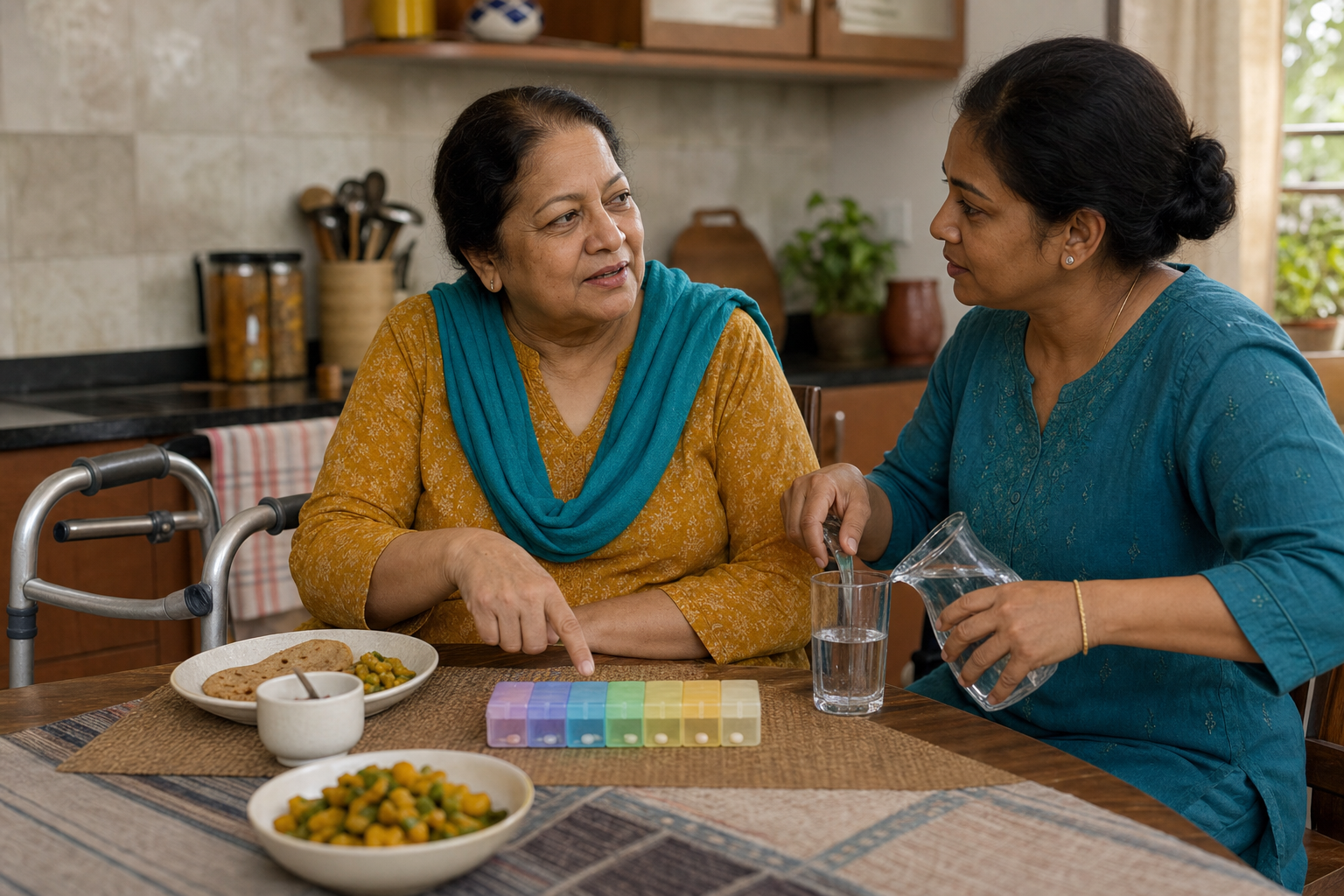
People who built identity around helping often wait too long to ask for help. By the time they speak, the request is urgent, choices are fewer, and shame is louder. Receiving care earlier is not the opposite of seva. It allows service to become reciprocal rather than one-sided.
Ask for a defined action instead of asking someone to “support you.” A defined request is easier to answer and less likely to produce resentment or confusion.
- “Please drive me to the appointment and wait until I am checked in.”
- “I need you to listen without offering solutions. I will ask if I want advice.”
- “I can attend, but I may need to leave when my symptoms rise.”
- “Please take over this task. I cannot complete it safely today.”
- “Could you check in after the appointment so I do not have to explain everything while I am processing it?”
With clinicians, describe observable change rather than trying to prove that you are suffering enough. Explain what the symptom prevents you from doing, what makes it better or worse, what has changed from your usual baseline, and which medicines or practices you are using. Bring written notes if fatigue, pain, or anxiety makes recall difficult.
With family or sangat, state the kind of presence you need. Some moments call for prayer or kirtan. Some call for a meal, transport, silence, or help with a form. Some require a listener who will not turn illness into unsolicited theology. You are allowed to decline explanations that blame you, minimize your symptoms, or pressure you to abandon appropriate care.
If worry is persistently disrupting sleep, daily functioning, relationships, or your ability to follow medical care, involve a qualified mental-health professional. If you may harm yourself or cannot remain safe, seek urgent local crisis or emergency support. A spiritual teacher or community can offer meaning and companionship, but should not be made responsible for clinical work outside its competence.
Agency also means deciding what not to disclose. You can tell someone your practical limit without sharing your diagnosis, prognosis, or private history. “I am managing a health condition and cannot commit to that” is a complete boundary.
Key takeaways
- Separate the medical condition from the character judgment you have attached to it.
- Grieve a precise loss; do not let one lost capacity become a verdict on your whole life.
- Turn worry into a present fact, an available action, or a conscious release.
- Redefine strength as truthful response, including rest, treatment, boundaries, and asking for help.
- Express enduring values in forms your present body can sustain.
- Keep spiritual practice beside medical and psychological care, never in place of them.
Your next step need not be dramatic. Name one capacity that has changed, identify the value beneath it, and choose one smaller way to live that value today. Let that honest action, rather than the remembered speed of your former life, be the measure of strength.
References
- DharmaRenaissance Blog — From Body Betrayal to Brave Becoming: Reclaiming Identity with Compassionate Strength
- DharmaRenaissance Blog — Worry Hurts More Than Disease: Dharmic Wisdom for Mental Clarity, Health, and Peace
