
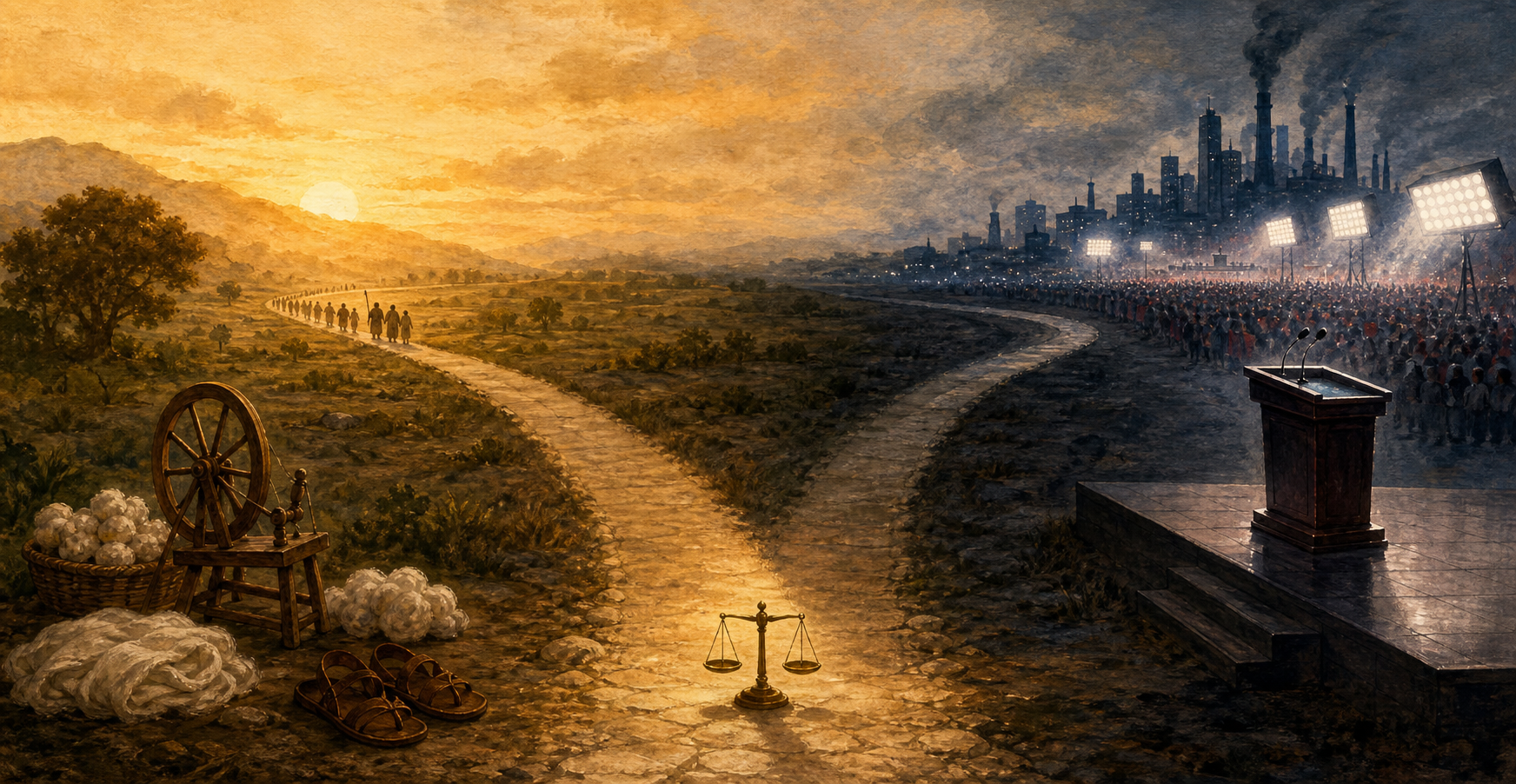
If someone tells you that Donald Trump resembles Mahatma Gandhi, you don’t have to choose between instant agreement and offended disbelief. The useful response is to ask: resembles him in what respect?
There are genuine parallels in personal discipline, economic nationalism, political pressure, and personality-centred leadership. They are worth examining. But a resemblance in habits or tactics does not establish an equivalence in philosophy, moral authority, historical situation, or political purpose. If you keep those levels separate, the comparison becomes illuminating instead of absurd.
The honest answer: a narrow analogy, not an equivalence
A political comparison can operate at four different levels. Two leaders may share a personal habit. They may employ a similar tactic. They may pursue comparable political ends. Or they may embody the same moral vision. Confusion begins when evidence at the first or second level is treated as proof of the third or fourth.
Trump’s avoidance of alcohol, smoking, and drugs provides a limited biographical parallel with Gandhi’s emphasis on personal restraint. That resemblance tells you something about self-command. It does not tell you whether the two men understood truth, duty, power, sacrifice, or the nation in the same way.
This distinction matters especially in a Dharmic evaluation. Personal discipline is valuable, but dharma is not a checklist of private prohibitions. You must also examine the purpose of an action, the means used, the duties attached to a person’s role, the treatment of opponents, and the foreseeable consequences. Two people can refuse the same substance while practising radically different forms of politics.
Start, then, by making every alleged similarity complete this sentence: Trump and Gandhi are alike in this specific respect, but that resemblance does not by itself establish anything beyond it. That one discipline prevents a suggestive observation from becoming hero worship, condemnation by association, or a substitute for historical thought.
Swadeshi and MAGA share a political grammar, not one philosophy

The strongest substantive parallel is between Gandhi’s Swadeshi movement and Trump’s MAGA economic nationalism. Both appeal to national renewal through domestic productive capacity. Both treat economic choices as political choices. Both ask citizens to see dependence on foreign goods as more than a question of price.
That is a real similarity. A call to favour domestic production can restore dignity to labour, reinforce national confidence, and turn ordinary consumption into participation in a larger project. The rhetorical structure is recognisable: a country has lost control of something essential, foreign dependence reflects that loss, and national regeneration requires citizens to change what they produce or purchase.
Yet the shared structure cannot carry the entire comparison. Gandhi’s boycott of foreign goods belonged to a struggle against British rule. MAGA operates within an already sovereign state and uses economic nationalism as a strategy for American power and domestic political renewal. One arose from a colonised society trying to recover agency; the other arises from a powerful state debating how to preserve or restore its advantage. The slogans may point toward domestic production, but their historical positions are not interchangeable.
You can test the analogy by separating three questions. What dependency is being resisted? Who is being asked to bear the cost of resistance? What political condition is the campaign trying to create? If the answers differ, the policies may still be comparable as techniques, but they are not expressions of the same historical project.
This also guards against a common error in Indian political discussion: treating every form of protectionism as Swadeshi. A tariff, boycott, domestic-production programme, and civilisational ethic of local self-reliance can overlap, but they are not identical. Before invoking Gandhi, identify whether the policy changes production, consumption, ownership, strategic dependence, or merely campaign language. National vocabulary alone is not economic decolonisation.
Non-cooperation and the RINO label discipline coalitions differently

A second parallel concerns internal political pressure. Gandhi used severe personal acts, including fasts unto death, to exert moral pressure on colleagues and influence the Congress Party. Trump uses the label RINO to mark centrist or insufficiently loyal Republicans and raise the political cost of dissent. Both methods can narrow the room available to members of a coalition.
That common effect deserves attention. Political parties are held together not only by constitutions, manifestos, and votes, but also by informal mechanisms of approval and exclusion. A leader with a devoted following can make disagreement feel like betrayal. Gandhi’s moral prestige and Trump’s command of partisan identity each give the leader influence beyond a formal office or procedural vote.
The mechanisms, however, are fundamentally different. A fast places the leader’s own body at risk and turns self-suffering into moral pressure. A delegitimising label directs reputational and electoral pressure outward, towards the dissenter. The first says, in effect, that the leader will suffer to force a moral reckoning. The second tells supporters that a named faction is not authentically part of the group. Both can constrain colleagues, but the location of the cost is different.
That difference changes the ethical question you should ask. With a fast, examine whether voluntary self-suffering becomes coercive because followers feel responsible for the leader’s survival. With a loyalty label, examine whether legitimate disagreement is being converted into proof of treachery. Neither method should escape scrutiny merely because one sounds spiritual and the other combative.
The practical lesson extends beyond these two personalities. Whenever a leader pressures allies, identify the instrument precisely: persuasion, self-sacrifice, public shame, threat of expulsion, control of nominations, or appeal to a mass following. Then identify who bears the penalty for saying no. Calling all of these methods non-cooperation hides the most important moral and institutional distinctions.
Private restraint, ego, and controversy must be judged separately

The comparison becomes least reliable when observations about personality are turned into conclusions about public virtue. Abstaining from intoxicants may demonstrate discipline. It cannot settle how a leader uses authority, responds to criticism, selects successors, or balances personal loyalty against institutional duty.
The claim that Gandhi favoured Jawaharlal Nehru over Sardar Patel because of ego illustrates the problem. Gandhi’s preference can be debated as a consequential political choice. Calling ego the decisive cause is an interpretation of motive, not a self-proving fact. You should ask what evidence distinguishes personal attachment, ideological preference, strategic calculation, and institutional judgement before accepting any single explanation.
The same standard belongs in an assessment of Trump. His leadership is strongly associated with his public personality, but describing a decision as personality-driven is only the beginning of analysis. Which formal process was displaced? Which adviser, faction, or institution lost influence? Did personal loyalty override a stated policy? Without answers, ego becomes a label that expresses approval or disapproval while explaining very little.
War and peace require the same care. Gandhi’s anti-war reputation sits beside his support for Indians fighting on behalf of the British. Trump has used the language of peace while also making consequential choices in defence policy. These tensions do not make the two records identical. They show why rhetoric, personal intention, political circumstance, and concrete action need separate ledgers.
Partition is an even more serious test of intellectual discipline. Gandhi’s choices surrounding India’s partition deserve unsentimental examination. But treating partition as one man’s simple acceptance, and then assigning its immense human consequences to that single act, compresses a many-actor rupture into a morality tale. A leader can bear responsibility without being the sole cause; criticism becomes stronger, not weaker, when it specifies the decision, available alternatives, constraints, and chain of consequences.
Public discussion of relationships with women can produce a similar distraction. Biographical candour or notoriety is not itself a meaningful political parallel. The relevant questions concern truthfulness, consent, accountability, misuse of power, and any effect on public duty. If those connections have not been demonstrated, sexual biography is being used for provocation rather than understanding.
A Dharmic judgement should therefore resist two temptations at once. Do not protect Gandhi from scrutiny by turning him into an untouchable symbol. Do not transfer Gandhi’s moral aura to Trump because a few habits or tactics look familiar. Dharma requires discrimination between an act and its motive, a means and its end, self-restraint and public responsibility.
Key takeaways for testing any Trump-Gandhi claim
- Name the exact resemblance. Personal abstinence, economic nationalism, coalition discipline, and personality-centred leadership are distinct claims. Do not bundle them into a declaration that the men are simply alike.
- Compare political position. Swadeshi emerged within resistance to British rule; MAGA functions within a sovereign American state. Similar economic language can serve different historical purposes.
- Locate the cost of the tactic. Gandhi’s fast placed his own body at risk while pressuring colleagues. Trump’s RINO label places reputational and electoral pressure on political opponents within his party.
- Separate conduct from moral authority. Avoiding alcohol, smoking, or drugs may indicate discipline, but it does not prove just governance or a shared philosophy.
- Do not infer motive from outcome. Claims about ego, succession, war, or partition must distinguish documented choices from interpretations of why those choices were made.
- Refuse moral halo transfer. A tactical resemblance neither canonises Trump nor settles Gandhi’s contested decisions. Judge each leader’s actions within his own duties, institutions, circumstances, and consequences.
The next time you encounter this comparison, don’t begin by defending one personality against the other. Ask the speaker to identify the shared feature, the mechanism behind it, and the conclusion it supposedly proves. If that conclusion travels farther than the evidence, stop it at the boundary. If the parallel survives, use it as a narrow lens into political technique — never as a verdict on two entire lives.
References
- DharmaRenaissance Blog — Unveiling the Unexpected Parallels: Trump and Gandhi
