
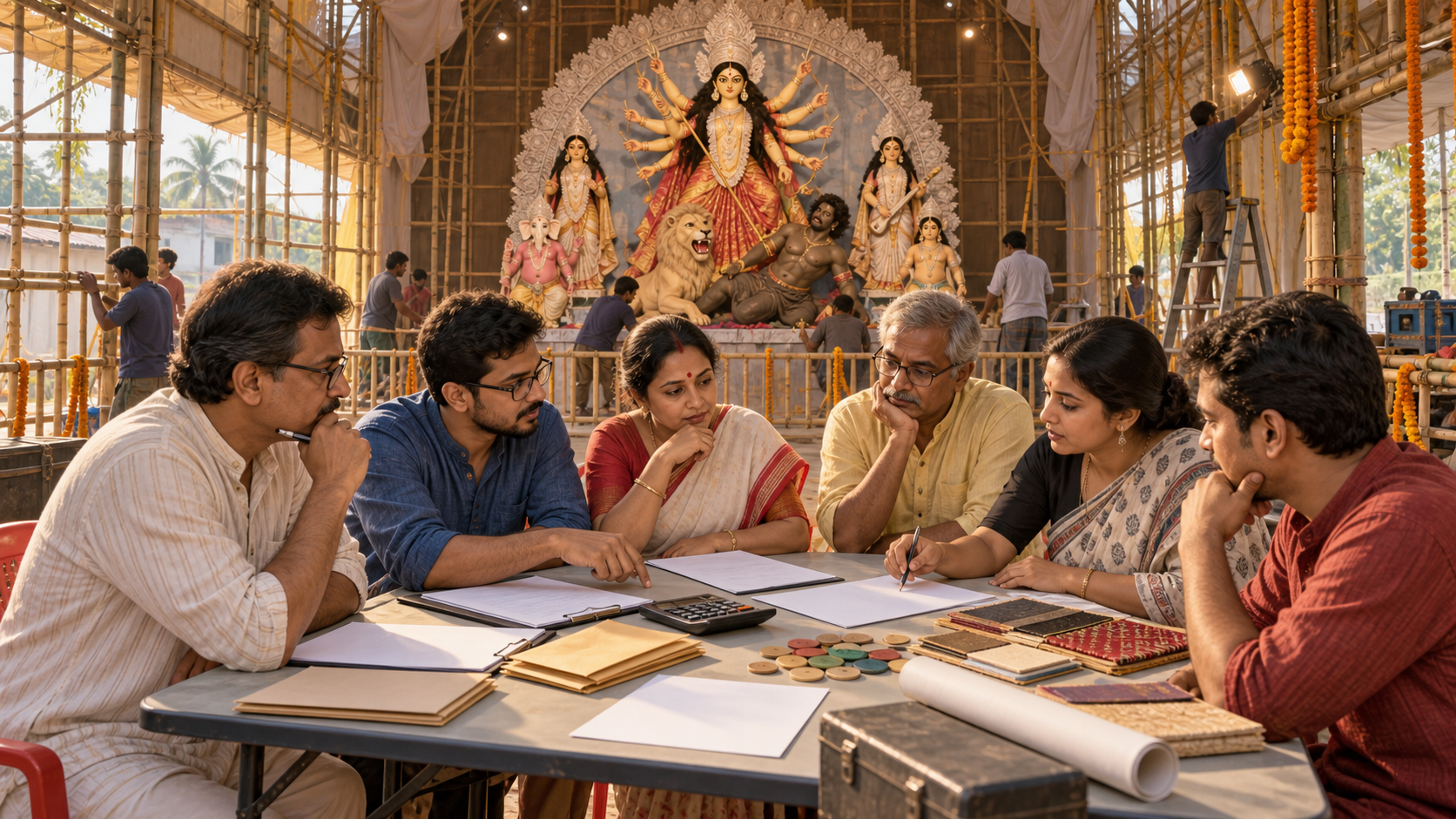
If you help run a neighbourhood Durga Puja, Rs. 1,00,000 in state support may solve a real budget problem. It can also tempt a committee to promise spending before it knows whether it qualifies, when the money will arrive, or what conditions accompany it.
Handle the funding decision and the festival restrictions as separate matters. Your committee needs a written financial plan for the grant, a written operational plan for the Ashtami dry day and DJ ban, and a clear line protecting the ritual life of the Puja.
Key takeaways for Puja committees
- The announced framework allows Rs. 1,00,000 for low-budget Pujas. Do not treat that amount as cash in hand until your committee has the eligibility rules, sanction and disbursement terms.
- Wealthier committees have been urged to forgo state support. A committee that can finance itself should decide openly whether declining the aid would leave more public support for smaller community Pujas.
- The framework includes an Ashtami dry day and a ban on DJs. Those short labels are not an operating manual; obtain the exact hours, area, definitions and enforcement instructions in writing.
- Keep traditional worship distinct from commercial entertainment. Ask expressly how the DJ restriction treats dhaak, conch, Chandipath, sankirtan, live devotional music, microphones and fixed loudspeakers.
- Publish what you receive and how you spend it. Public funding should strengthen a community Puja without turning the committee into a vehicle for patronage or private benefit.
Separate the announced terms from the missing rules
The usable facts are presently narrow: support of Rs. 1,00,000 is associated with low-budget Pujas, wealthier committees are being asked to stand aside, Ashtami is to be a dry day, and DJs are prohibited. A responsible committee should not fill the gaps with assumptions.
Get answers to the questions that change your plan
- What precisely qualifies as a low-budget Puja: total expenditure, prior-year expenditure, location, committee type or another test?
- Is Rs. 1,00,000 a fixed grant, a maximum reimbursement, or an amount subject to verified expenses?
- Which authority receives the application, and what are the deadline, required documents and approval process?
- When is the money disbursed: before the Puja, during it or after bills are submitted?
- What accounting, audit, bank-account or unspent-balance conditions apply?
- What dates and hours does the dry-day order cover, and does it regulate sale, service, storage, consumption or only specified licensed premises?
- How does the DJ ban define a DJ, sound equipment and recorded music? Does it distinguish those activities from traditional instruments and devotional performance?
- Which authority will enforce each restriction, and where can a committee obtain a written clarification before changing contracts?
Ask for the circular or order number, issuing authority, date and official contact. A forwarded image, party statement, social-media message or verbal assurance is not enough for a decision involving public money or a vendor contract. Keep the written material with the minutes of the meeting at which your committee acts on it.
This discipline protects both sides. It prevents an eligible neighbourhood Puja from abandoning useful assistance because of rumour, and it prevents a committee from spending money it has not actually been sanctioned.
Decide whether the Rs. 1 lakh aid genuinely helps
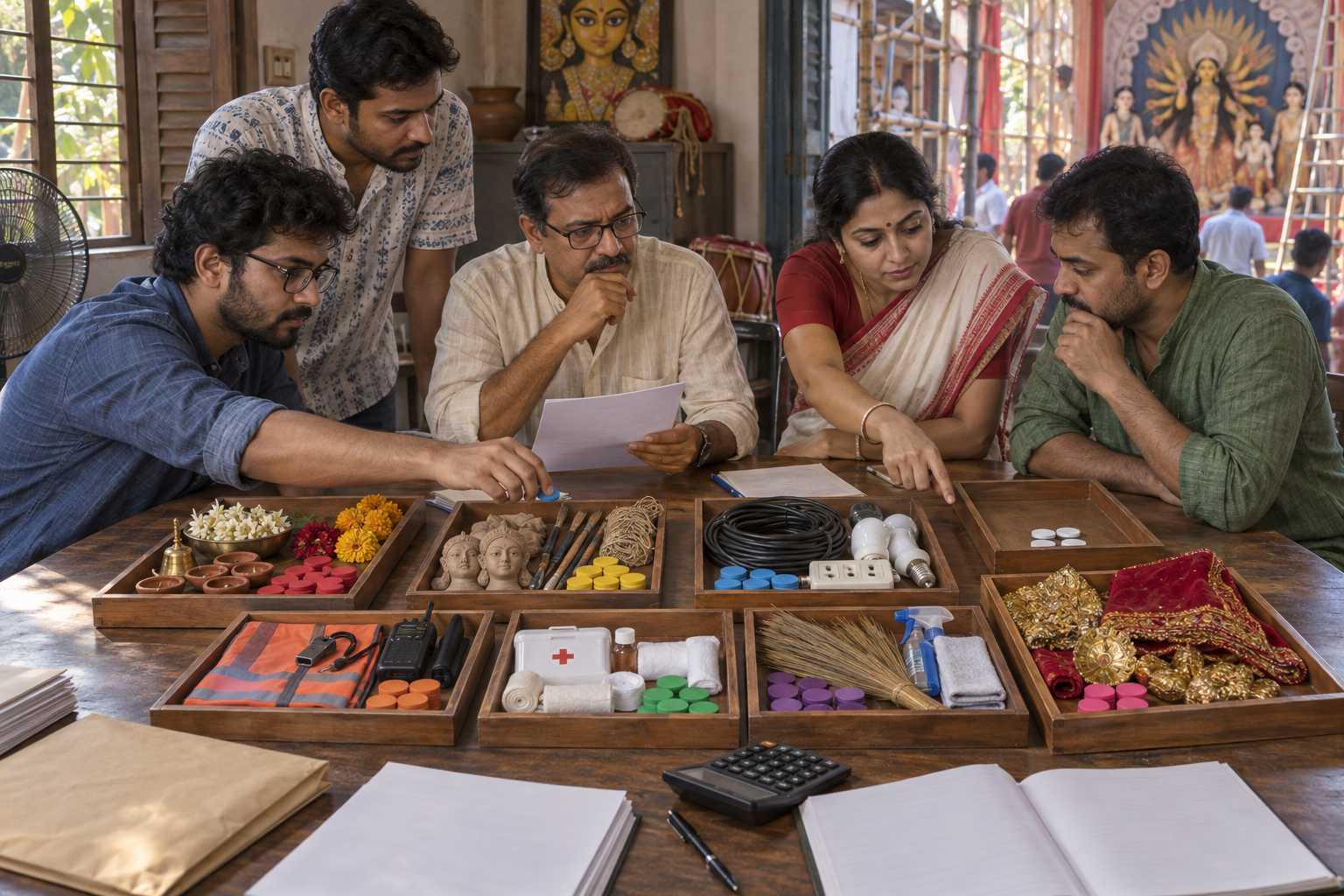
For a small committee, declining assistance merely to appear independent may burden local families and volunteers. Accepting transparent public support for a public cultural celebration is not, by itself, a surrender of Dharma. The serious questions are whether the committee qualifies, whether the conditions are lawful and workable, and whether every rupee remains accountable.
Prepare two budgets. The first must deliver a dignified Puja without the grant. The second can assign the aid after approval. Until the money is sanctioned, do not use it to justify a larger idol, added decoration, a costlier cultural programme or a vendor commitment that local contributions cannot cover. If payment is delayed or denied, worship should not be left hostage to the gap.
Place any eventual aid in its own ledger line. Retain the sanction, bank record, invoice, payment proof and remaining balance for each expense charged against it. At the pandal or through the committee’s normal public channel, disclose the amount received and a short expenditure statement. Do this even if the formal scheme asks for less disclosure. It answers the question every donor is entitled to ask: did public aid supplement the Puja, or disappear into an opaque general fund?
A financially strong committee faces a different decision. The request that wealthier Pujas forgo support is voluntary as described, so the committee should record its reasoning rather than make a private arrangement. If existing donations comfortably cover worship, safety, sanitation and contracted obligations, declining the money can help preserve the scheme’s moral focus on modest para Pujas. If the committee applies despite its apparent wealth, it should be able to explain its eligibility and need publicly.
Do not confuse the two legal and practical questions. Refusing the grant does not necessarily release a Puja from generally applicable public-order restrictions. Accepting the grant does not mean that every informal demand from a political intermediary becomes a valid condition. The written scheme and the applicable orders matter; if a condition threatens substantial money, a signed contract or the conduct of worship, obtain advice from a local lawyer familiar with public grants before acting.
Turn the dry day and DJ ban into an operating plan
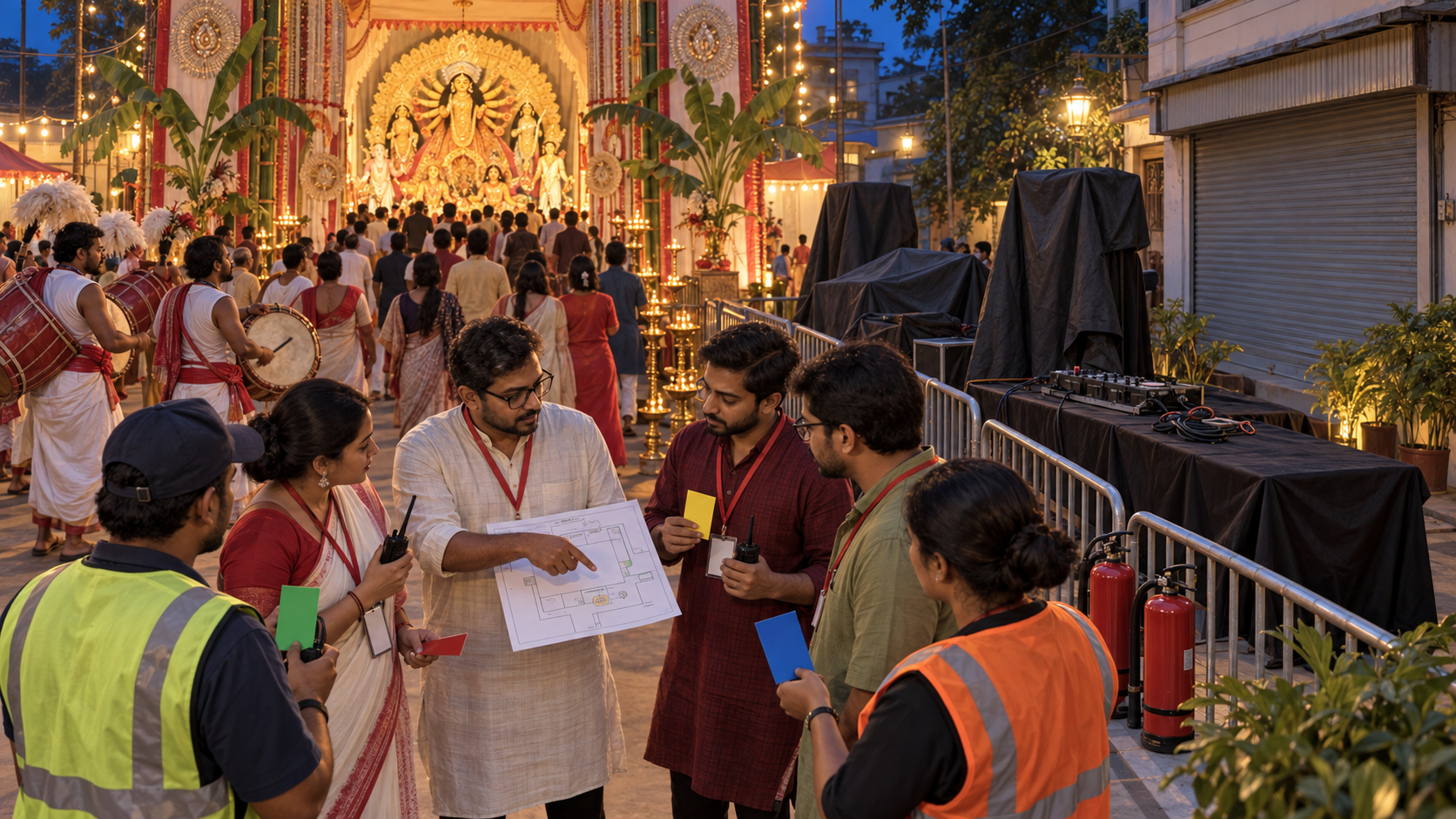
A short restriction becomes troublesome when nobody knows who must comply. Do not leave volunteers to interpret it at the gate on Ashtami. Map each requirement to the committee, vendors, contractors and public authorities before the festival.
For the Ashtami dry day
- Obtain the complete order and mark its start time, end time and territorial reach on the committee calendar.
- Confirm whether the order governs licensed sale, service at events, possession in the Puja area or some other defined conduct. Do not broaden a government order through guesswork.
- Notify caterers, stall operators, sponsors and venue partners in writing. Add the applicable requirement to new vendor instructions so nobody can later claim ignorance.
- Keep the pandal, bhog area and procession alcohol-free as a committee rule consistent with the dignity of worship. State that rule on signs and volunteer briefings without encouraging volunteers to search people or seize property.
- Give volunteers a named police or administrative contact for suspected violations. Public enforcement belongs to the competent authority, not to an improvised committee patrol.
Ashtami draws its meaning from worship of the Devi, not from state regulation. A dry day can support sobriety around the sacred occasion, but the committee’s own standard should come from reverence and orderly conduct. Enforcement should remain clear, proportionate and within lawful authority.
For the DJ ban
- List every booking involving a DJ, recorded-music operator, mobile sound rig, stage system or procession vehicle. Note deposits, cancellation terms and payment dates.
- Ask for written clarification before assuming that the prohibition also covers dhaak, kansor-ghanta, conch, Chandipath, sankirtan, live devotional singing, microphones or ordinary announcement systems.
- If a signed booking is affected, amend or cancel it in writing under the contract. Do not simply withhold payment; that can turn an administrative restriction into a financial dispute for the committee.
- Create a sound schedule that follows whatever hours and limits the operative orders prescribe. Give one authorised person control of the system so volunteers cannot restart prohibited equipment after a warning.
- Maintain a brief incident log recording the time, complaint, official contacted and action taken. It is more reliable than trying to reconstruct conflicting accounts after the Puja.
A DJ ban need not become a ban on Bengal’s ritual soundscape. Commercial amplification and traditional devotional expression are different in purpose and form. That distinction should be written into implementation rather than left to the preference of an officer or volunteer at the roadside.
Keep worship central while demanding fair governance
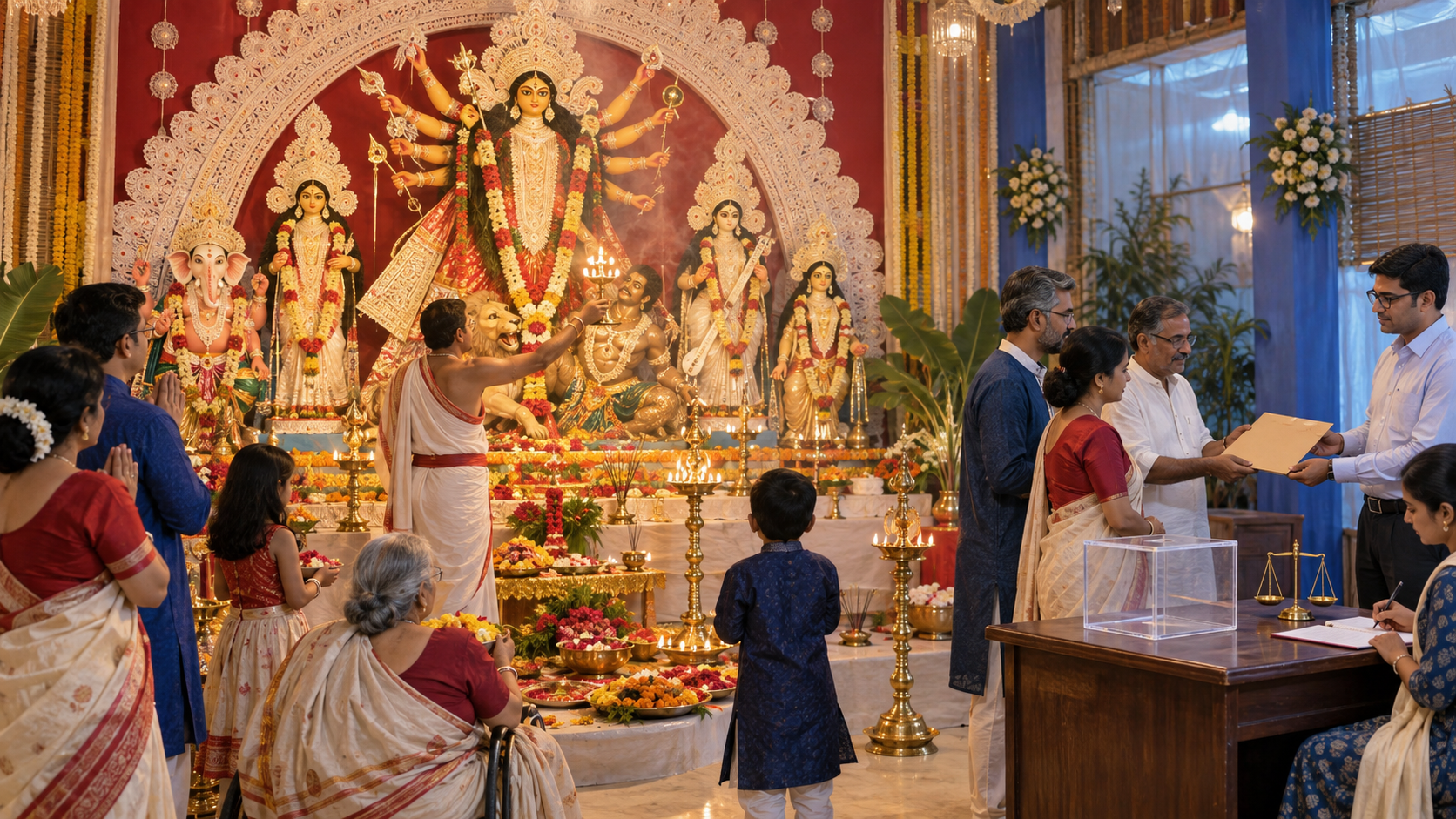
You do not have to choose between gratitude for assistance and scrutiny of government power. A pro-Dharmic position can support help for modest Pujas, welcome measures that preserve Ashtami’s dignity, and still insist that eligibility and enforcement be transparent.
Use four tests when your committee evaluates the final rules:
- Transparency: Can any committee discover the eligibility test, application route, approval status and spending conditions without approaching a political intermediary?
- Religious autonomy: Do the rules regulate public money, alcohol, noise or safety, or do they intrude into the choice of ritual, priest, mantra, image or devotional tradition?
- Equal treatment: Are comparable committees given the same financial criteria and the same interpretation of the restrictions?
- Proportionality: Is a committee held responsible for what it can actually control, rather than for unrelated conduct elsewhere in a neighbourhood?
If two committees receive conflicting directions, compare the written orders before turning the disagreement into a partisan confrontation. Send one joint request for clarification, retain the reply and circulate it to nearby Pujas. Shared documentation is especially valuable for small committees that lack administrative connections.
At your next meeting, assign three named responsibilities: one person obtains the operative orders, the treasurer prepares budgets with and without the grant, and one member reviews every affected vendor contract. Pass no grant-funded expense and cancel no booking until those three reports are on the table. That single discipline will protect the Puja better than either unquestioning acceptance or reflexive political opposition.
References
