
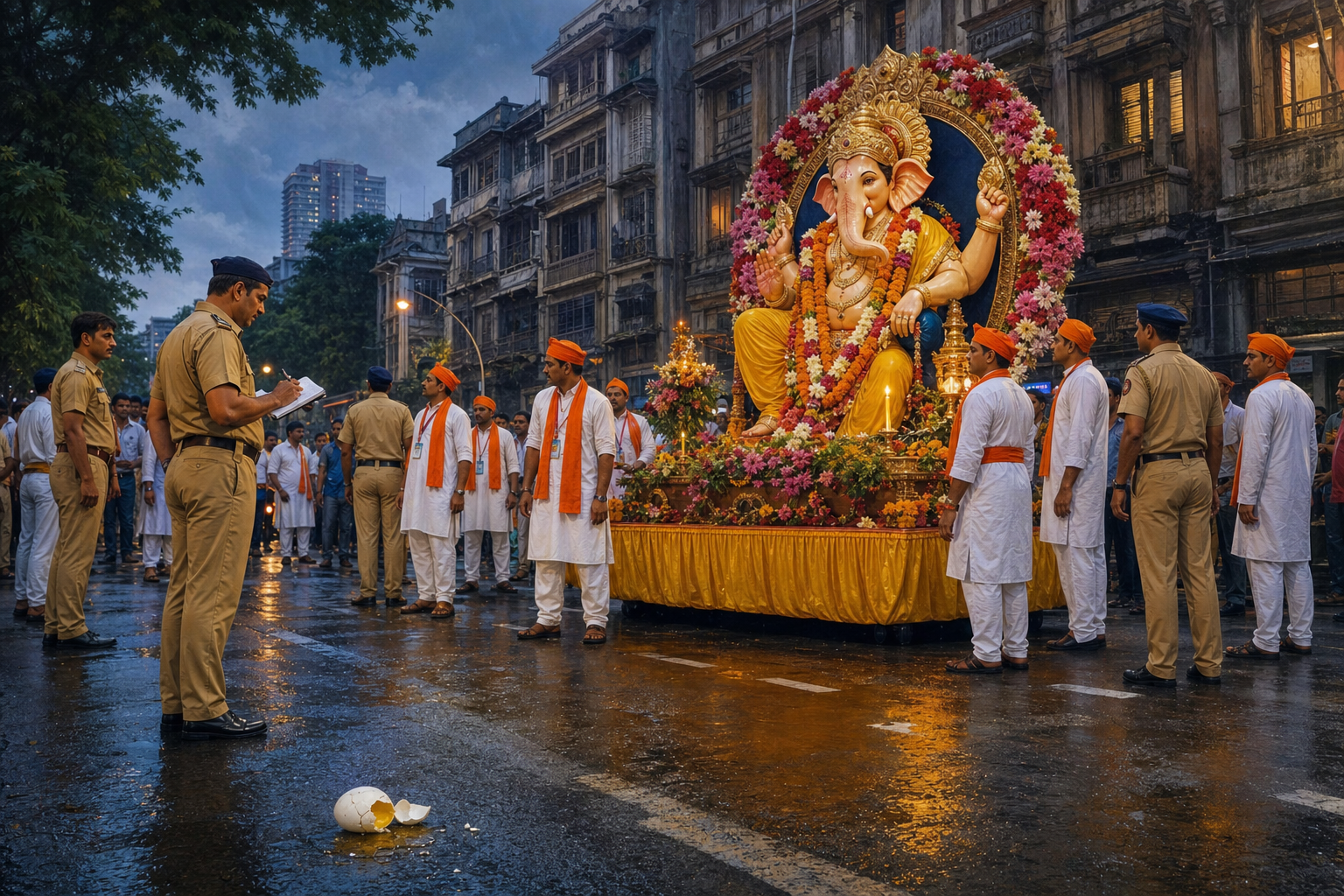
If you saw news of the egg attack on a Ganesh procession in Mumbai and wondered what devotees should do next, begin by refusing the provocateur’s chosen terrain: confusion and disorder. An insult to a sacred murti deserves a firm response, but firmness starts with verified facts, preserved evidence, lawful pressure and protection for future processions.
This is also a test of public discipline. You do not have to minimise the offence to reject rumours, collective blame or retaliation. A response can defend Hindu dignity without endangering innocent people or making the investigation harder.
What is established about the Mazgaon incident
On the night of 23 August, eggs were reportedly thrown deliberately at the Mazgaoncha Morya Ganesh idol during its arrival procession in Mazgaon. Local devotees protested, and police registered a case against unidentified individuals.
Those facts define the responsible boundary of public discussion. The reported act, the procession, the protest and the police case can be stated. The available information does not establish the identity, religion, organisational affiliation or motive of whoever was responsible. It also does not justify attaching guilt to residents of a building, neighbourhood or community.
That distinction is not a retreat from accountability. Unidentified does not mean insignificant; it means the investigation still has work to do. Devotees can insist that the act be investigated seriously while declining to fill evidentiary gaps with assumptions.
Be equally careful with minimisation. Calling the incident a harmless prank before the circumstances are established is another form of speculation. Throwing objects at a religious procession can create panic as well as insult. The appropriate demand is neither premature communal attribution nor premature dismissal. It is identification of the responsible person or persons through evidence.
Turn anger into evidence before details disappear
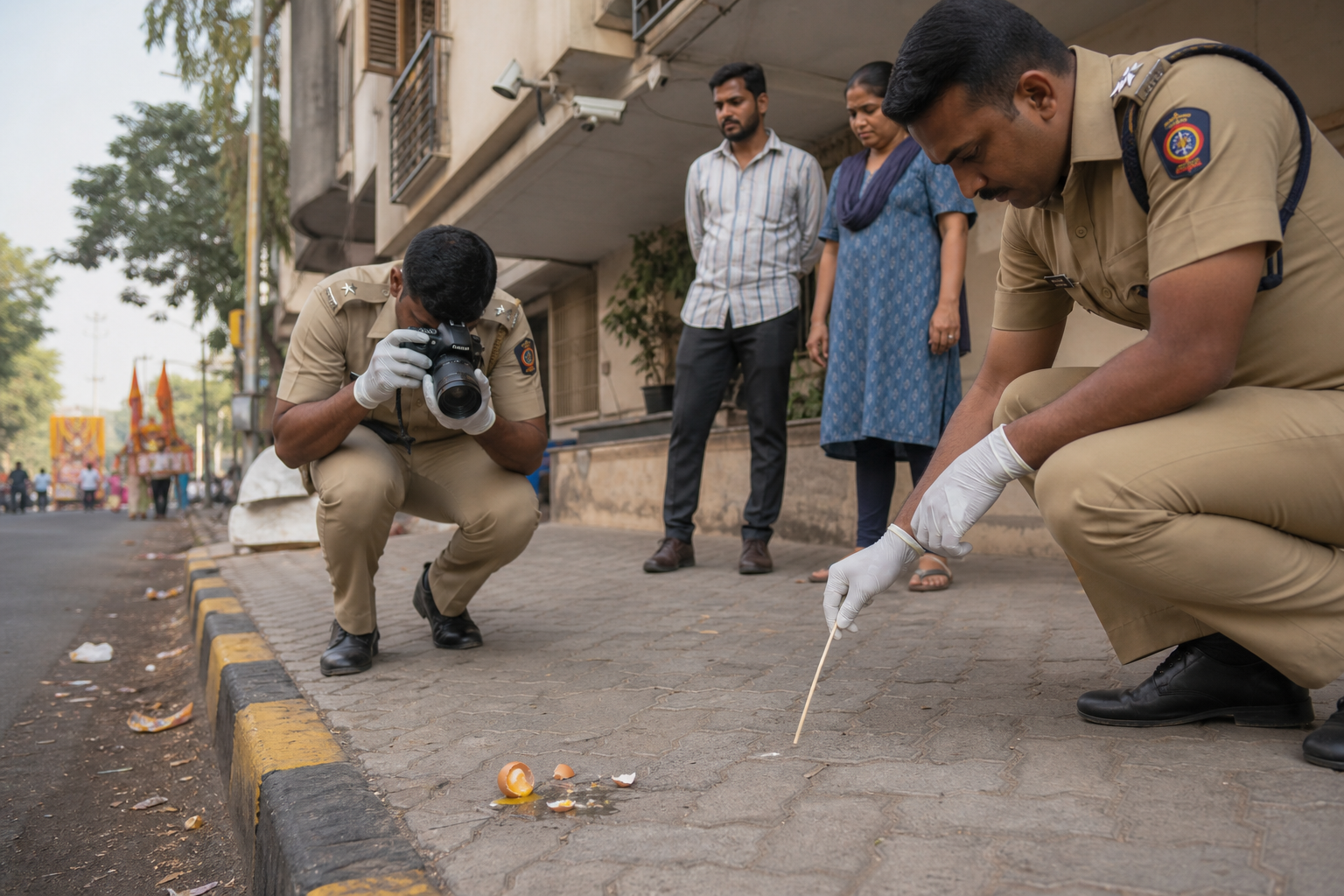
If you witnessed the incident or possess an original recording, your most useful contribution is a clean evidentiary trail. Social-media circulation can wait. Original files, precise observations and independent witness accounts are more valuable than a heavily captioned clip copied through several messaging groups.
- Retain the original photograph or video file. Do not trim it, add music, place text over it or overwrite it with an edited version.
- Record what you personally observed: the approximate time, your location, the direction from which the objects appeared to come and what happened immediately afterward. Separate observation from inference.
- Note who made each recording. If several witnesses were present, ask them to write their recollections separately before discussing details as a group. This helps prevent one person’s assumption from becoming everyone else’s memory.
- Provide relevant material to the investigating police and the procession organisers. Ask for an acknowledgement or case reference when one is available, and keep a copy of what you submitted.
- Treat reposted clips, screenshots and forwarded voice messages as possible leads, not proof. State clearly when you did not witness something yourself.
If an incident is still unfolding, personal safety comes first. Do not move toward a suspected throwing point, enter private premises, chase anyone through a crowd or provoke a confrontation for the sake of obtaining footage. Alert procession organisers and police, create distance from the immediate risk and document only from a safe, lawful position.
Avoid publishing the faces, telephone numbers or addresses of people who have not been identified through the investigation. A confident caption does not turn an unclear image into evidence. Misidentification can expose an innocent person to harassment and divert attention from the actual offender.
Be firm without allowing the protest to become a second incident
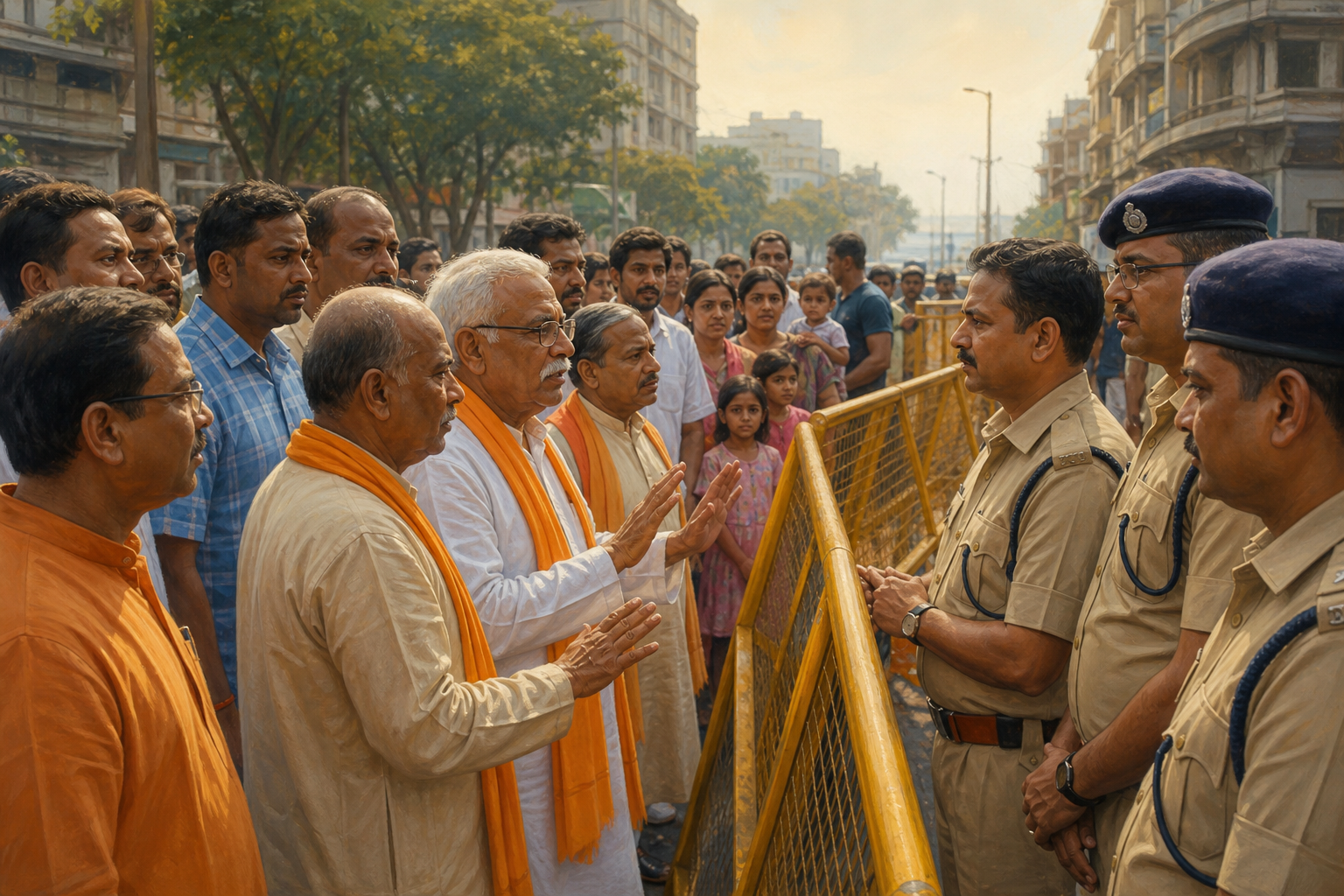
Devotees were entitled to demand police action, and the registration of a case gives that demand a formal path. The next task is to keep public pressure specific: identify those responsible, secure available evidence, protect future processions and communicate verified developments.
A disciplined protest strengthens those demands. Property damage, threats, forced entry into buildings or slogans aimed at an entire community would shift the public issue from the attack on the procession to the conduct of the crowd. They could also frighten witnesses and give the actual offender more room to disappear inside a wider conflict.
If you are speaking for a mandal or community organisation, keep every public statement within four boundaries:
- Describe the reported act and the status of the police case accurately.
- Ask for investigation of individuals rather than assigning collective guilt.
- Correct viral claims that cannot be traced to a witness, original recording or official update.
- Tell devotees where verified evidence can be submitted and who is authorised to speak for the procession.
This is where a Dharmic response differs from either passivity or vengeance. Ahimsa does not require pretending that desecration is trivial. It requires control over the means used to oppose adharma. Reverence for Ganesha is not served by harming an uninvolved person, spreading a false accusation or letting a provocateur dictate the community’s conduct.
Protect the next procession without turning it into a siege
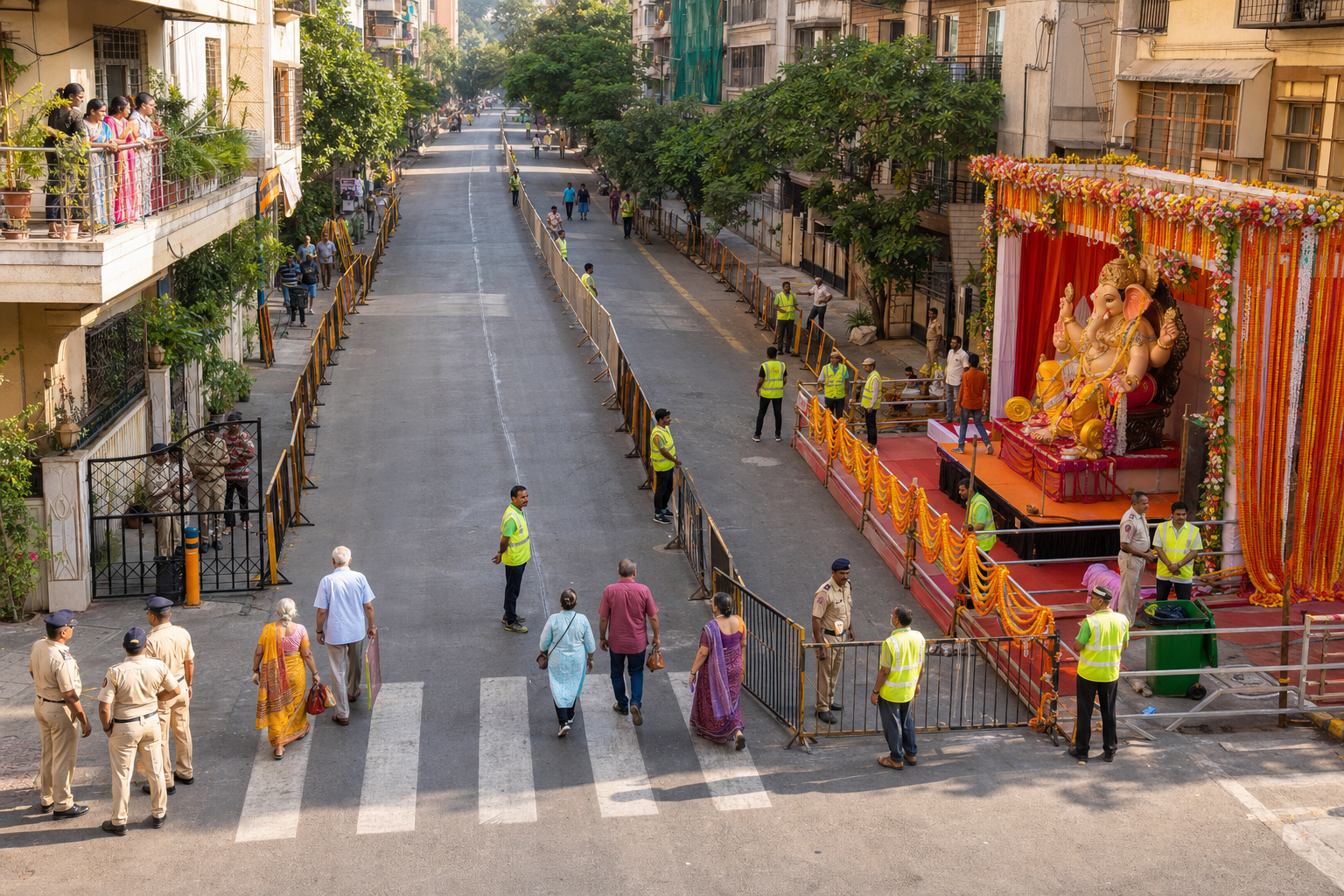
The practical lesson is not to hide Hindu festivals from public space. It is to organise processions so that an isolated provocation is noticed, contained and documented before it can trigger a crowd surge. Security should support worship, not overwhelm it.
Before the procession, organisers should walk the route with police and identify narrow stretches, congested junctions and overhead points from which objects could reach participants. Local permissions and police directions vary, so route, assembly and recording arrangements should be confirmed with the responsible local authorities rather than assumed.
- Appoint one coordinator to communicate with police. Volunteers should report through that person instead of issuing competing instructions.
- Assign identifiable volunteers to the front, rear and flanks of the procession. Their role is to observe, guide and de-escalate, not to chase or detain suspects.
- Designate a small documentation team. Give it a clear method for preserving original files and recording witness contact details with consent.
- Maintain a safe buffer around the murti and procession vehicle so that a sudden stop does not become a crush point.
- Agree on a short incident signal that tells volunteers to slow or pause the procession, protect the immediate area and call the police liaison.
- Brief participants not to enter buildings, climb onto private property or follow unverified accusations shouted from the crowd.
If something is thrown, volunteers should first prevent a rush toward the suspected direction. The coordinator can alert police, note the approximate point of origin and move the murti and nearby devotees away from continuing exposure when it is safe to do so. Witnesses should be directed to the documentation contact instead of being surrounded by people asking leading questions.
Decisions about cleaning the murti or performing a purification observance belong to the mandal and its priestly or sampradaya guidance. Practices differ, so an incident should not become an occasion for strangers online to impose a supposedly universal ritual. Secure the scene, preserve evidence and then follow the tradition under which the murti is being worshipped.
Afterward, organisers should hold a short factual review: where the object came from, how quickly police were alerted, whether volunteers knew their roles, whether original recordings were preserved and where crowd movement became unsafe. Convert each failure into one named responsibility before the next procession. A vague promise to be more careful will not change behaviour on the route.
Key takeaways for devotees and organisers
- The reported Mazgaon incident led to a police case against unidentified individuals; identity and motive should not be invented while they remain unestablished.
- If you hold evidence, preserve the original file, distinguish observation from inference and submit it through a documented channel.
- Demand accountability for the responsible individuals without threatening residents or blaming an entire community.
- For future processions, assign a police liaison, trained route volunteers and a documentation contact before the murti begins moving.
- Use Dharmic restraint as operational discipline: protect the sacred, protect innocent people and deny provocateurs the wider disorder they may seek.
If you help organise a Ganesh mandal, do one concrete thing now: put the liaison, evidence and de-escalation roles in writing before the next route briefing. If you are a devotee, refuse to forward the next accusation until you can identify what is verified. That combination of vigilance and restraint is how a community remains both fearless and just.
References
