

If your teenager says someone has photos or videos and is demanding marriage or a change of religion, treat that sentence as a safety disclosure, not as a family-honour crisis. Do not begin with blame, seize the phone in anger, or arrange a confrontation. Your first jobs are to move the child out of danger, preserve the evidence, and make it safe for them to tell you the whole sequence.
The most useful opening question is not, “Why didn’t you tell us earlier?” Ask instead: “What do they have, what have they demanded, and what are you afraid will happen next?” The Lucknow allegations show why those questions belong together: harassment on a school route, threats, digital material, marriage demands, and pressure to change religion may be parts of the same coercive chain.
Key takeaways
- The claims in the Lucknow case remain allegations. Arrest or custody does not establish guilt.
- When a child discloses blackmail, respond first to danger and evidence. Questions about judgment, secrecy, or broken household rules can wait.
- Preserve complete conversations, account identifiers, timestamps, call records, and the original device. Do not edit, delete, or circulate sensitive material.
- A voluntary religious decision is categorically different from a demand allegedly enforced through threats. Defend that distinction without turning one case into a verdict against an entire community.
- Families and schools should establish a disclosure plan before a crisis: a code word, safe pickup points, named adults, and a written route-safety process.
What the Lucknow allegations actually establish
The minor’s mother filed a complaint with Gudamba police on 25 June. She alleged that her daughter was harassed while travelling to and from school, subjected to offensive remarks, and threatened when she objected.
Police said the minor’s subsequent statement brought out further allegations: photos and videos were being used to blackmail her, while she was pressured to change religion and marry. Investigators then added a conversion-related provision to the case. Police arrested Mohammad Saeed, also known as Chidda, near the Rajouli culvert on 6 November 2026. They described the Rajouli resident as having evaded arrest for about five months. Another juvenile connected to the case had already been placed in judicial custody.
The arrested man did not give police a substantive response and said he would present his position in court through his lawyer. That point must remain visible. A complaint records allegations; an arrest shows that police have detained a person; custody is not a judicial finding of guilt. No responsible discussion should erase either the seriousness of the claims or the accused’s right to due process.
The sequence nevertheless gives parents a concrete lesson. The first visible problem may be behaviour on a road outside school. The fuller danger may sit on a phone. When a child reports repeated comments, following, unwanted contact, or threats along a regular route, ask whether the same person has also contacted them online, obtained any image or recording, demanded secrecy, or tried to dictate a relationship, marriage, or religious choice.
If a child discloses blackmail, protect safety and evidence

A frightened minor may disclose only the least embarrassing part first. Anger can shut down the details you need most. Choose one calm adult to hear the initial account, use the child’s own words, and avoid making them repeat the story to every relative. Then work through the response in this order.
- Check immediate danger. Ask whether the person knows the child’s present location, home, school timetable, or usual route; whether a meeting has been demanded; and whether anyone has threatened to come to the home or school. If danger appears imminent, move the child to a safe place and contact police or local emergency services. Do not send a relative to conduct an improvised confrontation.
- Record the child’s account without coaching it. Note the approximate dates, locations, names, usernames, phone numbers, demands, threats, and any witnesses. Separate what the child directly saw or heard from what someone else told them. A clean chronology is more useful than an emotional reconstruction.
- Preserve the digital context. Capture the entire conversation rather than isolated threatening lines. Include profile pages, handles, phone numbers, timestamps, URLs, call logs, voice messages, and surrounding messages that show how contact developed. Retain the original device and account. Do not crop, annotate, rename, or delete the originals.
- Do not circulate the material. Sending screenshots to relatives, neighbourhood groups, or social media can expose the minor, spread the very content being used for leverage, and alert the accused before authorities can act. If any file may be intimate, do not forward it casually even for the purpose of seeking help; show the original device directly to police or a qualified local lawyer.
- Do not negotiate alone. Avoid threats, payment, promises, or a staged meeting intended to catch the person. After preserving the immediate evidence, ask police or a qualified lawyer how further messages should be handled. If blocking an account is necessary for immediate safety, save the identifying information and conversation first when it is safe to do so.
- Report both the alleged offence and the school-route risk. Give police a written chronology and request an acknowledgement or reference number. Notify a named school administrator in writing, identify the affected route and timings, and request a concrete arrival-and-departure plan. The child should not be left to explain the danger repeatedly to different staff members.
- Secure the accounts after evidence is preserved. From a trusted device, change passwords, enable multi-factor authentication, revoke unfamiliar sessions, inspect linked email addresses and cloud albums, and turn off unnecessary location sharing. Check whether the same password was used on other accounts.
Legal procedures vary, and the precise offences or protective measures cannot be determined from a news account. Where the threat is continuing, sensitive media is involved, or police action is disputed, obtain advice from a lawyer qualified in the relevant jurisdiction. Online advice is not a substitute for counsel who can examine the complaint and evidence.
Defend religious freedom without communal shortcuts

A demand to change religion does not become an ordinary theological disagreement merely because it is packaged with a relationship or promise of marriage. If photos, videos, threats, or fear are being used to obtain compliance, the central issue is alleged coercion. A free religious choice and a religious demand enforced through blackmail belong in different moral categories.
You can say this clearly to a child: “No one gets to use an image, threat, relationship, or marriage proposal to choose your faith for you. You will not be punished for telling us.” That language protects agency without forcing the child to defend every earlier conversation or feeling before receiving help.
A Dharmic response should combine courage with restraint. Protect the vulnerable person. Tell the truth precisely. Insist on lawful investigation and due process. Do not publish the minor’s name, face, school, route, or private messages. Do not convert an allegation against identified individuals into suspicion of every Muslim neighbour, classmate, or interfaith couple. Collective blame neither safeguards the child nor strengthens the case.
The standard must also remain consistent when identities change. Harassment, blackmail, forced religious conformity, and coerced marriage are wrong regardless of the faith of the accused or victim. That consistency is not a retreat from defending Hindu society. It is what makes the defence credible.
Build the disclosure plan before a threat arrives
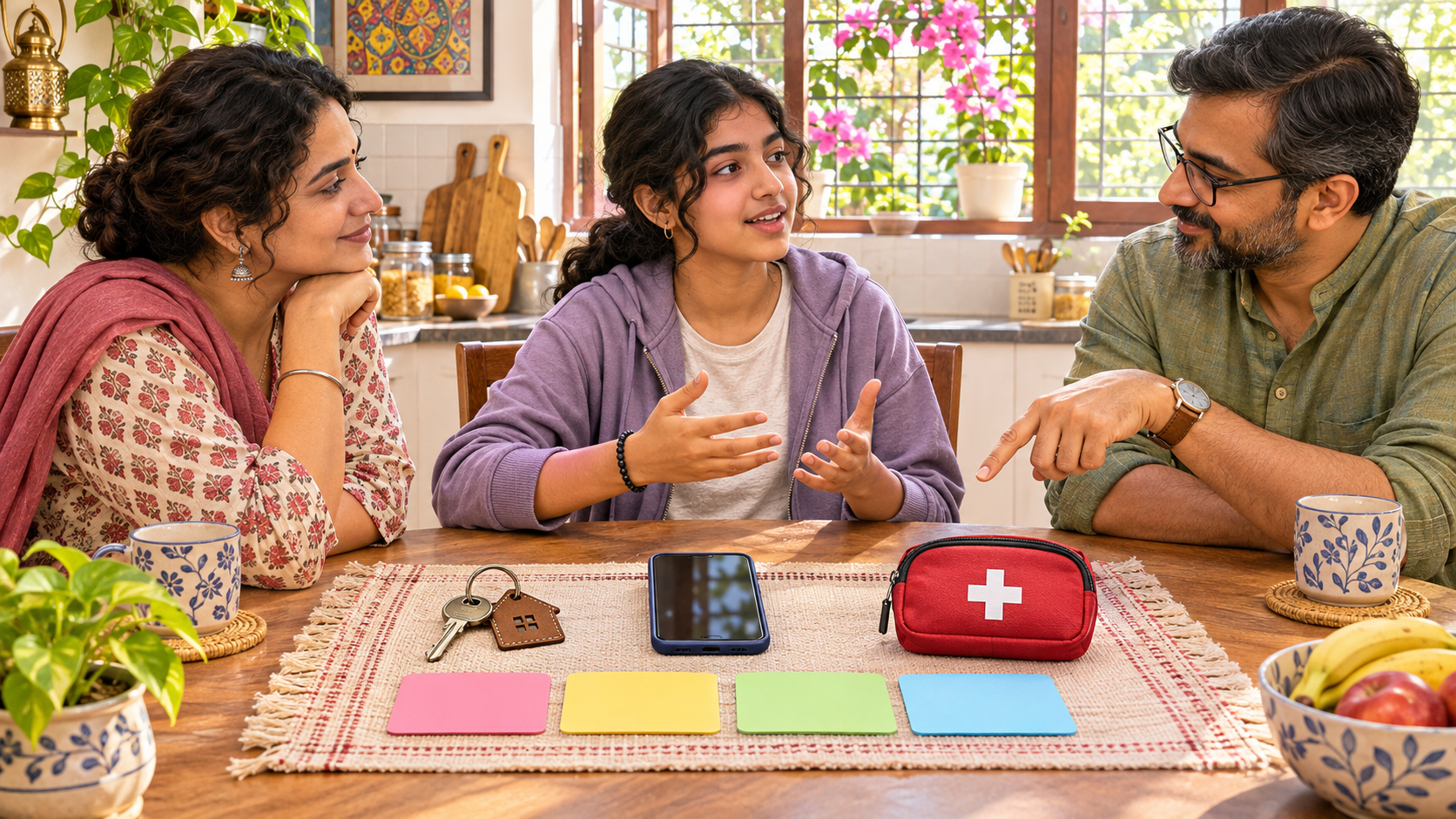
The strongest family protection is not total surveillance. It is a reliable way for a child to ask for help before fear becomes isolation. Build that system during an ordinary week, not after a threat appears.
At home
- Make one explicit promise: disclosure itself will not be punished. You can address unrelated rule-breaking later; immediate safety comes first.
- Choose a neutral code word the child can send when they need collection but cannot safely explain. Agree in advance who will respond and which staffed public place will serve as the pickup point.
- Identify two trusted adults beyond the parents whom the child may contact. A child who fears one caregiver’s reaction still needs a route to safety.
- Teach three rules for coercive messages: do not meet alone, do not delete the conversation, and do not negotiate without a trusted adult.
- Review privacy settings together at the start of a school term or after a new device is introduced. Show the child how to find logged-in sessions, location sharing, cloud backups, blocked accounts, and recovery contacts.
- Explain that blackmail survives on secrecy. Compliance rarely restores control because the person making the demand can return with another demand. The safe objective is not to satisfy the blackmailer but to bring in trusted adults and lawful authorities.
At school
Ask the school for a named contact rather than a generic office number. If a route concern arises, the written plan should identify who receives the child, who releases them, how an unexpected pickup change is verified, and where the child can wait safely. A vague promise to “keep an eye out” is not a safeguarding plan.
Schools should also treat route harassment and digital coercion as potentially connected. A complaint about comments outside the gate should prompt discreet questions about messages, images, impersonation, threats, and pressure to meet. Staff should record the child’s words, restrict unnecessary disclosure, and avoid informal mediation between a minor and the person accused of coercing them.
Start tonight with one short conversation: tell your child whom to contact, what code word to use, and that they will receive help before judgment. A child who knows exactly how disclosure will work is less likely to face a threat alone.
References

Leave a Reply
You must be logged in to post a comment.