

If you are trying to decide what the Burdwan conversion dispute means for Hindus, do not let the loudest image, slogan, or social-media claim make the decision for you. The useful questions are narrower: What is established? What remains alleged? What response protects Dharma, public safety, and the possibility of discovering the truth?
The known public outline is limited. On 10 November 2026, a protest over an alleged conversion network in Burdwan reportedly turned violent; people described as members of Hindutva groups allegedly assaulted Christian worshippers, and a pastor’s police complaint was reportedly withdrawn under pressure. The conversion network remains an allegation, not an independently established finding. We also cannot independently verify the complete sequence of events, each participant’s responsibility, or the circumstances in which the complaint was withdrawn.
What Burdwan does – and does not – establish

A communal dispute often collapses several different questions into one emotional verdict. That is precisely what you should resist here. Burdwan presents at least four separate claims:
- That an organised religious-conversion network was operating.
- That any conversion effort involved coercion, deception, threats, or benefits conditioned on changing religion.
- That people participating in the protest assaulted or threatened Christian worshippers.
- That the pastor did not withdraw his police complaint freely.
Each claim needs its own evidence. Proof of an organised missionary effort would not, by itself, prove coercion. Proof of coercion would not authorise private citizens to assault anyone. Proof of an assault would not show that every conversion concern was fabricated. A forced withdrawal, if established, would raise a serious accountability issue without establishing every allegation contained in the original complaint.
A complaint records an allegation; it is not a verdict. Its withdrawal does not automatically prove that the allegation was false. Fear, outside pressure, reconsideration, legal advice, or a voluntary resolution can all affect a complainant’s decision. Do not assign a motive until evidence supports one.
This distinction matters because a crowd can turn uncertainty into punishment within minutes. Once that happens, the visible violence begins to overshadow the original question. Witnesses may become afraid, evidence can be lost, and everyone has a stronger incentive to defend a communal camp rather than describe what actually occurred.
Conversion, proselytism, and coercion are different questions

The word “conversion” is often used too loosely to support a reliable conclusion. It may refer to a voluntary change of belief, an invitation to attend worship, sustained evangelism, baptism, charitable work, or conduct involving pressure or deception. Those acts can raise very different moral, social, and legal questions.
When someone alleges conversion activity, ask what conduct is actually being alleged:
- Was a person merely invited to a service or religious discussion?
- Did the person independently choose to adopt a different faith?
- Was assistance offered without any religious condition?
- Was money, employment, education, medical help, or another benefit allegedly conditioned on a change of religion?
- Was anyone threatened, deceived, isolated, impersonated, or prevented from leaving?
- Is the claim based on a direct witness, an identifiable record, or only a forwarded message?
Disapproval of aggressive proselytism is not proof of force. At the same time, invoking religious freedom does not answer credible evidence of threats or deception. The right approach is to identify the precise act, preserve the evidence, and let the appropriate lawful process determine whether that act crosses a legal boundary. Because the governing law and available remedies depend on the facts and jurisdiction, obtain qualified local legal advice before publicly accusing a named person of a crime.
This discipline is especially important for Hindu families worried about vulnerable relatives. Speak directly with the person concerned. Ask what was offered, promised, represented, or demanded. Record the person’s own words without coaching. If the person is an adult acting voluntarily, disagreement within the family is not proof of coercion. If there are specific threats, deception, confinement, or pressure, preserve those particulars and seek lawful help instead of organising a confrontation.
A Dharmic response rejects coercion and mob punishment
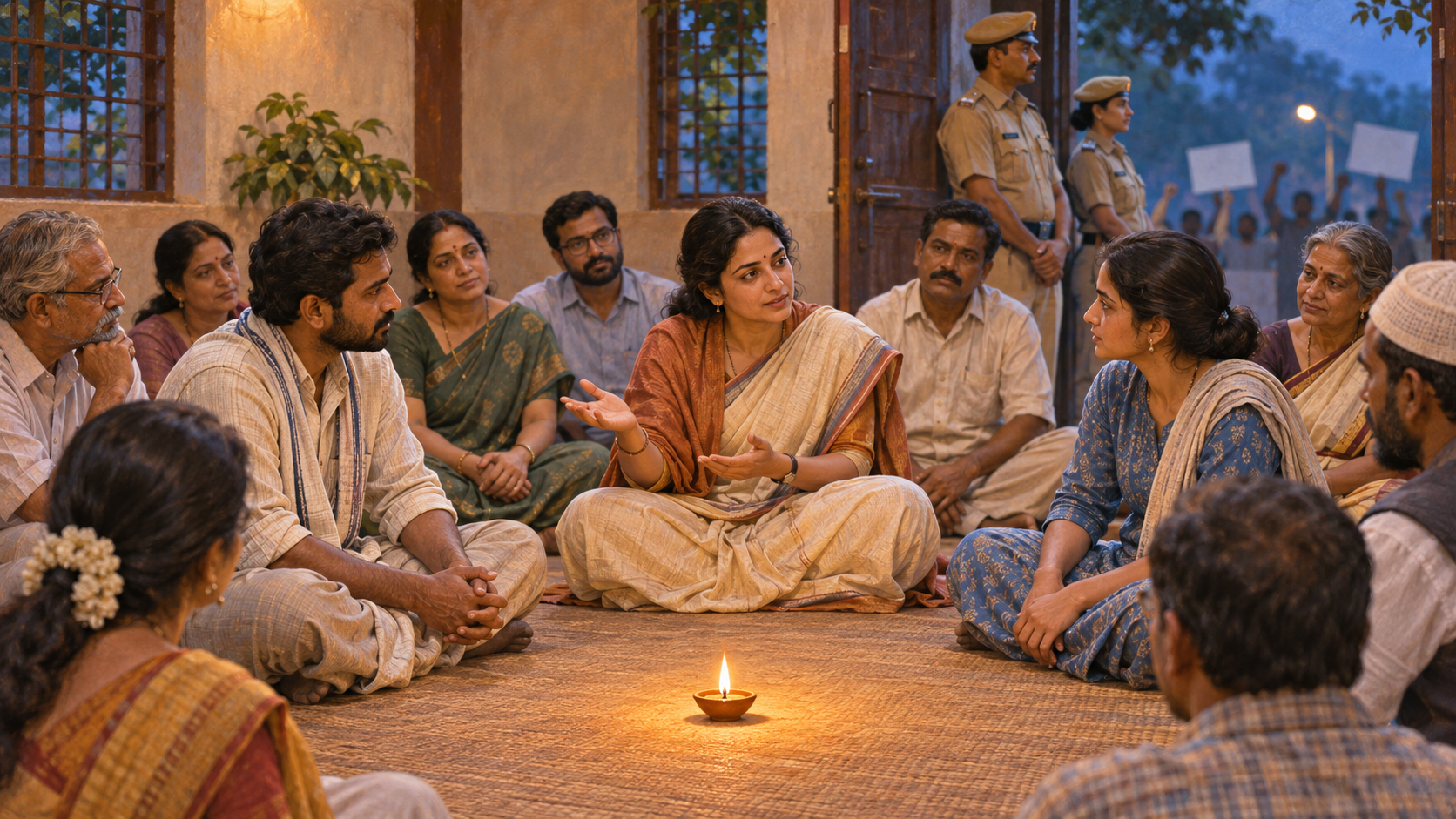
A pro-Hindu response should be exacting about conversion allegations and unambiguous about violence. These positions do not conflict. No religious organisation should receive a free pass for coercion, and no activist should receive a free pass for assault committed in the name of protecting Hindu society.
Satya demands that we distinguish what we know from what we suspect. Ahimsa demands restraint from avoidable injury. Dharma also requires the protection of people who may be vulnerable to coercion, intimidation, or communal retaliation. These duties work together: investigate concrete wrongdoing, protect the threatened, and refuse collective punishment.
Non-violence does not mean passivity. A community can document suspected coercion, accompany a frightened complainant, engage a lawyer, request an official investigation, hold a peaceful demonstration, and publish verifiable findings. What it cannot do responsibly is treat an accusation as a licence to invade, strike, threaten, or humiliate.
Violence also weakens the very cause its perpetrators claim to defend. It moves public attention from the alleged conversion conduct to the assault. It gives opponents an easy way to dismiss legitimate questions. It can intimidate useful witnesses and contaminate later testimony. Most importantly, it replaces evidence with the power of the larger or angrier group.
The standard should therefore be symmetrical and easy to state: no forced conversion, no forced withdrawal of a complaint, no assault, and no fabricated accusation. Applying all four principles is not moral equivalence. It is a refusal to let one alleged wrong excuse another.
What to do before you protest, post, or complain

If you witnessed part of the Burdwan incident, know someone involved, or face a similar dispute in your own locality, your first actions can determine whether reliable evidence survives. Use this sequence:
- Make the scene safe. Leave an active confrontation, help injured people reach medical care, and contact the appropriate emergency or local authorities. Do not summon a counter-crowd or confront suspected offenders yourself.
- Write a first-person account promptly. Record the date, approximate time, exact location, sequence of events, and words you personally remember. Clearly separate what you saw or heard from what somebody later told you.
- Preserve original evidence. Keep complete photographs, videos, messages, account names, links, and timestamps. Do not crop or edit the only copy. Retain the original file even if you create a shorter version for lawful sharing.
- Keep the allegations in separate files. Evidence concerning suspected conversion activity belongs in one record; evidence concerning violence or threats belongs in another; evidence concerning pressure to withdraw a complaint belongs in a third. This prevents one dramatic claim from being used as a substitute for proof of another.
- Use identifiable, lawful channels. Submit a factual written statement where appropriate, retain a copy, and keep any acknowledgement you receive. A frightened complainant or witness should consult a qualified local lawyer about protection, privacy, and the correct procedure.
- Set strict boundaries for peaceful protest. Organisers should prohibit physical contact, threats, weapons, entry into homes or worship spaces, and public disclosure of private addresses. Appoint one liaison to communicate with authorities and end the event if participants breach those rules.
- Correct false information visibly. If you shared a wrong name, an edited clip, or an unverified claim, correct it in the same place and with comparable prominence. Quietly deleting it does not repair the damage caused by wider circulation.
Before forwarding any new claim, test its provenance. Ask who created the record, whether the person witnessed the event directly, whether the material is complete, whether time and place can be established, and whether an apparently independent second account merely copied the first. Ten repetitions of one anonymous message are still one unverified claim.
Apply the same caution to visual evidence. A video may establish that a visible act occurred within the recorded frame, but it may not establish what happened before filming began, what happened outside the frame, or why each person acted. Describe only what the recording actually shows. Do not attach an unseen motive to a visible act.
Useful follow-up evidence would include unedited recordings with clear provenance, consistent first-person witness statements, the complaint and any withdrawal record with sensitive personal information protected, relevant medical or incident records where lawfully available, and specific evidence supporting or contradicting the alleged conversion network. None of these items should be treated as automatically conclusive; their consistency and authenticity still matter.
Key takeaways
- Burdwan involves two distinct controversies: an alleged conversion network and reported violence against Christian worshippers, followed by an allegedly pressured complaint withdrawal.
- The supplied facts do not independently prove the conversion allegation or settle the complete sequence and responsibility for the violence.
- Voluntary religious change, proselytism, conditional assistance, deception, threats, and force are different forms of conduct and require different evidence.
- Concern about conversion cannot justify assault, just as religious freedom cannot excuse coercion.
- If you have direct knowledge, protect people first, preserve original evidence, separate observation from hearsay, and seek qualified local legal help.
- Peaceful, documented advocacy serves Hindu interests better than a crowd acting on unverified accusations.
The responsible next step is not to decide which community deserves automatic belief. Demand separate evidence for every allegation, protect witnesses from pressure, and keep public advocacy peaceful. If you are directly involved, make a precise factual record now and let lawful scrutiny do the work a crowd cannot.
References

Leave a Reply
You must be logged in to post a comment.