
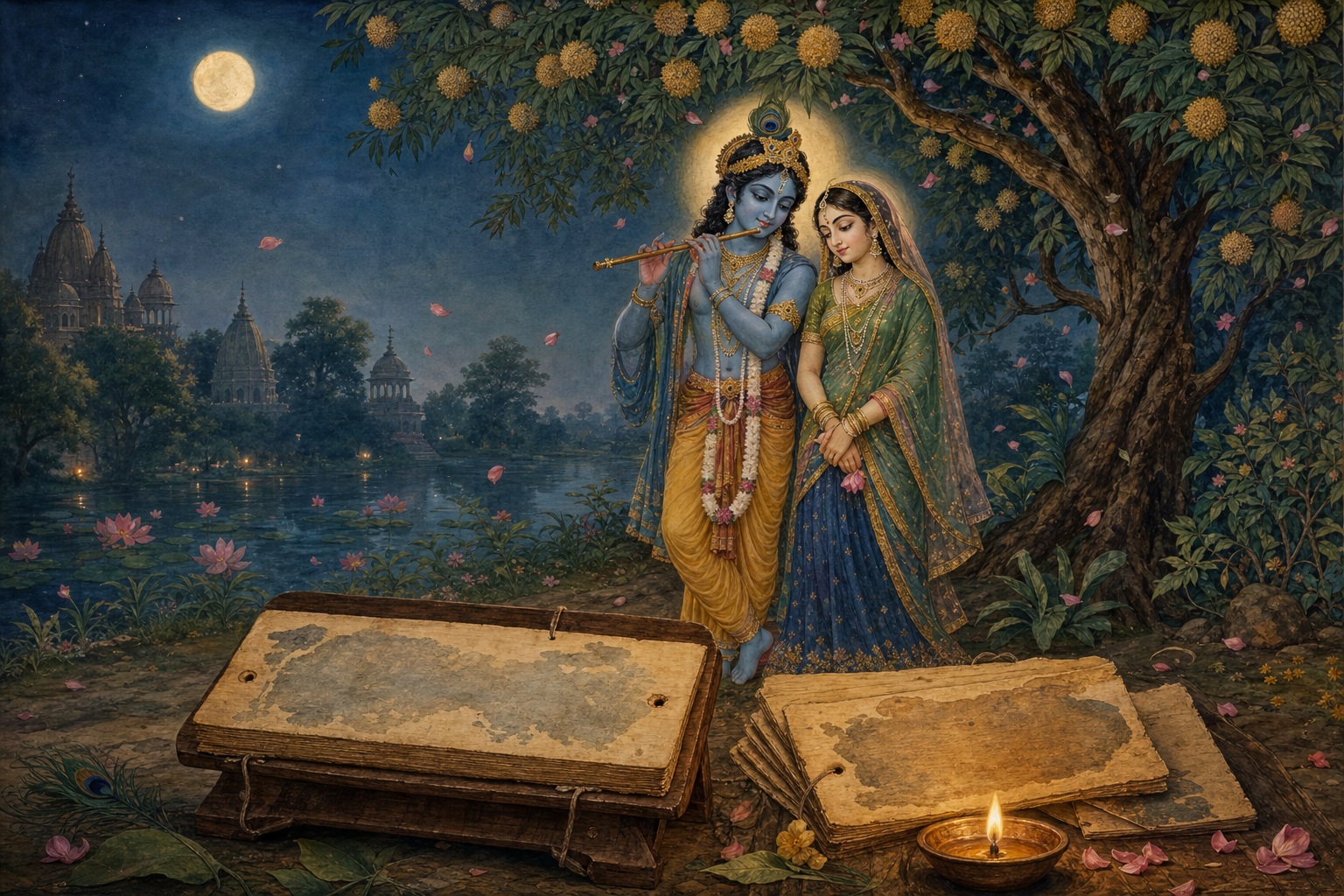
If you have heard that Radha belongs only to late devotional literature, or that she must be equally explicit in every Krishna text, neither claim gives you a reliable map. The evidence becomes much clearer when you stop asking whether Radha is simply “early” or “late” and ask what kind of presence each text preserves.
For a careful account, you need to distinguish an early literary reference from a developed sacred narrative, a mature poetic portrayal, and the beginning of worship itself. Those are related questions, but they are not interchangeable.
The earliest claim must remain precise
The Gaha Sattasai, also known as the Gathasaptasati, is a collection of Prakrit verses that may preserve the earliest literary reference to Krishna’s love for Radha. That is a significant claim, but its strength depends on keeping every part of it intact.
Literary means that the claim concerns a surviving textual witness. It does not identify the first devotee, the first oral telling, or the first act of worship. Reference means an identifiable connection between Radha and Krishna; it does not require the verse to contain the complete theology found in later traditions. May preserves the appropriate caution around an earliest-known claim.
If you are explaining this history in a class, satsang, family discussion, or online debate, use those three safeguards. Say that the Gaha Sattasai may contain the earliest surviving literary reference. Do not turn that into a claim that historians have located the exact birth of Radha-Krishna devotion.
This precision does not diminish the tradition. It prevents two avoidable errors: demanding that a compact early reference contain every feature of later bhakti, and treating later poetic development as proof that the underlying sacred relationship had no earlier life.
Three literary stages answer three different questions
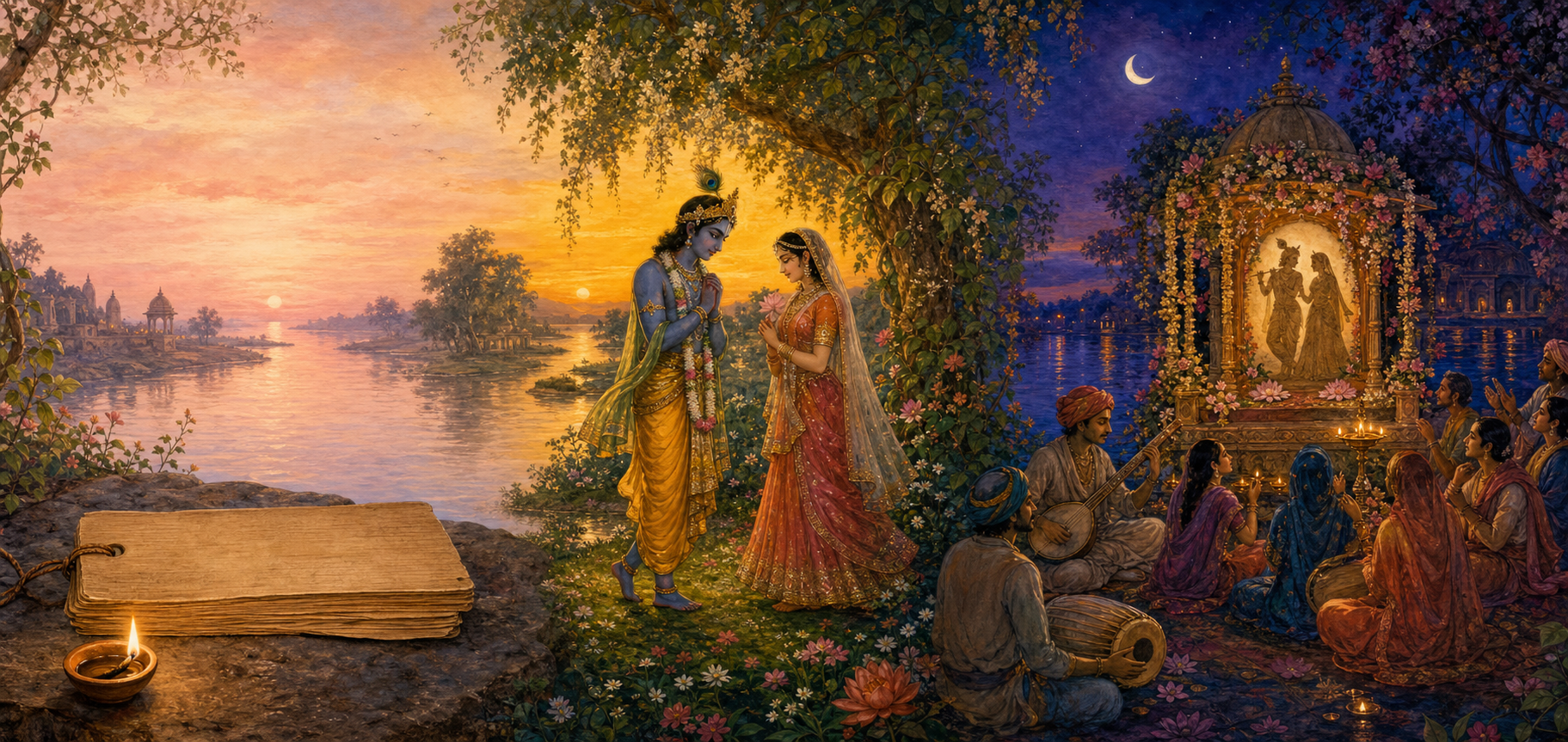
The most useful literary sequence is not a contest in which one text replaces another. The Gaha Sattasai, the Bhagavata Purana, and the Gita Govinda preserve different degrees and forms of articulation. Each should be asked to establish only what it actually contributes.
Gaha Sattasai: an early sign of recognition
The importance of an early allusion is not measured by its length. A compact poetic reference can show that an association was recognizable enough to be invoked without a complete narrative introduction. In this case, the Prakrit witness matters because it places the love of Radha and Krishna in an earlier literary horizon than the works that would give Krishna’s pastoral play and Radha’s role much fuller expression.
Notice what you can responsibly infer. The reference supports the literary recognizability of Radha’s connection with Krishna. It cannot, by itself, reconstruct the extent of worship, the communities that carried the motif, or the full doctrinal meaning attached to the divine pair. Those questions need evidence of their own.
Bhagavata Purana: Krishna’s divine play with the gopis
The Bhagavata Purana gives Krishna’s divine play with the gopis a major sacred setting. Its contribution to this history is therefore broader than a hunt for one personal name. It establishes the devotional world of Krishna’s pastoral love, the gopis’ orientation toward him, and the religious depth of that relationship.
When discussing Radha’s literary history, do not silently convert every reference to the gopis into an explicit reference to Radha. Name the distinction. The Bhagavata stage illuminates Krishna-gopi devotion, while the earlier Prakrit witness is important specifically because it connects Radha and Krishna. Later Radha-centered interpretation can draw these strands together, but historical explanation should not pretend that every layer uses the same degree of explicitness.
Gita Govinda: Radha in luminous poetic focus
By the Gita Govinda, Radha receives her most luminous literary form. She is no longer merely a figure to be recovered from a brief indication or treated as part of an undifferentiated collective. Radha and her relationship with Krishna occupy the poetic foreground.
This explains why the Gita Govinda can dominate cultural memory without being the beginning of the literary trail. A later work may give an inherited sacred relationship its most compelling language, emotional concentration, and artistic visibility. Literary culmination and literary origin are not the same thing.
An earliest surviving reference is not a birthday
Surviving literature gives us a point by which a motif was demonstrably in circulation. It rarely supplies the moment when that motif first arose. Oral narration, song, performance, local memory, and devotional practice may precede a surviving written witness. Their possible priority should be acknowledged, but it should not be assigned an invented date.
The distinction works in both directions. The Gaha Sattasai cannot prove how much earlier the Radha-Krishna relationship was known. Its brevity also cannot be used to prove that nothing more developed existed outside the surviving verse. The honest conclusion lies between those two exaggerations.
It helps to separate three levels whenever you assess a historical claim:
- Attestation: What names, relationships, or motifs are actually present in the surviving wording?
- Development: How does a later text expand the narrative, devotional, or poetic meaning?
- Reception: How do later communities interpret earlier passages within a mature Radha-Krishna tradition?
Confusion begins when reception is projected backward as though every early verse already stated the complete later theology. The opposite mistake is just as serious: assuming that fuller later expression must have been created without any earlier literary or cultural ground.
Key takeaways for reading the tradition
- For the earliest possible literary connection between Radha and Krishna, begin with the Prakrit Gaha Sattasai and retain the qualifier “may.”
- For the sacred world of Krishna’s divine play with the gopis, turn to the Bhagavata Purana without pretending that collective gopi references are automatically explicit Radha references.
- For Radha’s radiant poetic centrality, look to the Gita Govinda.
- Do not confuse the earliest surviving written witness with the beginning of oral memory, devotional practice, or worship.
- Judge each stage by what it adds; do not demand that an early allusion look like a later theological or poetic masterpiece.
How to discuss Radha’s antiquity without overclaiming

Before accepting or repeating a confident claim about Radha’s origins, ask four questions. Is the speaker discussing the earliest named reference, the Krishna-gopi setting, Radha’s poetic prominence, or organized worship? Is the evidence explicit, inferred, or supplied by later interpretation? Has an earliest surviving witness been mistaken for an absolute beginning? Has a later text’s prominence been mistaken for proof that the tradition began there?
A concise formulation you can use is:
Radha-Krishna devotion has a layered literary history. The Gaha Sattasai may preserve its earliest surviving literary reference; the Bhagavata Purana gives Krishna’s play with the gopis a profound sacred setting; and the Gita Govinda brings Radha and Krishna into luminous poetic focus.
That formulation is strong because it neither apologizes for the tradition nor asks the evidence to carry more than it can. It recognizes continuity without flattening distinct texts into one voice.
The next time someone asks whether Radha is “early” or “late,” do not accept the terms of that vague question. Ask which layer of the tradition they mean. Then place the Prakrit reference, Krishna’s gopi lila, and Radha’s later poetic centrality in their proper relationship. You will give a clearer answer, and you will also read the tradition with greater care.