
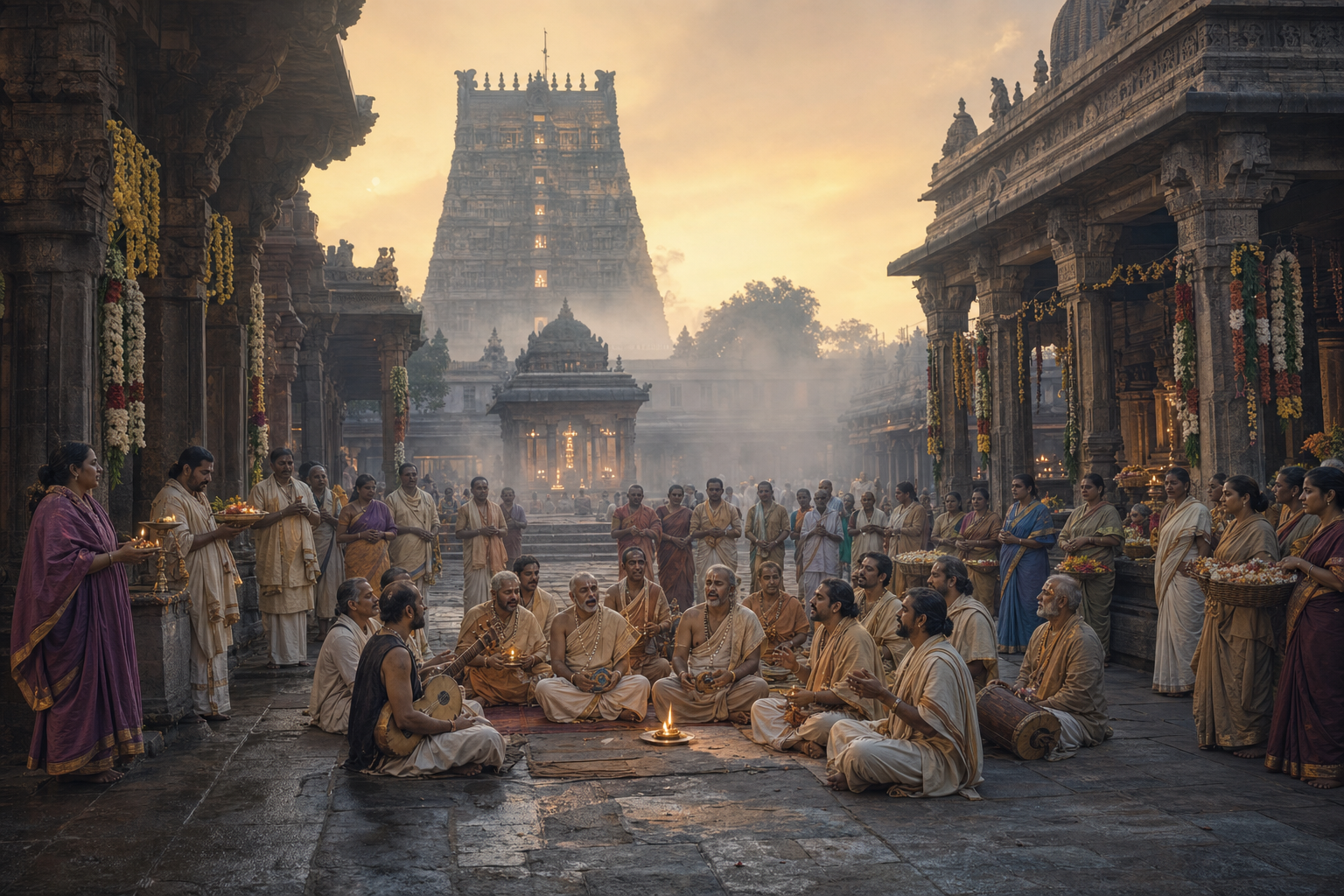
Tamil bhakti in the Sri Vaishnava tradition is best understood as a relay of religious meaning. The Alvars give theology an emotionally vivid poetic voice; temples place that voice within worship, pilgrimage and service; Acharyas preserve its meanings through commentary and disciplined transmission.
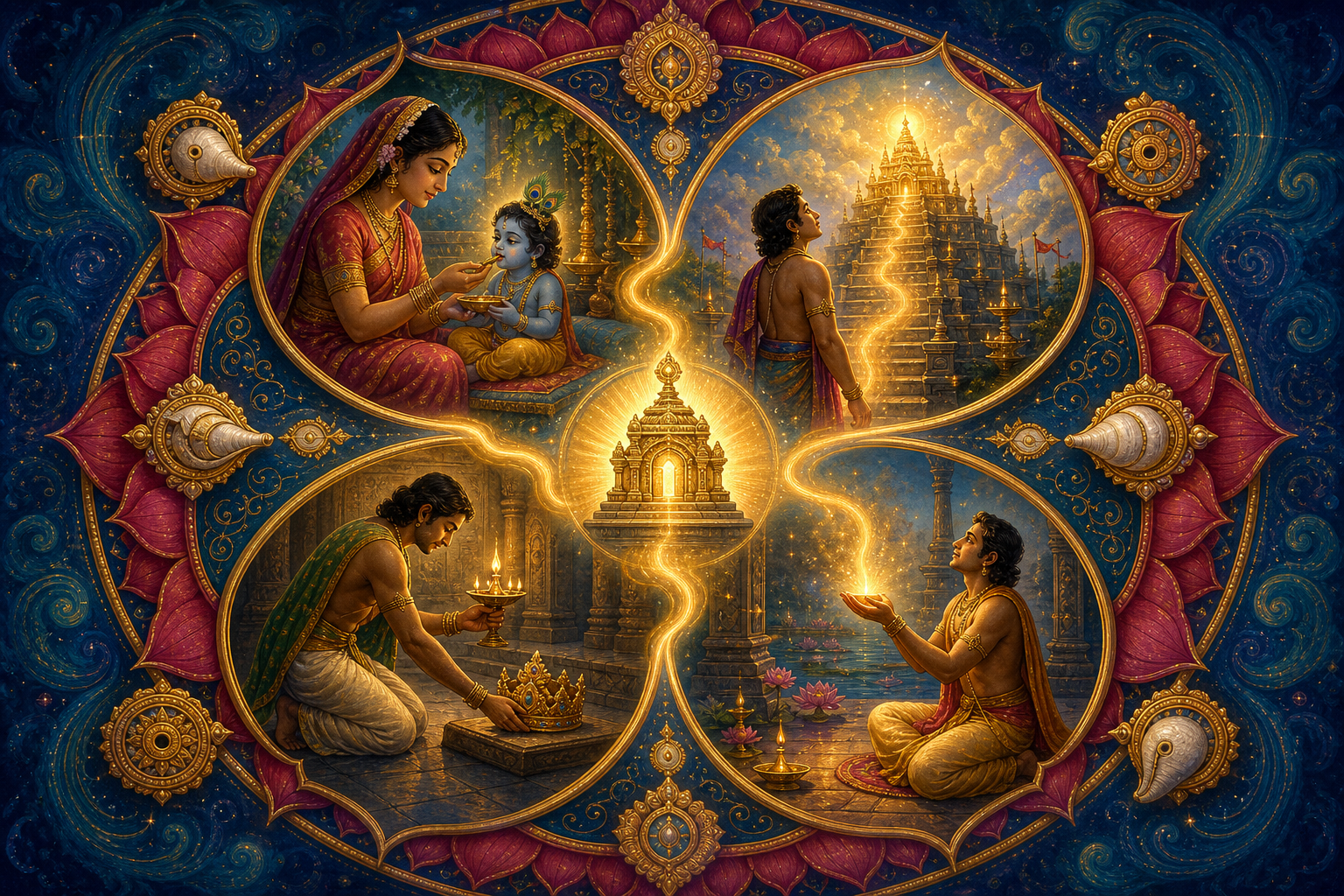
Read together, the source articles explain how this tradition can accommodate strikingly different relationships with Vishnu without losing its theological center. A devotee may protect the Lord as a child, behold Him through an ascending vision, relinquish royal status for service, or receive sacred knowledge through a teacher. Each mode turns surrender from an abstract principle into a lived practice.
Tamil became a theological language, not merely a translation
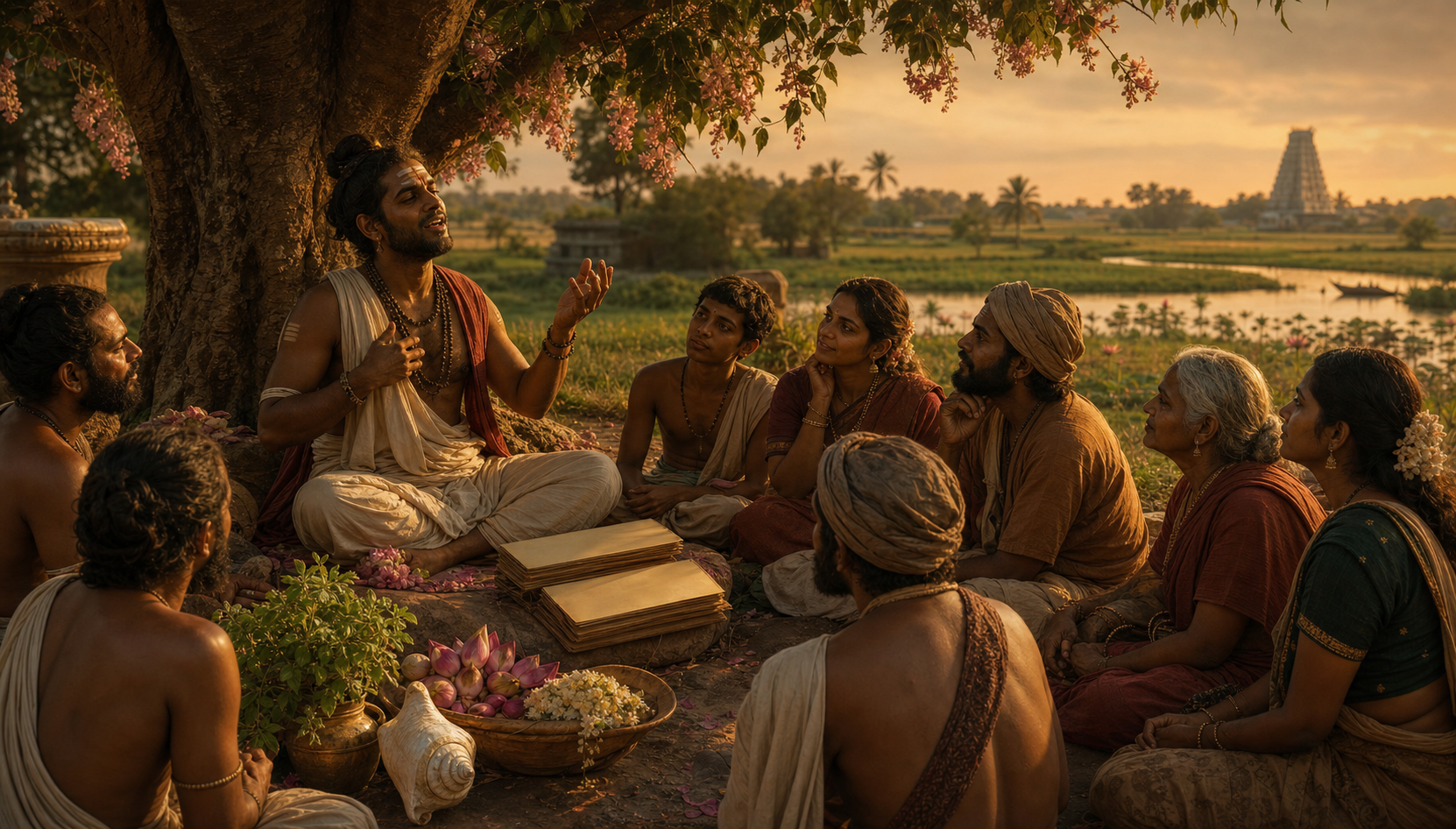
The general survey of the Alvars presents them as twelve poet-saints whose historical dates remain debated, even as devotional tradition places them within a wider sacred chronology. Their compositions were gathered into the Naalayira Divya Prabandham, traditionally associated with Nathamuni’s work of recovery and organization. Sri Vaishnava tradition honors this collection as the Tamil or Dravida Veda.
That designation does not make Tamil a rival to Sanskrit. Both the Alvar survey and the profile of Periyalvar describe the Tamil canon as a devotional expression complementary to Sanskrit sacred learning. The Kulashekhara profile makes the relationship especially visible by placing the Tamil Perumal Tirumoli beside the Sanskrit Mukundamala in the king-saint’s remembered legacy.
Tamil therefore does more than make pre-existing ideas easier to understand. In the Prabandham, longing, separation, tenderness, refuge and service become ways of thinking theologically. The Alvar survey relates these poems to questions of tattva, the nature of reality; hita, the means to the Divine; and purushartha, the highest goal. Doctrine is not abandoned for emotion. It is apprehended through emotion and then carried into recitation, worship and conduct.
Different relationships reveal a shared center
Periyalvar: protecting the divine protector
The Periyalvar profile presents Vishnuchittar as a devotee of Srivilliputhur whose service included preparing flower garlands. His distinctive contribution is vatsalya bhakti, the parental mode of devotion. In Tiruppallandu, he blesses Vishnu and expresses concern for the Lord’s well-being; in Periyalvar Tirumoli, he enters the emotional world of Yashoda caring for the child Krishna.
This reversal does not suggest that the eternal Lord literally requires human protection. It shows how love transforms the devotee’s standpoint. Metaphysical majesty remains intact, but distance gives way to care: the one who ordinarily seeks divine protection becomes so absorbed in affection that he wishes to protect the Divine.
Thiruppaan Alvar: vision, grace and human dignity
The Thiruppaan Alvar profile associates the saint with the Panar community, devotional music and Lord Ranganatha at Srirangam. It describes his ten-verse Amalanadhipiran as a contemplative ascent through the divine form, beginning at the feet and proceeding toward the face and eyes. The feet signify refuge, while the gradual vision turns darshan into an inward movement from surrender to intimacy.
The profile carefully presents the Muni Vahana episode as sacred memory rather than a celebration of exclusion. In the traditional account, the priest Lokasaranga injures the absorbed singer; the wound then appears on Ranganatha, and the Lord directs the priest to carry Thiruppaan into the temple. The narrative makes the devotee’s injury a theological concern and overturns the social judgment that had kept him outside. His hymn and his remembered life converge on one claim: divine grace recognizes a person’s spiritual intimacy more truly than inherited status does.
Kulashekhara Alvar: sovereignty converted into service
The Kulashekhara profile presents him in Sri Vaishnava memory as a Chera king, while acknowledging uncertainty about attempts to identify him with a particular historical ruler or literary figure. What remains consistent within the inherited portrait is the conversion of power into surrender. His poetry enters the experiences of Rama, Sita, Dasaratha, Krishna and Devaki with an immediacy that makes sacred narrative a field of ethical participation rather than distant recollection.
The tradition of the Kulasekhara padi at Tirumala concentrates this transformation in a single image: the ruler associated with social elevation longs for the humble nearness of a threshold beside the sanctum. Renunciation here is not presented simply as flight from responsibility. It establishes a hierarchy of values in which authority becomes meaningful when it protects devotees, serves truth and yields before the Divine.
The wider Alvar survey adds still more relationships: Nammalvar voices dependence and separation, Andal combines bridal longing with communal observance, and Madhurakavi directs devotion toward his teacher Nammalvar. These are not disconnected emotional experiments. They disclose a shared center in which the finite self finds fulfillment through dependence, loving relationship and service.
Temple space makes poetic theology public
The Alvar survey reports that the 108 Divya Desams are temples praised in the hymns and that this sacred geography continues to shape Vaishnava pilgrimage. The individual profiles show why place matters. Srirangam is inseparable from Thiruppaan Alvar’s vision of Ranganatha; Srivilliputhur holds the intertwined memory of Periyalvar and Andal; Tirumala gives architectural form to Kulashekhara’s desire for proximity and service.
Within these accounts, temple features and ordinary actions become theological instruments. The feet of the deity signify refuge, the threshold represents nearness without possession, and a flower garland embodies attentive service. Song, sight, movement and manual care allow ideas about surrender to be practiced with the body rather than held only as propositions.
Temple culture also creates an ethical test. The Thiruppaan narrative does not permit the sacredness of the temple to justify failure to recognize the sacred worth of a devotee. Instead, Ranganatha’s identification with the injured bhakta makes the temple the setting in which exclusion is exposed and corrected. The institution preserves worship, but the deity remains the standard by which the conduct of its representatives is judged.
Commentary turns inspired song into a durable sampradaya
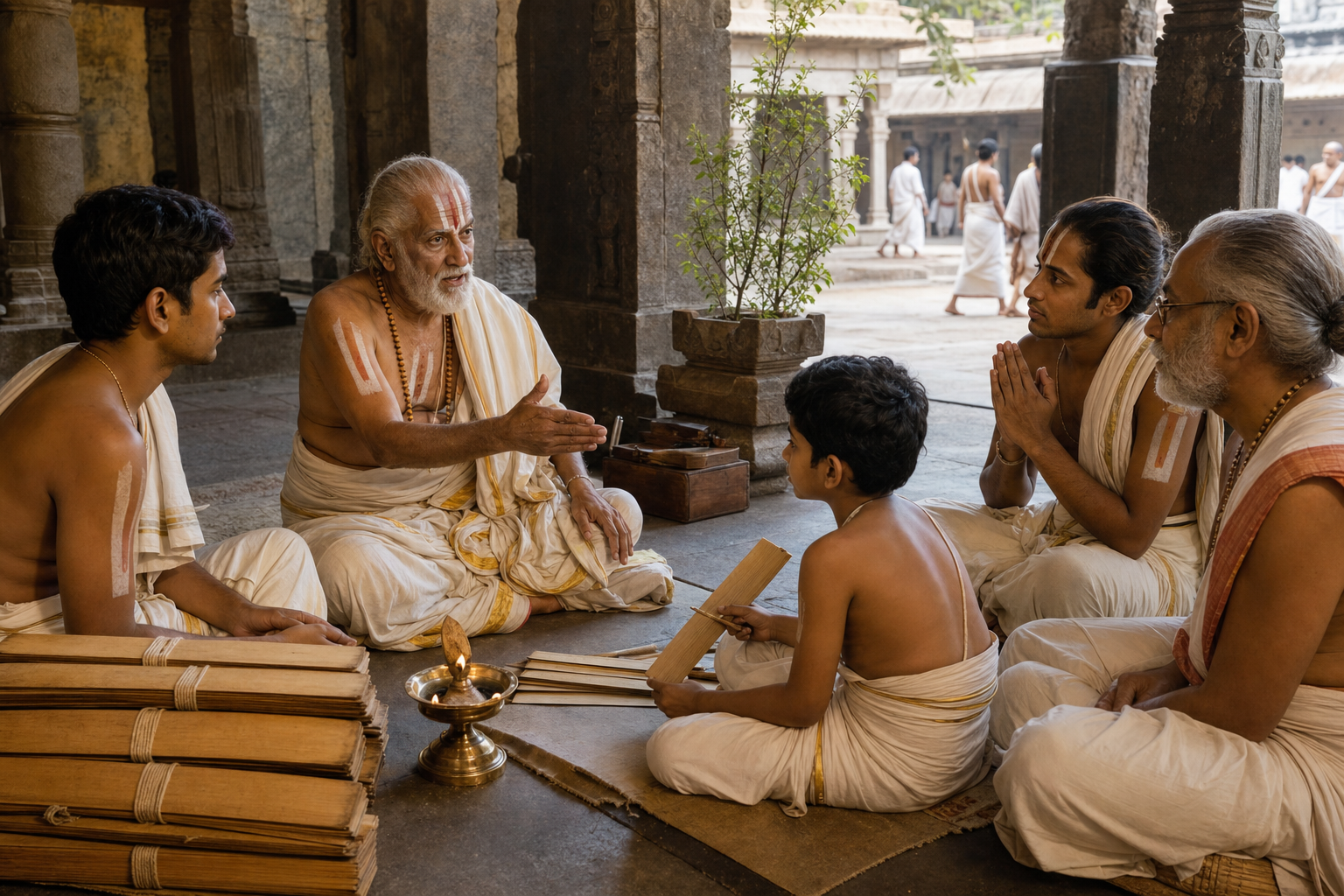
Poetry and temple practice alone do not explain the continuity of Sri Vaishnavism. The profile of Nayanar Achan Pillai emphasizes the role of Acharya lineages in transmitting the Divya Prabandham. It presents Nayanar Achan Pillai as the adopted son and principal disciple of Periyavachan Pillai, the celebrated commentator associated with extensive interpretation of the Alvar hymns.
According to that profile, Sri Vaishnava commentary must attend to language, scriptural connections, doctrine, devotional emotion and temple practice. Its purpose is neither to replace the poems nor to reduce them to technical propositions. Commentary protects their density, ensuring that emotional immediacy remains connected to a coherent understanding of reality, the path and the goal.
The same source locates this interpretive tradition within Vishishtadvaita as systematized by Ramanuja: the individual self and universe are real, Narayana with Sri is their ultimate ground, and the soul’s fulfillment lies in loving service. That framework helps explain why Alvar poetry can be intensely personal without becoming merely private. Each voice belongs to a larger account of dependence, grace and kainkaryam.
Thirunakshatram observance completes the chain of transmission. The Nayanar Achan Pillai profile describes remembrance through recitation, study, prasadam and service, with the sacred birth star determined through the lunar nakshatra framework. Commemoration consequently becomes more than biography: it trains new participants to receive, interpret and embody inherited teaching.
Key takeaways
- Tamil bhakti functions as theology in poetic form, while remaining complementary to Sanskrit learning within the sources’ account of Sri Vaishnavism.
- The Alvars’ varied devotional moods offer different relationships with Vishnu while sharing an orientation toward dependence, grace and service.
- Temples give the hymns a public and embodied setting, but sacred narratives can also use the temple to challenge failures of dignity and spiritual recognition.
- Acharya commentary, communal recitation and remembrance connect the emotional force of the hymns to doctrine and durable practice.
Future study is most fruitful when an Alvar hymn is read beside its temple setting and inherited commentary, while devotional memory and historical reconstruction remain carefully distinguished. That approach preserves both the emotional intelligence of Tamil bhakti and the disciplined interpretive culture that has carried it forward.
References
- DharmaRenaissance Blog — Thiruppaan Alvar: A Powerful Sri Vaishnava Witness to Devotion and Equality
- DharmaRenaissance Blog — Kulashekhara Alvar: The Chera King Whose Bhakti Redefined Power and Surrender
- DharmaRenaissance Blog — Nayanar Achan Pillai Thirunakshatram: Powerful Sri Vaishnava Legacy
- DharmaRenaissance Blog — Alvars and the Sacred Power of Tamil Bhakti: Vishnu’s Immersed Saint Poets
- DharmaRenaissance Blog — Periyalvar’s Vatsalya Bhakti: The Powerful Azhwar Who Blessed Vishnu