

You may have opened Mahabrahmana to meet Viswamitra and wondered why Devudu Narasimha Sastri asks you to pause at the threshold. Do not hurry past those opening pages. The central question is not merely how Emperor Kaushika became a rishi. It is how inherited wisdom becomes lived knowledge, and how lived knowledge becomes a gift rather than a possession.
If you want to know whether the Atma of Bharatavarsha means more than cultural pride, watch the sequence Devudu establishes: receive from the rishis, submit yourself to discipline, allow that discipline to transform you, and return what you have received in a form others can use. That sequence gives you a practical way to read both Viswamitra’s life and your own relationship with Dharma.
Begin with Arsha Rna: the debt before authorship
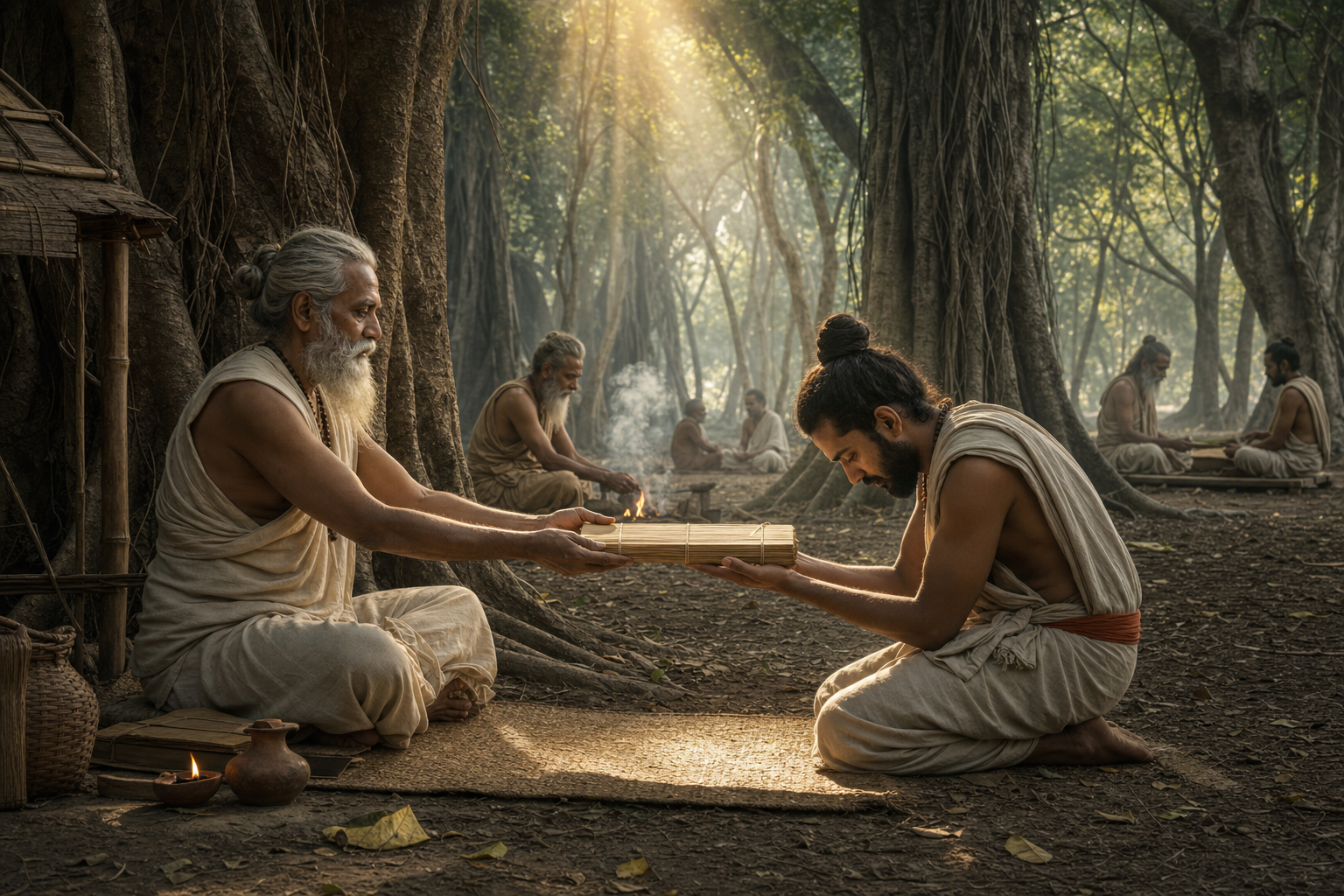
Devudu Narasimha Sastri (1902-1962) did not treat literary ambition as sufficient preparation for writing about a rishi. His learning extended across Veda, Vedanta, Mimamsa and Kavya, as well as music, education, journalism and drama. Yet breadth of accomplishment did not persuade him that he could approach Viswamitra casually.
The impulse to write came in 1926, after he had recognized the glory of Gayatri. He nevertheless judged traditional preparation necessary before narrating the life of the rishi associated with its realization and transmission. He called this obligation Arsha Rna: the debt owed to the rishis. The impulse matured by 1947, and he completed the novel in August 1950.
Here, debt does not mean inherited guilt. It names an ethical asymmetry. You received language, categories of thought, disciplines of attention and sacred memory before you were capable of creating any of them. A civilization remains alive when recipients acknowledge that asymmetry and answer it with competent transmission.
This corrects a common habit in contemporary cultural work. Admiration is often mistaken for qualification. A person encounters a mantra, deity, temple or historical figure, feels strongly about it, and immediately begins explaining it to others. Devudu inserts a necessary middle term between inspiration and expression: preparation.
Before you speak or write about a Dharmic inheritance, ask four questions:
- What exactly have I received? Name the teaching, practice, language, lineage or form rather than appealing vaguely to tradition.
- What training does it require? Affection for a tradition cannot replace study, pronunciation, practice or correction by someone more competent.
- What has it changed in me? If the encounter has produced only opinions, public identity or content, it has not yet become realization.
- What am I returning? Transmission should make the inheritance clearer and more accessible without pretending that simplification is the same as fidelity.
Use these questions whenever you encounter a confident claim about Bharat’s civilization, including your own. The speaker’s enthusiasm matters less than the path between inheritance and utterance. Arsha Rna turns civilizational memory from an entitlement into a responsibility.
Viswamitra changes the question from status to transformation

Many readers first meet Viswamitra in the Ramayana, but his presence reaches across the Rig Veda, Yajur Veda, Aitareya, Kaushitaki and Gopatha Brahmanas, and later works including the Mahabharata, Vishnupurana, Harivamsha and Yogavasistha. That breadth should prevent you from reducing him to a single episode or a convenient symbol in a modern dispute.
Devudu organizes the life around an inner revolution: Emperor Kaushika moves from Kshatra to Brahmana in the fullest sense, becoming Viswamitra. He does not merely exchange one social label for another. Power, will and royal authority are subjected to tapas until another order of being becomes possible.
Do not force this journey into either of two shallow readings. It is not a slogan with which to erase the historical complexity of varna. Nor is it evidence that spiritual attainment can be enclosed by birth and left untouched by character. Devudu uses Brahmana to name the culmination of Kaushika’s transformation, not a decorative honorific attached to his old identity.
Follow the transformation along three axes:
- From governing others to governing oneself. Kshatra can command, protect and contend. Tapas exposes whether the person possessing that force can direct it inward.
- From acquisition to realization. Sacred knowledge is not another object for a powerful personality to conquer. The seeker must become capable of receiving what cannot be seized.
- From private attainment to benevolent transmission. Devudu chose Viswamitra as the one who realized Gayatri and shared it. Realization reaches its civilizational form when it is handed onward.
Viswamitra’s association with Gayatri is central here. Gayatri is a Vedic hymn in the Gayatri metre, addressed to Savitr and carried through rishi-lineage. Devudu was interested not only in the mantra’s verbal form but in the kind of human transformation required for its realization.
This distinction matters when you approach a mantra today. Possessing its printed words is not the same as understanding it. Repetition is not automatically realization, and public display is not transmission. Ask what disciplines of attention, conduct and receptivity the mantra demands. Viswamitra becomes intelligible when you stop asking who may claim the symbol and begin asking what kind of person can bear its meaning.
Creative insight must survive the test of ego

Devudu describes serious creation as a movement beyond the cramped self that constantly demands ownership. The jiva’s ordinary cry is brutally concise:
"Me! Me! I! I!"
Devudu Narasimha Sastri, preface to Mahabrahmana
When that pettiness falls away, Devudu says, a previously unavailable insight can fill the heart and seek literary form. Authorship then becomes neither passive dictation nor sovereign self-expression. The writer labours, but the deepest source of insight is not treated as the private manufacture of the everyday ego.
He reports experiences involving Rudra’s physical manifestation, communication among devatas, Manmatha’s exposition of ahamkara, and blessings associated with Brahmanaspati and Pusha. Some experiences preceded composition; others arose while he wrote. Such claims can tempt you toward instant belief or instant dismissal. Both reactions avoid the harder work of discernment.
Read an experiential claim at three distinct levels:
<!– wp:list {