
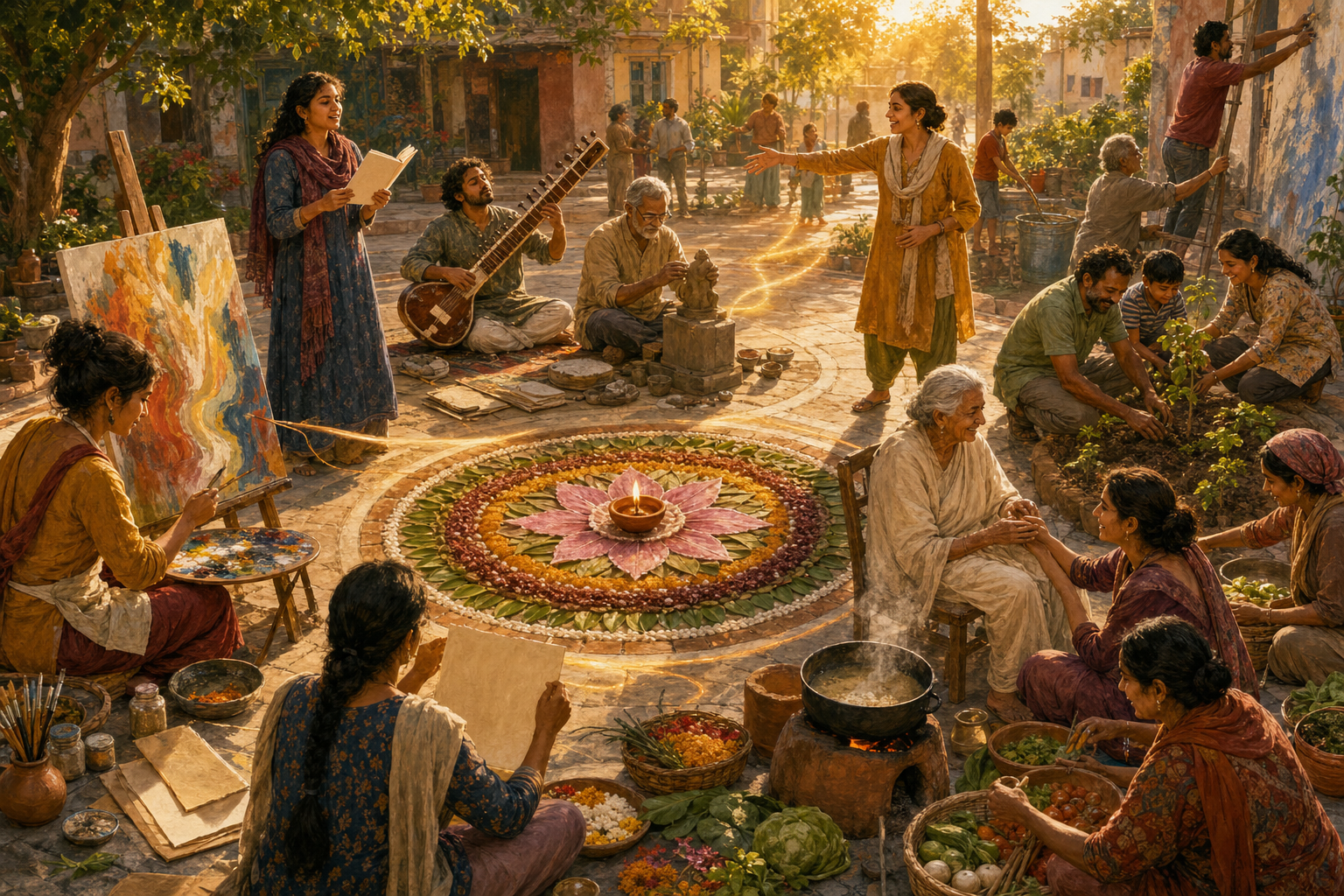
You may be planning an exhibition, reading circle, essay, performance, or heritage project and wondering whether it can do more than affirm people who already agree with you. It can, but only when you design a passage from attention to understanding, from understanding to relationship, and from relationship to practice.
That passage is what separates cultural activity from cultural change. If you want people to leave with more than a feeling, ask what they should be able to see, explain, and do afterward. The method below helps you answer that question without turning art into propaganda or reducing Dharma to a slogan.
Key takeaways
- Begin with an observable human change, not a preferred medium: decide who should understand or do what before choosing a painting, book, film, performance, or event.
- Match the form to the obstacle. Visual art can reveal what has been overlooked; literature can supply language; stories can let people rehearse moral choices; participatory forms can convert concern into practice.
- Use shared Dharmic values as points of conversation, not as proof that Hindu, Buddhist, Jain, and Sikh traditions are interchangeable.
- Build interpretation, distribution, dialogue, and a next action around the creative work. The work opens the door; the surrounding structure helps people walk through it.
- Measure understanding, relationships, practice, and continuity separately. Attendance and praise show exposure, not social change.
The path from imagination to public practice
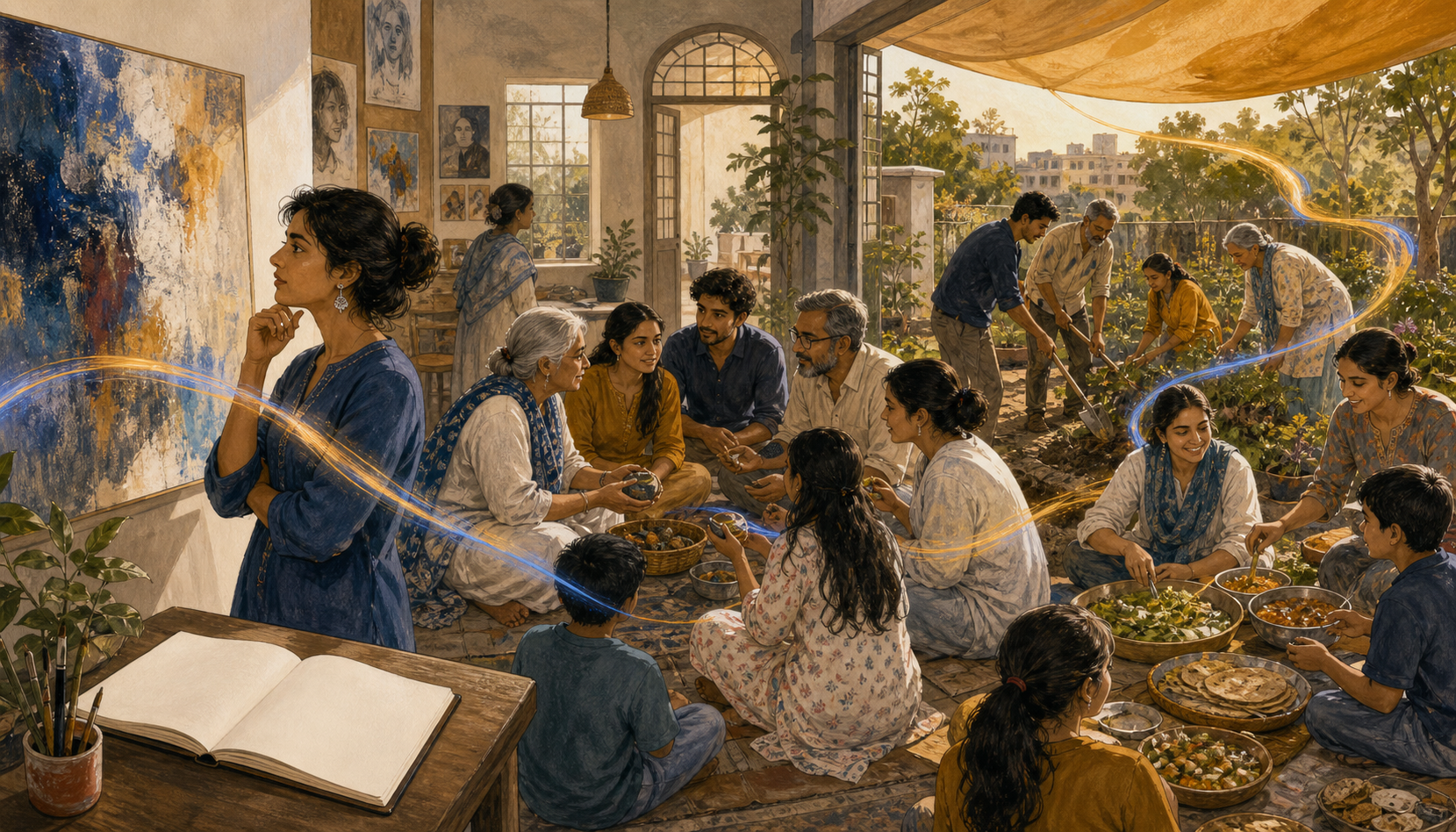
Culture changes what people notice before it changes what institutions do. A poem cannot enact a policy, and a painting cannot perform seva. They can alter the moral field in which people interpret a policy, recognize a duty, or decide whom they regard as a neighbour. That indirect route is not a weakness. It is the distinctive work of culture.
A useful change sequence has five linked movements:
- Perception: The work makes a neglected person, custom, contradiction, or possibility visible.
- Language: It gives the audience words, images, symbols, or stories with which to discuss what they have noticed.
- Moral rehearsal: It allows people to consider consequences and competing duties without first having to defend a public position.
- Relationship: Discussion around the work brings memories and perspectives into contact.
- Practice: A community turns the insight into service, education, preservation, changed conduct, or an institutional habit.
Miss one link and the effect usually stops there. Attention without interpretation produces a mood. Interpretation without relationship remains a private insight. Relationship without a practical handoff produces a memorable event. Practice without continuity fades when the organisers move on.
This matters because social assumptions are often formed outside dramatic public events. Journalism necessarily gives unusual developments more space than ordinary habits, while art can disclose the mundane settings in which values and biases become normal. A play about a family disagreement, a painting of community labour, or a story about a compromised duty can therefore reveal something that a procession of headlines cannot: how a society feels from within its routines.
Literature adds portability. In 1776, Thomas Paine’s Common Sense used accessible language and wide circulation to place complicated political questions inside a common moral conversation. The transferable lesson is not a particular political conclusion. It is the combination of a clear frame, language ordinary readers could carry, and a distribution network capable of moving the idea beyond its first audience.
Stories and performances add moral rehearsal. Jataka tales, Jain parables, Sikh shabads, and Hindu epics have carried questions of compassion, non-harm, service, discipline, and duty through memorable forms. A narrative can place two genuine obligations in tension and let the audience experience the cost of each choice. That is often more useful than telling people that the correct value is obvious.
None of this travels on inspiration alone. Florence’s Renaissance joined capital and patronage to recovered manuscripts, classical study, comparatively broad literacy, urban exchange, and close examination of earlier forms. Wealth created capacity, but learning, institutions, skilled makers, and audiences converted that capacity into cultural renewal. Your project likewise has two designs: the work itself and the system through which people will encounter, interpret, discuss, and reuse it.
Dharmic precision creates stronger solidarity
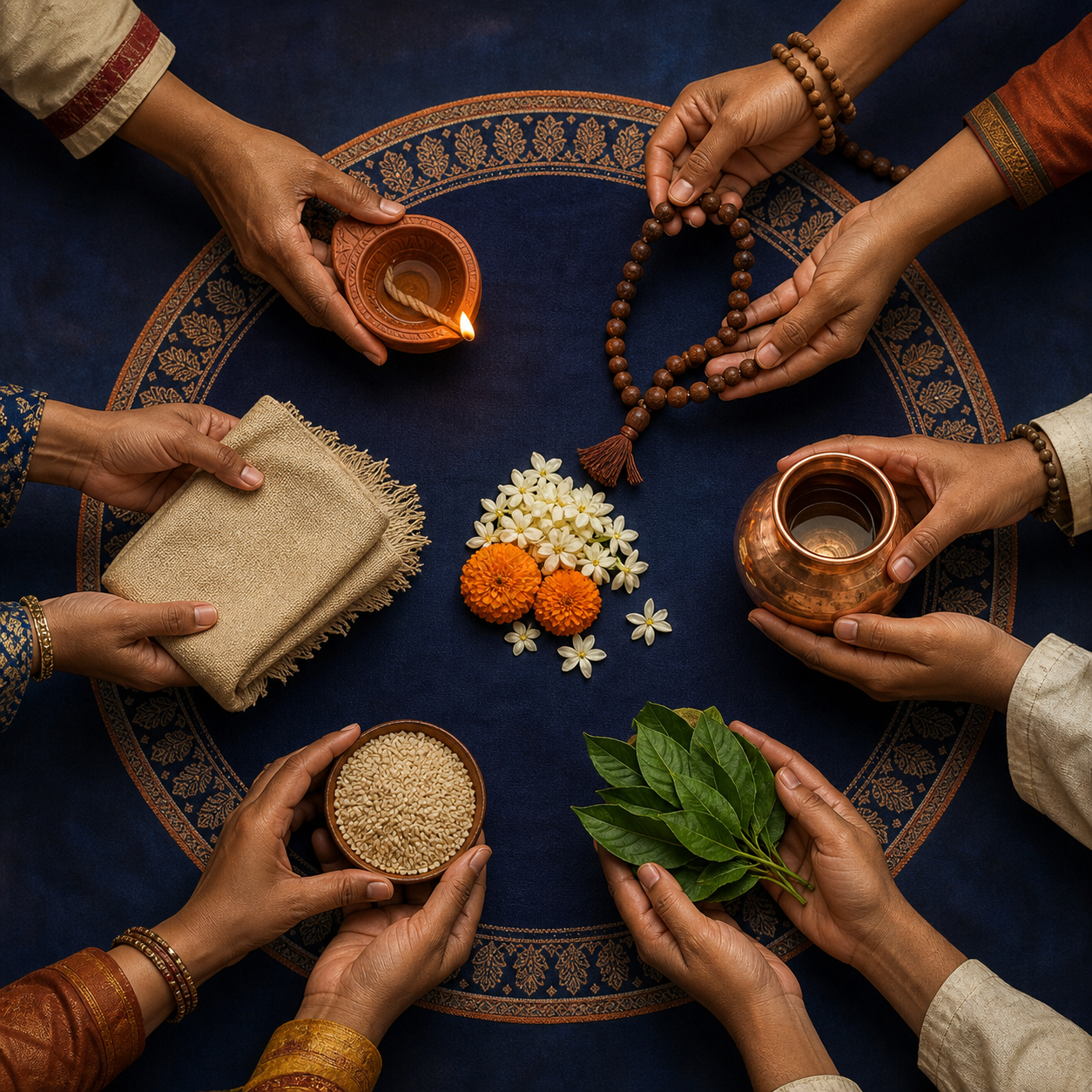
Hinduism, Buddhism, Jainism, and Sikhism offer real grounds for ethical conversation. Compassion, restraint, truthfulness, discipline, service, and responsible conduct recur across their histories. Their meanings, authorities, practices, and metaphysical settings are not identical, however. Shared ethical ground is a bridge, not a blender.
The Bhagavad Gita, Dhammapada, Jain Agamas, and Guru Granth Sahib demonstrate how words can cultivate conduct across distinct Dharmic paths. They do not speak in one theological register. Treating them as interchangeable may create a quick impression of unity, but it prevents readers from learning why a teaching matters inside the tradition that preserves it.
Apply four editorial checks whenever you present a Dharmic subject:
- Name the lineage: Identify the tradition, region, community, text, artistic form, or historical setting. Do not label every Bharatiya work as generically spiritual.
- Protect the key term: Explain words such as dharma, ahimsa, seva, sat, or shaurya in their immediate context. A convenient English gloss can begin the explanation, but it should not replace it.
- Preserve the tension: Show the duty, temptation, conflict, sacrifice, or discipline at stake. Values become intelligible through choices, not through strings of uplifting nouns.
- Include community agency: Let people from the represented tradition help determine context, pronunciation, interpretation, and the boundary between respectful access and careless display.
Compare two ways of framing the same exhibition. A flattening label says that all Dharmic religions teach the same values. A more precise label says that a Sikh work foregrounds seva and sat within Sikh community life, then invites viewers to compare that ethical concern with Hindu, Buddhist, and Jain approaches to duty, compassion, and non-harm. The second formulation creates solidarity without making a claim of equivalence.
This precision is especially important when Bharatiya traditions cross borders. Sikh art presented in New York can connect sacred figures, community life, symbolism, Gurbani-associated calligraphy, migration, and collective memory for audiences who do not share the same background. Context does not weaken the emotional encounter. It gives viewers a way to understand what they are seeing without detaching the form from the community that gives it meaning.
Tradition also need not be frozen to remain authentic. Diaspora artists, contemporary writers, and new performance settings can carry inherited forms into present circumstances. Ask whether an adaptation preserves the work’s ethical centre, names its lineage, and makes its changes visible. If it does, innovation can demonstrate continuity rather than conceal a rupture.
Build a cultural intervention people can carry forward
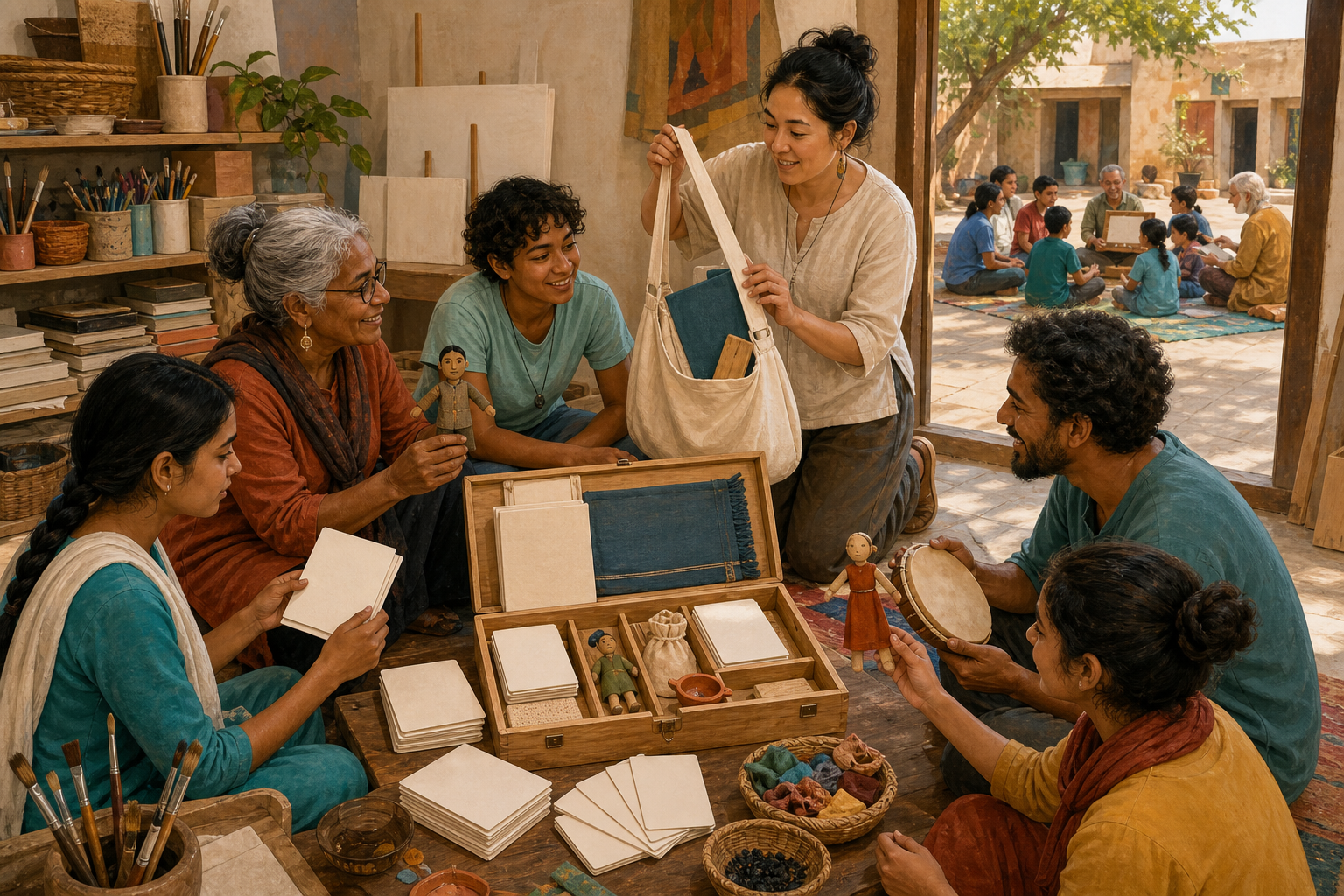
Design backward from one outcome sentence: After encountering this work, this specific audience will take this observable action because they can now explain this ethical insight in their own words. If you cannot complete that sentence plainly, the project is not ready to be judged as an instrument of social change.
- Choose a specific audience. Students encountering Sikh history for the first time need a different entry point from families preserving inherited memory or artists already familiar with the tradition.
- Identify the actual obstruction. Is the problem invisibility, conceptual confusion, emotional distance, fragmented memory, mistrust, or a lack of practical agency? Do not assume that lack of information is always the problem.
- Ground the work in something concrete. Use a particular image, passage, melody, testimony, object, custom, or moral dilemma. An audience can examine a concrete form; it can only agree vaguely with an abstraction.
- Construct the encounter. Decide what viewers should notice first, which term needs explanation, where they may ask questions, and which disagreement the format must be able to hold.
- Add a proportionate handoff. A work about seva might lead to a defined service role. An oral-history exhibition might invite a family contribution. A reading might lead to a facilitated circle in which the text can be examined more carefully.
- Recruit carriers. Teachers, artists, libraries, cultural associations, temples, gurdwaras, viharas, Jain centres, and reading groups can give an idea a life beyond its first venue. Choose carriers whose regular work already touches the intended audience.
- Plan for reuse. Prepare accurate captions, discussion prompts, pronunciation help, reading notes, or a facilitation outline so another person can carry the work without stripping away its context.
Match the form to the obstacle
| Obstacle | Useful opening form | Necessary handoff |
|---|---|---|
| A reality is present but socially unseen | Painting, photography, sculpture, or a curated exhibition | A guided observation prompt, contextual testimony, or invitation to contribute memory |
| A concept is widely used but poorly understood | Short essay, pamphlet, annotated passage, or reading circle | A precise vocabulary note and a question that tests understanding |
| The audience knows facts but feels no relationship | Story, theatre, music, or a character-centred narrative | Facilitated reflection and contact with the people or community represented |
| Heritage is treated as static or remote | Archive, calligraphy, community art, or a contemporary reinterpretation | An explanation of continuity and change, followed by a preservation or creative contribution |
| Concern does not become action | Participatory workshop, performance, or community programme | A named role in seva, education, documentation, dialogue, or cultural stewardship |
The interpretive layer should answer five questions without overwhelming the work: What are we encountering? Whose lineage or experience does it carry? Which term or symbol must be understood accurately? What human tension does it reveal? What can the audience do next?
Accessibility is not the same as simplification. You can shorten a caption without removing the name of a tradition. You can translate a term while retaining its original form. You can tell a compelling story without inventing certainty. The aim is to reduce avoidable friction while preserving the distinctions on which truthful understanding depends.
Distribution should receive the same moral attention as creation. Srila Bhaktisiddhanta Sarasvati framed the spreading of Gaudiya literature as a form of divine and compassionate service. That is a demanding standard. A book left where no intended reader can enter it is an object delivered, not an understanding shared. The person distributing it must consider language, context, welcome, and what happens when a reader returns with a question.
Do not ask the creative work to perform an institutional job by itself. Art can help someone recognize a responsibility and become willing to act. A community must still provide the place, role, relationship, and repetition through which that willingness becomes practice.
Measure change beyond attendance and applause
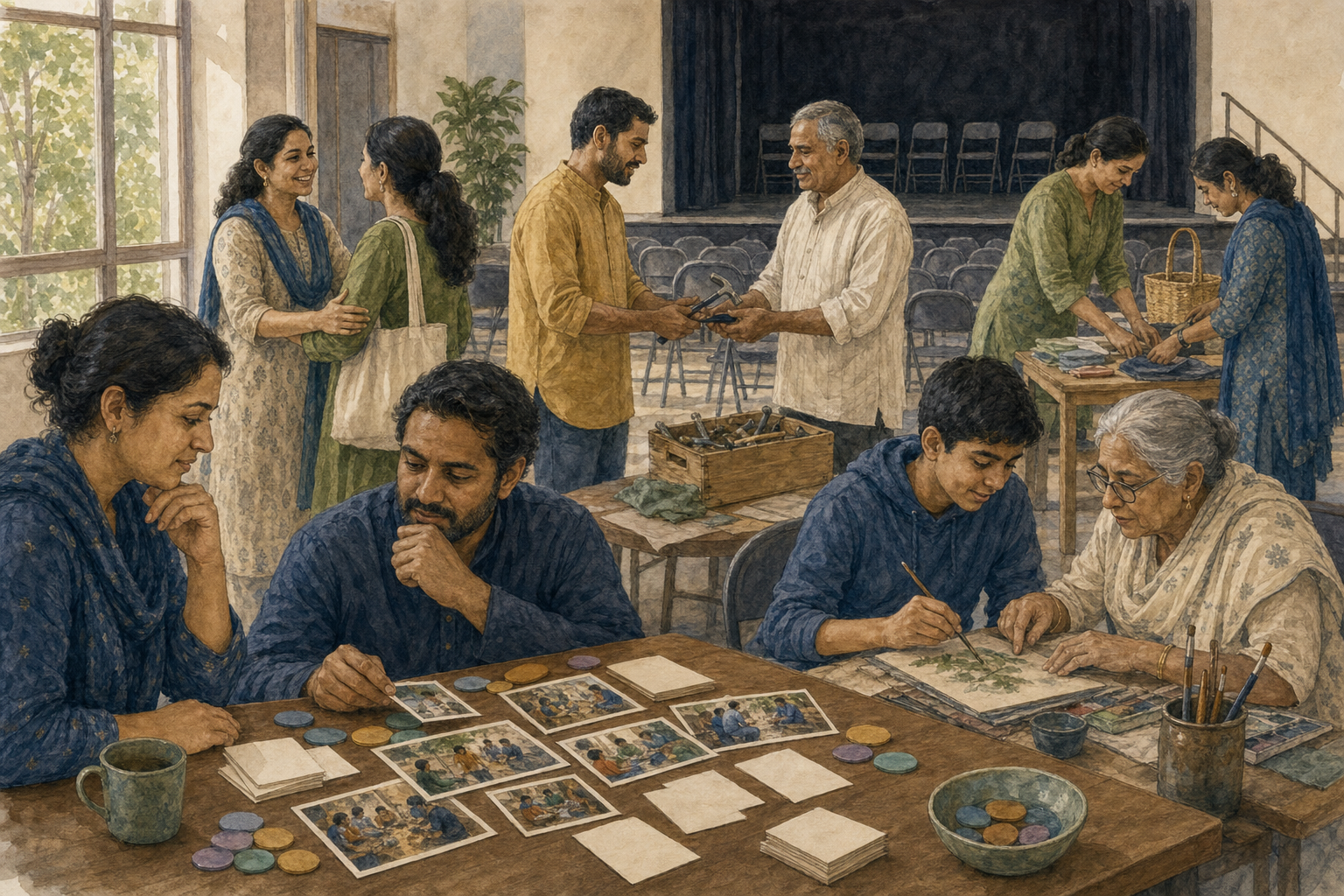
A crowded room can mark cultural reach, but it cannot tell you whether the audience understood the work or did anything differently. Measure the stages separately so you can see where the passage from imagination to practice broke down.
| Stage | Question to ask | Useful evidence | Misleading substitute |
|---|---|---|---|
| Attention | Did the intended audience actually encounter the work? | Attendance, completed readings, meaningful viewing, or circulation within the intended community | Raw impressions that reveal nothing about attention or completion |
| Understanding | Can people explain the central symbol, idea, or dilemma accurately? | Open-ended responses, accurate retellings, and fewer recurring misconceptions | General praise or emotional intensity without comprehension |
| Relationship | Did the encounter create a new conversation or connection? | Questions across communities, continued dialogue, and participation beyond the usual insiders | Agreement among people who already held the same view |
| Practice | Did anyone take the action built into the project? | Participation in seva, a reading circle, teaching, documentation, preservation, or another named activity | Statements of intention with no follow-through |
| Continuity | Can someone else carry the idea into another setting? | Reuse by educators or communities, repeat gatherings, new contributions, and integration into regular programmes | A one-time burst of visibility with no institutional home |
Write your outcome sentence before the public encounter. When appropriate, ask the same short, open-ended question before and after it. Ask people to explain what they understood rather than merely rate whether they enjoyed the experience. Record the action they actually completed, not only the action they endorsed.
The pattern of failure will usually identify the repair. If people attend but cannot explain the central idea, improve interpretation. If they understand but do not act, strengthen the handoff or remove practical friction. If only established supporters participate, change the carriers and entry points. If another group reuses the work but distorts its meaning, improve the contextual material and community oversight.
Recognise the failure modes before they harden
- Spectacle without moral clarity: People remember the scale, colour, or celebrity but cannot name the question. Repair it with a clearer interpretive key.
- Nostalgia without continuity: The past is admired as a lost world rather than used as a disciplined resource. Show how an inherited form can inform a present duty.
- Unity through flattening: Differences disappear under generic language about peace or spirituality. Restore the tradition-specific terms and let comparison follow accurate description.
- Advocacy only for insiders: The work rewards prior knowledge and treats confusion as hostility. Add an entry point that welcomes a sincere newcomer without weakening the argument.
- Action without ownership: The audience receives an urgent command but no role, place, or accountable group through which to act. Build the pathway before issuing the appeal.
- Visibility without continuity: The event succeeds and then vanishes. Give the materials, facilitation method, and next gathering to a community capable of carrying them.
A cultural work becomes propagandistic when it predetermines every answer, uses beauty to conceal weak claims, or reduces human beings to loyal friends and irredeemable enemies. Dharmic advocacy need not be timid. It should be exact, morally serious, and willing to examine the conduct of its own community. A pro-Dharma voice gains durability through accuracy and disciplined interpretation, not exaggeration.
For your next project, complete the outcome sentence before choosing the venue or format. Select one work, passage, story, or image; identify the obstruction it must address; attach a realistic next action; and name the community that can carry it onward. Let scale follow evidence. Once people can explain the idea accurately, embody it in practice, and transmit it without your supervision, art has begun to become culture, and culture has begun to reorganise public life.
References
- SikhNet – News — Art of Punjab
- Dandavats — The Proven Power of the Pen: Discover How Ideas Transform History and Unite Dharmic Traditions
- Varnam — Unveiling Antiquity: Italy’s Renaissance
- RightViews — Why Is Art Important?
