
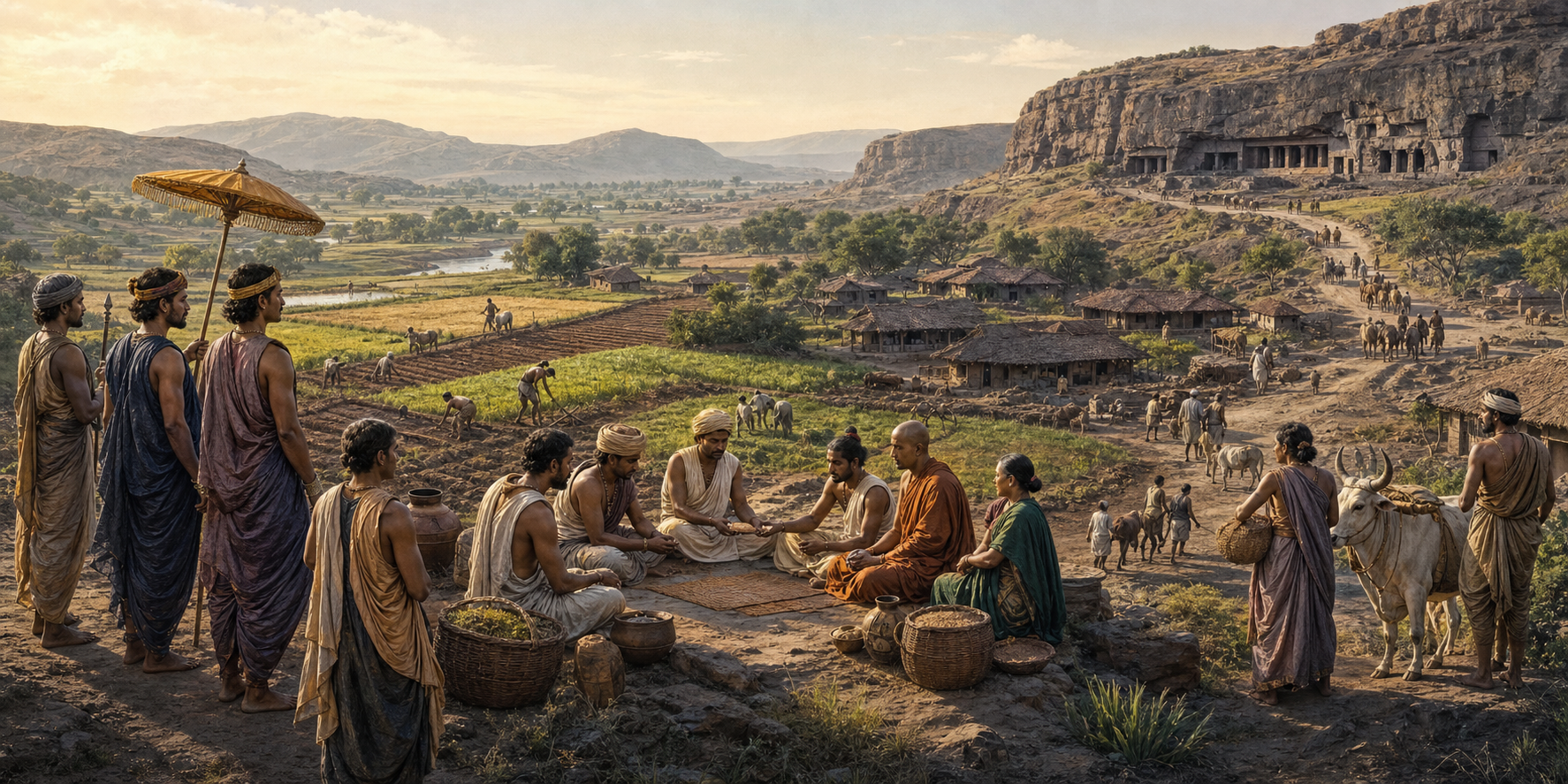
If you want to understand the economy of Satavahana-era Maharashtra, begin with a practical question: who could claim land, control it, share it, or give it away? The answer is more revealing than a simple picture of an all-owning king or a countryside divided into modern-style private properties.
The surviving inscriptional picture points to three forms of land ownership: royal, private or individual, and joint. Those categories show an economy in which superior political authority could coexist with rights held by individuals and groups. Once you keep those levels separate, royal titles and land donations become much easier to interpret.
Ask which right existed, not merely who owned the land
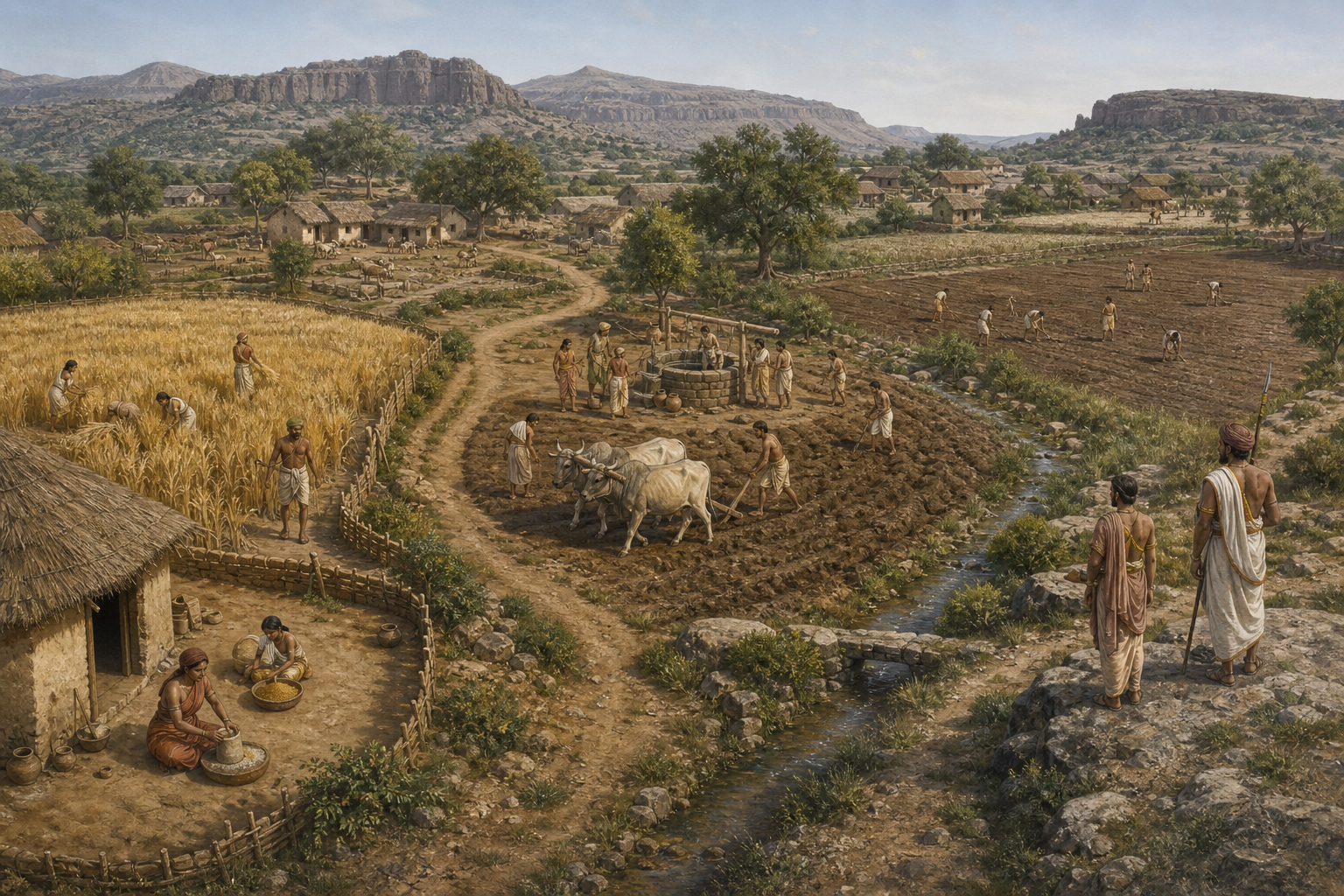
Ownership is not always one indivisible power. It can include the right to possess land, use it, share it, receive benefits from it, transfer it, or exercise superior jurisdiction over it. An inscription may establish one of those powers without describing every other right attached to the same property.
That is why the broad question, Who owned the land?, needs to be divided into four smaller questions:
- Who exercised sovereignty over the territory?
- Who possessed or used a particular holding?
- Was the claim individual or shared?
- Who had the recognized authority to donate or otherwise alter rights in that holding?
The three recorded forms answer different parts of that inquiry. They should not be collapsed into a single modern category.
| Form of ownership | What the evidence supports | What you should not assume |
|---|---|---|
| Royal | The king asserted superior authority over land, and royal land donations were recognized administrative acts. | That every plot was necessarily a crown estate under the king’s direct possession. |
| Private or individual | An individual claim to land existed as a distinct category. | That it carried every right associated with modern freehold property. |
| Joint | Land could be held through a shared claim rather than by one person alone. | Who the joint holders were, how their shares were divided, or how disputes were settled. |
This distinction matters whenever you encounter the statement that the Satavahana king owned the land. Ask whether ownership means territorial sovereignty, direct possession, administrative control, or the power to authorize a transfer. Without that clarification, a true statement about kingship can become a misleading statement about the entire rural economy.
Royal sovereignty was expressed through title and transaction
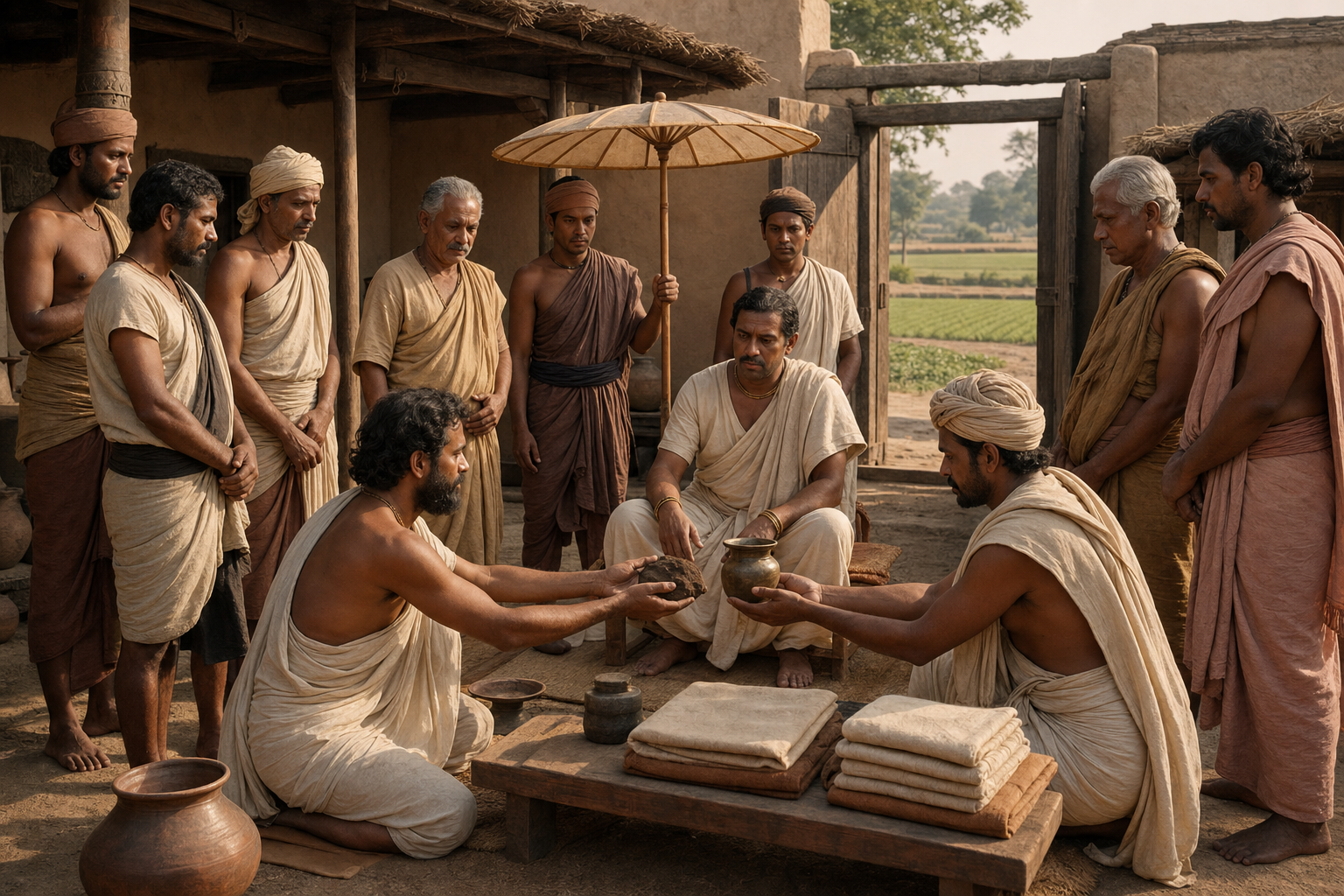
Naganika’s cave inscription at Naneghat uses the title Dakshinapathapati. In this setting, the title indicates the king’s theoretical sovereignty over the land. It places territorial authority at the royal level, but it does not by itself describe who occupied every field or how every holding was managed.
The administrative dimension becomes clearer through land grants. Inscriptions connected with Naganika, Gautamiputra Satakarni, and Vashishthiputra Shri Pulumavi at Naneghat, the Nashik Caves, and the Karla Caves record several royal land donations. A title states a political principle; a recorded donation shows royal authority being used in a particular act.
At minimum, these grants show that royal sovereignty had an operative side. The court could function as a recognized grantor and place a donation into an enduring public record. Royal ownership, therefore, was not merely decorative language attached to kingship.
Yet the same evidence does not require you to treat sovereignty and possession as identical. A ruler may exercise superior jurisdiction while individuals or groups retain recognized claims below that level. This layered reading accommodates all three ownership categories without making one erase the others.
Private and joint claims prevent an all-royal reading
The recognition of private or individual ownership changes how the Satavahana land system must be described. If an individual claim existed alongside royal authority, then the king’s superior position did not automatically eliminate every proprietary right beneath it. The safest formulation is coexistence: royal sovereignty at one level and identifiable non-royal claims at another.
Joint ownership adds another layer. It tells you that a landholding could belong through a shared arrangement rather than through a lone individual. That is economically important because decisions about use, benefit, donation, or division may involve more than one rights-holder.
But joint ownership is also where disciplined restraint becomes essential. From the information available here, we cannot determine:
- whether the joint holders were relatives, partners, members of a community, or some other body;
- whether each holder possessed an equal share;
- whether joint ownership governed cultivation, income, transfer, or all of them;
- how a shared holding was divided or how disagreements were resolved.
Do not fill those gaps with a familiar institution from a later century. The category of joint ownership is established; its internal mechanism still needs evidence. Keeping that boundary clear makes the history stronger, not thinner.
Donation inscriptions are economic records in a religious setting
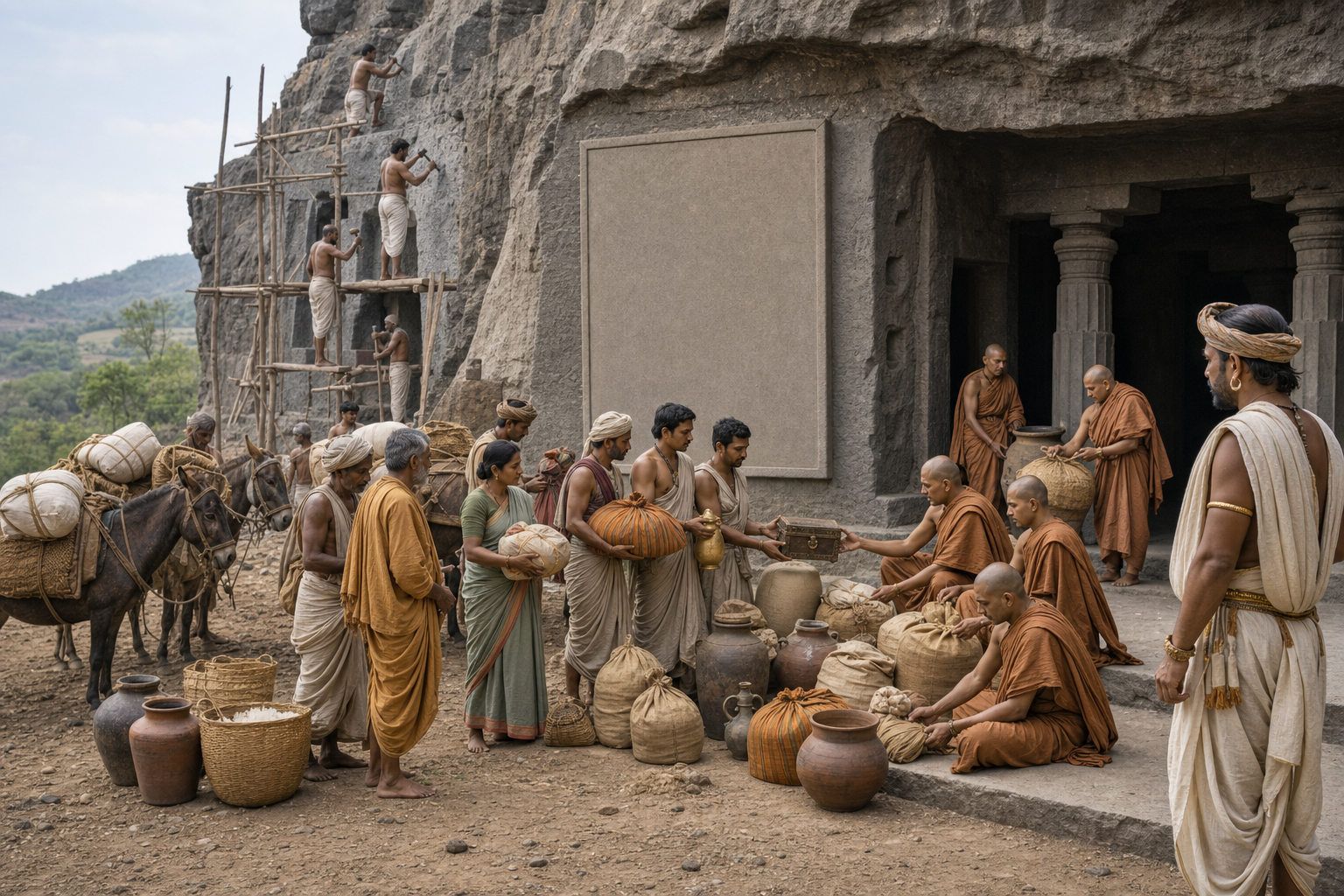
The Buddhist caves at Nashik and Karla matter to economic history because their inscriptions preserve acts involving land and royal power. Their religious setting should not lead you to treat them as evidence only for devotion, architecture, or sectarian history. A land donation also concerns authority, property, beneficiaries, and the formal recognition of a transaction.
At the same time, the presence of a donation inscription does not justify sweeping claims about the whole economy. It establishes a particular kind of act, not the prevalence of that act across every district or social group. It also does not supply, on its own, the value of the land, its produce, a tax rate, or the share of Maharashtra governed by each ownership form.
You can test any interpretation of a Satavahana land record with a five-step reading method:
- Identify the exact claim. Is the inscription asserting a royal title, naming an owner, or recording a donation?
- Separate status from action. A title establishes standing; a grant records the use of authority in a transaction.
- Classify the ownership level. Mark the claim as royal, individual, or joint only when the evidence supports that label.
- Preserve the setting. Record whether the inscription belongs to Naneghat, Nashik, Karla, or another site rather than merging distinct records into one generalized account.
- Write down what remains unknown. Do not silently convert an absent acreage, tax term, beneficiary, or ownership mechanism into an assumed fact.
This method also helps you judge modern claims about the period. If someone moves directly from Dakshinapathapati to the assertion that no private ownership existed, the reasoning has skipped the separate evidence for private and joint claims. If someone treats one donation as proof of a uniform system throughout ancient Maharashtra, the scale of the conclusion has outrun the record.
Key takeaways
- Satavahana-era inscriptions point to royal, private or individual, and joint forms of land ownership.
- Dakshinapathapati expresses superior royal sovereignty, but it should not automatically be read as direct royal possession of every holding.
- Royal land donations show that sovereignty operated through recognized administrative transactions as well as political titles.
- Private and joint claims indicate a layered land order in which non-royal rights could coexist with the king’s overarching authority.
- The evidence identifies ownership categories more securely than it explains their frequency, acreage, internal rules, productivity, or tax treatment.
The next time you examine the Satavahana economy, put three labels at the top of your notes: sovereignty, possession, and transfer. Place each inscriptional claim under the right label before drawing a larger conclusion. That small discipline will give you a clearer picture of how land, kingship, and patronage worked in ancient Maharashtra while leaving genuine unknowns open for further evidence.
References
