
You may revere Kartarpur Sahib and still wonder what, precisely, its founding asks of you. Is its central message remembrance, equality, service, honest work, or generosity? Guru Nanak Dev’s answer at Kartarpur was that these are not rival emphases. A truthful community has to hold them together.
That gives you a practical way to understand Kartarpur. Do not measure spiritual life only by what people recite, profess, or feel. Look at how they earn, eat, share, serve, and assign dignity. Kartarpur made those ordinary arrangements a test of whether wisdom had reached the heart.
Kartarpur was a community design, not only a sacred idea
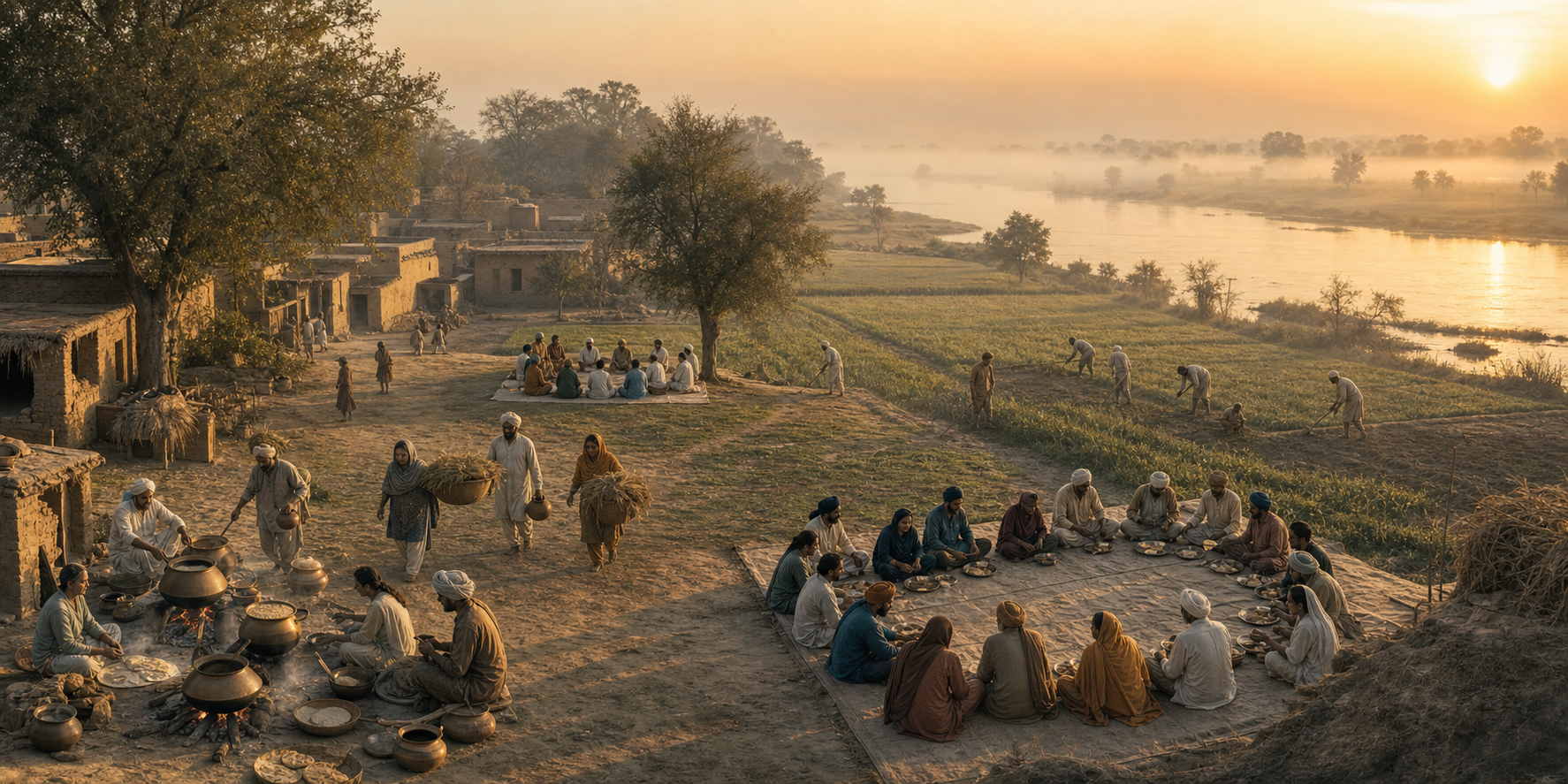
Guru Nanak Dev established Kartarpur around 1519, on the banks of the Ravi in present-day Narowal District, after his extensive journeys. The timing matters because Kartarpur was not merely another stop on an itinerary. It was a settled answer to a difficult religious question: can divine remembrance govern the material routines of a community?
The answer took visible form. Farming supported livelihood. Ethical work made earning part of spiritual accountability. Kirtan and remembrance oriented the community toward the Divine. Seva directed human effort toward others. Shared food made equality tangible. Kartarpur therefore joined contemplation, production, distribution, and fellowship within one daily rhythm.
This distinction is easy to miss. A devotional event can praise equality for an hour while its kitchens, donor relationships, work assignments, and social circles continue to reproduce status. Kartarpur set a stricter standard. The ordinary structure of community life had to express the teaching heard in worship.
When you assess a religious or cultural institution, follow one ordinary day rather than beginning with its slogans. Notice who performs the work, who receives honour, who eats with whom, how resources are allocated, and whether people without money or influence receive the same dignity. Those repeated arrangements reveal more than a ceremonial declaration does.
Naam Japna, Kirat Karo and Vand Chhako form one discipline
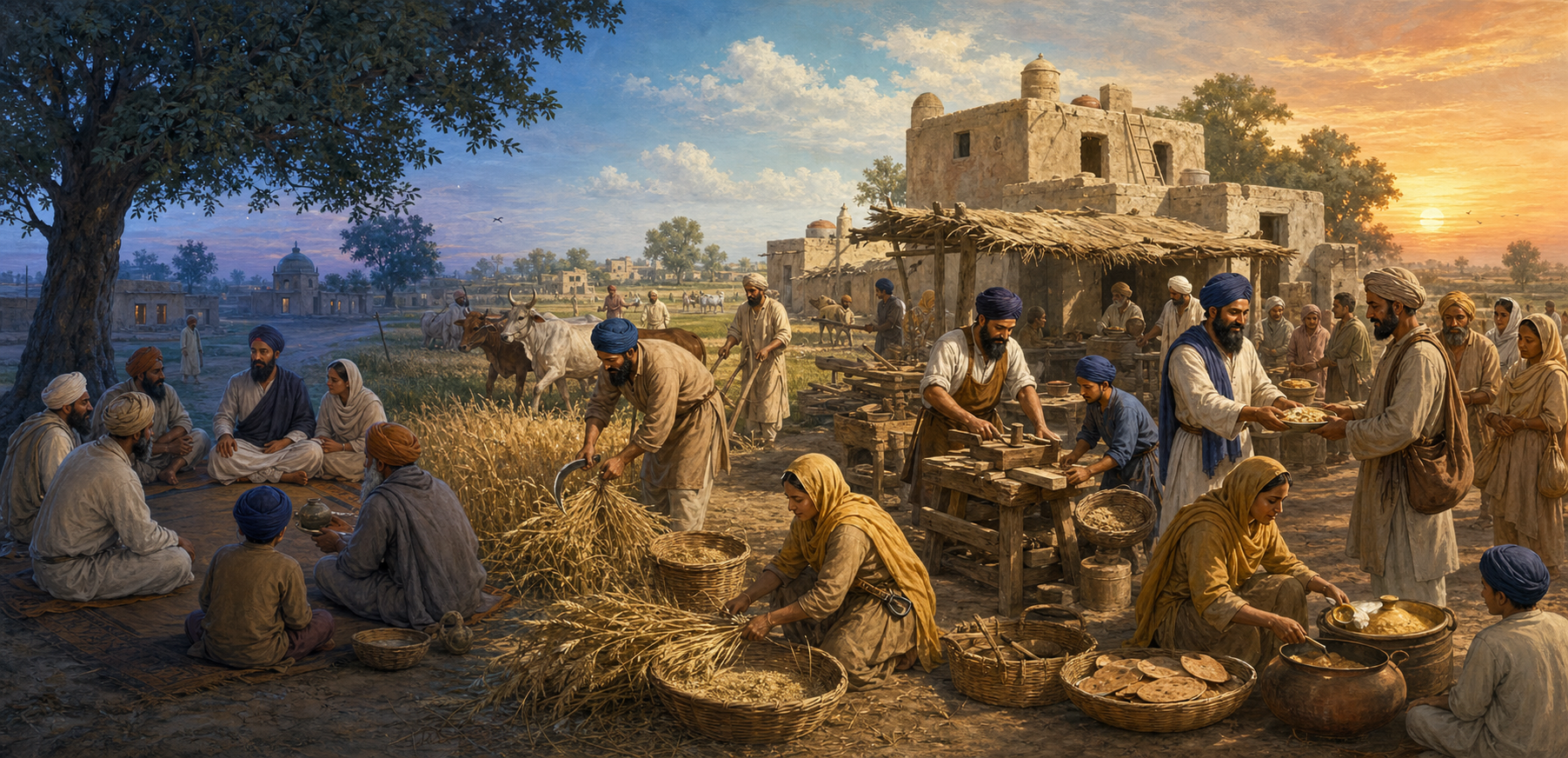
Kartarpur’s pattern is commonly expressed through Naam Japna, Kirat Karo and Vand Chhako: remembrance, honest work, and sharing with others. These principles are often presented as three items. Their deeper usefulness appears when you treat them as one circuit.
Naam Japna turns attention toward the Divine. At Kartarpur, remembrance was not confined to private thought; kirtan gave it a communal rhythm. The purpose was not to accumulate religious vocabulary. Remembrance had to correct the ego that seeks superiority, possession, and recognition.
Kirat Karo places livelihood inside the moral field. How you obtain what you later share matters. Honest labour prevents generosity from becoming a decorative act added to questionable conduct. It also refuses the false division in which worship is sacred but earning is morally neutral.
Vand Chhako moves the fruit of work outward. Sharing is not postponed until every private desire has been satisfied. Food, earnings, time, and effort become means of sustaining a wider community. The principle does not make possession the final purpose of labour.
Read together, remembrance checks ego, honest work checks means, and sharing checks attachment. Remove one, and the others can become distorted. Remembrance without accountable conduct can become spiritual self-image. Work without sharing can turn success into accumulation. Giving without concern for how wealth was earned can preserve the very harm that generosity appears to relieve.
You can apply this circuit to one week of ordinary life. Identify a regular practice that steadies your attention. Examine one earning, purchasing, or workplace decision for honesty. Then commit a definite share of food, skill, time, or income to someone beyond your immediate circle. The amount will differ by circumstance; the important correction is to make sharing intentional rather than accidental.
Langar turns equality from a belief into an arrangement

Langar was central to Kartarpur because it gave equality a recurring social form. The community meal welcomed people irrespective of caste, creed, or background to partake as equals. That is more demanding than holding an inclusive opinion. Food has to be obtained, prepared, served, received, and cleared away in a manner consistent with equal dignity.
Langar is therefore not simply a feeding programme. A feeding programme can leave a sharp divide between benefactor and beneficiary. Langar places shared nourishment within a discipline of seva and fellowship. A person does not gain greater human worth by arriving with wealth, and another does not lose worth by arriving hungry.
The physical and organizational details matter. At your next community meal, trace the experience from entry to cleanup. Ask whether caste, wealth, profession, family name, or donor status changes the welcome a person receives. Notice whether prominent guests are separated for prestige, whether the same less-powerful people always perform invisible labour, and whether serving is treated as lower than speaking from the front.
The correction is concrete: give everyone a dignified welcome, keep food and fellowship free from status tests, make service possible across social ranks, and honour cleaning as much as visible leadership. Distinct arrangements needed for disability, age, or care can preserve dignity without becoming privileges of rank.
There is also a matter of respect. Not every charitable meal should be casually renamed langar. Within Sikh life, langar belongs to a specific spiritual and institutional discipline. You can support it on its own terms and allow its structural lesson to improve other community meals without stripping the practice of its Sikh identity.
The wealthy patron represents redirection, not glorification
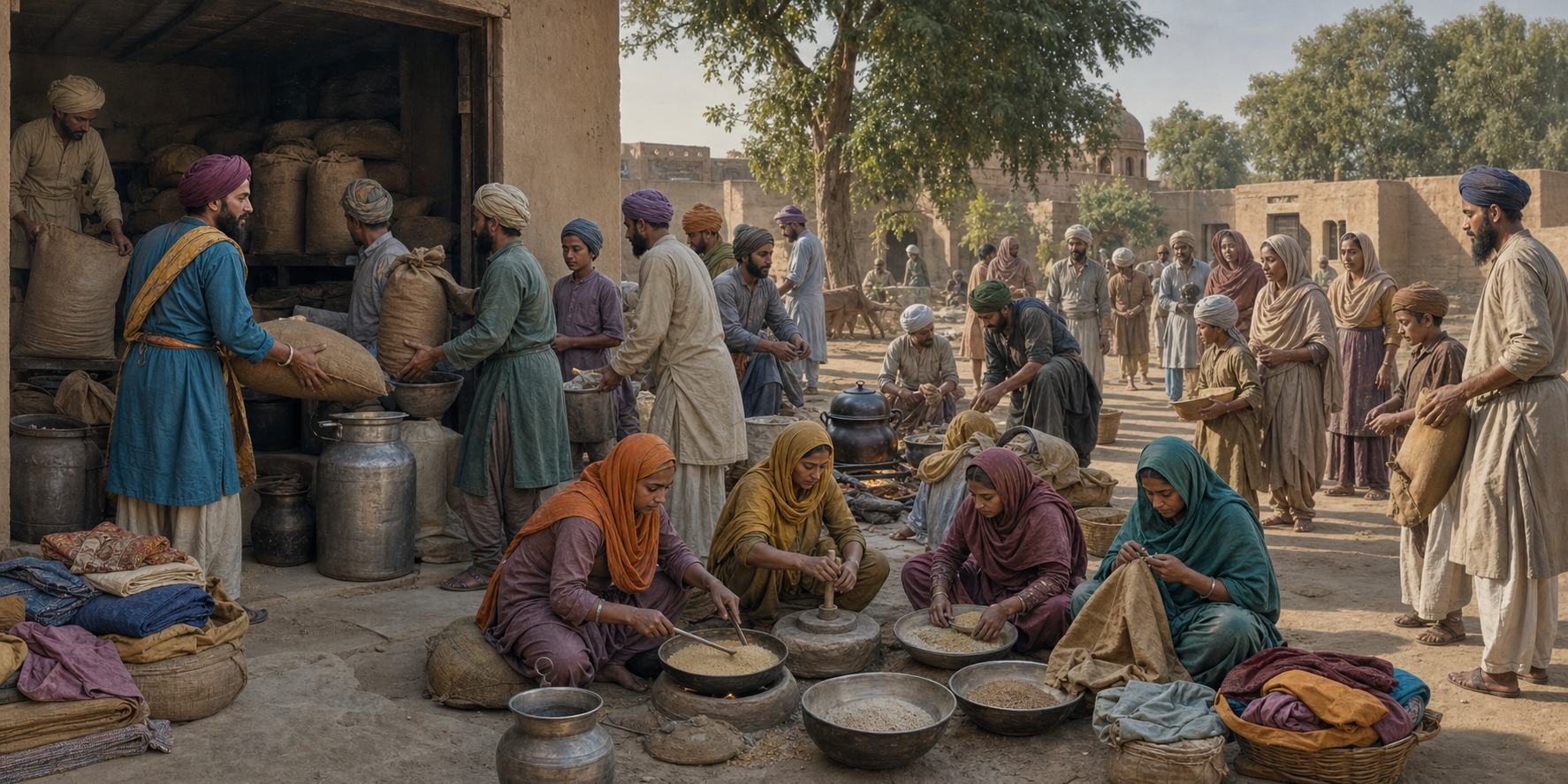
One Kartarpur origin tradition remembers a wealthy patron, often described as a millionaire, being moved by Guru Nanak Dev’s teaching. The tradition’s ethical force does not depend on a precise balance sheet. Its concern is the direction of wealth: resources accumulated around one person are redirected toward a settlement organized for common spiritual and material well-being.
This is not a simple declaration that wealth is evil or poverty is automatically pure. It is a test of mastery. Does a person possess resources responsibly, or do those resources possess the person’s imagination, loyalties, and need for status? Kartarpur’s answer was not theatrical renunciation. Wealth could be put to work, but its purpose had to be transformed.
The idea of sach daan places truthful living, compassion, and communal uplift above mere accumulation. A large contribution does not compensate for dishonest earning, and a donor’s generosity should not purchase spiritual rank, institutional control, or privileged access. The gift is closest to Kartarpur’s ethos when it expands shared capacity while preserving the dignity of everyone who benefits.
If you help govern a gurdwara, temple, cultural association, or service organization, examine a major gift before attaching the donor’s name to the project. Identify the common need it will meet. State who will control its use. Decide whether recognition gives the donor any special authority. Apply the institution’s ordinary rules to the giver as well as everyone else. These conditions let generosity strengthen community without quietly rebuilding hierarchy.
The same test works at household scale. Set aside something useful before spending solely for display or status. That contribution may be food, skilled work, patient attention, or money. Sharing leftovers can be kind, but planned sharing changes the purpose for which you work in the first place.
A shared Dharmic grammar does not erase Sikh distinctiveness
Readers from other Dharmic traditions will recognize important resonances in Kartarpur. Hindu bhakti joins devotion with seva. Buddhist karuna carries insight toward the alleviation of suffering. Jain ahimsa and restraint require knowledge to become non-harm in conduct. Sikh practice at Kartarpur joined remembrance, righteous livelihood, sharing, seva, and fellowship within a distinctive communal form.
These are genuine family resemblances, but they do not make the traditions interchangeable. Shared ethical direction is not proof of identical theology, authority, discipline, or history. Flattening every tradition into generic spirituality would hide precisely what Kartarpur contributes: a Sikh answer embodied through particular practices and institutions.
Use Dharmic comparison as translation, not takeover. Name the Sikh practice first. Explain what it does in Sikh community life. Offer a parallel from another tradition to aid recognition. Then return to the difference in form and setting. For example: langar institutionalizes Sikh equality through shared food; a Hindu listener may recognize the moral importance of seva, but that recognition does not turn langar into a generic name for all service.
This method is especially useful when you teach children, lead an interfaith discussion, or speak in a mixed Dharmic gathering. It allows people to find kinship without claiming ownership of another community’s sacred vocabulary. Unity becomes more durable when it is built from accurate recognition rather than blurred boundaries.
Key takeaways: use the Kartarpur test where you live
You do not need to found a settlement to apply Kartarpur’s founding ethos. Choose one household, workplace, congregation, or volunteer group and examine its recurring arrangements through these six tests:
- Head-to-heart test: Name one teaching your group repeats. Then identify the schedule, budget line, work rule, or service practice that makes it visible. If you cannot find one, the teaching has not yet become communal conduct.
- Remembrance test: Establish a regular period of Naam, kirtan, prayer, or reflective attention appropriate to your tradition. Let it precede consequential decisions so that remembrance can challenge ego rather than merely console it afterward.
- Livelihood test: Examine how resources are earned or obtained before celebrating how they are donated. Correct one practice that depends on deception, unfair treatment, or concealed labour.
- Sharing test: Decide in advance what food, time, skill, or income will be shared. Make it a stable commitment rather than whatever remains after every private preference has been met.
- Equality test: Follow a newcomer through the actual experience of entry, food, participation, and service. Remove status advantages that are unrelated to genuine care or accessibility.
- Wealth test: Direct contributions toward a common need without allowing the gift to buy control, spiritual prestige, or a different standard of treatment for the giver.
Start with the next shared meal, work decision, or contribution. Change one recurring arrangement so that remembrance affects how people earn, share, serve, or receive welcome. When the arrangement continues after the emotion of the occasion has passed, Kartarpur’s ethos is no longer only admired. It is being practised.
References
- SikhNet – Discover Kartarpur’s Origins: Guru Nanak’s Essential Lesson to a Millionaire on Heart-Wisdom
- SikhNet – Discover the Proven Origins of Kartarpur Sahib: Guru Nanak Dev’s Transformative Vision
