
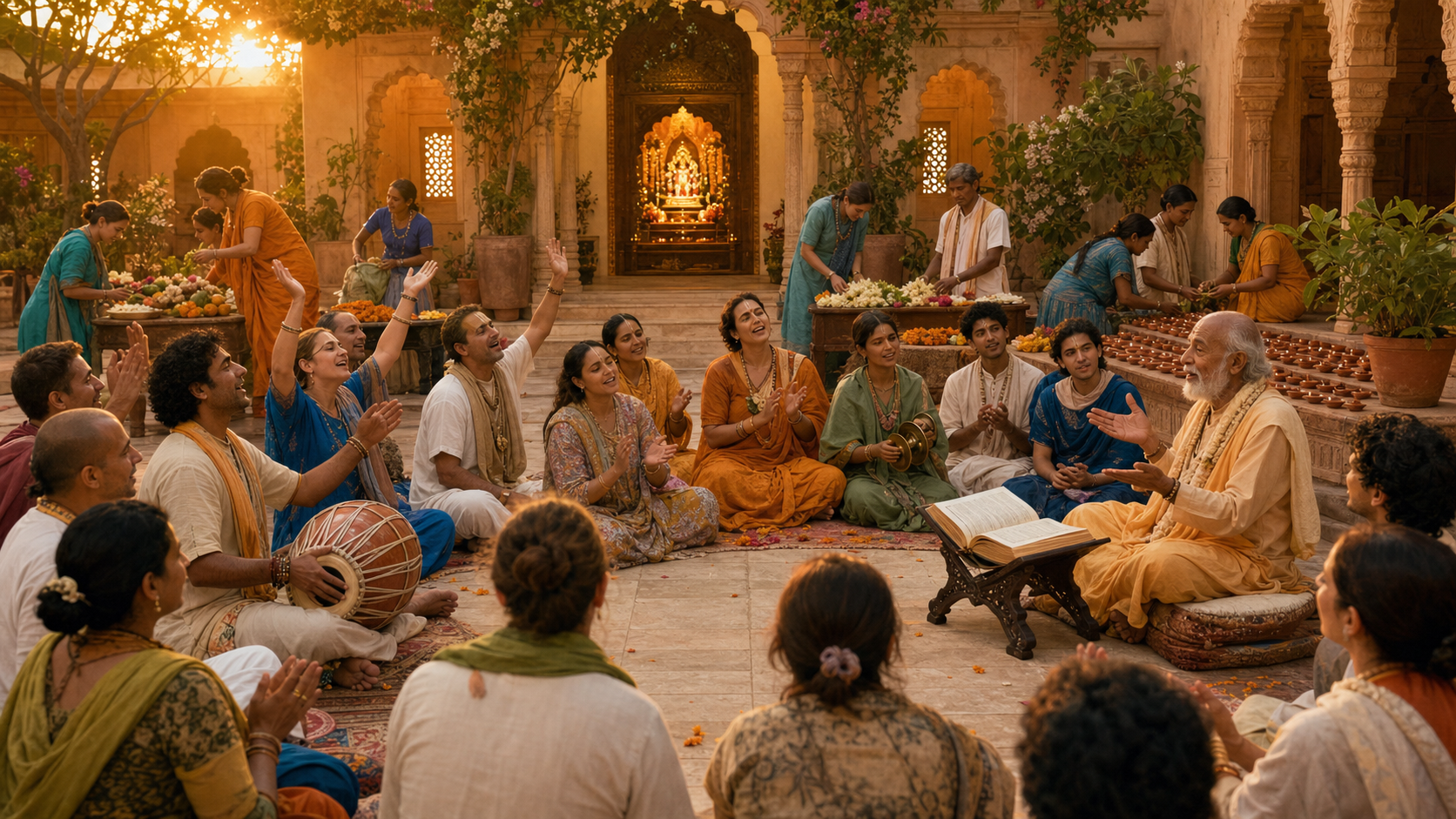
You may open an ISKCON calendar, find a festival notice beside a kirtan recording and a remembrance of Srila Prabhupada, and wonder how these very different activities belong to the same devotional history. The answer matters if you want to participate rather than merely browse.
Approach ISKCON through three connected strands: the sacred personalities being remembered, the practices devotees repeat, and the communities that keep those practices alive. Once you know which strand is in front of you, a temple program or online recording becomes much easier to understand.
History is carried by what devotees repeat
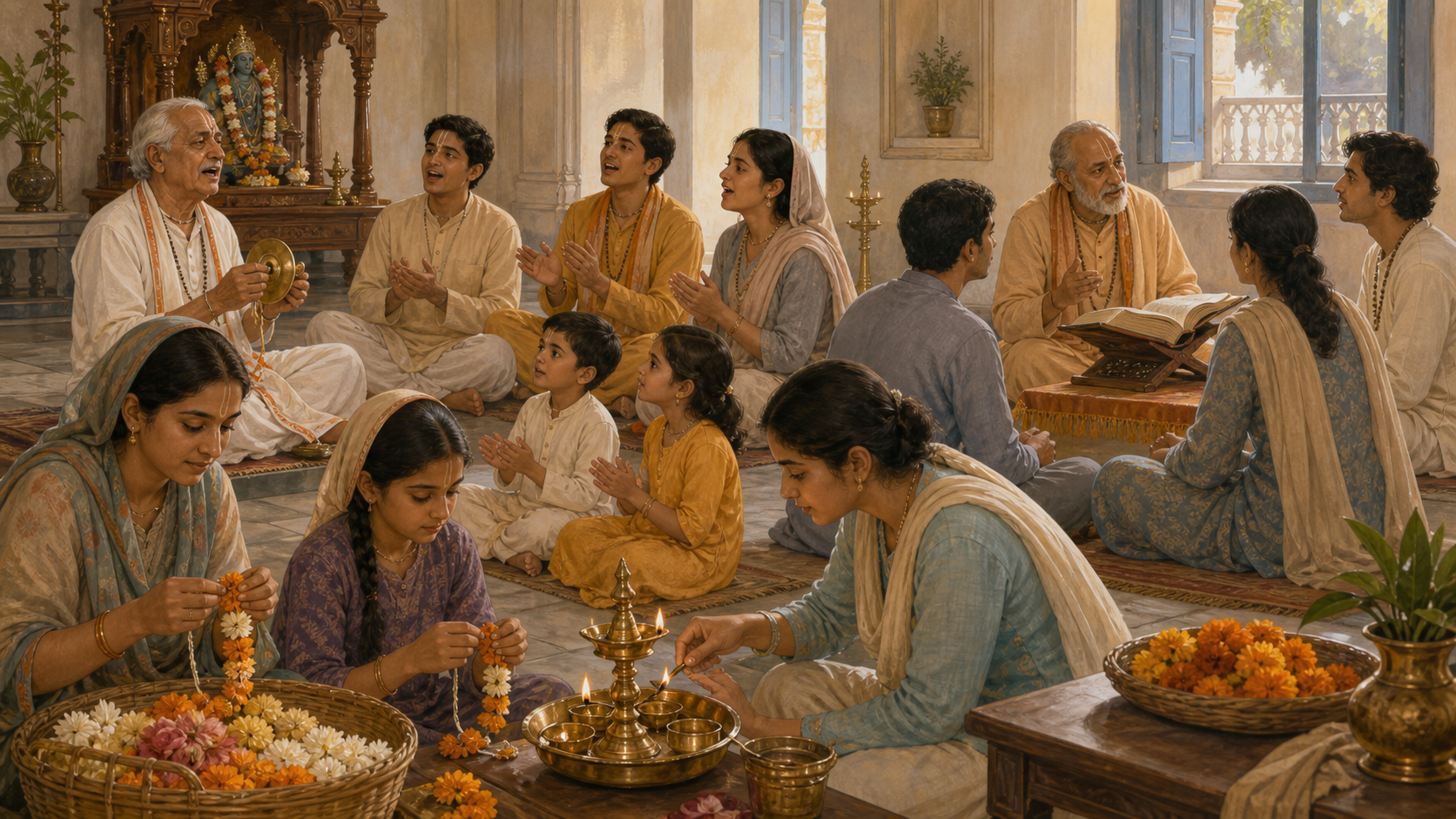
ISKCON history is not only a sequence of institutional dates. It is also a history of devotional actions. Srila Prabhupada’s beginnings in the West are remembered together with the start of kirtan in ISKCON, because chanting was not incidental to the movement’s formation. It was one of the principal ways its teaching became audible, participatory, and communal.
This changes what you should notice. In a conventional history, you may look first for dates, places, and organizational milestones. In devotional history, you should also ask which practice made the event possible and why devotees continue that practice. A recollection of early kirtan is therefore doing two jobs: preserving memory and teaching a living form of devotion.
ISKCON programs also move among several meanings of the word “history.” Krishna-lila belongs to sacred narrative. Prabhupada-lila centers on remembered episodes involving Srila Prabhupada. A discussion of early ISKCON kirtan concerns the movement’s development. An appearance-day festival brings sacred remembrance into the recurring calendar. These layers support one another, but they should not be collapsed into a single historical register.
| Layer | What you are encountering | What to notice |
|---|---|---|
| Divine lila | Sacred accounts centered on Krishna, Balaram, or another divine personality | The devotional meaning of the account, not merely its sequence of events |
| Prabhupada-lila | Remembrance centered on Srila Prabhupada | What his words, choices, and relationships taught the community |
| Movement history | Accounts of ISKCON’s beginnings and developing practices | How a practice such as kirtan shaped the movement rather than simply accompanying it |
| Calendar observance | A recurring holy day marked by a local community | How remembrance becomes worship, hearing, chanting, and service in the present |
When you hear a historical talk, write down one event and one practice connected to it. If the event is remembered but the practice is never identified, you have only half the picture. If the practice is described without its devotional purpose, you have the other half.
A holy day can have more than one date attached to it
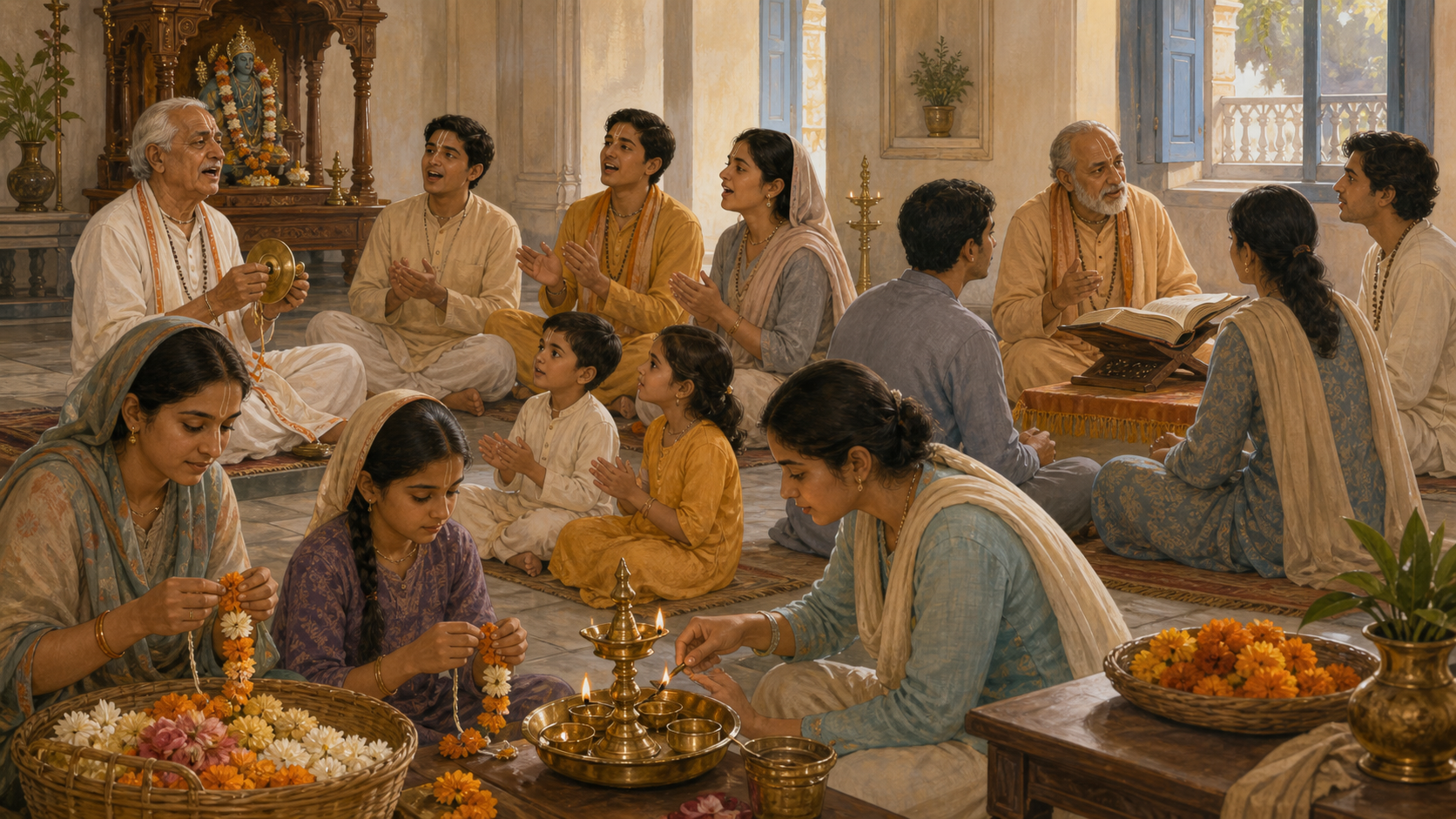
ISKCON North Atlanta marked Lord Balaram Appearance Day on August 27, 2026, while the weekly page carrying that item was dated Sunday, August 30. That small difference illustrates a common source of confusion: the observance date, a venue’s program date, and an online publication date do not necessarily mean the same thing.
Do not turn the date on one recording or event page into a universal annual rule. Dharmic holy days may fall on different Gregorian dates in different years, and local schedules can differ. For a future observance, use the current calendar of the temple you intend to visit and confirm its local time zone.
- Sacred-calendar date: the date on which the holy day is being observed according to the relevant devotional calendar.
- Local program date: when a particular temple holds its gathering, which is the date you need if you plan to attend.
- Recording or publication date: when material reaches the internet; this may be later and should not be treated automatically as the festival date.
Read the event name just as carefully as the date. An appearance day is not a generic cultural celebration with a devotional label added to it. The named personality supplies the focus. For Lord Balaram Appearance Day, arrive ready to hear why Balaram is being remembered and how the community expresses that remembrance.
If a notice does not explain fasting, offerings, dress, or arrival time, ask the local temple before assuming. A recording can show that an observance occurred, but it does not automatically provide every instruction a visitor needs. One short message to the host community is more reliable than copying practices from an unrelated event.
Choose the devotional format that answers your question
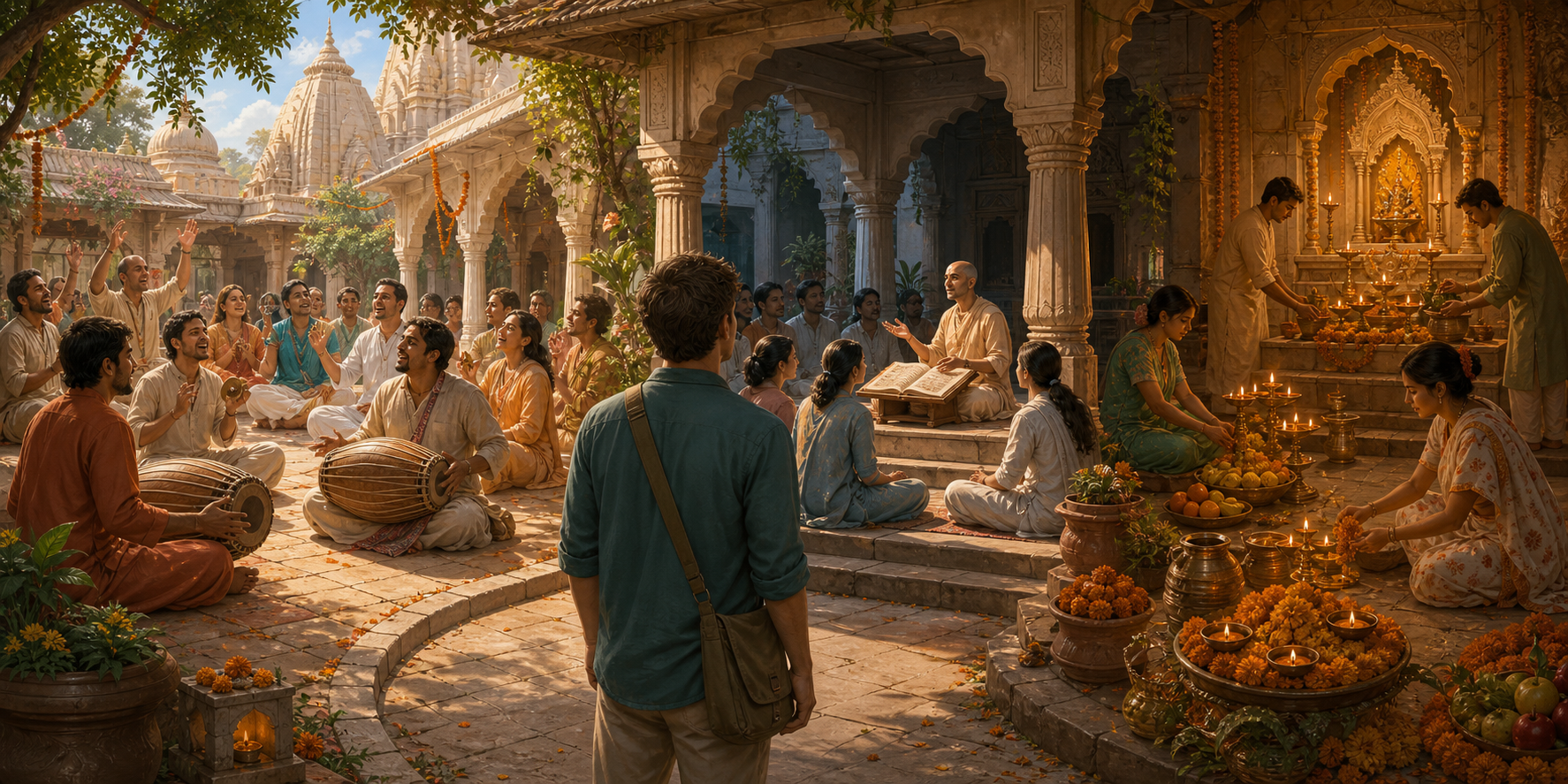
Late-August 2026 ISKCON programming included a Paris Prabhupada-lila presentation, a discussion of the start of kirtan, Krishna-katha, Krishna-lila narration, and a Srimad Bhagavatam class. Their coexistence is not redundancy. Each format asks something different of you.
- Kirtan: choose this when you want to participate through chanting. When it takes a lead-and-response form, listen through one response before joining so that you can follow the words and melody without rushing.
- Krishna-katha or lila-katha: choose this for sacred narration and devotional interpretation. Listen for the relationship being revealed, the quality being praised, and the response the narration is inviting from a devotee.
- Srimad Bhagavatam class: choose this when you want teaching anchored in a scriptural discourse. Note the stated passage or class title, the speaker’s central argument, and one question that remains. This will help you distinguish textual explanation from a memorable illustration used during the talk.
- Prabhupada-lila: choose this when you want to understand how Srila Prabhupada is remembered within ISKCON. Ask who is recounting the episode, what principle the memory is meant to illuminate, and whether you are hearing personal recollection, devotional interpretation, or a broader historical claim.
- Appearance-day observance: choose this when you want to experience remembrance as a community practice. Confirm the local schedule and allow the named holy personality, rather than your assumptions about a generic festival, to guide your attention.
If you are completely new, kirtan followed by katha is often easier to enter than an isolated recording whose context you do not know. The chanting lets you encounter the practice; the discourse helps you understand what the community believes it is doing. If you already have a textual question, begin with the Bhagavatam class and then hear how the same teaching is embodied in kirtan or observance.
Use this plan for your first observance
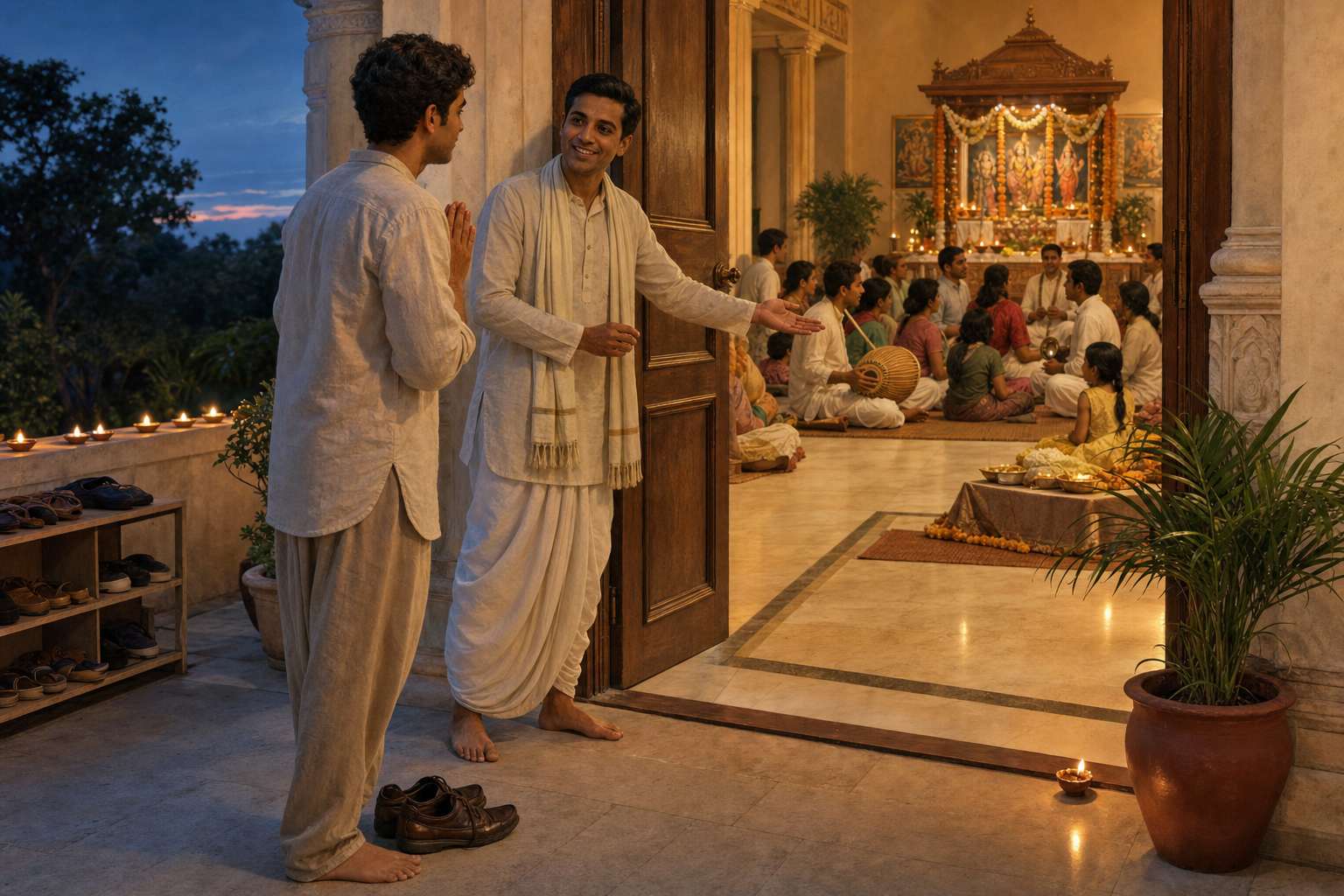
- Identify the format before you go. Look for precise words such as kirtan, katha, class, lila, appearance day, or historical remembrance. They tell you whether the gathering emphasizes participation, narration, textual instruction, commemoration, or a combination.
- Verify the local date and time. Use the host temple’s current schedule. If you found an older video, keep its observance date separate from its upload or archive date.
- Learn the names you will encounter. You do not need a complete theological vocabulary. Begin with the personality being honored, the speaker or teacher, and the text named in the program. This prevents Krishna-lila, Prabhupada-lila, and institutional history from blending into one vague category.
- Choose one form of active attention. In kirtan, follow the response. In katha, track one relationship or teaching. In a Bhagavatam class, note one textual claim and one application. A narrow intention is more useful than trying to retain the whole program.
- Ask about unfamiliar etiquette. Ask the host about seating, offerings, food, fasting, photography, and when newcomers should arrive. Local guidance is especially important when a brief online notice supplies only a title and date.
- Connect the event to a repeatable practice. Afterward, write one sentence completing this prompt: “This remembrance is kept alive through…” Your answer may be chanting, hearing sacred narrative, studying scripture, serving a community, or returning annually to the holy day. That sentence turns an event you watched into history you understand.
If you come from another Hindu sampradaya or another Dharmic tradition, you do not need to erase the differences in order to participate respectfully. Keep ISKCON’s Gaudiya Vaishnava vocabulary intact, listen for how its practitioners explain their own observance, and compare traditions only after you have understood the practice on its own terms.
Key takeaways
- Read ISKCON history through recurring practices as well as dates; kirtan is part of the movement’s historical formation and its continuing devotional life.
- Distinguish divine lila, Prabhupada-lila, movement history, and calendar observance. They are related, but they answer different questions.
- Separate a holy day’s date from a local program date and an online publication date. Confirm future plans with the current local temple calendar.
- Select kirtan, katha, Bhagavatam class, historical remembrance, or an appearance-day program according to whether you need participation, narrative, scriptural explanation, context, or communal observance.
The next time an ISKCON program appears in your calendar or video feed, do not begin by trying to absorb everything. Identify the devotional form, verify the date with the host community, and follow one practice closely. That is the shortest route from seeing an observance to understanding how a tradition remembers.
References
