
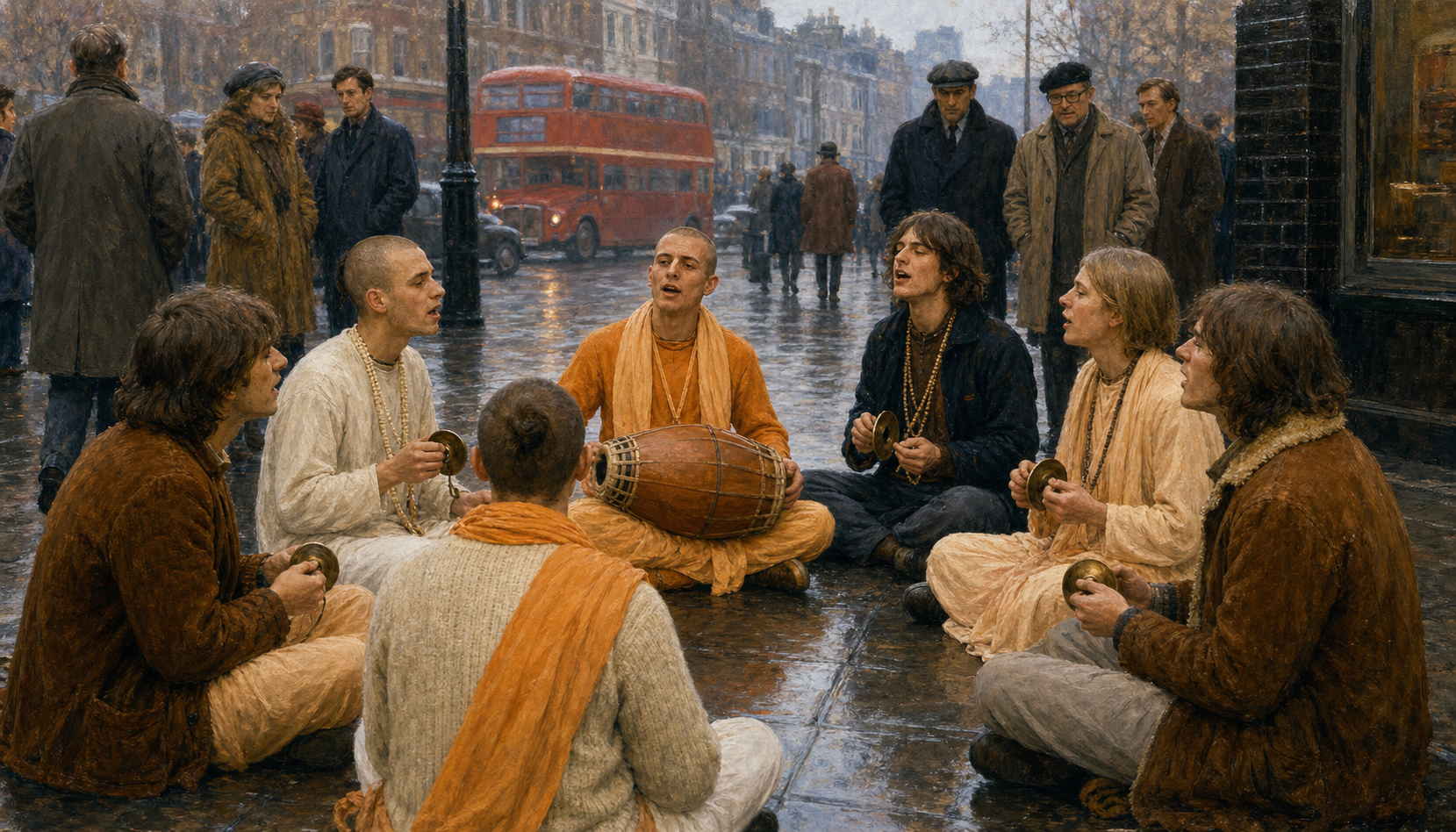
If you want to understand how ISKCON took root in London, do not begin with the institution it later became. Begin in 1968-69, when a small circle of new devotees had to learn spiritual discipline, sing kirtan in public, speak with seekers, and carry a mission almost at once.
The useful question is not simply how the group attracted attention. It is how shared enthusiasm became a functioning spiritual community. Early ISKCON London offers a clear answer: practice, public service, guidance, and responsibility had to reinforce one another.
The rhythm mattered more than the size
The community developed around a recurring rhythm of concentrated sadhana, public kirtan, and steady engagement with seekers. None of these activities was sufficient by itself. Sadhana gave the devotees an inner discipline. Kirtan made devotion public. Conversations with seekers required them to express what they were learning in terms another person could understand.
This distinction matters when you read the history of any young spiritual movement. Public activity is the visible part, but visibility is not the same as formation. A crowd can gather around novelty. A community begins when people return to a practice, accept obligations to one another, and keep serving after the first excitement has passed.
The London devotees did not wait until they possessed years of training before acting. Their learning occurred alongside service. That created pressure, but it also made every lesson consequential: greater competence in kirtan, scripture, or personal discipline immediately affected the shared mission. If you are assessing whether a spiritual group is actually forming people, look for that connection. Practice should change how members serve, and service should reveal where their practice still needs depth.
Guidance across distance became part of the training
Across distance, Srila Prabhupada trained the London mission through direct correspondence that joined clarity of purpose with personal accountability. He did not separate philosophical understanding from immediate application. The devotees were being formed in kirtan, scripture, discipline, cooperation, and the practical capacity to carry responsibility.
The speed of that training can be misunderstood. Moving quickly does not have to mean lowering the standard. It can mean narrowing the distance between instruction and practice. A principle is explained, someone applies it to real service, uncertainty becomes visible, and guidance corrects the next attempt. The lesson becomes lived knowledge instead of remaining an idea.
For anyone guiding a spiritual community, the underlying sequence is concrete:
- State the shared purpose clearly enough that a member can use it to make a decision.
- Connect instruction to an actual practice, such as kirtan, scriptural study, personal discipline, or service.
- Give the member room to act, while keeping accountability visible.
- Correct what has drifted, encourage what is sound, and return attention to the common mission.
Encouragement and correction belong in the same process. Encouragement without correction leaves a novice unsure of the standard. Correction without encouragement can make initiative feel dangerous. Prabhupada’s leadership held purpose steady while new devotees developed the confidence to act.
Responsibility turned participants into a mission
Within months, a small circle had accepted responsibilities far beyond what its size might suggest. This was not merely a way to distribute chores. Responsibility became part of spiritual formation. The devotees had to translate conviction into reliability, cooperate with others, and place personal ability in service to a purpose larger than themselves.
That is the difference between assigning work and empowering a person. An assignment says what must be done. Empowerment also provides a clear purpose, recognizable disciplines, access to guidance, and room for the person’s strengths to matter. Early London combined these elements closely enough that new practitioners could become active bearers of the mission rather than permanent spectators.
You can test whether present-day responsibility is formative by asking four questions. Can the person explain the purpose of the service? Do they know which practices and standards govern it? Can they seek correction before uncertainty becomes conflict? Are they trusted to make any meaningful decision? If the answer is no across the board, the person has probably received a task but not genuine responsibility.
The pattern also belongs to a wider dharmic vocabulary. Seva directs ability beyond personal prestige. Discipline keeps service from dissolving into impulse. Compassion prevents discipline from hardening into control. Hindu, Buddhist, Jain, and Sikh traditions are not interchangeable, but each recognizes that a community is sustained through trained conduct and service, not through identity alone.
Honest history preserves agreement and difference
Jamuna Devi and Shyamasundar remembered the same formative world from different positions within it. Their recollections converge around the central pattern while differing gently in nuance. You do not have to select one memory as the winner whenever emphasis or texture varies.
Start with the shared spine: the 1968-69 setting, concentrated spiritual practice, public kirtan, engagement with seekers, rapid acceptance of responsibility, and Prabhupada’s continuing guidance. Then preserve viewpoint. One participant may remember hesitation, another a practical instruction, and another the emotional force of encouragement. Different emphasis is not automatically factual contradiction.
A careful historian can use contemporary correspondence to place guidance within the unfolding mission without asking it to cancel personal memory. Correspondence preserves instruction and intention; recollection preserves how events were experienced. Each answers a different kind of question. The first helps establish what was being asked. The second helps explain how new devotees received, interpreted, and embodied it.
This method protects you from two common errors. The first is romanticizing the beginning until uncertainty and fatigue disappear. The second is treating every variation in memory as evidence that nothing can be known. Early ISKCON London’s broad pattern remains coherent precisely because agreement on the essentials can coexist with human differences in remembrance.
Key takeaways
- ISKCON London’s early community formed through a repeatable combination of sadhana, public kirtan, engagement with seekers, and service.
- Public visibility was an outcome of community formation, not a substitute for inner discipline.
- Srila Prabhupada joined philosophical instruction to immediate practice, accountability, correction, and encouragement.
- Real responsibility allowed new devotees to develop competence while contributing to a common mission.
- Differences between personal memories should be weighed against the shared historical spine rather than flattened or exaggerated.
If you are building a sangha, put the London lesson onto one page this week: state the purpose in one sentence, name the regular practice that sustains it, give one person a real responsibility, and establish a dependable point for guidance. If you are studying history, map those same four elements in the formative period you are examining. They will help you distinguish a memorable event from the formation of a community.



References
