
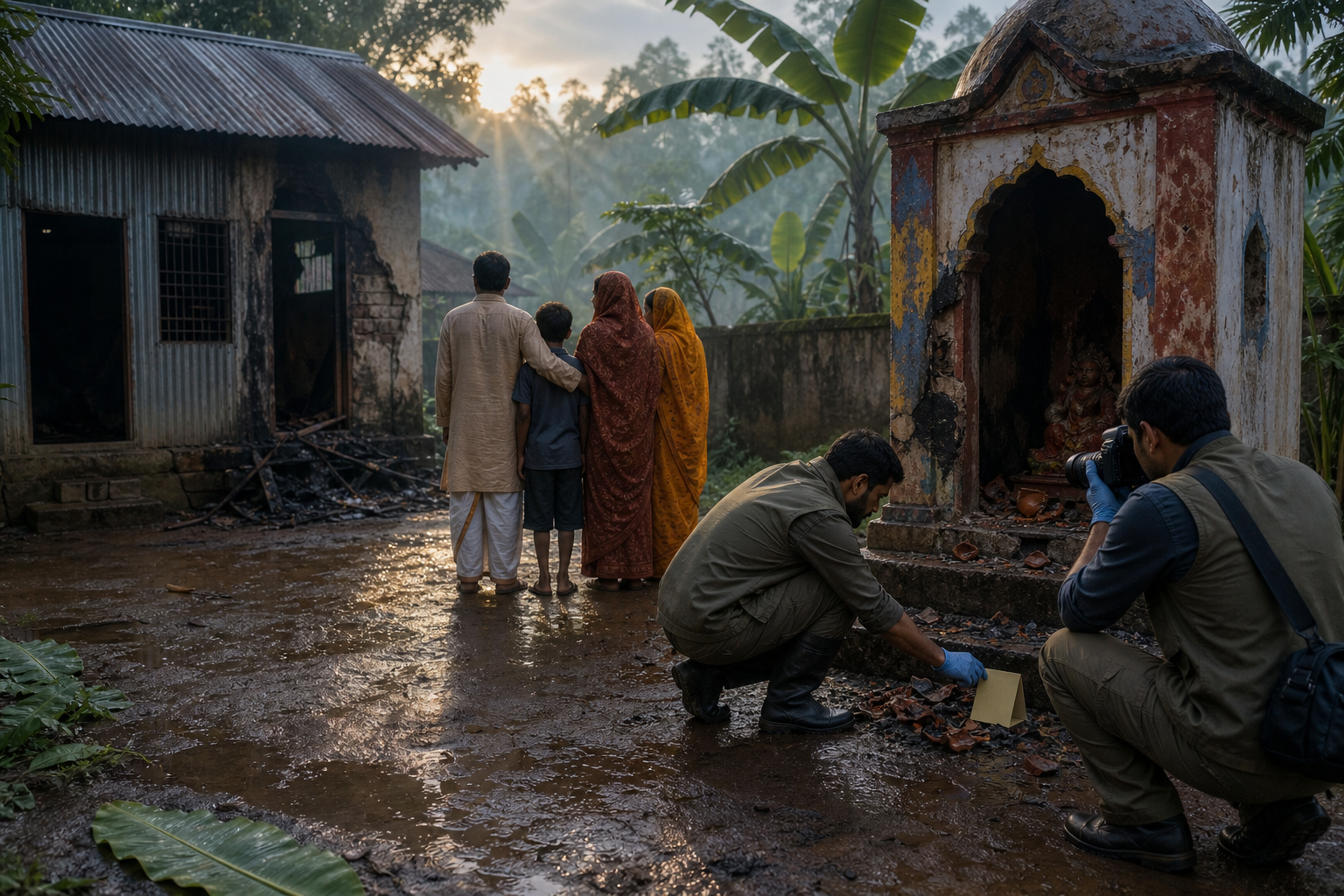
A video of a vandalized murti or a burned Hindu home reaches your phone. You want to defend the victims immediately, but you may not know whether the date, location, caption, or claimed cause is accurate. Sharing first and checking later can expose survivors, weaken a legitimate case, and give officials an excuse to dismiss the wider pattern.
You do not have to choose between silence and instant certainty. A disciplined response can recognize persecution, preserve evidence, protect people at risk, and turn concern into demands that governments and institutions can be required to answer.
Key takeaways
- Look beyond a single outbreak. Repeated attacks on temples, homes, businesses, property rights, and community security can reveal a pattern even when the immediate trigger changes.
- Use the word genocide with legal precision. You can sound an atrocity warning and demand prevention without claiming that a court has already established genocidal intent.
- Do not make endangered people produce dramatic footage. Safety, consent, original files, corroboration, and protected identities matter more than social-media speed.
- Replace the vague demand to “do something” with a named institution, a specific remedy, and a public measure of progress.
- Let satya govern what you claim and ahimsa govern how you act. Defending Hindus does not require collective blame or retaliation against another community.
Recognize the machinery of persecution, not just each outbreak

Persecution is broader than a count of deaths. It can include recurring violence against places of worship, destruction of livelihoods, dispossession, intimidation, localized displacement, and institutional failure that leaves a religious group less able to live securely as itself. One incident may be a crime. A repeated combination of selective targeting, predictable triggers, weak protection, and impunity points to a structural problem.
In Bangladesh, communal attacks have tended to intensify around religious festivals, political volatility, and other flashpoints. The 2021 Durga Puja violence showed how an inflammatory claim circulating through social media could help mobilize attacks on temples, homes, and businesses. That sequence is useful as an early-warning model, although it should never be forced onto an incident before the facts are known.
- A triggering claim circulates. It may be a blasphemy allegation, an unverified accusation, manipulated material, or an ordinary dispute recast in communal terms. Record the original claim and who amplified it; do not repeat it as fact.
- Online agitation becomes local mobilization. Watch for calls to gather, threatening language, publication of addresses, and movement toward a temple or minority neighborhood. This is the window in which rapid clarification and preventive policing matter most.
- Religiously identifiable targets are attacked. Damage to murtis, mandirs, homes, shops, and festival sites helps establish whether the violence was selectively directed at Hindu life rather than merely occurring in an area where Hindus live.
- The institutional response shapes the next outbreak. Delayed intervention, opaque investigations, unsafe witnesses, and prosecutions that disappear from public view teach potential attackers that the cost will be low.
- The cumulative effect outlasts the riot. A family that loses a shop, land, worship space, or confidence in local protection may relocate even if it survives the immediate attack.
This does not mean that every attack has one organizer or a single national command. A pattern can be structural without being centrally directed. Rumor networks, opportunistic land grabbing, political calculations, local prejudice, and prior impunity can reinforce one another. Document each mechanism separately rather than compressing them into one unsupported theory.
Bangladesh’s formal commitments also have to be distinguished from their enforcement. Its constitutional framework recognizes equality before the law, bars religious discrimination, and affirms freedom of religion. Secularism has been restored to constitutional doctrine while Islam remains the state religion. The decisive question is whether those guarantees produce protection, investigation, prosecution, and remedy in daily life. Constitutional language is important, but it is not evidence that a threatened family is safe.
Demography supplies another warning, but it must be used carefully. The Hindu share of the population fell from more than one-fifth in the early post-Partition decades to well below one-tenth in more recent years. That change does not, by itself, prove one cause or a legally defined plan of destruction. Migration and demographic change have multiple drivers. It does justify close investigation of recurring violence, property dispossession, insecurity, and the continuing effects of the Vested Property Act and its antecedents. Treat the trend as evidence of vulnerability and cumulative pressure, not as a substitute for incident-level proof.
Use legal terms precisely without lowering the alarm
You can be unequivocal about anti-Hindu persecution while remaining exact about the word genocide. Precision protects the credibility of victims. It also prevents a debate over terminology from swallowing the urgent questions: Who is in danger, what warning signs are present, and what must authorities do now?
Under the 1948 Genocide Convention, genocide requires an intent to destroy, in whole or in part, a national, ethnical, racial, or religious group. The enumerated acts include killing; causing serious bodily or mental harm; deliberately imposing conditions of life calculated to bring about the group’s physical destruction; imposing measures intended to prevent births; and forcibly transferring children. Serious discrimination, cultural destruction, or repeated communal attacks can be grave without automatically satisfying that specific legal test. The central legal difficulty is proving the required intent.
Keep three questions separate:
- Did a particular incident happen as described? This requires evidence of the event, its time, location, targets, injuries or damage, and relevant actors.
- Does the incident belong to a wider pattern of persecution or atrocity risk? This requires comparison across incidents, including target selection, rhetoric, methods, institutional response, displacement, and impunity.
- Does the evidence establish genocide in law? This requires proof not only of prohibited acts but also of an intent to destroy the protected group, in whole or in part. That determination demands a rigorous legal and evidentiary assessment.
Prevention does not have to wait for the third question to be settled. The United Nations Office on Genocide Prevention treats hate speech, entrenched discrimination, impunity, dehumanizing propaganda, and destruction of religious or cultural heritage as relevant warning factors. Several such warning signs have been raised repeatedly in relation to Bangladesh. Calling for early action on those risks is not a concession that the violence is minor. It is the purpose of atrocity prevention.
Your public language should also preserve the status of every claim:
- Verified fact: supported by reliable, independent evidence sufficient for the precise statement being made.
- Credible allegation: plausible and supported by meaningful evidence, but still missing a material element or independent confirmation.
- Unverified claim: not yet supported well enough to repeat as fact, however disturbing or widely shared it may be.
Say “a credible allegation of an attack is being investigated” when that is what you know. Say “verified footage shows damage to this temple at this location” only when the footage, place, and time have actually been established. Reserve a legal conclusion about genocide for evidence that addresses the intent requirement. If the status changes, update the same incident record and preserve the correction history.
Verify and document an incident without increasing the danger

Documentation is not merely content collection. It may become evidence in a criminal case, a property claim, a request for protection, or an international human-rights communication. It may also expose a survivor to retaliation. Never ask someone in immediate danger to keep filming, confront alleged attackers, revisit an unsafe location, or reveal an identity for the sake of a stronger post.
- Preserve the original. Keep the first available image, video, audio file, message, or document without cropping, filters, added music, translated overlays, or compression. A public copy can be edited for safety, but the evidentiary copy should remain unchanged.
- Record provenance. Note who supplied the material, when it was received, how it was transferred, whether that person created it, and whether any edits occurred before receipt. Keep the original platform link where one exists. A chain of custody is a history of the evidence, not simply possession of a file.
- Establish place and time separately. Identify visible signs, distinctive temple features, roads, landmarks, or other location markers. Record the claimed date and time zone, then distinguish the file’s creation time, its first known upload, and the time of the alleged event. Do not turn a plausible match into a declared fact.
- Seek independent corroboration. Compare the account with separate witnesses, additional original media, local records, or trusted contacts. Ten accounts reposting the same video are still one originating source.
- Describe what the evidence proves. Footage may prove that a temple was damaged without proving who organized the attack or why. A witness may identify attackers without knowing whether officials directed them. Keep observation, attribution, motive, and legal conclusion in separate fields.
- Interview with consent and care. Explain how testimony may be used, allow anonymity, ask open questions, avoid pushing a survivor to repeat distressing details, and stop when continuing would cause harm. Record uncertainty instead of filling gaps for the witness.
- Protect sensitive information. Remove personal phone numbers, precise home addresses, faces, identity documents, and names from the public version unless informed consent and a clear protective reason justify publication. Keep the full record access-controlled.
A useful incident record should contain a unique case identifier; the date or time range; district and locality; coordinates when safe; the type of target and harm; an anonymized account of affected people; links to original media; the evidence chain; verification status and rationale; police, court, compensation, and restitution updates; and the date of the last review. A centralized, anonymized, geocoded, and time-resolved database can connect attacks with arrests, prosecutions, compensation, and property remedies. That turns a feed of alarming posts into an accountability record.
Keep a private evidence file and a separate public summary. The private file preserves identities, originals, and contact details for qualified lawyers or investigators. The public summary carries only what can be disclosed safely. If a survivor wants to pursue a criminal or property case, connect that person with qualified Bangladeshi counsel or an established human-rights organization. Online volunteers should not improvise legal strategy or promise protection they cannot provide.
Turn solidarity into demands that can be measured

Advocacy usually loses force at the words “take action.” An authority can acknowledge that request without changing anything. A stronger demand identifies who has power, what that institution should do, what evidence it must publish, and when the public should check again.
| Who can act | Specific demand | Evidence of progress |
|---|---|---|
| Police and local administrations in Bangladesh | Adopt festival and temple protection procedures covering perimeter security, crowd management, rumor rebuttal, and rapid intervention against mob formation. | District-level security plans, recorded alerts and response times, incident outcomes, and public after-action reviews. |
| Prosecutors and courts | Use dedicated prosecutors, timely communal-violence proceedings, and meaningful witness protection. | Separate figures for arrests, charges, trials, convictions, acquittals, and cases still pending, rather than a single arrest total. |
| Land and property authorities | Accelerate Vested Property Act claims, digitize land records, protect dispossession victims, and provide restitution or timely market-linked compensation. | Claims filed, resolved, rejected with reasons, property restored, compensation paid, and average resolution time. |
| National monitoring bodies and civil society | Maintain an anonymized incident system covering temples, homes, shops, displacement, legal action, compensation, and restitution. | A public methodology, verification labels, correction history, geographic coverage, and regularly updated case outcomes. |
| United Nations mechanisms and international partners | Seek urgent communications and country engagement by relevant Special Rapporteurs, OHCHR technical assistance, and human-rights benchmarks in diplomatic cooperation. | Published communications, accepted visits, named recommendations, technical programs, and disclosed progress against benchmarks. |
| India and Bangladesh | Create working arrangements on minority protection, pilgrimage access, cultural-heritage security, and humane treatment of genuine asylum-seekers within border management. | A public work plan, responsible officials, meeting records where appropriate, and reported operational outcomes. |
| Diaspora and Dharmic organizations | Fund verification, legal aid, survivor services, secure documentation, and principled advocacy. | Safeguarding rules, transparent use of funds, correction procedures, documented referrals, and survivor-centered results. |
Individualized sanctions may be appropriate where credible evidence identifies people who organized or financed serious abuses and domestic accountability has failed. Such measures need an evidentiary basis, procedural safeguards, and narrow targeting. Broad economic punishment can harm ordinary Bangladeshis, including the minorities it is meant to help, without holding a perpetrator personally responsible.
If you are writing to an elected representative, diplomatic office, civil-society body, or international mandate, build the request as a one-page brief:
- State the verified facts first and label every unresolved allegation.
- Explain whether the case indicates a recurring method, location, trigger, target type, or accountability failure.
- Name the institution that has authority to provide the remedy.
- Make one primary request, such as protected prosecution, restoration of property, a country communication, or publication of case outcomes.
- Specify the measure that would show whether the request was implemented.
- Set a follow-up date and keep a log of replies, non-replies, new evidence, and corrections.
Choose one lane you can sustain: evidence verification, survivor relief, legal support, property restitution, festival security, or policy advocacy. Before donating, ask how beneficiaries are verified, how identities are protected, how funds are reported, and whether survivors can refuse publicity without losing assistance. Before sharing an organization’s case count, read its inclusion standard and correction policy. Comparable data matters more than the largest possible number.
Dharmic solidarity must also discipline the language used in public. Ahimsa does not require passivity in the face of violence; it requires that defense of the vulnerable does not become a pretext for revenge. Satya requires you to correct a false claim even when it appeared to support your cause. Sarva-dharma-sambhava requires equal civic protection, not indifference to targeted persecution.
Name attackers, organizers, financiers, negligent officials, and institutional failures as precisely as the evidence allows. Do not say “Muslims” or “Bangladeshis” when you mean particular perpetrators. Collective blame hides individual responsibility and places uninvolved people at risk. The same protective framework should include Buddhist, indigenous, and other vulnerable minorities without making Hindu suffering conditional on anyone else’s.
The next time an alarming claim reaches you, preserve it before forwarding it. Establish what happened, protect the people behind the evidence, and direct one measurable demand to the institution able to act. That is how attention becomes protection rather than another brief surge of outrage.
References
