

If your child is preparing for a decisive examination in Kota, an IIT hostel, a medical college, or alone at home, your first task is not to improve motivation. It is to find out whether the student is safe, whether pressure has become entrapment, and whether an honourable exit is still visible.
If you are the student, hold on to one distinction: an examination problem can be changed, postponed, failed, or left. Your life must never be made the price of solving it.
Before philosophy, check for immediate danger

Direct talk about suicide, an expressed intention to die, a plan, or access to the means of carrying it out requires urgent action. Do not interpret it as attention-seeking, a lack of faith, or ordinary examination anxiety. Do not leave the student alone while you decide what to do.
Ask plainly and calmly: “Are you thinking about killing yourself?” If the answer is yes, ask whether there is a plan and whether the student has access to what they would use. You are not conducting a diagnosis. You are establishing whether immediate safety may be at risk.
- Stay physically present, or arrange for a trustworthy adult to reach the student immediately. A phone call is not enough when action may be imminent.
- Reduce access to dangerous means if you can do so safely. Do not put yourself or another person at risk.
- Contact local emergency services, the nearest hospital, or a qualified mental-health professional who can assess the student urgently.
- If the student is in a hostel, paying-guest accommodation, or coaching centre, involve a responsible local adult who can remain present. Do not simply tell the student to sleep and call in the morning.
- Do not promise secrecy. Explain that privacy matters, but immediate safety matters more.
If suicidal thoughts are present without an immediate plan, arrange a prompt assessment by a qualified mental-health professional and agree on who will stay in contact until that assessment happens. Prayer, japa, meditation, time in a temple, and family presence may offer support, but none of them is a substitute for urgent clinical care when a life may be in danger.
A Vedic lens separates the person from the performance

Vedic psychology should not be used as a vague label for telling a distressed student to think positively. Here it means a dharmic way of seeing the person: a temporary role, result, or social judgment cannot exhaust the value of a human life. It also places duties on every person and institution whose power shapes the student’s environment.
This lens becomes practical through three separations:
- Separate the student from the rank. “You did not clear this examination” describes an outcome. “You are a failure” attacks identity. Never allow the second sentence to masquerade as discipline.
- Separate effort from entitlement to an outcome. Hard work deserves respect, but it does not guarantee a particular seat or rank. When adults treat sacrifice as a debt the child must repay with success, love begins to feel conditional.
- Separate care from control. Monitoring every mark can produce information without producing trust. A student is more likely to disclose danger when disclosure does not immediately trigger ridicule, punishment, or a lecture about family sacrifice.
A parent can make these distinctions audible. Say: “You are not in trouble for telling us the truth. We can change the exam plan, course, city, or living arrangement. Your safety comes before the money already spent.” Do not hide that message behind “We only want the best for you.” Name the available exits.
Then ask questions that cannot be answered with a rank: “Which part of the day feels unbearable?” “Do you feel trapped?” “What are you afraid will happen if you stop?” “Are you thinking about hurting yourself?” Listen through the first uncomfortable silence. Do not use the conversation to defend your intentions.
Dharmic language should be offered, not imposed. If a student finds strength in spiritual practice, make room for it. If the student cannot receive such language while distressed, do not turn reluctance into another moral failure. The immediate dharma of the adult is protection, truthful listening, and competent help.
Put responsibility where the power sits

NCRB data records an increase in student suicides from 8,068 in 2014 to 14,488 in 2024, a rise of about 80 per cent. Those totals establish the scale and direction of the problem. They do not establish a single cause for every death, and they should not be used to diagnose an individual student.
A useful accountability sequence begins with the home, then the educational institution, then government, and finally the wider public. Treat that as a sequence for action, not a scientific ranking of causes. Suicide is not explained by one actor alone. Responsibility should follow the power each actor has to reduce pressure, detect danger, and provide an exit.
At home: remove the fear of becoming unacceptable
Parents come first because home is the environment they can change immediately. This is not an invitation to blame frightened parents who believed they were securing a child’s future. It is a demand to notice when fear about money, status, or uncertainty has been transferred to the student.
Write down the family’s position before the next result arrives. It should answer three questions: What happens if the student fails? Can the student pause or leave the present programme without losing the family? Who will be contacted if the student feels unsafe at night? A fallback that exists only in a parent’s mind does not help a child who believes there is no way out.
- Replace result-only calls with a regular conversation about daily life, physical wellbeing, loneliness, fear, and the living environment.
- Stop using fees, loans, sacrificed comforts, or comparisons with cousins as motivational tools. These can make the student experience education as an unpayable family debt.
- Give explicit permission to return home, change accommodation, pause coaching, or reconsider the examination plan.
- Agree on a local adult who can reach the student if the family lives far away. “Call us anytime” is not a complete safety arrangement.
- Plan for result day in advance, especially if the student fears humiliation. Decide where the student will be and who will be physically present.
At the institute: build a duty of care, not just a timetable
A coaching centre, college, or hostel cannot treat welfare as an optional service advertised at admission. It controls schedules, evaluation, accommodation, staff access, and much of the student’s social environment. That power creates responsibility.
- Name a welfare contact whom students and families can actually reach, including a clear route for urgent escalation.
- Respond to an alarming message or unexplained disappearance with a physical welfare check, not merely an attendance notice.
- Give students a confidential path to report harassment, humiliation, unsafe accommodation, or overwhelming pressure without approaching the person involved.
- End public shaming through ranks, marks, or classroom comparisons. Performance feedback does not require an assault on identity.
- Make pause, transfer, and withdrawal procedures understandable. A student should not have to navigate an administrative maze while in severe distress.
- Train staff to pass an immediate safety concern to qualified help. A motivational speech is not a suicide-risk assessment.
In government: make enforcement visible
A rule that exists without inspection, an accessible complaint route, or consequences for non-compliance is only a paper safeguard. Families should be able to see who enforces welfare requirements, how a violation is reported, what records are kept, and what happens after a complaint.
Government also has a responsibility to make data useful for prevention. Counts should not become annual rituals of outrage. Policymakers need enough comparable information about educational setting and living conditions to test proposed explanations instead of turning every death into a convenient story about one child or one family.
In public life: stop making rank a family’s moral worth
The public appears last in the sequence but shapes the other three. What relatives praise, what media celebrate, what neighbours ask, and what voters tolerate all influence parental and institutional behaviour.
You can change this culture in ordinary conversations. Do not introduce a young person by an entrance rank. Do not turn admission into proof of superior character or failure into evidence of laziness. After a suicide, do not hunt for one villain before the facts are known. Demand accountable systems while refusing gossip about the student.
The CA-Kota contrast is a design question, not proof
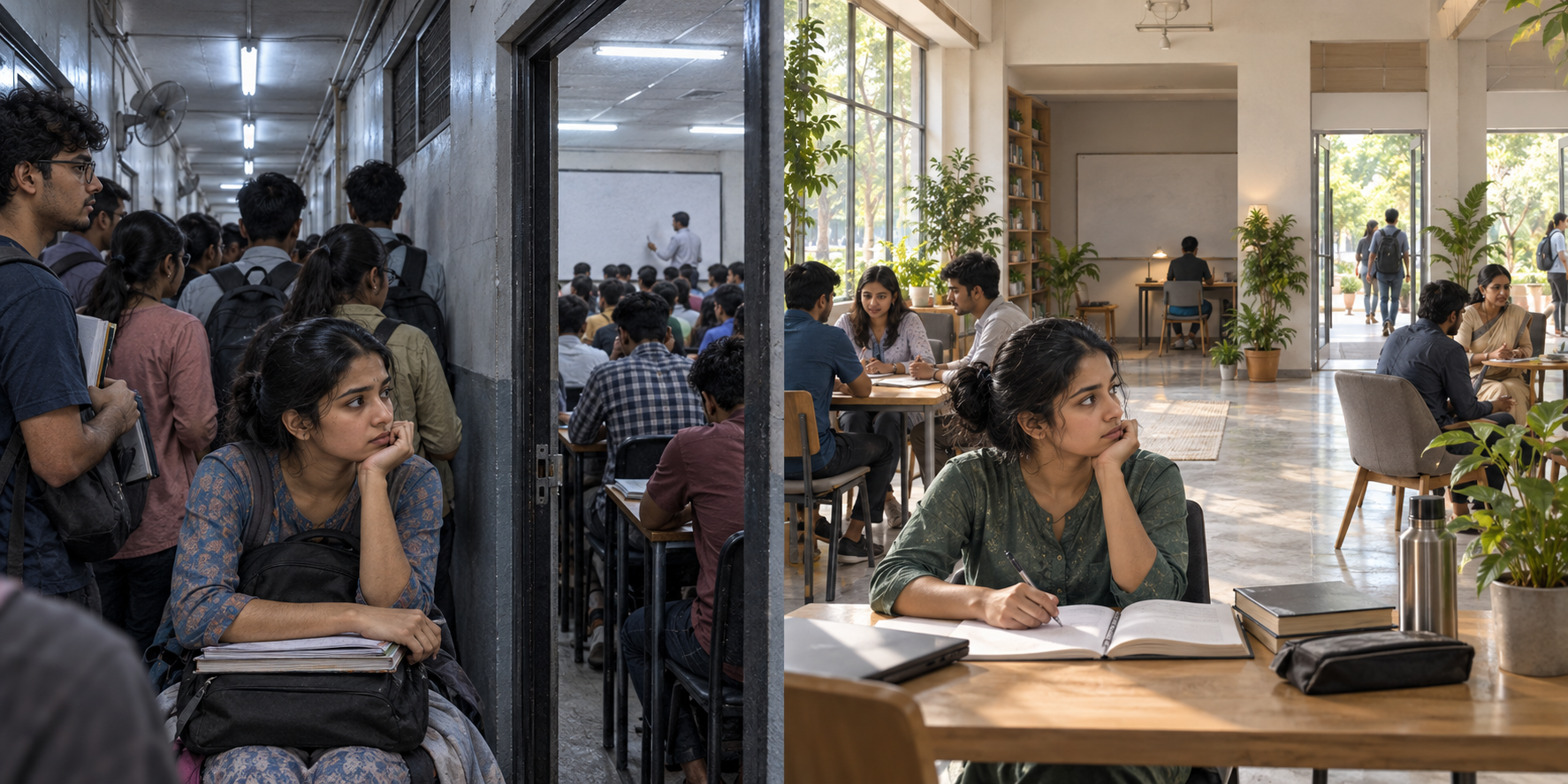
Competitive difficulty alone cannot explain why one educational environment becomes dangerous for a particular student. CA preparation can include work in real offices while the student remains at home. The contrast with residential coaching in Kota points toward useful questions about environment, adult contact, and life outside examination preparation.
It does not, by itself, prove that CA students have a lower suicide rate. A comparison of impressions is not a comparison of rates, populations, ages, living arrangements, or reporting. Repeating the claim as settled fact would distract from the practical insight: the design of a student’s daily life may matter alongside the difficulty of the examination.
Use the contrast to audit the environment around your child:
- Does the student have daily contact with an adult who is not evaluating academic performance?
- Does the day contain meaningful activity outside test preparation, or has the exam swallowed the whole identity?
- Will someone notice quickly if the student stops attending, communicating, or returning to the room?
- Can the student say “I want to leave” without first proving total collapse?
- Is there a written fallback plan, or does every conversation assume only one acceptable result?
- Does the institute know how to respond to a safety concern, or does it redirect everything to academic counselling?
Every troubling answer identifies a concrete repair. Add a local adult contact. Fix a dependable family check-in. Ask the institute for its escalation procedure. Put alternative courses and timelines on paper. Bring the student home when the living environment itself has become unsafe. Do not wait for a better mock-test score to decide whether the surrounding system is humane.
Key takeaways
- A student’s result is an event, not an identity. Make that distinction explicit before failure or disappointment arrives.
- Direct talk of suicide, a plan, or access to lethal means requires immediate safety action and qualified help. Spiritual practice must not replace emergency or clinical care.
- Begin at home because it is the first environment a family can change, not because every suicide can be reduced to parental blame.
- Give the student visible exits: pausing, returning home, changing accommodation, changing course, or changing the examination plan.
- Institutes must connect welfare promises to reachable people, physical checks, safe reporting, and clear escalation.
- Use comparisons between educational pathways to examine daily-life design. Do not present an unverified difference in suicide rates as fact.
- A dharmic response assigns responsibility to every actor with power: family, institution, government, and public culture.
Before the next mock test, rank list, or result, have the conversation that pressure usually postpones. Tell the student which doors remain open. Ask directly about safety. Save the contact details of the people who can help. The most important change is not another lecture on resilience; it is making sure the student no longer believes that one result can close every path home.
References

Leave a Reply
You must be logged in to post a comment.