
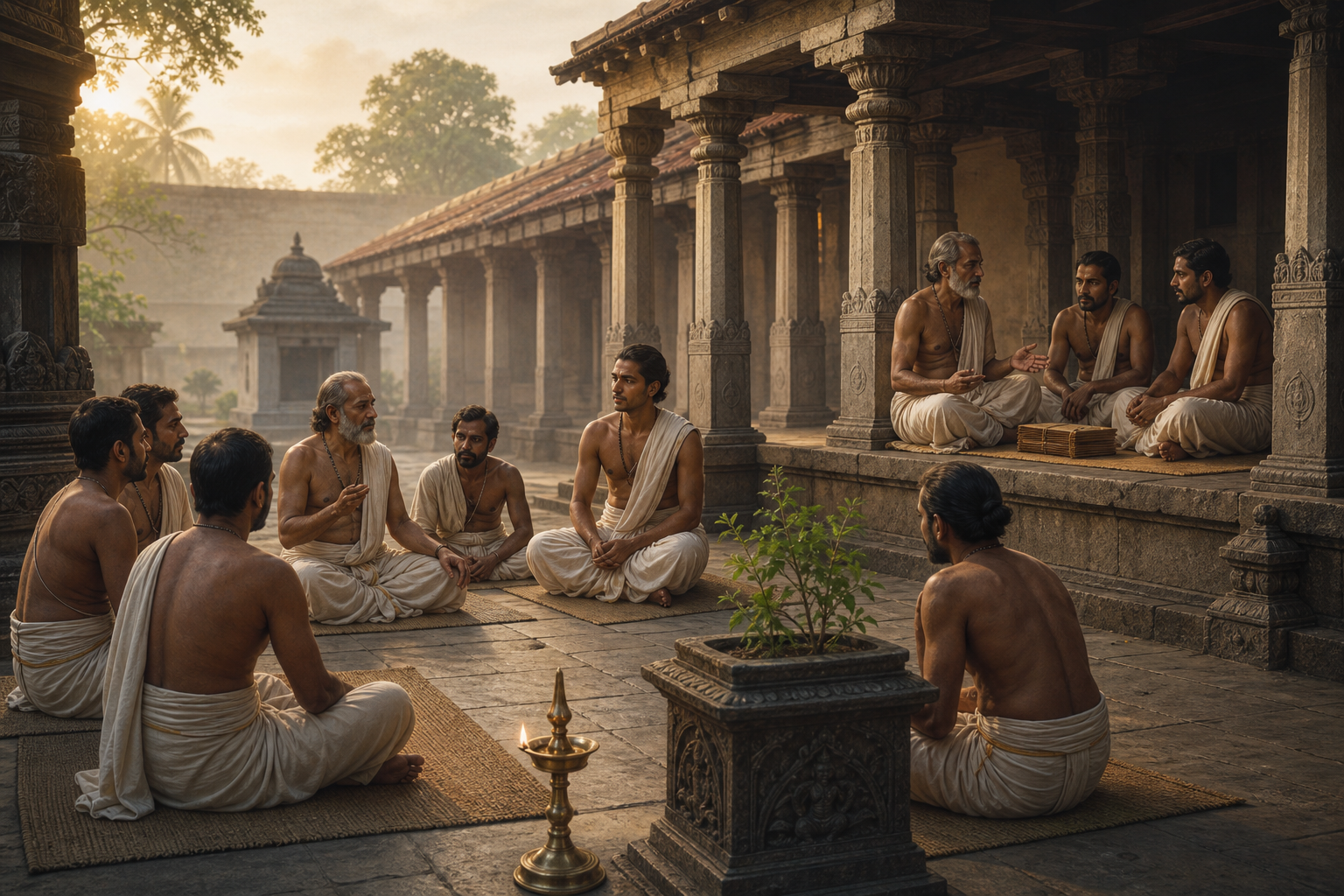
If you want to study Dharma seriously, you may feel pulled between exact recitation and philosophical inquiry. Should you first learn to reproduce sacred words faithfully, or should you begin by asking what they mean?
Vedic recitation and Dvaita scholarship show why this is the wrong choice to force. They train different capacities. One disciplines the voice, ear, memory, and continuity of transmission. The other disciplines understanding, distinction, reasoning, and devotional expression. Your task is to enter through the right doorway and then let both kinds of discipline correct you.
Key takeaways
- Begin with guided oral instruction when your aim is accurate Vedic recitation. A recording can help you review, but it cannot hear and correct your mistakes.
- Begin with a text-based teacher when your aim is to understand Dvaita claims, distinctions, arguments, and their consequences for devotional life.
- Keep recitation practice and interpretation study distinct enough that you can identify which skill is being corrected.
- Measure progress by what you can reproduce accurately, explain clearly, and apply responsibly, not by how much material you have encountered.
- Treat advanced recitational achievements as evidence of a mature teaching tradition, not as templates for unsupervised imitation.
- Support teachers, students, temples, and learning institutions if you want sacred knowledge to remain a living inheritance rather than archived information.
Choose the doorway that matches what you need to learn
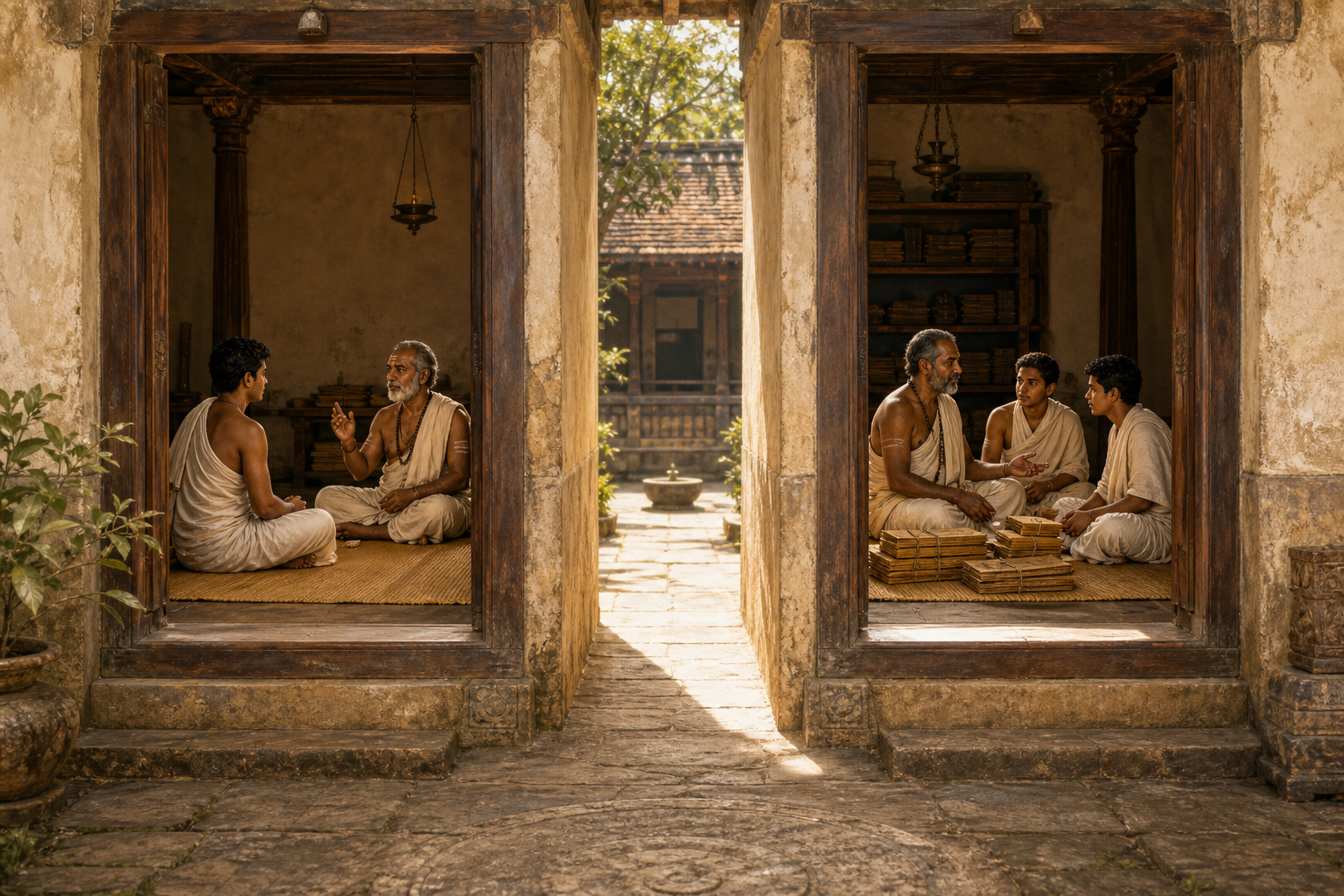
Vedic recitation and Dvaita are not competing labels for the same activity. Vedic recitation is a discipline of receiving and transmitting sacred utterance. Dvaita is a philosophical sampradaya associated with Madhvacharya. A Dvaita student may study Vedic materials, while a Vedic reciter ordinarily learns within a particular lineage and interpretive setting. The categories overlap in lived Hindu tradition, but they are not interchangeable.
This distinction matters because an unsuitable method can create false confidence. Reading a transliteration does not establish recitational accuracy. Memorizing philosophical vocabulary does not establish understanding. Feeling devotional emotion does not, by itself, settle either question.
| What you want to be able to do | Appropriate starting point | Evidence of real progress |
|---|---|---|
| Recite a Vedic passage accurately | Oral instruction from a qualified teacher who can demonstrate and correct | You can reproduce a correction consistently without being prompted through it |
| Understand a Dvaita teaching | Guided study of an identified text, its terms, and its reasoning | You can state the claim, preserve its distinctions, and explain why it matters |
| Build a Sanskrit foundation | Structured study of script, pronunciation, grammar, and vocabulary | You can recognize forms and follow the teacher’s analysis instead of guessing from familiar-looking words |
| Enter devotional literature responsibly | A hymn or poem selected with its philosophical and linguistic context | You can appreciate the expression without treating poetic fluency as proof of doctrinal mastery |
Before joining a course or adopting a daily routine, write down the capability you actually seek. Use a sentence such as, “I want to recite this passage under correction,” or, “I want to understand this Dvaita claim well enough to explain its reasoning.” A precise intention helps a teacher place you correctly and prevents you from mistaking exposure for attainment.
Vedic recitation trains fidelity before self-expression
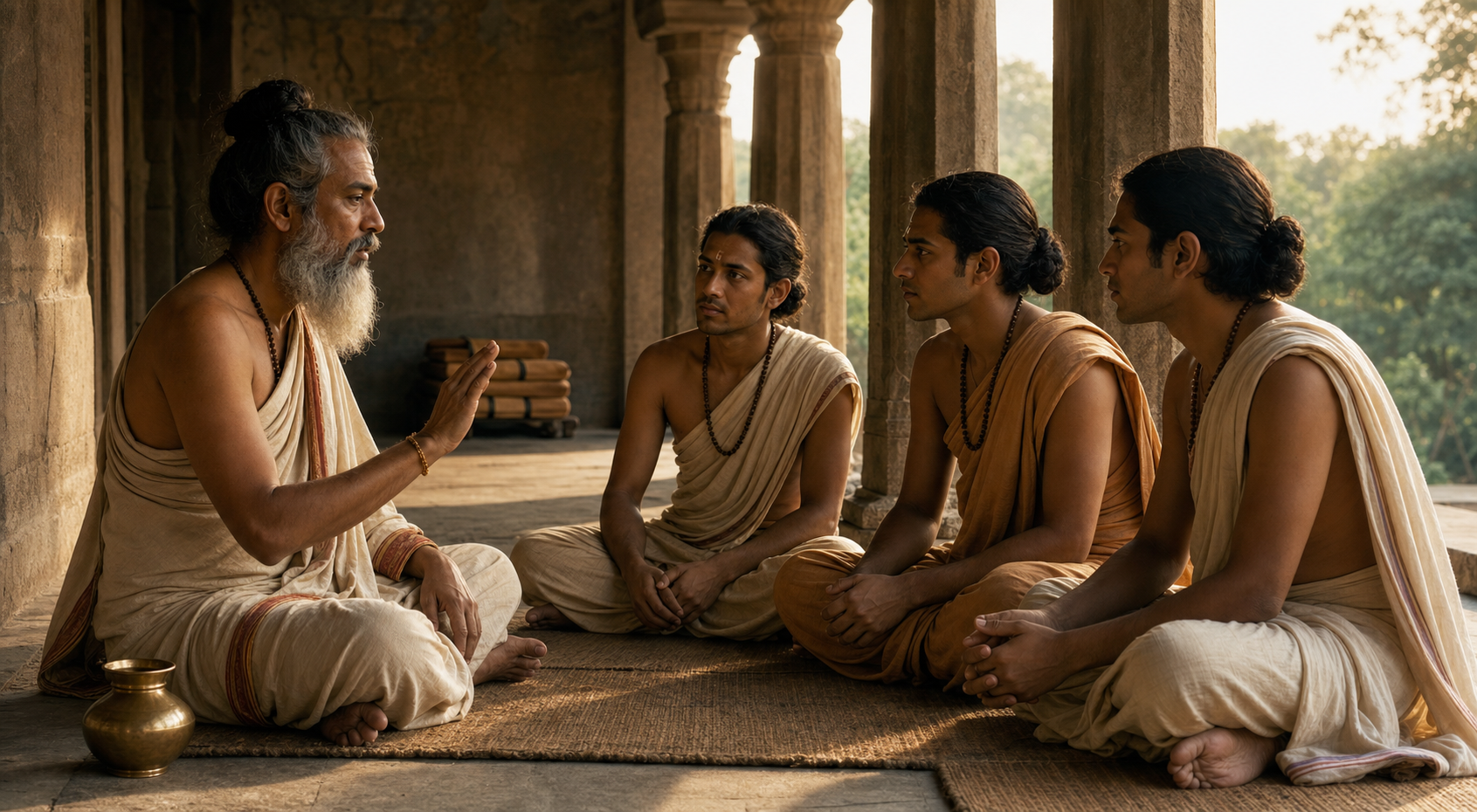
Ordinary education often rewards a student for paraphrasing, improvising, or making material sound personal. Advanced Vedic recitation places a different obligation first: preserve what has been received. The student’s creativity must not quietly alter the sound, cadence, sequence, or continuity entrusted to the lineage.
The rigor becomes visible in the Dandakrama Parayana completed in Kashi by Shri Devavrat Mahesh Rekhe at the age of 19. The recitation continued for 50 consecutive days and revived a rare practice in the city after nearly two centuries. Its difficulty lay not merely in endurance, but in maintaining textual fidelity, Sanskrit phonetics, prosodic accuracy, cadence, and ritual continuity throughout the undertaking.
That achievement should change how you look at memorization. Sacred memory is not mechanical storage. It is trained responsiveness. You hear a received form, attempt it, accept correction, reproduce the corrected form, and retain it without allowing the earlier error to return. Memory becomes trustworthy through repeated correction, not through repetition alone.
If recitation is your path, build your practice around a correction loop:
<!– wp:list {