
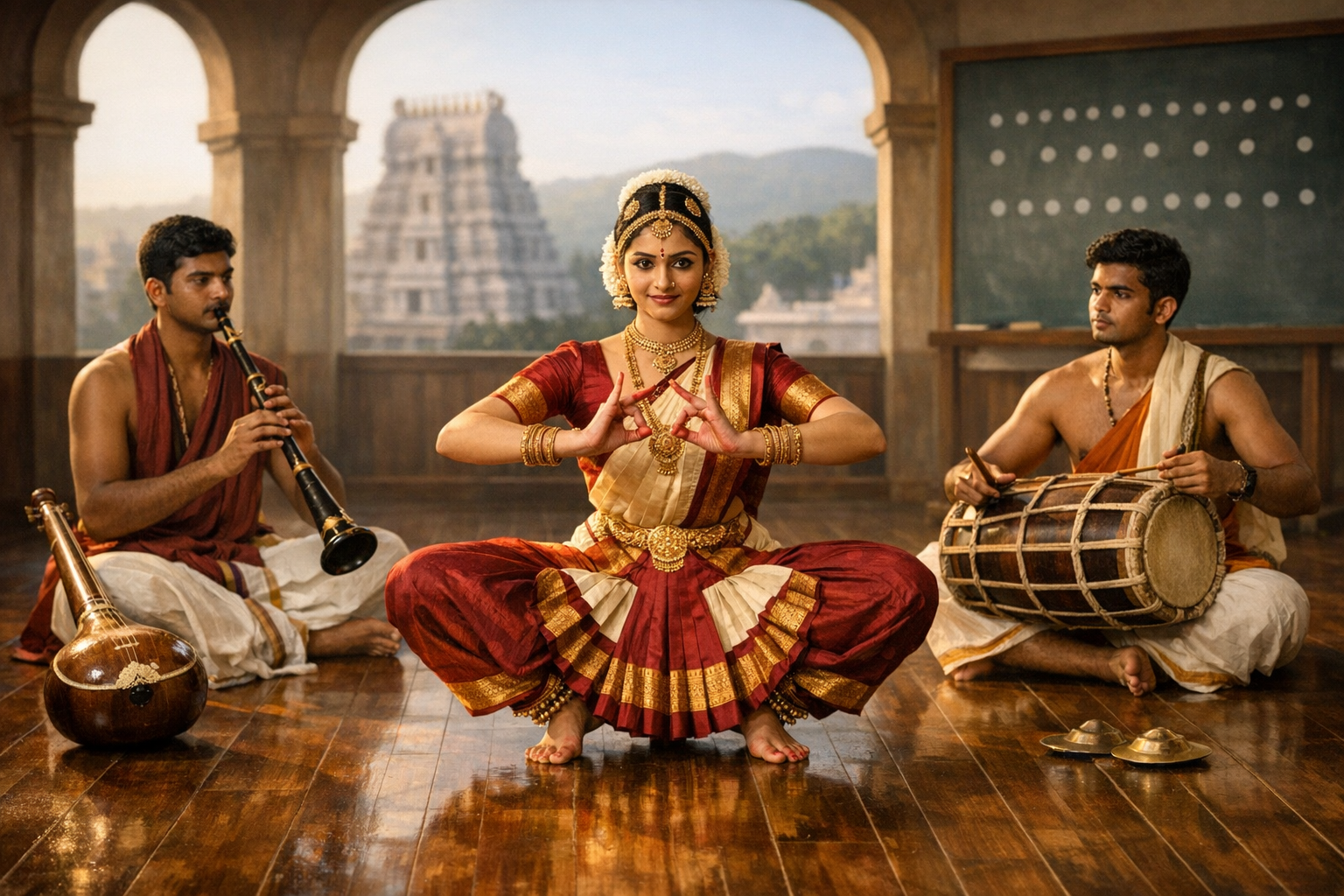
Applications are invited for the academic year 2026–27 to Sri Venkateswara Music and Dance College and SV Nadaswaram & Dolu School in Tirupati, institutions administered by Tirumala Tirupati Devasthanam (TTD). The call covers admissions to a spectrum of regular and part-time courses that nurture proficiency in classical music, classical dance, and traditional temple instruments, with a focus on rigorous training and cultural stewardship.
These TTD-run institutions have long served as vital custodians of South India’s temple arts ecosystem, sustaining standards in performance and pedagogy while cultivating the next generation of practitioners. Training in vocal music and instrumental streams aligns organically with dance repertoires, while special emphasis at SV Nadaswaram & Dolu School strengthens living traditions central to temple worship and community celebrations across Andhra Pradesh and beyond.
The 2026–27 admission cycle spans multiple pathways, typically including foundation, certificate, diploma, and part-time formats designed for diverse learner profilesschool and college students, working professionals, temple artists, and serious hobbyists. Program structures generally integrate theory (śāstra) and practice (prayoga), preparing learners for both stage performance and the liturgical responsibilities associated with temple and community contexts.
Eligibility norms usually differentiate between beginners and advanced entrants. While prior training is an advantage for higher-level placement, introductory pathways commonly welcome motivated beginners with musical aptitude or dance readiness. Dance applicants are expected to demonstrate physical fitness and rhythm awareness; instrument students benefit from basic familiarity with fingering/embouchure; and vocal applicants are typically assessed for śruti alignment, tonal stability, and rhythmic perception. Applicants from all dharmic communitiesHindu, Buddhist, Jain, and Sikhare encouraged, reflecting the shared Indic aesthetic of nāda (sound), laya (tempo), and rasa (expressive sentiment) that unifies these traditions.
Application forms are to be obtained and submitted strictly as per TTD’s official notification and prospectus for 2026–27. The standard process commonly involves: accessing the official admission notification; procuring the application form (online or at designated counters, as notified); completing accurate personal and academic details; enclosing supporting documents; paying the prescribed application fee; and following instructions for screening tests or auditions. All dates, fee amounts, and modalities will be as notified by TTD in its official communication channels.
A typical document checklist includes: proof of age and identity; recent passport-sized photographs; academic transcripts/certificates; caste/community certificates if applicable under prevailing norms; prior training or grade certificates in music/dance (if any); a brief repertoire list; and a medical fitness note for dance-focused applicants. Employed candidates may be asked for a No-Objection Certificate, depending on course timing and intensity.
Selection is commonly audition-based, with discipline-specific assessments. Vocal and melodic instrument applicants are often evaluated for śruti alignment, swara articulation, rāga identification, alapana readiness, and laya stability. Percussion applicants (including Dolu) may be tested in sollukattu recitation, nāḍai transitions, kālai/eduppu awareness, and execution of mora/korvai patterns. Dance applicants are typically assessed on adavu precision, araimandi alignment, tāla comprehension, abhinaya acuity, and familiarity with margam items (e.g., alarippu, jatiswaram, śabdam, varnam, padam, tillana) at an appropriate level. Theory components can include questions on tāla-śāstra, rāga-lakṣaṇa, sahitya diction, and performance ethics.
Curricula in these institutions generally balance performance training with complementary knowledge systems. Learners engage with compositions (varṇams, kritis, padams, javalis), sahitya pronunciation, regional languages relevant to repertoire (often Telugu and Sanskrit), stagecraft, basic pedagogy, and ensemble skills. In temple-oriented streams (notably Nadaswaram & Dolu), pedagogy usually emphasizes repertoire appropriate to processions, rituals, and community events, thereby aligning technical mastery with cultural responsibility.
Facilities at such TTD institutions typically include practice halls, access to instruments for training, a reference library, and performance opportunities synchronized with TTD’s cultural calendar. Exposure to temple and community stages often accelerates professional growth, allowing students to internalize the demands of live performance and service. Details of infrastructure, hostels, and financial assistance opportunities (if any) are confirmed in the official prospectus each year.
Graduates commonly pursue roles as temple musicians and dancers, accompanists, solo performers, instructors, cultural curators, and community arts coordinators. Many continue into research, archival projects, and arts administration, while others build independent studios and digital platforms. The training modelrooted in śruti-laya discipline and repertoire depthequips learners to contribute meaningfully to India’s cultural heritage economy.
Preparation for auditions benefits from a systematic regimen: steady tāla practice with metronomic support; daily voice/instrument sādhanā emphasizing sruti stability and gamaka nuance; repertoire polishing with attention to diction and bhava; and stamina-building for dance footwork and adavus. Instrument maintenance, vocal hygiene, and mindful rest on the day before auditions frequently improve performance outcomes. Prospective candidates also find value in mock auditions and constructive feedback from mentors.
Key timelinesapplication window, last dates, audition schedules, publication of merit lists, and reporting dateswill be specified in TTD’s official notification for 2026–27. Applicants are advised to read the prospectus thoroughly, adhere to instructions on file naming and document upload (if online), and retain acknowledgement receipts. Any reservations, fee concessions, or special provisions are implemented as per TTD and Government of Andhra Pradesh norms in force.
Academic integrity, attendance, and code of conduct are integral to progression. Evaluation commonly combines internal assessments, practical juries, and end-semester examinations, culminating in stage demonstrations or recitals appropriate to the course level. The learning environment affirms unity among dharmic traditions by celebrating shared philosophies of devotion, discipline, and compassion, thereby positioning the arts as a bridge across communities.
For 2026–27, this admission call offers a timely pathway to rigorous training in temple artsmusic, dance, Nadaswaram, and Doluat the heart of TTD’s cultural mission in Tirupati. Candidates seeking structured, scholarship-grounded pedagogy with real-world performance exposure should follow the official TTD channels for the prospectus, dates, and application form, and prepare auditions with methodical focus. This is an opportunity to learn, serve, and sustain India’s intangible cultural heritage with technical excellence and cultural humility.
Inspired by this post on Hindu Pad.
