

If a clinic asks you to join a clinical trial – or a research team asks you to introduce one to Sikh families – you need more than an assurance that the work may help people. You need to know whether this particular trial deserves trust.
Sikh ethics can help you make that judgment. Seva and sarbat da bhala give clinical research a compelling purpose, but they do not excuse weak consent, avoidable harm, selective recruitment, or careless science. Ethical participation joins service to free choice, honest uncertainty, justice, and scientific discipline.
Key takeaways
- Seva can be a sound reason to participate, but participation must remain voluntary. A request from a clinician, family member, or respected community leader must never become moral pressure.
- A participant should understand the trial’s purpose, alternatives, burdens, risks, possible benefits, uncertainties, data practices, and withdrawal process before consenting.
- Language, dietary needs, family involvement, and religious observance affect comprehension, attendance, retention, and data quality. They belong in trial planning, not in an afterthought.
- A gurdwara can support trial literacy and community oversight without endorsing a particular intervention or turning sangat into a recruitment pool.
- Sikh participation also means having Sikh professionals in biostatistics, regulatory affairs, data management, pharmacovigilance, protocol development, and clinical operations.
Seva supplies the motive; consent sets the boundary

Helping to produce knowledge that may benefit others can be a genuine form of seva. Yet seva is not self-erasure. A person does not owe a trial their body, medical information, time, or continued participation simply because the trial has a worthy aim.
Informed consent is therefore more than a signed form. It is a conversation in which the participant receives an understandable account of what will happen, what remains uncertain, what choices exist outside the trial, and what participation could demand. The person must be able to ask questions, consult others, decline, or withdraw without being shamed for placing limits on their service.
One crucial concept is equipoise: there must be genuine uncertainty about which intervention or study arm is preferable. If the experimental option were already known to be better, there would be no ethical basis for assigning some participants elsewhere merely to prove the point. A recruiter who describes an experimental intervention as though it were established treatment hides the uncertainty that makes the trial necessary.
A related danger is therapeutic misconception. This occurs when someone mistakes research for treatment designed specifically around their personal needs. A clinician ordinarily recommends care for a particular patient; a trial follows a protocol so that investigators can answer a general question. The same institution or professional may be involved in both, which makes the distinction especially important. Ask directly which procedures are research-only and which are part of ordinary care.
Family discussion can improve understanding, particularly when the participant wants relatives involved. It cannot transfer the final decision away from a capable adult. A spouse, parent, elder, granthi, or physician may help someone think, but ethical consent must still express the participant’s own choice.
This is where a Dharmic vocabulary becomes demanding rather than decorative. Compassion asks whether suffering is being reduced. Non-harm asks whether avoidable risks and burdens have been removed. Responsibility asks whether the trial can answer its question reliably. The common good asks who may receive the eventual benefit and who is being asked to bear the burden. Hindu, Buddhist, Jain, and Sikh traditions are not interchangeable, but these shared concerns provide strong ground for scrutinizing research rather than blessing it automatically.
Seven questions to ask before joining a trial

Take these questions to the consent conversation and write the answers in your own words. A trustworthy study team should welcome the questions. If an answer remains vague, ask again before signing.
- What exact question is this trial trying to answer? Ask what is experimental, what the comparison group receives, whether assignment is random, and what the researchers genuinely do not know.
- What could happen to me? Separate possible personal benefit from benefit to future patients. Ask about known risks, unknown risks, discomfort, tests, procedures, and what will be monitored.
- What are my choices outside the trial? Ask about ordinary care, other available options, and what happens to your clinical care if you decline. An invitation should not be framed as your only path unless that is genuinely the case.
- What will participation require in daily life? Ask about the number and length of visits, travel, time away from work or family, fasting or dietary instructions, follow-up contacts, and any expenses. A medically acceptable protocol can still be impractical for you.
- Who will use my information? Ask which medical and personal data will be collected, who can access them, how identity will be protected, and whether samples or data may be used for purposes beyond the immediate trial.
- What happens if my condition changes or I am harmed? Ask whom to contact, which symptoms or problems require urgent reporting, what care is available, and how the study team will communicate new risk information.
- How do I leave? Ask what withdrawal involves, which information may already have been collected, whether any safety follow-up is needed, and how ordinary care continues afterward.
Do not stop or alter prescribed treatment merely because a trial has been offered. Discuss treatment changes with your treating clinician and the study team, especially when the investigator also provides your ordinary care. If the consent information is not available in a language you understand well enough for a medical decision, do not rely on politeness or partial comprehension. Request a clear explanation before deciding.
Community enthusiasm is not a substitute for this individual review. A health event at a gurdwara may be a good place to learn that a trial exists, but it should not create pressure for immediate enrollment. Education can be collective; consent must remain personal.
Cultural competence is part of scientific control

Cultural competence is sometimes treated as hospitality: translated material, suitable food, or a familiar community venue. Those things matter, but the scientific consequence goes further. A participant who misunderstands instructions may complete a procedure incorrectly. A person whose dietary needs were discovered too late may miss a visit. A family excluded from a decision that the participant wanted to discuss may lose trust. These operational failures can increase attrition and weaken the reliability of the data.
A research team should build cultural understanding into the protocol and site workflow:
- Ask each participant which language they prefer for complex medical explanations. Do not assume conversational fluency is enough for informed consent.
- Identify dietary practices before scheduling visits or issuing fasting and meal instructions. Explain which requirements are medically essential and which arrangements can be adapted.
- Offer family involvement when the participant wants it, while addressing questions to the participant and protecting their independent decision.
- Ask whether visit times, procedures, clothing requirements, or other logistics affect religious observance. Do not infer an individual’s practice from appearance or surname.
- Provide a named contact who can resolve questions after consent. Understanding can change when a participant encounters the actual schedule, symptoms, or family concerns.
- Record recurring barriers and correct the workflow across the site instead of expecting every participant to negotiate the same accommodation alone.
The aim is not to create a fixed checklist of supposed “Sikh needs.” Sikh communities differ by language, place, generation, personal practice, and family circumstances. Cultural competence means asking good questions without stereotyping, then distinguishing requirements essential to the science from routines that can be changed.
Representation can strengthen trust, recruitment, retention, and data quality, particularly in studies operating across India and the diaspora. It also helps research teams notice bad assumptions earlier. Sikh clinicians, coordinators, statisticians, data managers, and community advisers can influence which questions are asked, how risks are explained, whether burdens are realistic, and how participants are treated after enrollment.
Community partnership must produce oversight, not pressure
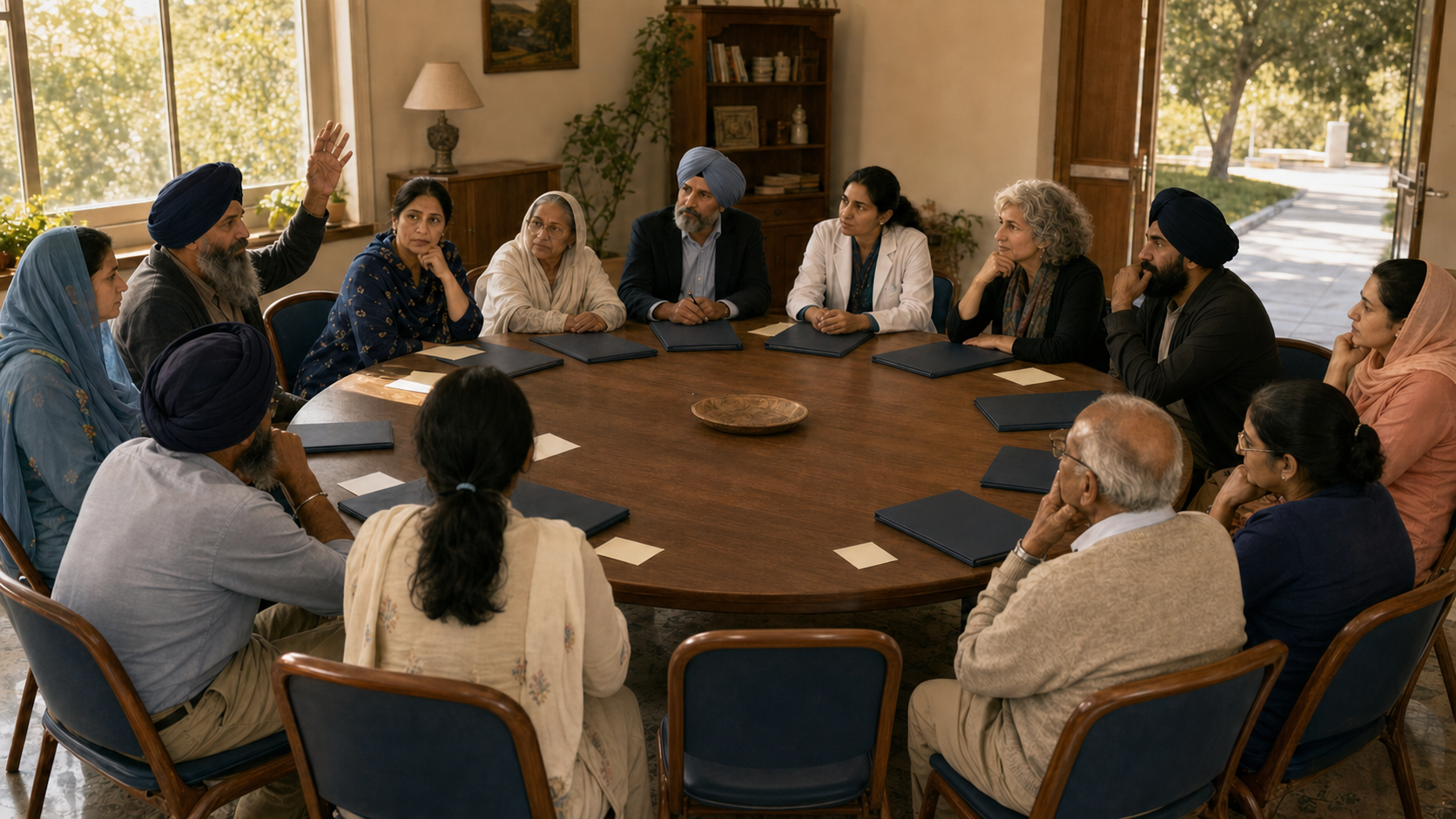
A gurdwara can be an effective setting for health education and trial literacy because it already supports learning, service, and community connection. Its moral standing also creates risk: people may hear permission to share information as an endorsement of the intervention. Leaders and research teams should state the boundary clearly.
- Teach before recruiting. Explain why trials use comparison groups, why uncertainty matters, what informed consent requires, and how research differs from personalized treatment. General literacy should not depend on whether a particular trial is currently enrolling.
- Create community review. A community advisory board can include Sikh clinicians, public-health practitioners, people familiar with local language needs, and community members who are independent of the sponsor. It can examine recruitment wording, visit burdens, consent explanations, dietary issues, and family engagement before outreach begins.
- Protect private choice. Community leaders can host education without collecting names, announcing who enrolled, or suggesting that participation proves generosity or faith. Interested people should be able to contact the study privately after the educational event.
- Keep accountability open. Participants need a route for raising concerns beyond the person who recruited them. Communities lending their trust should also ask how important changes, safety information, and understandable findings will be communicated.
Good Clinical Practice, clear risk-benefit communication, sound data controls, fair participant selection, and safeguards against therapeutic misconception remain essential no matter how culturally familiar the recruitment setting feels. Religious literacy can improve understanding; it cannot repair a weak protocol or excuse compromised data.
Community participation must also reach the workforce. Mentorship, early exposure, internships, and visible role models can open routes into biostatistics, regulatory affairs, data management, clinical operations, pharmacovigilance, trial design, and protocol development. This is not merely a diversity exercise. People working inside the research process shape decisions long before a participant sees a consent form.
If you are a student or early-career professional, choose one technical entry point rather than trying to master the entire field at once. Complete a short Good Clinical Practice course, build working knowledge in your chosen area, and seek practical exposure through a contract research organization or academic medical center. Add communication and stakeholder engagement to the technical training: a correct analysis or compliant protocol still fails participants if nobody can explain it clearly.
If you are a clinician, researcher, or community leader, ask for the consent material and community-engagement plan before lending your credibility to a trial. If you are considering enrollment, carry the seven questions into your next conversation. If you are entering the profession, select a technical lane and begin with Good Clinical Practice. Ethical Sikh participation starts before recruitment, at the point where service is joined to scrutiny.
References
