
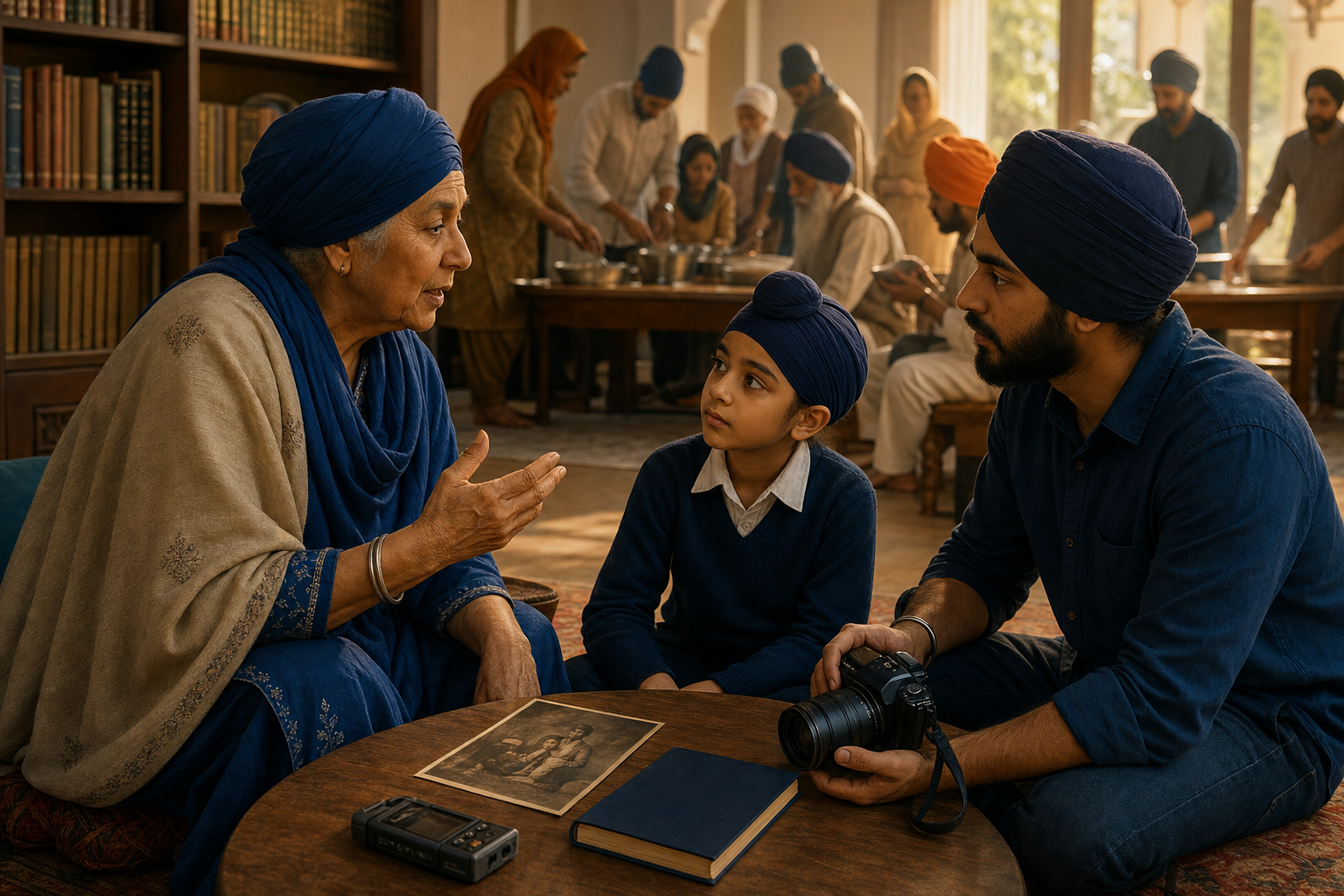
You may be retelling a sakhi to a child, preparing a school lesson, writing a historical scene, or reviewing a video before it goes public. The difficult question is the same: how much can you simplify without turning living Sikh memory into either dry chronology or embellished legend?
Use one governing rule: preserve the moral choice even when you compress the scene. Authenticity does not mean including every available detail. It means keeping four things in honest relation: what happened, what Sikh tradition remembers, what Gurmat teaches, and what your audience can responsibly receive.
Begin with the choice your listener must understand
A Sikh story should leave the listener able to recognize a way of acting. If the lasting impression is only that a Guru possessed extraordinary power, that an enemy was cruel, or that Sikhs were brave, the ethical center has probably been buried beneath spectacle.
Before outlining scenes, write an ethical spine in one sentence:
When __________ is threatened, __________ chooses __________, accepts __________, and acts from __________.
This sentence forces you to identify pressure, agency, cost, and principle. It also exposes weak treatments early. If the blank for principle can only be filled with a vague word such as goodness, heroism, or spirituality, you have not yet found the specifically Sikh reason for the action.
Consider Guru Tegh Bahadur. Sikh memory places his martyrdom within the defence of people facing coercion to abandon their ancestral faith. In 1675, he refused to surrender the principle of conscience and was beheaded in Delhi; Bhai Mati Das, Bhai Sati Das, and Bhai Dayal Das also suffered execution. The usable ethical spine is not simply that a warrior confronted an emperor. It is that a Guru accepted mortal danger rather than consent to the coercion of another community’s faith.
That distinction changes the whole telling. It keeps the focus on freedom of conscience rather than revenge. It explains why the honorific Hind di Chadar, the shield of Hind, belongs to communal memory. It also prevents the episode from becoming an accusation against every member of another religion. The wrong being opposed is compulsion; the person being protected is the other; the discipline governing resistance is freedom from both fear and hatred.
Ask five questions before you develop the plot:
- What pressure makes the right action costly rather than obvious?
- What does the Sikh figure actually do that the listener can observe?
- Which Gurmat principle governs that action?
- Who benefits from the choice, especially beyond the figure’s own family or community?
- What nearby action could the listener imitate without pretending to reproduce a Guru’s historical sacrifice?
The last question matters. A child cannot imitate martyrdom, but the child can refuse to join religious bullying. A student cannot reproduce the founding of Anandpur Sahib, but the student can help build a community in which discipline, hospitality, and courage coexist. A viewer cannot step into seventeenth-century Delhi, but the viewer can notice whether present-day conscience is being defended only for allies or for everyone.
Do not force a neat victory onto an episode whose power lies in faithful action despite worldly loss. Sikh courage is not authenticated by the hero receiving applause, defeating every opponent, or escaping every consequence. Sometimes the resolution is that the person remains inwardly free while outward power does its worst. That is a harder ending, but it is also the one that makes fearlessness morally intelligible.
Keep history, sakhi, and communal memory distinct

The most common authenticity failure is not a malicious falsehood. It is an unmarked shift between different kinds of truth. A date becomes fused with a devotional detail, a later interpretation becomes dialogue, and a cherished version is presented as the only version ever known. The listener is given no way to tell which claim belongs to which layer.
Historical anchors establish the public frame
Names, dates, places, offices, journeys, and observable practices form the historical skeleton. Guru Tegh Bahadur was recognized as the ninth Guru in 1664, founded Chak Nanaki, later Anandpur Sahib, in 1665, and was executed in Delhi in 1675. His compositions in the Guru Granth Sahib emphasize impermanence, detachment, fearlessness, and freedom from greed. These anchors help a listener understand that the ethical teaching belonged to a life, a community, and a political environment rather than to an interchangeable legend.
Historical compression is sometimes necessary, but compression must not become fabrication. You may shorten a journey, omit a minor figure, or combine explanations in narration. You should not invent private motives, exact conversations, or modern slogans and then place them in a Guru’s mouth. If a film uses constructed dialogue, identify it as dramatization in the credits, teaching notes, or accompanying description.
Contested details require precise framing. Instead of saying that every feature of an episode has been independently settled, write or say, “Sikh tradition remembers…” or “A widely told sakhi recounts….” Such language does not belittle tradition. It preserves the difference between inherited testimony and a modern claim of exhaustive verification.
Sakhi carries a virtue through memorable form
A sakhi is not made worthless because versions differ. Its pedagogical task is to make a disposition visible: humility, truthful speech, remembrance, generosity, courage, or protection of the vulnerable. The responsible question is not merely, “Can every detail be proven?” It is also, “What does this version train the listener to admire?”
Miraculous motifs demand particular care. When a well-known sakhi contains one, keep the emphasis on Naam, humility, hukam, or ethical transformation. If wonder becomes the whole point, the Guru is reduced to a wonder-worker and the listener learns to seek spectacle instead of discipline. A miracle should never be enlarged merely because animation, visual effects, or dramatic music can make it more exciting.
Where several versions circulate, you have three honest options: choose one and identify it as a traditional telling; briefly acknowledge the variation; or retain only the ethical core shared by the versions. What you should not do is splice the most dramatic elements together and call the result the definitive account. Transparency about the difference between inspirational sakhi and verifiable historical claim allows devotion and critical inquiry to support one another.
Communal memory shows how an event remains alive
Ardas, kirtan, commemorations, family narration, sacred geography, and honorific names show how a community continues to inhabit an event. Guru Tegh Bahadur’s sacrifice is remembered at Gurdwara Sis Ganj Sahib, associated with the execution, and Gurdwara Rakab Ganj Sahib, associated with the cremation. These places do more than illustrate a timeline. They gather prayer, grief, gratitude, and moral obligation around the memory.
Memory is evidence of enduring meaning. It is not an automatic certificate for every detail in every retelling. Respect it by describing what people do: they remember in ardas, visit a place, sing, use an honorific, tell children why the sacrifice mattered, and connect past courage to present duty. This is stronger than vaguely announcing that an episode is important to Sikhs.
Maintain a four-part claim ledger while you write:
- Historical anchor: a date, person, location, text, or practice you can state directly.
- Attested memory: a claim you introduce as Sikh tradition, a remembered sakhi, a liturgical practice, or a community association.
- Interpretive bridge: your explanation of why the event matters ethically. Mark interpretation with language such as “This reveals…” rather than disguising it as a reported fact.
- Dramatic construction: invented dialogue, a composite character, reordered events, or a compressed timeline. Disclose it wherever the work presents itself as historical.
Put every significant sentence into one of those four rows. If it fits nowhere, remove it or investigate it before publication. That small editorial habit prevents reverence from becoming credulity and historical caution from becoming contempt for inherited memory.
Turn Gurmat vocabulary into decisions people can see

Words such as seva, simran, and hukam often appear in Sikh storytelling as verbal decoration. A character mentions them, a narrator defines them, and then the plot continues unchanged. The listener may remember the vocabulary but never learn what it asks of a person under pressure.
Build scenes around Naam Japna, Kirat Karni, Vand Chhakna, seva, simran, and Sarbat da bhala. Introduce each Punjabi or Gurmukhi term with a gentle contextual gloss, then let its meaning accumulate through repeated action. You do not need to translate the term every time it appears.
- Naam and simran: show a person interrupting panic, vanity, or rage through remembrance before deciding what to do. The point is not that repetition magically removes the problem. It is that remembrance changes the quality of the response.
- Kirat Karni: place honest earning against a tempting shortcut. Let the character refuse deceit even when the dishonest option offers an immediate advantage.
- Vand Chhakna: show sharing before surplus appears. Giving away what is entirely effortless does not reveal the same disposition as sharing food, time, skill, or security when these are limited.
- Seva: choose necessary work without glamour. Cleaning, preparing food, carrying supplies, translating for an elder, or serving an unknown person can reveal more than a speech about selflessness.
- Nirbhau and Nirvair: let a person oppose wrongdoing without becoming ruled by fear or hatred. Fearlessness without non-enmity can turn into aggression; non-enmity without courage can become avoidance.
- Sarbat da bhala: test whether the desired outcome protects the welfare of all or only rewards the protagonist’s own group.
A useful scene therefore contains a dilemma, an inward discipline, an outward act, and a consequence. Do not have the narrator announce the virtue before the listener has watched the character choose it. Let the action carry the teaching, then name the concept in reflection or discussion.
Scripture requires another level of restraint. The Guru Granth Sahib is organized through raag and brings the bani of Sikh Gurus into a sacred musical and dialogical setting that also includes Bhagats such as Kabir, Ravidas, Namdev, and Sheikh Farid. When a story uses Gurbani, distinguish among the original words, a translation, and your commentary. Do not format a paraphrase as though it were a quotation. Do not bend a line into a convenient moral that its context does not support. If pronunciation, transliteration, or meaning is uncertain, obtain review before recording or printing it.
Sound can support this integrity. A refrain may help a child remember a term, while a quiet pause can create room for reflection. Kirtan, however, is not generic spiritual atmosphere. Its relationship to Gurbani, raag, voice, and sacred practice should govern how it is selected, performed, edited, and credited.
Cross-Dharmic storytelling works best after Sikh specificity has been made clear. Sikh commitments to seva, Sarbat da bhala, fearless protection, and non-enmity can enter meaningful conversation with Hindu accounts of dharma, Jain ahimsa and anekantavada, and Buddhist karuna and upekkha. Resonance is not identity. “All religions teach the same thing” erases the very traditions that dialogue is meant to honor.
For a mixed Hindu, Sikh, Buddhist, and Jain audience, use a three-step bridge. First, name the Sikh principle in its own vocabulary and setting. Second, identify a genuine ethical resonance in another tradition. Third, preserve the difference in how each path understands or practices that value. This gives you solidarity without dilution and unity without demanding uniformity.
Run seven checks before you teach, publish, or film
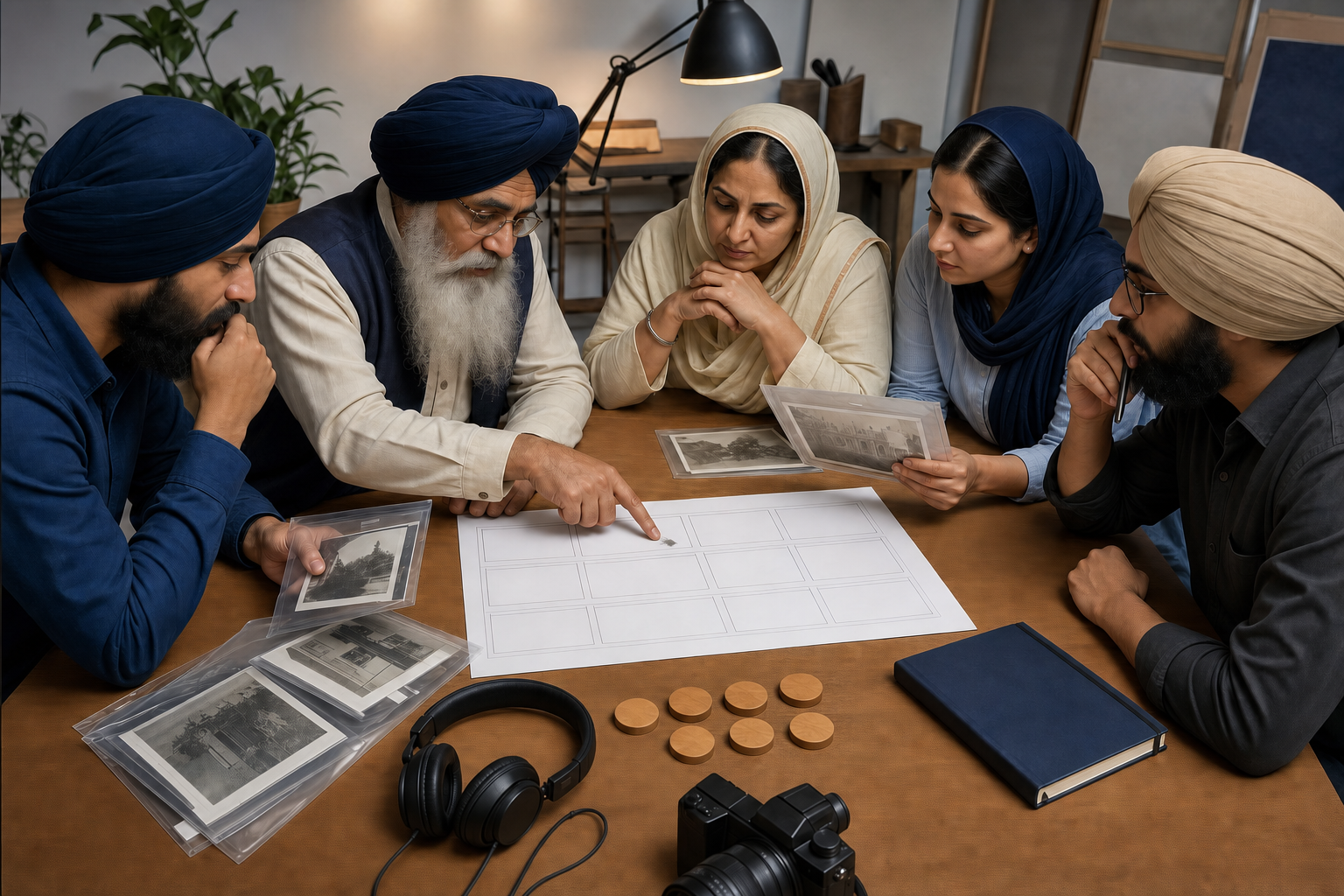
A moving draft can still fail through an invented claim, careless sacred-space scene, distorted Punjabi, or one-dimensional Sikh character. Treat the following seven checks as a release gate rather than optional polish.
- Check the moral center. State the ethical spine in one sentence. Confirm that the decisive action arises from Gurmat rather than from generic bravery, ethnic pride, revenge, or a modern slogan. Ask who is protected, what is risked, and whether the resolution remains consistent with Nirbhau and Nirvair.
- Check every claim’s status. Mark historical anchors, remembered tradition, interpretation, and dramatization in your working notes. Remove invented certainty. If versions differ, acknowledge the variation or choose one transparently. Never invent exact words for a Guru merely to make the dialogue flow.
- Check sacred protocol. Gurdwara scenes require more than familiar visual symbols. Confirm head covering and footwear practice, the handling of sacred space, the placement of people and equipment near the Guru Granth Sahib, and the conduct associated with ardas, kirtan, and langar. Treat the kara and kirpan as articles of faith rather than interchangeable props; the kirpan should express disciplined responsibility, not be staged automatically as a sign of menace. Consult the relevant gurdwara committee or a knowledgeable Sikh adviser when the setting is living sacred space.
- Check language and screen craft. Decide which Punjabi dialect and register each character would actually use. Preserve natural code-switching where it belongs, and verify Gurmukhi, transliteration, subtitles, and pronunciation separately. For screen work, test dastar fabric on the intended camera, watch for moire, avoid close extreme-wide-angle distortion, and handle kirtan recordings and rights with care. Accuracy in a lead role cannot compensate for generic turbans, clothing, or speech among background characters.
- Check the range of Sikh life. Do not make persecution the community’s only narrative function. Sikh characters can be farmers, artisans, parents, athletes, scientists, entrepreneurs, mentors, students, or artists. Give women and men meaningful agency. Remove casteist and gender stereotypes. Let characters experience humor, work, disagreement, fatigue, affection, and ordinary responsibility as well as ceremonial or heroic moments.
- Check what the audience can bear. For young children, preserve the cause, choice, and consequence without lingering on the mechanics of torture or death. Older learners can receive more political context and can be taught explicitly how memory and historical verification differ. When dealing with Partition, the anti-Sikh violence of 1984, or other survivor testimony, obtain informed consent, avoid pressuring people to relive trauma for dramatic footage, and build an appropriate review process. Graphic detail is not proof of seriousness.
- Check access, review, and correction. Provide captions or transcripts, a concise vocabulary note, and formats that remain usable for families with limited bandwidth. Use audio description where visual action carries the ethical meaning. Ask reviewers separate questions about theology, history, language, protocol, and age suitability; one person’s approval should not be treated as expertise in every field. Publish corrections plainly when an error is found.
A story is not ready merely because all seven topics were discussed. Record the answer to each check. Name the reviewer or verification method in your internal notes. Identify unresolved questions. If a serious uncertainty affects what a Guru taught, what occurred in a sensitive event, or how a sacred practice is shown, pause publication or rephrase the scene so that it does not claim more than you know.
Community consultation is most valuable when it happens before expensive choices become fixed. A cultural adviser brought in after casting, location design, costume construction, recording, and editing can identify mistakes but may not be able to repair them. Include informed Sikh voices during outlining, script review, pre-production, and the final cultural-integrity screening.
Consultation should not become a hunt for a single person willing to certify the whole project. Sikh communities contain regional, linguistic, historical, and interpretive differences. When reviewers disagree, identify whether the disagreement concerns fact, maryada, dialect, artistic judgment, or a genuine variation in practice. Then make the choice visible instead of pretending that no difference exists.
Key takeaways
- Write the ethical spine before the plot: pressure, choice, cost, principle, and beneficiary.
- Label history, sakhi, communal memory, interpretation, and dramatization instead of blending them into one voice.
- Show Gurmat through observable decisions; do not use Punjabi vocabulary as decoration.
- Present cross-Dharmic resonance only after preserving Sikh terms, practices, and theological distinctiveness.
- Treat sacred protocol, language, trauma, casting, accessibility, and correction as parts of authenticity, not production extras.
- Measure success by what the listener can recognize and practice, not by how grand the hero appears.
For your next story, make a single working page containing the ethical spine, the four-part claim ledger, the Gurmat vocabulary the audience will encounter, and the seven release checks. If a dramatic line cannot survive that page, change the line rather than bending history or tradition around it. That discipline is how inherited memory remains trustworthy enough to guide another generation.
References
- SikhNet – Re-reading Guru Tegh Bahadur: A Fearless Beacon of Religious Freedom and Dharmic Unity
- SikhNet – Sikhi Through Story: Evidence-Based, Gurmat-Aligned Narratives for a Dharmic Unity Vision
- SikhNet – Bringing Sikh Stories to Screen: Authentic Representation, Dharmic Unity, and Cultural Power