

You open the Tarkasamgraha because you want to understand Hindu logic, but its compactness creates an immediate problem: a short line can contain a definition, a classification, and the beginning of an argument. If you read it like ordinary prose, the words pass before the relationships become clear.
The better approach is to treat the text as intellectual training. Your first task is not to master an entire philosophical system or win a debate. It is to learn how to define a term precisely, place it correctly, follow an inference, and explain your reasoning without hiding uncertainty.
What the Tarkasamgraha is designed to teach you
Annambhatta was a philosopher and logician who came from Andhra Pradesh and flourished in the latter part of the 17th century. His enduring achievement was pedagogical: he gave beginners a concise route into Hindu logic through clear Sanskrit, orderly definitions, classification, inference, and argumentation.
That purpose should determine how you read. The Tarkasamgraha is a primer, not a collection of independent reflections to browse at random. Each distinction prepares you to understand another distinction. A familiar-looking word cannot safely be replaced with whatever it means in casual speech, and a list of categories is not merely a list to memorize. You need to notice the principle that separates one category from another.
Set three practical goals for your first encounter with each unit:
- State the central term without relying on another vague word.
- Show where that term belongs in the classification being presented.
- Reconstruct the movement from a reason to a conclusion in your own words.
If you cannot yet do one of these, you have found the place to reread. That is useful evidence, not failure. A primer exposes gaps early so they do not become confusion in a more advanced work.
The text’s wide circulation beyond its region also matters. Annambhatta’s writing crossed regional boundaries and served generations of learners, showing how compact Sanskrit instruction could sustain a shared scholarly culture across Bharat. You are therefore approaching a teaching instrument that proved portable, not an isolated historical curiosity.
A practical method for reading one passage at a time

Do not measure progress by pages completed. Measure it by distinctions you can preserve after the book is closed. Work with one compact passage or one connected cluster of terms, then use the following sequence.
- Mark the technical vocabulary. Circle or record every word that appears to carry a defined meaning. Do not assume that recognition equals understanding.
- Find the defining feature. Write what makes the thing what it is. If your note merely repeats the Sanskrit term in English letters, you have copied a label rather than understood a definition.
- Map the classification. Draw the parent category above its subdivisions. Use branches rather than a sentence when the passage is organizing several kinds of things.
- Track the inferential movement. Write the conclusion, the reason offered for it, and the connection that is supposed to make the reason relevant.
- Test the boundary. Ask what would fall outside the definition, what nearby idea might be confused with it, and which additional fact would weaken your interpretation.
- Explain it with the book closed. Give a brief account without saying “it is obvious” or “it is basically the same.” Reopen the text and correct what your explanation blurred.
A four-line notebook entry is enough for each term: its name, its defining feature, its relation to another category, and one unresolved question. This format keeps uncertainty visible. It also prevents a long page of notes from giving you the false impression that you have understood what you merely transcribed.
Keep Sanskrit terms beside any English gloss you use. An English word can help you enter the discussion, but it may carry associations that the technical term does not. Retaining both lets you revise the gloss without losing the original conceptual address.
Build three habits: definition, classification, and inference

Read a definition as a boundary
A definition does more than supply a meaning. It tells you what must be present for a term to apply and, by implication, what does not belong under that term. When two definitions seem nearly identical, compare their limiting features word by word. The important difference is often carried by the phrase you were tempted to skip.
Use a simple diagnostic: replace the term in the passage with your own definition. If the sentence becomes circular, broader than the original, or dependent on an unexplained synonym, revise your note. Precision here saves effort later because arguments built on a blurred definition cannot become clear at the conclusion.
Turn classifications into visible maps
Classification can look like memorization when it is left on the page. A diagram reveals the intellectual work. Put the most general category at the top, draw each stated subdivision below it, and annotate the feature responsible for every split.
Then ask two questions. Do any branches appear to overlap? Does the passage present a complete division, or only the divisions needed for the immediate discussion? Do not assume either answer. The point is to identify exactly what the classification establishes and what it leaves open.
Reconstruct an inference before evaluating it
Many disagreements become disorderly because someone attacks a conclusion before stating the reasoning that produced it. Train yourself to separate four elements: the claim being established, the basis offered, the connection between basis and claim, and the circumstance that might defeat that connection.
First reconstruct the strongest clear version you can justify from the passage. Only then ask whether you accept it. This order matters. It keeps criticism directed at the actual reasoning rather than at a weaker position created by haste.
Annambhatta’s lucid and economical presentation has long made the Tarkasamgraha a trusted starting point for structured inquiry. Its simplicity should therefore change your pace, not lower your standards. Slow down wherever a compact expression performs several logical jobs.
Use Hindu logic for careful Dharmic conversation
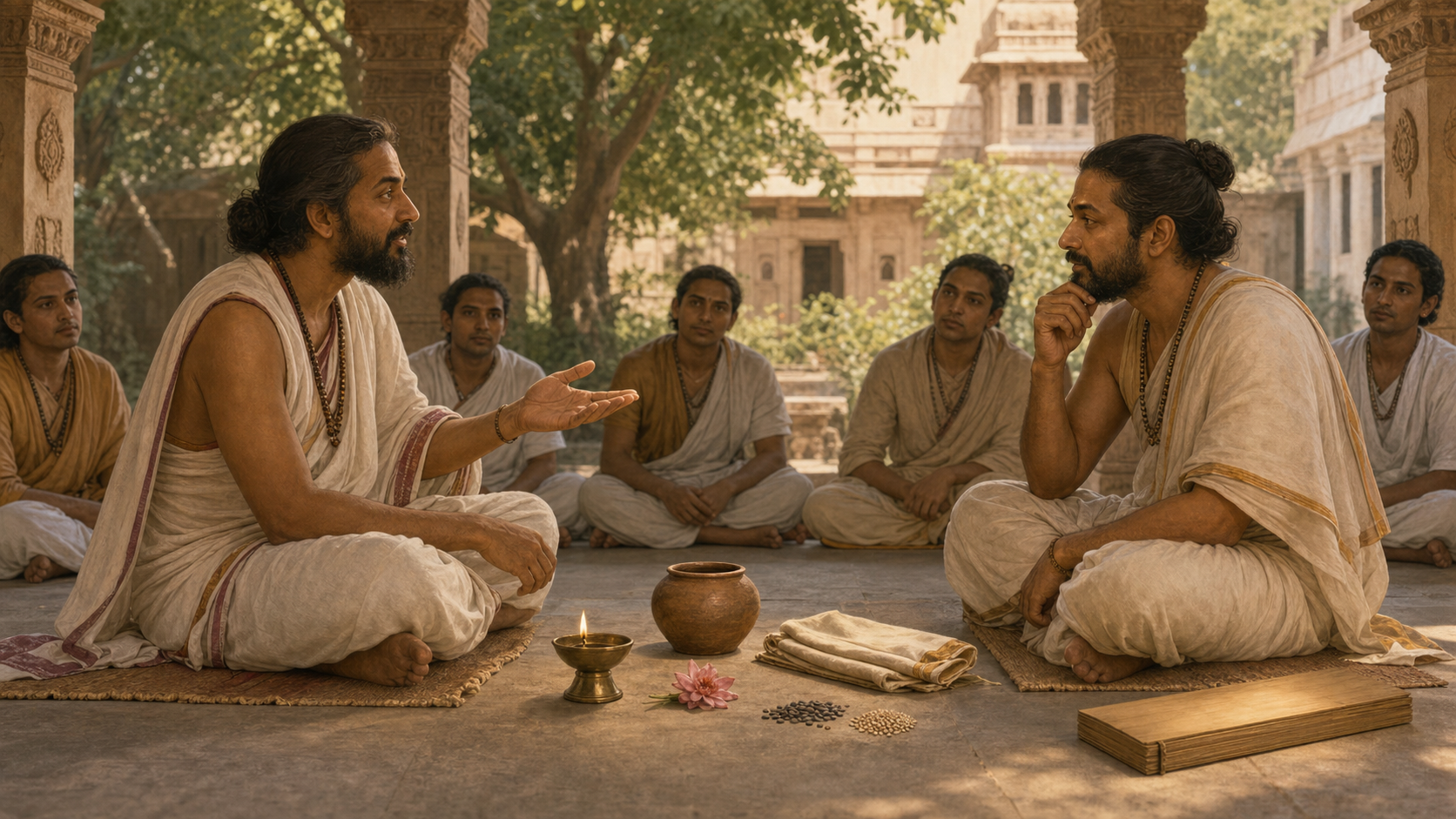
Logic does not replace sadhana, scriptural study, ethical discipline, or the guidance proper to a tradition. It performs a different service: it helps you notice what a claim means, what supports it, and where disagreement actually begins. That service is especially valuable when Hindus, Buddhists, Jains, and Sikhs discuss questions that sound shared but are framed differently within their respective traditions.
Do not use resemblance as proof that two teachings are identical. Shared civilizational settings and overlapping concerns can support dialogue without erasing distinct doctrines. A disciplined comparison follows a narrower sequence:
- Name the precise question under discussion.
- State each tradition’s relevant claim in its own vocabulary before translating it into a common vocabulary.
- Separate a shared question from a shared answer.
- Identify the kind of reason each position accepts as support.
- State the agreement or disagreement no more broadly than the evidence permits.
This method protects both unity and diversity. It lets you recognize a common culture of serious inquiry while refusing the lazy claim that every Dharmic path says exactly the same thing. A clearly located disagreement is more respectful than a superficial harmony produced by redefining everyone’s terms.
The same discipline improves ordinary debate. Before answering another person, state their proposition in a form they would recognize. Ask which premise you reject. If the real problem is an undefined term, resolve that before multiplying arguments. Intellectual humility here is not hesitation about truth; it is refusal to claim more than your reasoning establishes.
Key takeaways
- Approach the Tarkasamgraha as a training text, not as material to skim for isolated conclusions.
- Study one connected unit at a time and preserve the relationship among its terms.
- Keep the Sanskrit term beside your provisional English gloss.
- Turn classifications into diagrams so that every division and boundary becomes visible.
- Reconstruct an inference fully before accepting or criticizing its conclusion.
- Use precise reasoning in inter-Dharmic discussion to clarify genuine kinship without erasing genuine difference.
Your next step can be small. Choose one opening unit, make a four-line entry for each technical term, and explain one distinction with the book closed. When you can do that without vague substitutes, move forward. Annambhatta’s pathway into Hindu logic works through accumulated clarity, one exact distinction at a time.
References
