

If you are trying to decide whether a Mysore campus controversy represents principled reform or factional power, start with a harder question: what happens to a dissenter after the slogans end? A healthy intellectual movement can survive scrutiny, share institutions and let students continue learning. A faction sustained by patronage needs loyalty, recurring confrontation and enemies who cannot be allowed a fair hearing.
This distinction matters because ideological capture rarely calls itself capture. It arrives under respectable names: literary renewal, social justice, rationalism, tradition, equality or progress. Any of those causes may be sincere. The test is whether evidence governs affiliation or affiliation governs evidence. Mysore’s academic history gives you unusually clear warning signs, as well as a Dharmic way to resist them without denying real grievances.
The first distinction: conviction is not factionalism
Strong convictions do not make a scholar sectarian. Nor do anger, protest or membership in an ideological school. Factionalism begins when a group stops treating ideas as claims to be tested and starts using them as badges that determine who may speak, teach, publish, receive patronage or belong.
Three changes usually reveal the transition:
- The speaker replaces the argument. A claim is accepted or rejected by caste, camp, mentor or political identity before its evidence is considered.
- Mentorship becomes patronage. Guidance and opportunity flow primarily to loyal disciples, while independence carries professional or social penalties.
- A dispute becomes permanent mobilisation. Resolving the stated grievance is no longer enough because the network needs another confrontation to display its relevance.
This is why the labels attached to a faction tell you less than its operating method. A socialist, traditionalist, rationalist, caste association, literary circle or religious group can all behave honourably. Any of them can also become cultic if loyalty overrides evidence and institutional rules. Here, cultic does not mean religious devotion. It means an intellectual circle organised around protected authority, ritualised allegiance and punishment of internal doubt.
Before choosing a side in a campus dispute, apply a process test rather than a politics test. Can a member accurately state an opponent’s position without ridicule? Are appointments, awards and opportunities governed by rules known before the outcome? Can the conflict end if the demand is met? If the answer is repeatedly no, you are probably looking at factional power rather than ordinary disagreement.
Mysore’s shift from mutual correction to managed conflict
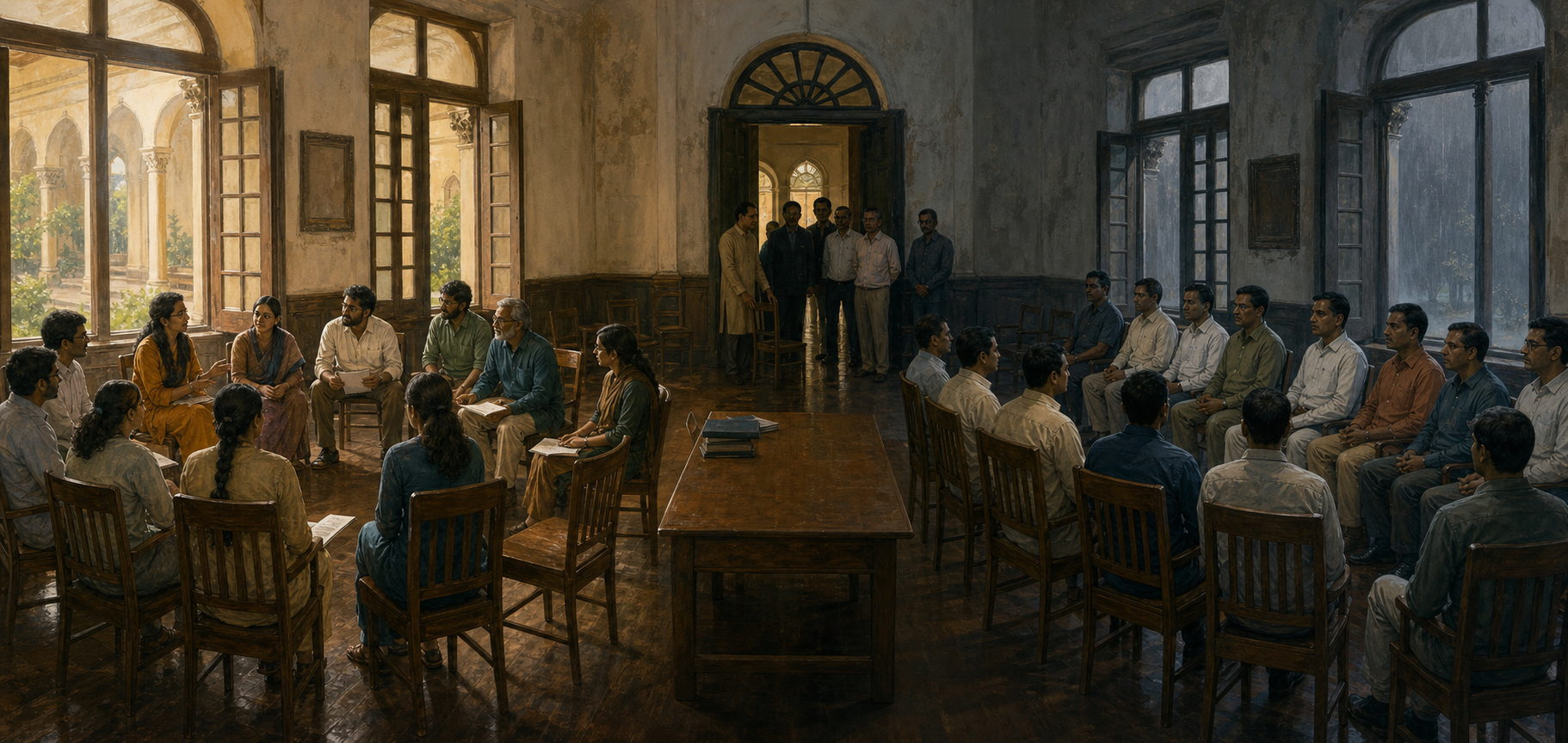
In A.N. Murthy Rao’s recollection of the Maharaja College Common Room, colleagues formed one another through conversation, friendship and moral accountability. A teacher’s reputation did not rest only on publications or public positions. It also rested on how that teacher behaved before peers who knew his strengths, weaknesses, enthusiasms and temptations.
That culture had a moral architecture. The individual scholar remained responsible for his judgement, but he was not imagined as a self-created celebrity. Friends and elders acted as correctives. When pride or expediency pulled someone towards an ignoble choice, the anticipated judgement of respected companions imposed restraint. Intellectual life was therefore social without becoming tribal: belonging made the scholar more accountable, not less answerable.
Roughly four decades later, B.G.L. Swamy described Manasagangotri as crowded with cult-like circles whose leaders appeared to need a public clash four or five times a year to remain visible. His satire should not be inflated into a census of every teacher and student. It does, however, identify a concrete mechanism that you can examine:
- A teacher or influential figure gathers favoured disciples in a private social circle.
- The circle selects or assembles a list of grievances.
- Messages and slogans prepare the wider campus to interpret events through the faction’s frame.
- Agitation moves from discussion into disruption, placing ordinary academic life under pressure.
The decisive change is not that students protested. Protest can be justified. The danger lies in manufacturing unrest from above while presenting it as spontaneous moral awakening from below. It turns teaching authority into political leverage and makes students instruments in contests whose rewards may flow to patrons rather than participants.
No honest reading can turn a satirist’s campus memories into a verdict on every movement or individual. Treat the pattern as a diagnostic model, not a total description. Then ask the question that exposes its cost: who loses when peace itself is treated as a problem? Usually it is the student whose class is suspended, whose examination is disrupted or whose relationship with a teacher becomes conditional on camp loyalty.
How caste, ideology and literary style became one machine

An earlier student-era alignment in Mysore was often described as B and Non-B: Brahmin and non-Brahmin. That broad division did not remain stable. It splintered into narrower caste and subcaste blocs, while socialist, rationalist, progressive, communist, Marxist and Lohiaite affiliations added ideological layers.
This was not a simple replacement of caste by ideology. Old social boundaries and new political vocabularies could reinforce one another. A faction might speak in universal terms while distributing trust, access and patronage through a much narrower network. Another might defend inherited culture while shielding its own social advantages from scrutiny. You therefore cannot identify factionalism merely by listening for left-wing or traditionalist words. You have to compare universal claims with actual conduct.
Mysore was also part of a wider change. From the mid-1960s, left-of-centre currents gained strength on Indian campuses, while caste-centred politics in Karnataka created new alignments and incentives. Within Kannada culture, Navya modernism supplied prestige and a language of rupture. Its mobilising idiom could divide history into an exhausted old age and a morally authorised new one.
That rhetoric can be artistically powerful while remaining politically dangerous when imported unchanged into institutional life. Poetry can compress conflict, intensify emotion and force neglected suffering into public view. University governance must do the opposite kind of work: distinguish cases, test evidence, protect procedure and allow people who disagree to continue sharing an institution.
Bandaya and Dalit assertion became major currents in this landscape. Their emergence should not be reduced to manipulation; anger can carry truthful testimony about humiliation and exclusion. Nor should an abrasive aesthetic be treated as proof of administrative misconduct. The error begins when the moral force of a grievance is used to settle unrelated questions of evidence, appointment, curriculum or permissible disruption.
A useful Dharmic diagnosis is raga-dvesha: attachment and aversion. Attachment makes the success of one’s camp feel identical to justice. Aversion makes an opponent’s defeat feel identical to truth. Prestige anxiety then acquires a moral costume, and resentment becomes a theory of history. The result is a prophetic mentality: a vanguard claims to embody the future, identifies a condemned class or age and treats polarisation as evidence of courage.
This diagnosis is not a command to remain neutral before injustice. It is a warning that a just cause does not purify every tactic used in its name. When you encounter a sweeping campus demand, separate three layers before deciding whether to support it:
- The grievance: What specific injury, exclusion or unfair rule is alleged?
- The interpretation: What evidence connects that injury to the proposed explanation of caste, ideology or institutional power?
- The demand: What precise change is requested, who receives authority from it and what rule will govern comparable cases later?
A genuine grievance can coexist with a weak interpretation or a self-serving demand. Keeping the layers separate lets you support correction without handing a faction permanent control.
A six-step test for any campus controversy

You do not need access to private correspondence to judge whether a controversy is becoming factional. Use publicly observable behaviour and apply the same questions to every camp.
- Write the disputed claim in one neutral sentence. If neither side can agree on what is being disputed, slogans are controlling the discussion. Ask each side to correct the sentence until it can recognise its own position.
- Request evidence that could change a mind. A scholarly position must have some conceivable fact, argument or procedural finding that would count against it. If nothing could change the conclusion, you are dealing with identity or faith in the faction, not inquiry.
- Separate standing from correctness. A person’s caste, experience or history may establish a right to be heard and may reveal evidence others missed. It does not make every inference automatically correct. Conversely, privilege does not by itself make an argument false.
- Trace patronage without drifting into gossip. Look for disclosed facts: mentorship, committee membership, selection power, repeated nominations and professional dependence. Ask whether the same published criteria would produce the same decision if the candidates exchanged ideological identities.
- Inspect the cadence of conflict. Does a new grievance appear whenever the campus becomes quiet? Do recurring mobilisations benefit the same organisers? A pattern of conflict for its own maintenance is more revealing than one dramatic incident.
- Count the cost paid by non-combatants. Record cancelled classes, suspended academic work, intimidation and lost access to teachers. A movement that treats students’ education as expendable should have to justify that cost explicitly, not hide it beneath moral language.
Your role changes how you should use this test. If you are a student, seek at least one mentor who can criticise allies and defend opponents from unfair treatment. If you are a teacher, disclose relevant patronage relationships and give written academic reasons for consequential decisions. If you are reading the history, distinguish observation from interpretation and avoid converting one person’s testimony into guilt by association.
Do not use the test to create another blacklist. Its purpose is to restore argument and procedure. Apply it first to the camp whose conclusions you already favour; otherwise it becomes one more weapon of factionalism.
A Dharmic repair starts with accountable company

The opposite of a faction is not an isolated scholar. It is satsanga: company oriented towards truth and capable of correction. Hindu, Buddhist, Jain and Sikh traditions do not teach identical doctrines, but each offers resources for disciplined association, restraint and responsibility. The relevant contrast is between community that corrects attachment and a clique that rewards it.
Nor is ahimsa an excuse for institutional passivity. Intellectual nonviolence allows forceful criticism, protest and reform. It refuses humiliation as a method, dehumanisation as an argument and disruption as a substitute for proof. Sabhyata, or civility, is not decorative politeness. It is the discipline that makes sustained disagreement possible without turning every appointment, poem or seminar into a battle for social existence.
That ethic needs institutional form. A university cannot rely on personal virtue alone. Selection criteria should be published before candidates are known. Consequential decisions should receive written reasons. Review and committee responsibilities should rotate where practical. Conflicts of interest should be disclosed. Students should have protected ways to raise grievances without becoming dependent on a patron’s private circle. Seminars should require participants to state an opponent’s case accurately before rebutting it.
The most valuable repair may also be the smallest: rebuild relationships across camps before the next crisis. Shared teaching, reading groups and open common spaces make it harder for a patron to monopolise a student’s intellectual world. They also restore the old corrective function of colleagues who can say, with credibility, that a clever tactic is beneath the scholar using it.
Key takeaways
- Judge a campus group by how it treats evidence, dissent and institutional procedure, not by whether its stated cause sounds progressive or traditional.
- Mentorship becomes factional patronage when opportunity depends on loyalty and independent judgement attracts punishment.
- Separate every controversy into grievance, interpretation and demand; strength in one layer does not prove the other two.
- Use raga-dvesha as a self-test before using it against an opponent: attachment to your own camp is the easiest bias to excuse.
- Rebuild scholarly trust through published criteria, disclosed relationships, written reasons and regular intellectual contact across factions.
At the next campus dispute, make a one-page record with five headings: claim, evidence, governing rule, beneficiary and cost to students. If organisers cannot answer those questions without returning to labels, do not lend your voice to the chant yet. Find one person across the divide who will examine the same page with you. That modest act is how a common room begins again.