
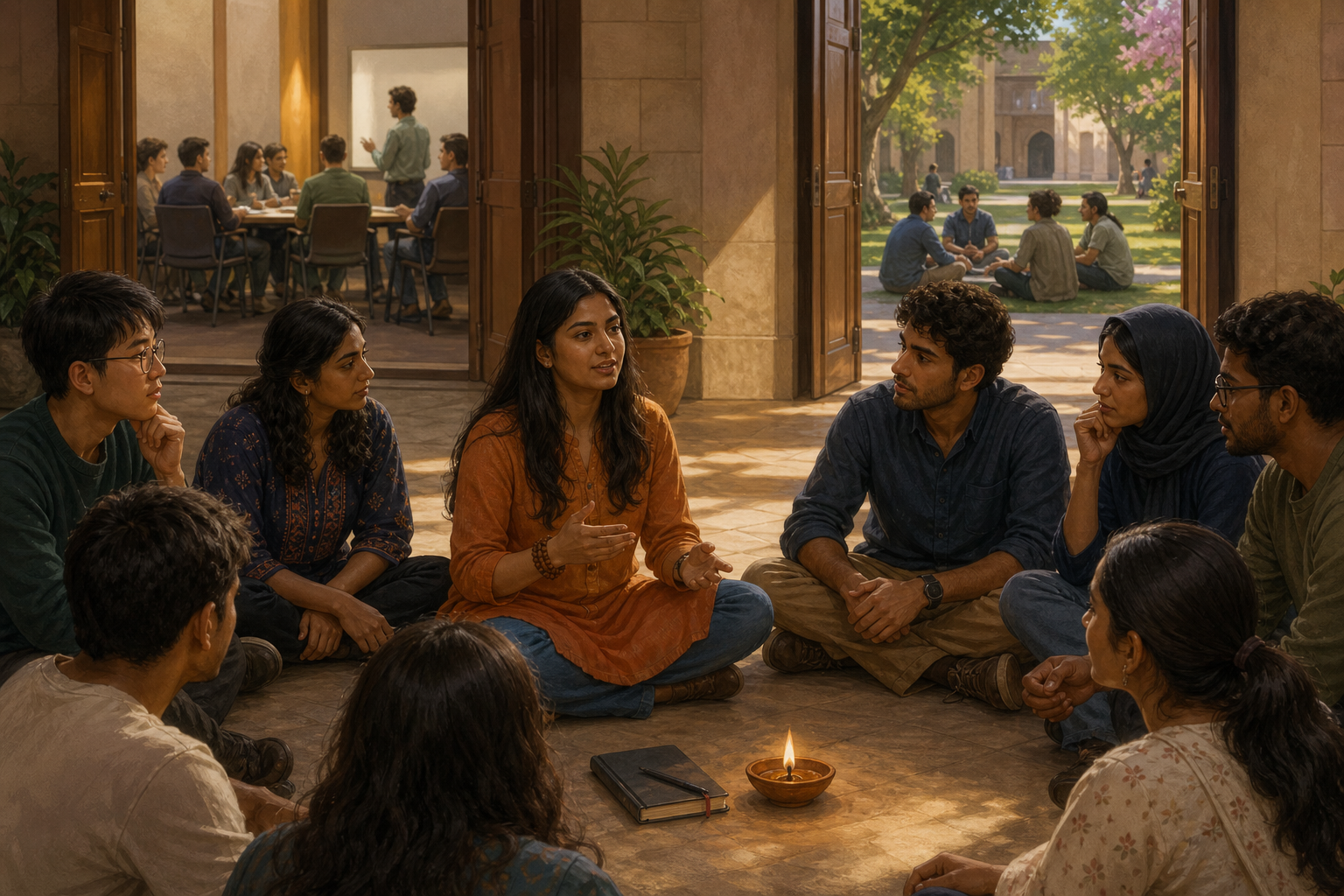
You see a campus event describe Hindutva as a threat, and your first concern is not merely whether its political thesis is fair. You want to know whether Hindu names, practices, temples, and student associations will be treated as evidence of guilt. You may also wonder whether objecting will make you look hostile to academic freedom.
You do not have to choose between silence and trying to shut the event down. A better response protects two principles at once: political ideas remain open to forceful criticism, while Hindu students remain free to study, worship, organize, and disagree without collective suspicion. Here is how to apply that standard before, during, and after a contentious campus event.
Key takeaways

- Ask speakers to define Hindutva, identify the people or institutions they are analyzing, and state the time and place covered by each claim.
- Do not treat a one-sided panel as proof of anti-Hindu bias. Look for the more serious problems: definitional slippage, unsupported collective claims, identity-based stereotyping, or harassment directed at students.
- Request concrete safeguards rather than a vague promise of balance: an opening distinction between ideology and religious identity, transparent event rules, moderated questions, and visible reporting contacts.
- Document exact conduct and its impact. A report built around dates, words, actions, witnesses, and preserved material is more useful than an accusation about presumed motives.
- When safety is at risk, use a graduated response. Debate ordinary disagreement, report directed harassment, and leave immediately when there is a credible threat or immediate danger.
Draw the line between political criticism and collective suspicion

Hinduism is a vast family of religious, philosophical, devotional, and cultural traditions. Hindutva is used in political and civilizational arguments, and people do not always use the term in the same way. That ambiguity does not prevent serious discussion. It makes an explicit working definition essential.
A panelist may criticize an organization, political program, public policy, historical claim, or interpretation of nationhood. The problem begins when the argument silently moves from that defined subject to Hindus as a religious population. A student’s surname, tilak, temple attendance, festival participation, or membership in a Hindu association does not establish adherence to a political program.
Use five questions to test whether an argument is precise enough for an academic setting:
<!– wp:list {