

You can read a teaching, remember its wording, and still fail to understand it. You can understand it once, then lose the thread as soon as your attention shifts. If you have wondered why serious study does not always become settled knowledge, the problem may be that you are treating several different tasks as one.
Vedic recitation, Upaniṣadic inquiry and the discipline of Yoga do not constitute a single educational system. They pursue different ends. Yet each makes you notice a neglected question: which human faculty must be trained for this kind of knowledge to remain alive?
The real divide is not memorisation versus understanding
Modern discussions often place memory on one side and meaningful learning on the other. That opposition is too crude. Memory can be mechanical, but understanding without memory is equally fragile. You cannot examine a teaching that disappears as soon as the page closes.
Learning can fail at every transition between reception and settled understanding. A statement may be heard inaccurately. It may be heard correctly but reproduced badly. It may be repeated correctly and then forgotten. It may be retained without being examined. It may even be understood, yet remain unavailable when an unsteady mind cannot stay with it.
That gives you a practical diagnostic:
- Reception: Did you actually hear or read the teaching as it was given, including its important distinctions?
- Reproduction: Can you say it again without silently replacing difficult language with a familiar approximation?
- Retention: Does it remain available when the book, screen or teacher is no longer supplying the words?
- Reflection: Can you state what it means, identify the distinction it makes and name what you still do not understand?
- Attention: Can you remain with its central question without continually abandoning it for loosely related thoughts?
This is not a claim that every Indian school formalised an identical sequence. The Vedic reciter, the Upaniṣadic seeker and the Yogic practitioner faced different intellectual tasks. Their practices should retain those differences. The useful connection is narrower: knowing depends on trainable capacities, not merely on exposure to information.
When study stalls, identify the faculty that failed before collecting more material. If your pronunciation is uncertain, return to attentive hearing. If you can recite a passage but cannot explain its central distinction, move into reflection. If the explanation is clear but your mind cannot remain with the question, more commentary may not help; steadier attention is the unfinished work.
Precision begins in the ear, voice and body
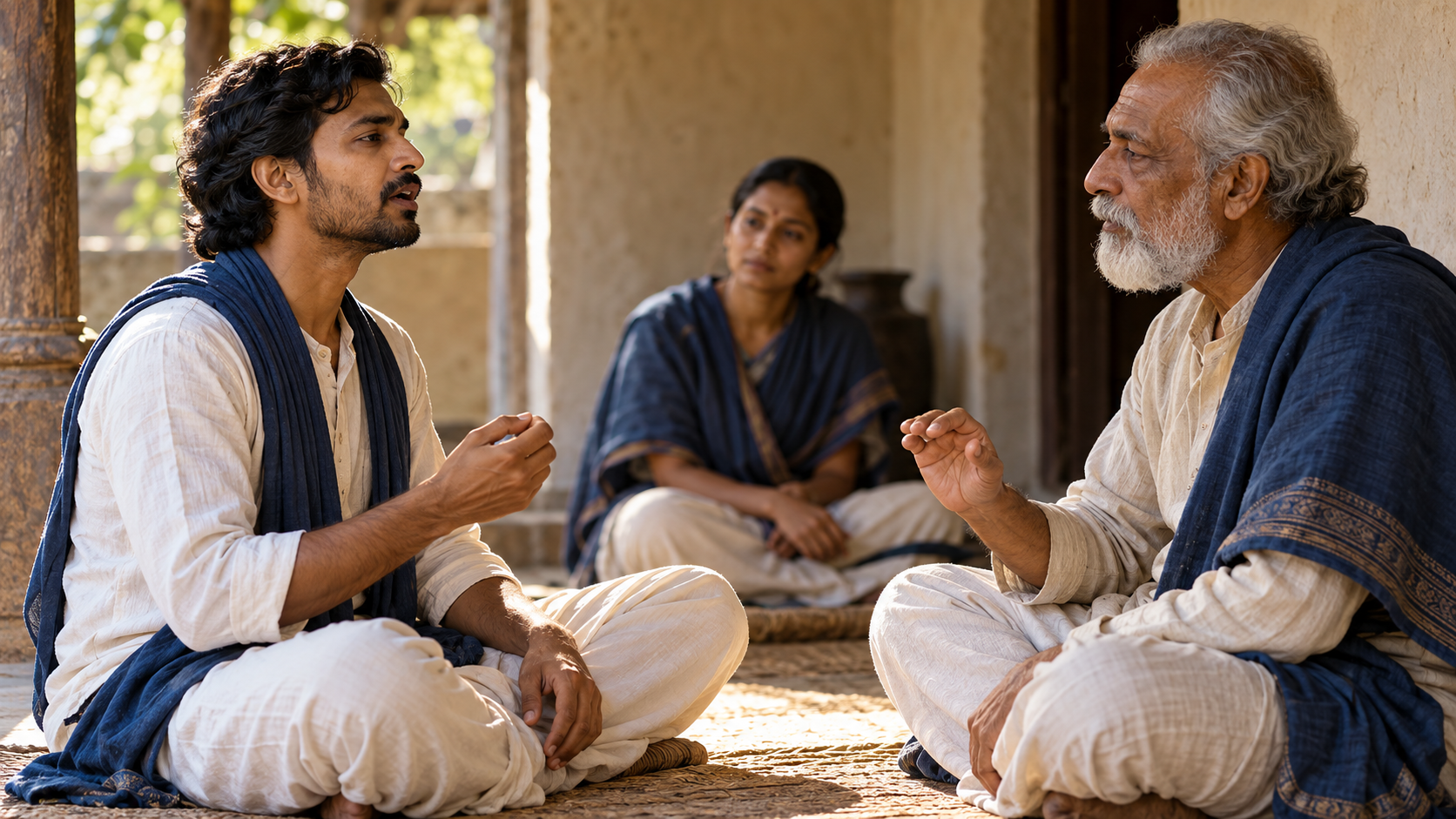
Vedic transmission makes the demand for fidelity especially visible. Large bodies of knowledge were preserved orally through disciplined hearing, speaking, repetition and correction. The remarkable result matters, but the method matters just as much: the learner’s faculties had to become reliable enough to carry what had been received.
In the Śikṣā teaching of the Taittirīya Upaniṣad, varṇa, svara, mātrā, balam, sāma and santāna concern, broadly, sound, accent, duration, effort, modulation and continuity. These are not interchangeable details. Writing a syllable on a page does not by itself perform its accent, duration or vocal effort. The student therefore had to learn how the teaching sounded, not merely recognise its written representation.
The wider recitation tradition reinforced a text through several patterned arrangements. Continuous recitation stood alongside forms such as pada-pāṭha and krama-pāṭha, followed by more elaborate vikṛti methods. Encountering the same material through different arrangements strengthened its sequence and made deviations easier to detect. Repetition here was not an endless replay of undifferentiated material. Its structure helped preserve the material being repeated.
Some Vedic traditions in Kerala also coordinate recitation with hand and finger movements corresponding to sounds or other features of chanting. This is a regional practice, not a universal characteristic of Vedic learning. That qualification matters. It would be misleading to turn one community’s embodied method into a claim about all Vedic recitation. What it does show is that voice, ear and bodily movement could participate together in transmission.
If you are learning a mantra or recited passage, apply the underlying discipline without pretending to reproduce a specialised pāṭha system:
- Receive the passage aloud from a competent teacher or another trustworthy transmission before fixing your own pronunciation in memory.
- Listen for the features that matter in that tradition. Do not invent Vedic accents from an unmarked printed text.
- Reproduce a short, manageable unit and compare it with what you received. Correct small deviations before they become habitual.
- Keep exact recitation distinct from explanation. Paraphrase may clarify meaning, but it cannot replace the wording when preservation of the wording is the task.
- If you are undertaking formal Vedic recitation, follow the method of the relevant teacher and lineage. A general study exercise is not a substitute for lineage-specific instruction.
The teacher-student relationship is central because accuracy cannot be established by private confidence alone. The learner needs correction, while the teacher carries responsibility for faithful transmission. The close of the Taittirīya Upaniṣad’s Śikṣāvallī also places continued study and teaching among the student’s responsibilities. Completion of a lesson is therefore not the end of learning. Received knowledge must be practised, maintained and passed onward with care.
Memory must become material for reflection

Accurate reproduction is a real achievement, but it does not settle every question. Once a teaching has been retained, another kind of work begins: you must examine what you can now hold before the mind.
In the Bṛhadāraṇyaka Upaniṣad, Yājñavalkya tells Maitreyī that the Self is to be seen, heard, reflected upon and contemplated: ātmā vā are draṣṭavyaḥ śrotavyo mantavyo nididhyāsitavyaḥ. The passage is not a ready-made theory of education for every subject. It does, however, refuse to treat hearing as the completion of inquiry. What has been heard must continue to occupy the seeker through reflection and contemplation.
The discussion of smara in the Chāndogya Upaniṣad gives memory an enabling place in this movement. Remembering allows what has been encountered to remain available for hearing, thinking and knowing. Memory is therefore not the rival of reflection. It supplies reflection with something stable enough to examine.
You can test whether that transition has occurred by closing the text and working through these questions:
- What is the passage actually asking you to know?
- Which distinction would disappear if you reduced it to a familiar slogan?
- Which words can you paraphrase confidently, and which still resist explanation?
- What question does the passage answer, and what question does it leave open?
- Are you reflecting on the teaching itself, or merely collecting associations around it?
Write what you remember before reopening the text. Then compare your account with the actual wording. This separates a gap in retention from a gap in understanding. If you omitted the central claim, return to memory. If the claim is present but your explanation is vague, remain with reflection. If your explanation quietly changes the claim, correct the paraphrase rather than congratulating yourself for making the passage easier.
Do not rush to personal application merely to make an ancient teaching feel relevant. First determine what it says. Then ask how its reasoning, distinctions or contemplative demand address you. Otherwise, the passage becomes a surface onto which you project ideas you already held.
This also changes how you use commentaries and lectures. Consult them to sharpen a question, recover a distinction or correct a misunderstanding. Do not use them to avoid the encounter between your own attention and the primary teaching. If every explanation produces another pile of notes but no clearer account of the passage, information is accumulating while inquiry remains still.
Stable attention is a separate discipline

Reflection can fail even when memory is sound. The mind may touch an idea briefly and then move through reactions, recollections and associations without staying with the object it meant to examine. Yoga addresses this instability directly, within its own discipline of consciousness.
Patañjali defines smṛti, memory, as the non-loss of an experienced object. In the later account of concentration, dhāraṇā binds the mind to a particular place or object, while dhyāna involves sustained contemplation of that object. These terms belong to Yoga and should not be reduced to generic productivity techniques. They show, nevertheless, why intellectual assent is not the same as stable knowledge: an idea cannot be contemplated deeply if attention repeatedly abandons it.
You can borrow a modest lesson without claiming that an ordinary reading exercise is dhāraṇā or dhyāna. Choose a passage you have already heard or read carefully. State the precise question you are considering. When attention drifts into a merely related subject, return to that question. At the end, record the unresolved point instead of covering it with fresh material.
Make two distinctions while doing this. Returning to the object is not the same as repeating your preferred conclusion. Sustained attention is also not proof that a claim is true. Attention gives reflection time to work; it does not remove the need for discernment.
Modern scientific language can tempt us to rename every traditional practice. Vedic recitation becomes “cognitive training,” coordinated gestures become “multisensory encoding,” and dhāraṇā becomes an ancient version of an attention technique. Such comparisons may generate useful questions, but the available historical practices do not by themselves establish modern scientific claims. A resemblance is not an identity, and a contemporary label can conceal the aim that gave the practice its meaning.
Use these guardrails when making comparisons:
- Name the traditional aim first. Preservation of recited material, inquiry into the Self and discipline of consciousness are not merely different techniques for the same modern outcome.
- Preserve the setting. A practice taught within a teacher-student relationship or a Yogic discipline should not be detached from that setting without acknowledging the change.
- Do not upgrade analogy into evidence. A gesture associated with sound may be called embodied learning descriptively; that does not establish a scientific effect that has not been demonstrated.
- Keep the standards of success distinct. Fidelity of recitation, clarity of reflection and steadiness of attention answer different failures in learning.
This restraint does not make the traditions less relevant. It makes the comparison more useful because you can see what each discipline was actually trying to accomplish.
Build a study cycle without pretending it is an ancient syllabus

The safest contemporary application is not to announce that ancient India anticipated every modern theory of learning. It is to let these distinctions change what you do during your next encounter with a difficult teaching. The following cycle is a practical synthesis, not a historical curriculum attributed to every Indian tradition.
- Receive. Read or hear a short unit carefully. If sound is integral to the practice, receive the pronunciation from someone qualified to teach it.
- Reproduce. Speak or write the material without looking, then compare it with what was given. Mark omissions and substitutions before interpreting them away.
- Retain. Return to the same material after attention has moved elsewhere. If it is no longer available, restore it before adding more.
- Reflect. State the central claim in your own words, identify the distinction on which it depends and write down the point that remains unclear.
- Contemplate. Keep attention with that claim or unresolved question. When the mind shifts to a different subject, notice the shift and return.
- Transmit. Explain the teaching to another learner without overstating what you know. Preserve the difference between the received words, your interpretation and your unanswered questions.
Do not treat the cycle as a ladder you must always climb to the end. Stop where the weakness appears. Faulty reception cannot be repaired by more contemplation. A vague interpretation cannot be rescued by confident recitation. Unstable attention cannot be solved by opening another commentary.
Key takeaways
- Vedic recitation, Upaniṣadic inquiry and Yoga remain distinct traditions even when they illuminate a shared problem of disciplined knowing.
- Precise hearing and reproduction protect what has been received; they do not automatically produce understanding.
- Memory makes a teaching available for reflection instead of standing opposed to thought.
- Attention must be trained separately when the mind cannot remain with the object of inquiry.
- Modern analogies should clarify a practice, not replace its original aim or manufacture unsupported scientific claims.
At your next period of study, choose a passage already important to you and diagnose just one failure honestly. If the sound is uncertain, return to a teacher. If the words disappear, restore them. If the meaning remains vague, write the unresolved question. If attention will not stay, keep the same object instead of reaching for more content.
That small change makes study answerable to the person you are becoming. You are no longer asking only how much information you have gathered. You are asking whether your ear, speech, memory, judgement and attention have become trustworthy enough to carry knowledge forward.
References

Leave a Reply
You must be logged in to post a comment.