
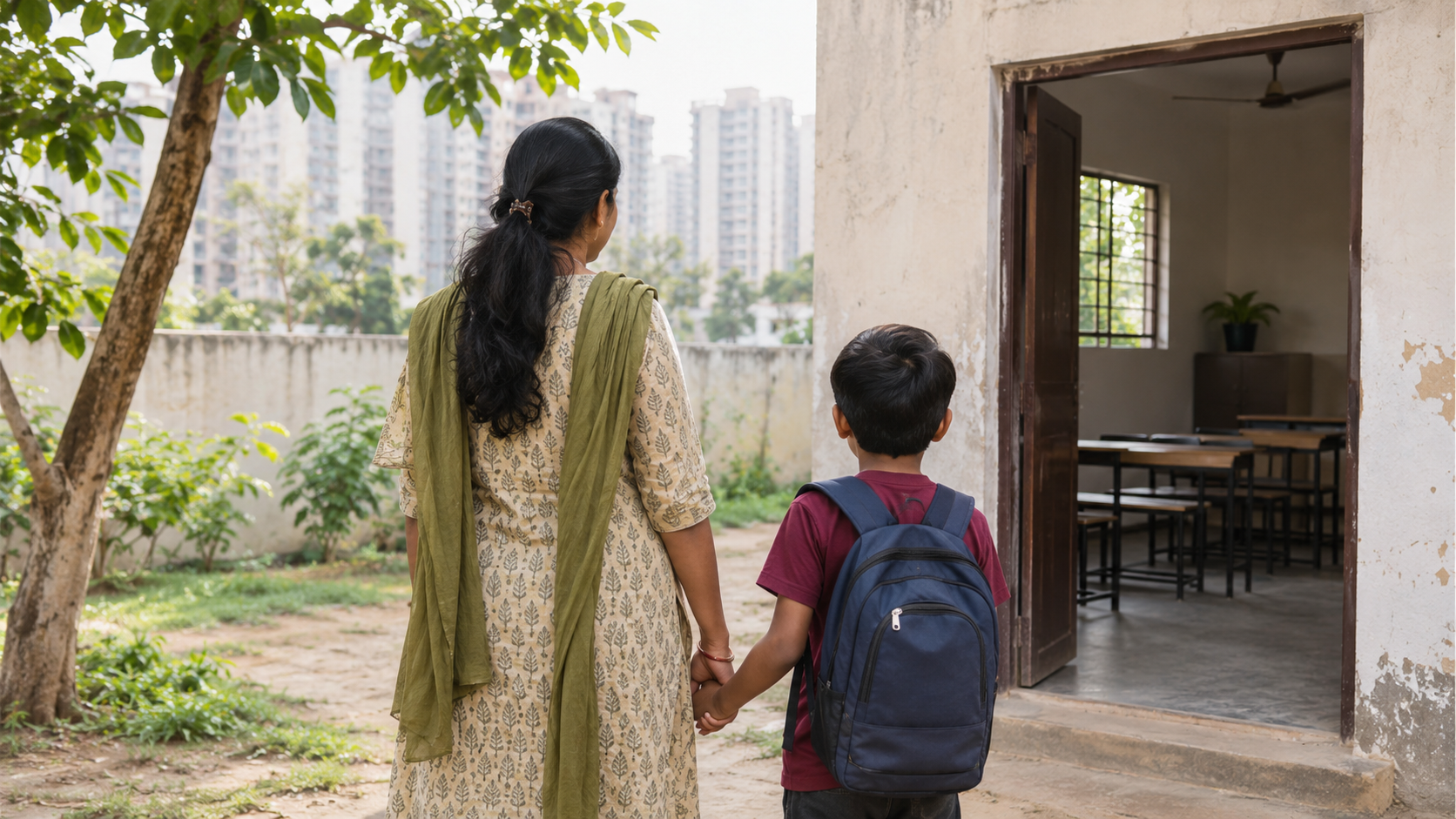
If your child attended a free pathshala, tuition class or NGO-run learning centre in Gurugram, you need more than a frightening headline. You need to know what has actually been alleged, what remains unproven and how to check your child’s experience without contaminating their account or exposing them publicly.
The immediate task is not to panic or condemn an entire religious community. It is to protect children, preserve evidence and insist that any organisation entrusted with them disclose who runs it, what it teaches and whether religious activity forms part of the programme.
What the Gurugram allegations do and do not establish
The case concerns a pathshala in Ghata village that was reportedly uncovered on 14 November 2026. Sector 56 police claim that, during three days in custody, accused Prabeen admitted that children were being encouraged to convert to Christianity through prayers, books and other activities conducted through NGO-operated pathshalas.
Police also reportedly received information about several similar centres in Delhi. The public account does not identify how many children attended those centres, how many families knew about the religious content or whether any conversion was completed. Those gaps matter. An alleged plan to influence children, an attempted conversion and a completed change of faith are not interchangeable claims.
Dr Peter Malkar and his wife, described as principal suspects in the alleged operation, were reported to be absconding, with a lookout circular issued against them. Prabeen’s reported statement and the couple’s status are investigative developments, not court-tested findings of guilt. A credible public position must hold both truths at once: the allegations are serious enough to require a full investigation, and the accused remain entitled to a fair process.
You should also notice what has not yet been established publicly: the precise curriculum, the instructions given to staff, the NGO’s financial trail, the nature of parental consent, the relationship among the Gurugram and Delhi centres, and the content actually presented to each child. These are not minor details. They determine whether investigators are dealing with isolated misconduct, a coordinated programme or activities that have been misunderstood.
Check the trust boundary before enrolling your child

A free class is still an institution exercising authority over a child. The word “NGO” does not prove that a centre is safe, neutral or accountable. Nor does religious affiliation by itself prove wrongdoing. What protects your family is verifiable disclosure before access to the child is granted.
Ask the operator for the following information in writing. If the centre cannot answer a basic question, pause attendance until it can.
- Legal identity: Record the organisation’s full name, registration details, office address and the name of the person legally responsible for the centre. A poster, social-media page or first name is not enough.
- Programme purpose: Ask for a written description of the subjects taught, the age group served and the expected learning outcomes. Compare that description with what your child actually brings home.
- Religious content: Ask directly whether the timetable includes prayer, scripture, devotional songs, testimony, worship, religious films or books advocating a particular faith. Do not accept “values education” as a complete answer.
- Parental consent: Determine whether religious activity is disclosed before enrolment and whether a child can decline it without losing tuition, food, gifts, transport or other assistance.
- Staff and visitors: Obtain the names and roles of regular teachers, volunteers, counsellors and visiting speakers. Ask who supervises one-to-one contact with children.
- Materials: Request the book list, worksheets and digital resources. Children should not be told to hide materials from their parents or return them before they can be examined at home.
- Communication: Confirm how attendance, schedule changes, outings and complaints are documented. Important instructions should not depend entirely on private messages between an adult and a child.
- Funding and affiliations: Ask who funds the programme and whether it is connected to another NGO, church, mission, school or overseas organisation. Funding is not proof of misconduct, but unexplained institutional relationships deserve clarification.
One ambiguous answer may reflect poor administration. A repeated pattern of concealed identity, undisclosed religious activity, pressure to keep secrets and refusal to involve parents is different. That combination should end unsupervised access while you document and report the concern.
Several warning signs deserve particular attention: a child being asked to conceal conversations; disparagement of the family’s deities, practices or elders; gifts or educational help tied to religious participation; pressure to use a new religious identity; or prayers introduced despite a parent’s refusal. These are general screening signs, not additional claims about the Ghata centre.
If your child attended, preserve their account carefully

A worried parent can unintentionally replace a child’s memory with the wording of an accusation. Your first conversation should therefore be calm and open-ended. The aim is to learn what the child remembers, not to secure agreement with what adults already suspect.
- Start with the ordinary routine. Ask, “Tell me what usually happened from the time you arrived until you left.” Then ask, “What happened next?” Avoid beginning with, “Did they try to convert you?”
- Let the child supply the names and words. Ask what teachers called an activity, which books were used and who was present. Record the child’s words as accurately as possible; do not translate them into a stronger allegation.
- Separate memory from interpretation. “We sang this song” is an observation. “They wanted to convert everyone” is an interpretation that requires supporting facts. Preserve both, but label them correctly.
- Save original material. Keep books, handouts, enrolment forms, receipts, attendance messages, photographs and relevant digital communications in their original form. Make copies for routine sharing and retain the originals securely.
- Build a dated chronology. Note when the child enrolled, when unusual activities began, when you learned of them, whom you contacted and what response you received. Distinguish dates you know from dates you are estimating.
- Report facts in writing. Give the responsible police unit or other competent local authority a concise account, copies of relevant material and your contact details. Request written acknowledgement or a reference number where available.
- Protect the child’s identity. Do not publish the child’s name, photograph, school details or unredacted messages. Public exposure can cause lasting harm and may complicate an investigation.
You may speak with other parents to learn whether they share the concern, but do not coordinate children’s answers or circulate a common script. Independent accounts are more useful than a group narrative shaped after everyone has discussed the same allegation.
Do not confront, threaten or publicly identify an accused person based only on a child’s incomplete recollection or a forwarded message. If you are considering publishing names, organising a public accusation or taking legal action, obtain advice from a qualified lawyer who can examine the evidence and the applicable law. The safer immediate choices are to suspend attendance, preserve records and report specific conduct through formal channels.
The proper test is disclosure, consent and corroboration

Religious teaching is not automatically covert conversion. Families may knowingly choose Christian, Hindu, Sikh, Buddhist, Jain or other faith-based education. The critical distinction is whether the institution states its purpose honestly, obtains meaningful parental consent and allows a child to decline religious participation without penalty.
A programme advertised as secular tuition crosses a serious trust boundary when it secretly introduces devotional formation or pressure to abandon the family’s faith. The same standard should apply regardless of which religion runs the centre. Defending Hindu families does not require collective suspicion of Christians; it requires an uncompromising demand for transparency and respect for parental responsibility.
For the Gurugram investigation to answer the central question, authorities need corroboration beyond a reported custodial statement. That means examining enrolment representations, lesson materials, staff instructions, parental communications, financial and organisational links, and independently recorded accounts from affected families. The reported information about Delhi centres should be verified centre by centre rather than treated as proof that every associated classroom operated identically.
The financial inquiry also needs discipline. Investigators should identify who funded each centre, what the funds were designated for and how they were spent. A foreign, Christian or charitable connection would not by itself establish a conversion scheme. The relevant evidence is whether money, benefits, staffing or teaching materials were knowingly used to facilitate concealed religious influence over children.
Likewise, the absence of a known completed conversion would not make deceptive conduct harmless. The alleged mechanism was gradual influence through ordinary educational activity. That makes intention, disclosure and repeated conduct especially important. Investigators should determine what adults were instructed to do, not merely count formal changes of religious identity.
Key takeaways
- Police allege that an NGO-run pathshala in Ghata was used to encourage children toward Christianity through prayers, books and related activities; this remains an allegation requiring corroboration.
- The public information does not establish how many children were affected, whether parents consented to religious activity or whether any conversion was completed.
- Before enrolling your child in any free or NGO-run centre, verify its legal identity, curriculum, staff, religious content, funding relationships and consent process.
- If your child attended, ask open-ended questions, preserve original records, create a dated chronology and report specific facts rather than circulating conclusions.
- Do not expose a minor or publicly declare an accused person guilty. Child protection and evidentiary discipline must come before social-media confrontation.
- Judge every faith-based programme by the same standard: honest disclosure, meaningful parental consent, freedom to decline and no coercion tied to educational or material assistance.
If this case has prompted you to review your child’s learning centre, begin with the written curriculum and the identity of the people in the room. Those two checks often reveal whether the programme parents approved is the programme children are actually receiving.
References

Leave a Reply
You must be logged in to post a comment.